Sunday, April 26, 2009

Encouragement to Keep the Mistakes

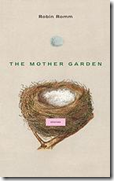
Robin Romm discussing writing programs Michael Silverblatt of KCRW’s Bookworm (3.26.09). She has written a collection of short stories (The Mother Garden) and a memoir (The Mercy Papers), both fueled by the experience of her mother’s death from cancer.

Robin Romm: I didn’t have a lot of expectations. I didn’t know what would be The Mother Storiesup for the taking. And what I found at San Francisco State were a lot of faculty members who were interested in new ways of approaching the creative life, who had sort of gotten away from workshop. And I didn’t take too many workshops actually. I spent more of my time in classes generating work and finding ways to look at the world—to learn to stare and to go deeper.

And for me, graduate school was this very interesting pause in my life where I could scrapple with what was going on for me emotionally, intellectually and try to get that down on paper somehow. And it was less about nit picking a sentence and making it conform to something.

The Mercy PapersAnd interestingly when I first met my editor on the phone, she said, “Did you take workshops?” And I said, “Not very many.” And she said, “I can tell. These have the quality that they’re different from a lot of the stories that I see. They’re rawer. They have edges and sharp places.” And she meant that as a compliment not a criticism.

I do think that the writing workshop is a great place to generate work and to get feedback on your work, but it has its limits, too.

Michael Silverblatt: It interests me because I have said and I think it’s true that what a young writer needs is encouragement to keep the mistakes. That what people are calling the mistakes are probably the sounds and insights that make the writing strange and individual. And that making sure that the writing is all mistake is the process of finding your own voice.

The Ability to Be Still

Excerpts from Stillness Speaks by Eckhart Tolle:

Stillness Speaks Silence is helpful, but you don’t need it in order to find stillness. Even when there is noise, you can be aware of the stillness underneath the noise, of the space in which the noise arises. That is the inner space of pure awareness, consciousness itself.

You can become aware of awareness as the background to all your sense perceptions, all your thinking. Becoming aware of awareness is the arising of inner stillness.

* * * * *

Any disturbing noise can be as helpful as silence. How? By dropping your inner resistance to the noise, by allowing it to be as it is, this acceptance also takes you into that realm of inner peace that is stillness.

Whenever you deeply accept this moment as it is—no matter what form it takes—you are still, you are at peace.

* * * * *

Pay attention to the gap—the gap between two thoughts, the brief, silent space between words in a conversation, between the notes of a piano or flute, or the gap between the in-breath and out-breath.

When you pay attention to those gaps, awareness of “something” becomes—just awareness. The formless dimension of pure consciousness arises from within you and replaces identification with form.

* * * * *

Do you need more knowledge? Is more information going to save the world, or faster computers, more scientific or intellectual analysis? Is it not wisdom that humanity needs most at this time?

But what is wisdom and where is it to be found? Wisdom comes with the ability to be still. Just look and just listen. No more is needed. Being still, looking, and listening activates the non-conceptual intelligence within you. Let stillness direct your words and actions.

[This handout contains is a summary of strategies developed by Shinzen Young designed to support experiencing these insights directly.]

Forgetting and Remembering the Self

Quotes from Zen master Mitsunen (Lou Nordstrom) excerpted from “Enlightenment Therapy,” by Chip Brown, The New York Times Magazine (April 26, 2009):

Illustration by Shout“The Zen experience of forgetting the self was very natural to me…I had already been engaged in forgetting and abandoning the self in my childhood, which was filled with the fear of how unreal things seemed. But that forgetting was pathological. I always had some deeper sense that I wasn’t really there, that my life and my marriages didn’t seem real. In therapy with Jeffrey [Rubin] I began to realize this feeling of invisibility wasn’t just a peculiar experience but was maybe the central theme of my life. It was connected to my having ‘ability’ as a Zen student and to my being able to have a precocious enlightenment experience. In a sense it was as if Zen chose me rather than that I chose Zen.”

“One of the most important insights I got from therapy with Jeffrey is that subconsciously I want the depth of my suffering to be witnessed by someone. I want to be seen for what a strange fellow I am. As a young guy I got off on the sense of being different. There was some arrogance and elitism in it. The positive spin of the surreal nature of my childhood was that there must have been some special destiny for me. To give up tenure, to become a monk, I embraced an aggrandized narrative. What Jeffrey has done is indicate that forgetting the self is not a constructive approach. What one needs to do from a psychoanalytic perspective is remember the self.”

“As a boy I consciously constructed this idea that I’m in a situation that makes no sense whatsoever. The only meaning I can glean from it is that there may be some kind of completely different life in store for me. There will be a compensation. I am owed.”

“This abandoned life of mine is like the abandoned boy, and I am the mother I never had who returns to claim that life and embrace it. It is a source of great pathos to reflect that without the therapy experience I might have died without having been reunited with my life! And in that sense, without having truly lived.”

Saturday, April 25, 2009

Ideas Are Like Fish

“There’s billions of ideas. Just gotta catch ‘em.”

~ David Lynch, from David Lynch Foundation Television

Catching the Big Fish: Meditation, Consciousness, and Creativity

Married to Amazement

When Death Comes
by Mary Oliver, from New and Selected Poems

When death comes
like the hungry bear in autumn;
when death comes and takes all the bright coins from his purse

to buy me, and snaps the purse shut;
when death comes
like the measles-pox;

when death comes
like an iceberg between the shoulder blades,

I want to step through the door full of curiosity, wondering:
what is it going to be like, that cottage of darkness?

And therefore I look upon everything
as a brotherhood and a sisterhood,
and I look upon time as no more than an idea,
and I consider eternity as another possibility,

and I think of each life as a flower, as common
as a field daisy, and as singular,

and each name a comfortable music in the mouth
tending as all music does, toward silence,

and each body a lion of courage, and something
precious to the earth.

When it's over, I want to say: all my life
I was a bride married to amazement.
I was the bridegroom, taking the world into my arms.

When it is over, I don't want to wonder
if I have made of my life something particular, and real.
I don't want to find myself sighing and frightened,
or full of argument.

I don't want to end up simply having visited this world.

As If For The First Time

My Name
by Mark Strand, from New Selected Poems

Once when the lawn was a golden green
and the marbled moonlit trees rose like fresh memorials
in the scented air, and the whole countryside pulsed
with the chirr and murmur of insects, I lay in the grass,
feeling the great distances open above me, and wondered
what I would become and where I would find myself,
and though I barely existed, I felt for an instant
that the vast star-clustered sky was mine, and I heard
my name as if for the first time, heard it the way
one hears the wind or the rain, but faint and far off
as though it belonged not to me but to the silence
from which it had come and to which it would go.

Momentary Playthings of Recognition

Some Playthings
by John Hollander, from A Draft of Light

A Draft of Light A trembling brown bird
standing in the high grass turns
out to be a blown

oakleaf after all.
Was the leaf playing bird, or
was it “just” the wind

playing with the leaf?
Was my very noticing
itself at play with

an irregular
frail patch of brown in the cold
April afternoon?

These questions that hang
motionless in the now-stilled
air: what of their

frailty, in the light
of even the most fragile
of problematic

substances like all
these momentary playthings
of recognition?

Questions that are asked
of questions: no less weighty
and lingeringly

dark than the riddles
posed by any apparent
bird or leaf or breath

of wind, instruments
probing what we feel we know
for some kind of truth.

Friday, April 24, 2009

Hidden in Plain Sight All Around Us

Excerpts from David Foster Wallace’s 2005 Kenyon Commencement Address which has been recently published by Little, Brown under the title This is Water:

This is Water There are these two young fish swimming along and they happen to meet an older fish swimming the other way, who nods at them and says "Morning, boys. How's the water?" And the two young fish swim on for a bit, and then eventually one of them looks over at the other and goes "What the hell is water?"

...a huge percentage of the stuff that I tend to be automatically certain of is, it turns out, totally wrong and deluded. I have learned this the hard way, as I predict you graduates will, too.

Here is just one example of the total wrongness of something I tend to be automatically sure of: everything in my own immediate experience supports my deep belief that I am the absolute center of the universe; the realest, most vivid and important person in existence. We rarely think about this sort of natural, basic self-centeredness because it's so socially repulsive. But it's pretty much the same for all of us. It is our default setting, hard-wired into our boards at birth. Think about it: there is no experience you have had that you are not the absolute center of. The world as you experience it is there in front of YOU or behind YOU, to the left or right of YOU, on YOUR TV or YOUR monitor. And so on. Other people's thoughts and feelings have to be communicated to you somehow, but your own are so immediate, urgent, real.

...Probably the most dangerous thing about an academic education—least in my own case—is that it enables my tendency to over-intellectualize stuff, to get lost in abstract argument inside my head, instead of simply paying attention to what is going on right in front of me, paying attention to what is going on inside me.

As I'm sure you guys know by now, it is extremely difficult to stay alert and attentive, instead of getting hypnotized by the constant monologue inside your own head (may be happening right now). Twenty years after my own graduation, I have come gradually to understand that the liberal arts cliché about teaching you how to think is actually shorthand for a much deeper, more serious idea: learning how to think really means learning how to exercise some control over how and what you think. It means being conscious and aware enough to choose what you pay attention to and to choose how you construct meaning from experience. Because if you cannot exercise this kind of choice in adult life, you will be totally hosed. Think of the old cliché about quote the mind being an excellent servant but a terrible master.

...And I submit that this is what the real, no bullshit value of your liberal arts education is supposed to be about: how to keep from going through your comfortable, prosperous, respectable adult life dead, unconscious, a slave to your head and to your natural default setting of being uniquely, completely, imperially alone day in and day out. That may sound like hyperbole, or abstract nonsense. Let's get concrete. The plain fact is that you graduating seniors do not yet have any clue what "day in day out" really means. There happen to be whole, large parts of adult American life that nobody talks about in commencement speeches. One such part involves boredom, routine, and petty frustration. The parents and older folks here will know all too well what I'm talking about.

...But of course there are all different kinds of freedom, and the kind that is most precious you will not hear much talk about much in the great outside world of wanting and achieving...The really important kind of freedom involves attention and awareness and discipline, and being able truly to care about other people and to sacrifice for them over and over in myriad petty, unsexy ways every day.

...It is about the real value of a real education, which has almost nothing to do with knowledge, and everything to do with simple awareness; awareness of what is so real and essential, so hidden in plain sight all around us, all the time, that we have to keep reminding ourselves over and over.

"This is water."

"This is water."

Our Central Fixation of Self

Emptiness Dancing “Nobody can really explain what the personal self is; we just feel it. It’s a visceral thing. It’s not just how we act and what we say; it’s our central fixation of self. As we see through it, we realize that the personal self is not who we are and that it was not ever anything substantial to begin with. And as we really see into our true nature, there is a paradox that arises: the more we realize that there isn’t a self, the more intimately present we actually are.”

~ Adyashanti, from Emptiness Dancing

How Wrong We Can Be

Follow Me “The wonderful thing about the novel form is that it can accommodate lots of different kinds of stories. Just between the covers of a book you can gather them. I worry about the ease of fundamentalism in all its forms. The ease with which it enters our lives and we become certain about these stories. A novel does seem to be a place where we can let those fundamental stories unravel a little bit, because they're put into some sort of tapestry where they're participating with other stories or competing with other stories or different versions...and maybe not offer absolute answers. For me as a writer, I'm passionate about fiction's ability to render uncertainty...The novel is a great place to consider how wrong we can be about things...how we can make mistakes. Those are good stories to tell, aren't they? When the stories are mistakes.”

~ Joanna Scott, in conversation with Michael Silverblatt of KCRW’s Bookworm (4/23/09) about her new novel, Follow Me.

Thursday, April 23, 2009

Little Emotions

Vincent van Gogh (1853-90), Self-Portrait With a Straw Hat and Artist's Smock, 1887. Oil on cardboard, 40.8 x 32.7 cm. Van Gogh Museum, Amsterdam (Vincent van Gogh Stichting).

“Don't let's forget that the little emotions are the great captains of our lives, and that we obey them without knowing it.”

~ Vincent van Gogh, in a letter to his brother Theo

Like Yesterday

“You must not count overmuch on your reality as you feel it today, since, like that of yesterday, it may prove an illusion for you tomorrow.”

~ Luigi Pirandello

[Thanks Alex!]

From a Bus Window

james-wrightFrom a Bus Window in Central Ohio, Just Before a Thunder Shower
by James Wright, from Selected Poems

Cribs loaded with roughage huddle together
Before the north clouds.
The wind tiptoes between poplars.
The silver maple leaves squint
Toward the ground.
An old farmer, his scarlet face
Apologetic with whiskey, swings back a barn door
And calls a hundred black-and-white Holsteins
From the clover field.

Wednesday, April 22, 2009

Leaving the Doors and Windows Open

Jonathan Carroll on writer’s block. Read the rest of his essay at Timothy Hallinan’s The Blog Cabin:

jonathan_carroll I like to write.  I have always considered writing my friend. We sit down together in the morning and do our job.   But (and this is a big but) if my friend Writing (notice the capital W) says not today because I’d rather go for a walk, or coffee, or nothing at all, I say fine — no work today.  If that extends to a week, then so be it.  Like the wild animals living so oddly but comfortably in the gamekeeper’s house on the Serengeti Plain, Writing stays friendly to me so long as I let him come and go as he pleases. If he doesn’t want to stay in the house he walks out and I do something else like read a book or go to the movies.  I never, ever grab Writing by the neck and say you sit back down here and go to work.   I would never treat a friend like that, nor would I treat a tiger like that.  So why treat the thing I love as much as my creative drive like that?
I believe people get writer’s block a lot of the time because they panic when the flow stops.  Then they run around the house shutting the doors and windows, trying to keep their creativity inside and at work.  Bad idea.  I do think that if they were just to get up and walk away from their work for however long, a lot of their problems would solve themselves.  Some of you might say yeah but I’ve been blocked for six months — what about that?  I’d posit that it’s likely some of the block, maybe not all, is because you are scared and trying to close all your windows.  Which in turn has scared your Writing and made IT panicky.

A Reality Engine

From The Ego Tunnel: The Science of the Mind and the Myth of the Self by Thomas Metzinger:

The Ego TunnelThe conscious brain is a biological machine—a reality engine—that purports to tell us what exists and what doesn’t. It is unsettling to discover that there are no colors out there is front of your eyes. The apricot-pink of the setting sun is not a property of the evening sky; it is a property of the internal model of the evening sky, a model created by your brain. The evening sky is colorless. The world is not inhabited by colored objects at all.

It is just as your physics teacher in high school told you: Out there, in front of your eyes, there is just an ocean of electromagnetic radiation, a wild and raging mixture of different wavelengths. Most of them are invisible to you and can never become part of your conscious model of reality. What is really happening is that the visual system in your brain is drilling a tunnel through this inconceivably rich physical environment and in the process is painting the tunnel walls in various shades of color. Phenomenal color. Appearance. For your conscious eyes only.

…Nor must your eyes be open to enjoy color experience. Obviously, you can also dream of an apricot-pink evening sky, or you can hallucinate one. Or you can enjoy an even more dramatic color experience under the influence of a hallucinogenic drug, while staring into the void behind your closed eyelids. Converging data from modern consciousness research show that what is common to all possible conscious sensations of apricot-pink is not so much the existence of an object “out there” as a highly specific pattern of activation in your brain. In principle, you could have this experience without eyes…

…it is not clear what counts as a whole experience: Are experiences discrete, countable entities? However, the flow of experience certainly exists, and cognitive neuroscience has shown that the process of conscious experience is just an idiosyncratic path through a physical reality so unimaginably complex and rich in information that it will always be hard to grasp just how reduced our subjective experience is. While we are drinking in all the colors, sounds, and smells—the diverse range of our emotions and sensory perceptions—it’s hard to believe that all of this is merely an internal shadow of something inconceivably richer. But it is.

Monday, April 20, 2009

Emerge

William Lamson is “a Brooklyn based artist, interested in photography, sculpture and performance. Using inexpensive materials and simple structures, he creates visuals that are mesmerizing and, in one word, playful.” An exhibition of his work will run from May 22 through June 21 at Pierogi Brooklyn.


From NPR’s Daily Picture Show blog.

[Thanks Scott!]

Knocking

I have lived on the lip
of insanity, wanting to know reasons,
knocking on a door. It opens.
I’ve been knocking from the inside!

~ Rumi

Sunday, April 19, 2009

An Actual Window

From “Natural Happiness,” by Paul Bloom, The New York Times Magazine (April 19, 2009):

Many studies show that even a limited dose of nature, like a chance to look at the outside world through a window, is good for your health. Hospitalized patients heal more quickly; prisoners get sick less often. Being in the wild re­duces stress; spending time with a pet enhances the lives of everyone from autistic children to Alzheimer’s patients. The author Richard Louv argues that modern children suffer from “nature-deficit disorder” because they have been shut out from the physical and psychic benefits of unstructured physical contact with the natural world.

…You might think that technology could provide a simulacrum of nature with all the bad parts scrubbed out. But attempts to do so have turned out to be interesting failures. There is a fortune to be made, for instance, by building a robot that children would respond to as if it were an animal. There have been many attempts, but they don’t evoke anywhere near the same responses as puppies, kittens or even hamsters. They are toys, not companions. Or consider a recent study by the University of Washington psychologist Peter H. Kahn Jr. and his colleagues. They put 50-inch high-definition televisions in the windowless offices of faculty and staff members to provide a live view of a natural scene. People liked this, but in another study that measured heart-rate recovery from stress, the HDTVs were shown to be worthless, no better than staring at a blank wall. What did help with stress was giving people an actual plate-glass window looking out upon actual greenery.

Body-Mind Connection

Photographs by Stephen Wilkes for The New York Times; Illustration by Christoph Niemann. Stylist: Megan Caponetto. Costume design: Phoebe Katzin and Rick Delancy. “Dancers from Moses Pendleton’s troupe, Momix, contemplate the green mind. The troupe turns ideas into action as they form their bodies into the first of several images created for this issue.”

Saturday, April 18, 2009

A Free and Active Space

From an interview with Ann Lauterbach, “From the Periphery,” by Celia Band, Poets & Writers (May/June 2009):

The night sky : writings on the poetics of experience In The Night Sky I write about being able to see best from the periphery as a kind of poetics. It’s easy to become romantic and idealize these kinds of abstractions, but I do think it’s pretty clear that when you’re in the center, you can’t see very far, and when you’re outside the bubble—whatever bubble it is—you see more clearly. The margin can be a free and active space. And in American poetry, there are hundreds of centers—everywhere you look there’s another center.

Or to Begin Again …I reject the idea of the muse because I’m not as interested in inspiration as I am in the riddle of making something. A poem is for me much more of an invitation to find form. Once the words are on the page, I have a conversation with them: “How can I help you become a poem?” A poet has to become the most generous and the most critical reader—it’s like being a really good parent. I might say to some of the poems in Or to Begin Again, “You can’t go there!” But they responded, “Yes, I can.”

Friday, April 17, 2009

Looking for Maria

A Position of Imagined Superiority

From Stillness Speaks by Eckhart Tolle:

Stillness Speaks What a miserable day.

He didn’t have the decency to return my call.

She let me down.

Little stories we tell ourselves and others, often in the form of complaints. They are unconsciously designed to enhance our always deficient sense of self through being “right” and making something or someone “wrong.” Being “right” places us in a position of imagined superiority and so strengthens our false sense of self, the ego. This also creates some kind of enemy: yes, the ego needs enemies to define its boundary, and even the weather can serve that function.

Through habitual mental judgment and emotional contraction, you have a personalized, reactive relationship to people and events in your life. These are all forms of self-created suffering, but they are not recognized as such because to the ego they are satisfying. The ego enhances itself through reactivity and conflict.

How simple would life be without those stories.

It is raining.

He did not call.

I was there. She was not.

How Unimaginably Easy It Would Be

Emptiness Dancing “What is born in awakening is a love of what is—of everything that is. The fact that there is anything at all seems wonderful because when the insight of awakening goes very deep, there is a realization about how tenuous existence is. I don’t simply mean that we could be killed at any moment. I mean we see an unbelievable miracle, we see how unimaginably easy it would be for absolutely nothing to be here. That anything exists at all is seen as an absolute and utter miracle, and from that seeing there is the birth of so much love simply for what is. It’s a different love than when we love getting what we want or we find the perfect partner. This is a love just for the fact that we have shoelaces or for the fact that toenails exist, that kind of love. A tremendous love arises simply for the miracle that is life, realizing that all and everything is the One.”

~ Adyashanti, from Emptiness Dancing

Everyone’s Dream

Being a Person
by William Stafford

Be a person here. Stand by the river, invoke
the owls. Invoke winter, then spring.
Let any season that wants to come here make its own
call. After that sound goes away, wait.

A slow bubble rises through the earth
and begins to include sky, stars, all space,
even the outracing, expanding thought.
Come back and hear the little sound again.

Suddenly this dream you are having matches
everyone's dream, and the result is the world.
If a different call came there wouldn't be any
world, or you, or the river, or the owls calling.

How you stand here is important. How you
listen for the next things to happen. How you breathe.

Never Could I Live Without You

To the Air
by W.S. Merwin, from Present Company

Present Company Just when I needed you
there you were
I cannot say
how long you have been
present all at once
color of the day
as it comes to be seen
color of before
face of forgetting
color of heaven
out of sight within
myself leaving me
all the time only
to return without
question never
could I live without you
never have you
belonged to me
never do I want
you not to be with me
you who have been
the breath of everyone
and each word spoken
without needing to know
the meaning of any of them
or who was speaking
when you are the wind
where do you start from
when you are still
where do you go
you who became
all the names I have known
and the lives in which
they came and went
invisible friend
go on telling me
again again

Wednesday, April 15, 2009

Taco Bell Drive-Thru Folk Song

Rhett and Link

She Really Does Emote

Coraline: A Visual Companion Animator Travis Knight talking about the many facial expressions which had to be created for the characters in Coraline. The main character herself required over 200,000 different expressions (from Coraline: A Visual Companion by Stephen Jones):

“For facial animation, in particular, we’ve been able to find ways to use a computer to help out the stop-motion. Replacement animation has been around forever, but there’s only a certain amount of refinement you can get with it—it’s hand-done and it’s a little crude, but it does have a real beauty to it. With the computer you can make it pixel-perfect, get real subtlety.”

“We have these machines that can transfer what we’ve done with the computer, make physical objects out of them. That’s how we did a lot of the facial replacement animation. We were modeling and sculpting in the computer, printing them out on these wacky 3-D printers, painting them all by hand, and then fitting them and putting them on the puppets. That was how we got this really incredible, subtle, beautiful, and expressive facial animation.”

A painter in the puppet department cleans Coraline replacement faces on location in Portland. "Coraline," August 6, 2008

“It hurts my stomach to think about all those poor people who had to paint all that stuff and build all that. But I think it shows. When you see the film, she really does emote, and she feels like a real, living, breathing girl. Of course, all that comes from the animators.”

Vice President of Animation Travis Knight works on the "Coraline" set in Portland, Oregon. August 7, 2008

Listening to Silence

From Stillness Speaks by Eckhart Tolle:

Stillness Speaks The equivalent of external noise is the inner noise of thinking. The equivalent of external silence is inner stillness.

Whenever there is some silence around you—listen to it. That means just notice it. Pay attention to it. Listening to silence awakens the dimension of stillness within yourself, because it is only through stillness that you can be aware of silence.

See that in the moment of noticing the silence around you, you are not thinking. You are aware, but not thinking.

Can Design Save the Newspaper?

From TED Talks (March 2009):

“Newspaper designer Jacek Utko suggests that it's time for a fresh, top-to-bottom rethink of the newspaper. (At this point, why not try it?) In his work, he's proved that good design can help readers reconnect with newspapers. A former architect, Utko took on the job of redesigning several newspapers in former Soviet Bloc nations, starting from basic principles. He worked closely with newspaper executives to figure out the business goals of their papers, and then radically reformatted the product to fit those goals.”

The Heart and Soul of Every Religion

Manifesting God “To reject the contemplative dimension of any religion is to reject the religion itself, however loyal one may be to its externals and rituals. This is because the contemplative dimension is the heart and soul of every religion. It initiates the movement into higher states of consciousness.”

~ Father Thomas Keating, from Manifesting God

Tuesday, April 14, 2009

A Tunnel Through Reality

From The Ego Tunnel: The Science of the Mind and the Myth of the Self by Thomas Metzinger:

The Ego Tunnel In this book, I will try to convince you that there is no such thing as a self. Contrary to what most people believe, nobody has ever been or had a self. But it is not just that the modern philosophy of mind and cognitive neuroscience together are about to shatter the myth of the self. It has now become clear that we will never solve the philosophical puzzle of consciousness—this is, how it can arise in the brain—if we don't come to terms with this simple proposition: that to the best of our current knowledge there is no thing, no indivisible entity, that is us, neither in the brain nor in some metaphysical realm beyond this world. So when we speak of conscious experience as a subjective phenomenon, what is the entity having these experiences?

...Throughout this book, I use one central metaphor for conscious experience: the "Ego Tunnel." Conscious experience is like a tunnel. Modern neuroscience has demonstrated that the content of our conscious experience is not only an internal construct but also an extremely selective way of representing information. This is why it is a tunnel: What we see and hear, or what we feel and smell and taste, is only a small fraction of what actually exists out there. Our conscious model of reality is a low-dimensional projection of the inconceivably richer physical reality surrounding and sustaining us.

Our sensory organs are limited: They evolved for reasons of survival, not for depicting the enormous wealth and richness of reality in all its unfathomable depth. Therefore, the ongoing process of conscious experience is not so much an image of reality as a tunnel through reality.

* * * * *

Research study: Full-body Illusions and Minimal Phenomenal Selfhood

Keeping Things Whole

by Mark Strand, from Selected Poems

In a field
I am the absence
of field.
This is
always the case.
Wherever I am
I am what is missing.

When I walk
I part the air
and always
the air moves in
to fill the spaces
where my body’s been.

We all have reasons
for moving.
I move
to keep things whole.

Monday, April 13, 2009

Dreaming

From "Boyle's Got Talent," by Mike Krumboltz, Yahoo's The Buzz Log:

Susan Boyle (remember that name) became a Web phenomenon after singing "I Dreamed a Dream" from Les Miserables. The performance brought the audience to its feet and left the judges (including Simon Cowell) either speechless or in tears.

Before going on stage, Ms. Boyle admitted some self-deprecating facts about herself (she's never been kissed and lives alone with her cat, Pebbles). For those reasons and more, audiences were expecting the female William Hung. They were wrong.

Lookups on the sudden star posted huge gains. A no-name just the other day, Ms. Boyle quickly surged into our top 5,000 overall searches. Blogs and gossip rags went wild. The Mirror jumped on the story, reporting that while Ms. Boyle thought she "looked like a garage" on TV, she received a standing ovation when she showed up at her local church.

Other sources write that as a child, Ms. Boyle was the target of bullies because of a disability. But, with her newfound fame, she is getting the last laugh. In fact, she's already meeting with officials from Mr. Cowell's Sony BMG label. This may have been the first you've heard of her, but it certainly won't be the last.

Don’t Know

"Where I am, I don't know, I'll never know, in the silence you don't know, you must go on, I can't go on, I'll go on."

~ Samuel Beckett


Sunday, April 12, 2009

The Very Best Sound an Audience Can Make

Mike Nichols, from “Mike Nichols, Master of Invisibility,” by Charles McGrath, New York Times (April 10, 2009):

“Movie acting was invented less than 100 years ago — movie acting with sound. You know how Harold Bloom says that Shakespeare invented us? It’s a fascinating idea, and you can go quite far with it. You could say that it’s in talking movies that The Graduateinner life begins to appear. You can see things happen to the faces of people that were neither planned nor rehearsed. This is what Garbo was such a master of: actual thoughts that had not occurred before that particular take. And you can see this taking tremendous leaps with Brando and Clift and then with Streep.”

“The greatest thrill is that moment when a thousand people are sitting in the dark, looking at the same scene, and they are all apprehending something that has not been spoken. That’s the thrill of it, the miracle — that’s what holds us to movies forever. It’s what we wish we could do in real life. We all see something and understand it together, and nobody has to say a word. There’s a good reason that the very best sound an audience can make — in both the theater and the movies — is no sound at all, just absolute silence.”


Meryl Streep said: “What makes Mike so great is one of the hardest things for people temperamentally drawn to directing. People who direct tend to want to be in control, and Mike’s gift is knowing when to take his hands off and just let it happen. A lot of directors are still dealing with the text when you’re on the set. Mike has done all that beforehand, so when you get on the set you feel it’s a secure world where all the architecture is in place. You can jump as hard as you want and the floor won’t give way.”

One Step Above All That

To the Gods
by W.S. Merwin, from Present Company

Present Company When did you stop
telling us what we could believe

when did you take that one step
only one
above
all that

as once you stepped
out of each of the stories
about you one after the other
and out of whatever we imagined we knew
of you

who were the light
to begin with
and all of the darkness
at the same time
and the voice in them
calling crying
and the enormous answer
neither coming nor going
but too fast to hear

you let us believe
the names for you
whenever we heard them
you let us believe the stories
how death came to be
how the light appeared

how the beginning began
you let us believe
all that

then you let us believe
that we had invented you
and that we no longer
believed in you
and that you were only stories
that we did not believe

you with no
moment for beginning
no place to end
one step above
all that

listen to us
wait
believe in us

Saturday, April 11, 2009

Whenever Knowledge Becomes Rigid it Stops Living

Anslem Kiefer in conversation with Michael Auping from Anselm Kiefer: Heaven and Earth:

Religion was a part of my childhood and my youth. It was a very important thing. The rituals and rites were important. I can still do them in Latin. Of course, I knew the Latin before I knew what it meant. But I was involved, like many young people of my generation, in learning religion at an early age.

Later, I discovered that Christian mythology was less complex and less sophisticated than Jewish mythology because the Christians limited their story to make it simple so that they could engage more people and defend their ideas. They had to fight with the Jewish traditions, with the Gnostics. It was a war of the use of knowledge. Resurrexit (1973) The wooden, hand-hewn interior, which appears in many of Keifer's works from this period, is drawn from the converted schoolhouse in the Oden Forest that served as his studio at the time. The stairs, in other words, lead to the door of the artist's atelier. By inscribing resurrexit on the stairs to his studio, Kiefer raises the question of the redemptive role of art. ~ From Disfiguring by Mark C. Taylor

However, it wasn’t just a defense against outside ideas. It was aggressive. Like politics, they wanted to win. You know, the first church in Rome was not defensive and not aggressive. It was quiet. It was spiritual in the sense of seeking a true discussion about God. It was exploring a new idea about humanity. But then there was “iglesias triumphant,” the Triumph of the Church. And then the stones were stacked up and the buildings came, and the construction of the Scholastics, Augustine, and so on. They were very successful in limiting the meaning of the mythology. There were discussions about the Trinity and its meaning. Anyone who had ideas that complicated their specific picture was eliminated. This made Christianity very rigid and not very interesting. Whenever knowledge becomes rigid it stops living.

Volkszählung (Census) 1991 Shelves of lead books filled with peas--representing the counting of a population--represents an enormousy heavy (grave) archive or cemetery (grave) of dead data.

…Since childhood, I had studied the Old Testament, and sometime as a young man I began to read of Jewish mysticism. Then in the mid-1980s, I went to Jerusalem and began to read the books of Gershon Scholem. Beside the fact that kabbalistic stories and interpretations are very interesting, I think my attraction has something to do with the way that I work.

People say that I read a lot, but in some ways I don’t. I read enough to capture images. I read until the story becomes an image. Then I stop reading. I can’t recite a passage, but I can recite it as an image. For an artist it is important to have a strong, complex subject. Kabbala means “knowledge that has been received,” a secret knowledge; but I think of it as images that have been received.

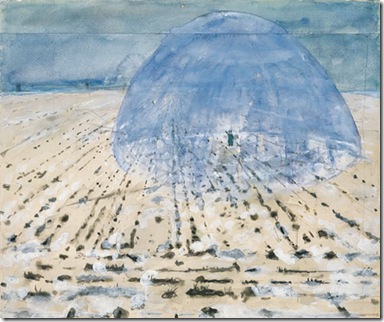
Everyone Stands Under His Own Dome of Heaven -- Both the title of this work and the image of the dome with a lone figure inside refer to Kiefer's view that there is no single system or belief, such as Marxism or Christianity, that is appropriate for all people. "Each man has his own dome, his own perceptions, his own theories," Kiefer has noted.

As I said before, the Christian church hardened in its knowledge and its symbolism at a certain point. The kabbalistic tradition is not one buy many, forming a sophisticated spiritual discipline. It is a paradox of logic and mystical belief. It’s part scholarship, part religion, part magic. For me, it is a spiritual journey anchored by images.

Friday, April 10, 2009

The Truly Living

Holy Longing (Selige Sehnsucht)
By Johann Wolfgang von Goethe
Translated by Shinzen Young

Tell it to no one but the wise
For most will mock it right away
The truly living do I prize
Those who long in flame to die.

In the coolness of loves evenings
Where you beget and were begotten,
You're overcome by strange new feeling
As the silent candle brightens.

No longer are you trapped and mired
In the darkened shadowings
But swept away by new desire
To a higher lovemaking.

Distance does not pall your flight
Spellbound through the air you're borne
Til at last mad for the light
You are a butterfly, then…gone.

And until you know of this:
How to grow through death
You're just another troubled guest
On the gloomy earth.

T.S. Eliot on Poetry

T.S. Eliot

“It may make us from time to time a little more aware of the deeper, unnamed feelings which form the substratum of our being, to which we rarely penetrate; for our lives are mostly a constant evasion of ourselves.”

~ Quoted in Matrix of Modernism by Sanford Schwartz

* * *

“If you want to write poetry, keep away from pencils and paper and typewriters until you have overcome the temptation…Whatever you think, be sure that’s what you think; whatever you want, be sure that’s what you want; whatever you feel, be sure that’s what you feel.”

~ From an address at Milton Academy, June 17, 1933


From East Coker
(No. 2 of Four Quartets)

From Wikipedia: East Coker is a village in Somerset, England from which T.S. Eliot's ancestors emigrated to Boston in 1660. Eliot visited the village in 1936-7 and his ashes are buried in the churchyard. Inside the church a plaque memorializing him was placed in 1965. It contains the words of his chosen epitaph, the opening and closing lines from East Coker: “in my beginning is my end"/"in my end is my beginning”. East Coker represents earth.

Thursday, April 09, 2009

Doing Nothing

From “A Year in a Cage: A Life Shrunk to Expand Art,” by Roberta Smith, New York Times (Feb. 18, 2009):

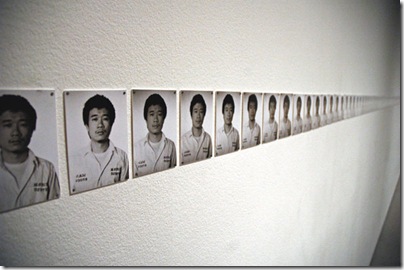
For “Cage Piece” Tehching Hsieh (pronounced dur-ching shay) built a cage from pine dowels and two-by-fours in a corner of his TriBeCa studio, furnishing it with a bed, a blanket, a sink (no toilet) and a pail, as well as some personal hygiene items. He entered the cell on Sept. 30, 1978. Robert Projansky, his lawyer, locked the door and affixed it and each dowel with paper seals that he signed. Every day a friend delivered food and dealt with the artist’s refuse. And each day the friend took a photograph of Mr. Hsieh, who had shaved his head at the beginning.

Tehching Hsieh photos For the next year Mr. Hsieh was mostly alone with his thoughts: no talking, reading or writing; no radio or television. On designated days once or twice a month his loft was open to the public from 11 a.m. to 5 p.m.; people could visit it like a gallery and see the work in progress. On Sept. 29, 1979, Mr. Projansky returned, verified that none of the seals had been broken, and Mr. Hsieh left his cell.

Performance 1: Tehching Hsieh, at the Museum of Modern Art, displays a wooden cage like one in which the artist spent a year, doing nothing. Chester Higgins Jr./The New York Times

Mandatum Novum

Today is Maundy Thursday, the Christian holy day commemorating The Last Supper of Jesus with his disciples.

The word Maundy is derived through Middle English, and Old French mandé, from the Latin mandatum. It refers to the "new mandate" given by Jesus to his apostles. The Gospel of John tells the story of Jesus illustrating the significance of this mandate by washing the feet of his disciples before sharing his last meal with them on the night before he was crucified.

Christ Washing the Feet of his Disciples, Rembrandt, c. 1655 Mandatum novum do vobis ut diligatis invicem sicut dilexi vos.

“A new commandment I give unto you, That you love one another as I have loved you.”

John 13:34

Thomas Merton wrote: True emptiness is that which transcends all things and yet is imminent in all. For what seems to be emptiness in this case is pure being. But it's not this or that. Whatever you say of it, it is other than what you say. The character of emptiness, at least for a Christian contemplative, is pure love, pure freedom. Love that is free of everything, not determined by any thing or held down by any special relationship. It's love for love's sake. It's a sharing through the Holy Spirit in the infinite charity of God. And so when Jesus told his disciples to love, he told them to love as universally as the Father who sends rain alike on the just and the unjust. This purity, freedom, and indeterminateness of love is the very essence of Christianity.

Wednesday, April 08, 2009

I Squirrel

"I don't make deals, I don't party and drink with sources, and I don't play a game of leaks. I read, I listen, I squirrel information. It's fun."

~ Seymour Hersh

No More Real than a Dream

From The Attention Revolution: Unlocking the Power of the Focused Mind by B. Alan Wallace:

The Attention Revolution By mindfully and discerningly attending to all kinds of perceptual appearances—material, mental, and otherwise—we can begin to distinguish between what appears to be our immediate sensory experience and our conceptual projections. In doing so, we start to discover the extent to which our waking experience is illusory. But the dreamlike nature of our experienced world may go a lot deeper than that. In the Perfection of Wisdom Sutras the Buddha makes the more radical claim that the world of our waking experience is fundamentally no more real than a dream. In a non-lucid dream, we mistakenly grasp onto all objective and subjective appearances as if they were inherently real, bearing their own intrinsic existence. Likewise, in the normal (non-lucid) waking state we do the same thing, imagining the physical world to be really “out there,” existing independently of our conceptual constructs, and we grasp onto our thoughts and other subjective experiences as being really “in here,” existing by their own inherent nature. In philosophical terms, we reify—or project as a substantial, independent existence—everything we experience while awake and asleep.

…Phenomena appear to exist inherently, independently of our conceptual frameworks, and we deludedly grasp onto them as existing just as they appear. But this simply perpetuates the dreamlike nature of experience of all kinds. When you become lucid in a dream, you begin to recognize that things are not as they appear, and now your challenge is to recognize the extent to which things in the waking state are no more real than a dream.

Tuesday, April 07, 2009

Unfold Your Own Myth

Who gets up early to discover the moment light begins?
Who finds us here circling, bewildered, like atoms?
Who comes to a spring thirsty
and sees the moon reflected in it?
Who, like Jacob blind with grief and age,
smells the shirt of his lost son
and can see again?
Who lets a bucket down and brings up
a flowing prophet? Or like Moses goes for fire
and finds what burns inside the sunrise?

Jesus slips into a house to escape enemies,
and opens a door to the other world.
Solomon cuts open a fish, and there's a gold ring.
Omar storms in to kill the prophet
and leaves with blessings.
Chase a deer and end up everywhere!
An oyster opens his mouth to swallow one drop
Now there's a pearl.
A vagrant wanders empty ruins,
Suddenly he's wealthy.

Don't be satisfied with stories, with how
others have done things. Unfold
your own myth, simply and directly,
Let yourself open to your truth.

Start on the path. Your legs may get heavy
and tired. Then comes a moment of feeling
the wings you have grown, lifting you
gently.

~ Rumi

Fleetingly Happier

From “When All You Have Left Is Your Pride,” by Benedict Carey, New York Times (April 6, 2009):

Psychologists have found that wearing a sad or happy face can have a top-down effect on how a person feels: Smile and you may feel fleetingly happier. The same most likely is true for an expression of pride. In a 2008 study, the Northeastern researchers found that inducing a feeling of pride in people solving spatial puzzles motivated them to try harder when they tackled the next round.

Pride, in short, begets perseverance. All of which may explain why, when the repo man is at the door, people so often remind themselves that they still have theirs, and that it’s worth something. Because they do, and because it is.

However much pride may go before a fall, it may be far more useful after one.

[Thanks Dōshin!]

The Neuroscience of Architecture

From "How Room Designs Affect Your Work and Mood," by Emily Anthes, Scientific American Mind (April 2009):

architecture Architects have long intuited that the places we inhabit can affect our thoughts, feelings and behaviors. Now behavioral scientists are giving their hunches an empirical basis.

Scientists are unearthing tantalizing clues about how to design spaces that promote creativity, keep students focused and alert, and lead to relaxation and social intimacy. The results inform architectural and design decisions such as the height of ceilings, the view from windows, the shape of furniture, and the type and intensity of lighting.

Such efforts are leading to cutting-edge projects such as residences for seniors with dementia in which the building itself is part of the treatment.

Outside of All Places

Go to the Bureau for Open Culture site for a list of participating artists and more information.

Of Other Spaces, curated by James Voorhies, explores how the origins and functions of spaces shape human behavior. It considers the ways in which places become charged with socio-cultural authority to act in service and in suppression of our activity.

Columbus College of Art & Design
Canzani Center Gallery
hours & location
From “Of Other Spaces,” by Michel Foucault (1967):

First there are the utopias. Utopias are sites with no real place. They are sites that have a general relation of direct or inverted analogy with the real space of Society. They present society itself in a perfected form, or else society turned upside down, but in any case these utopias are fundamentally unreal spaces.

There are also, probably in every culture, in every civilization, real places—places that do exist and that are formed in the very founding of society—which are something like counter-sites, a kind of effectively enacted utopia in which the real sites, all the other real sites that can be found within the culture, are simultaneously represented, contested, and inverted. Places of this kind are outside of all places, even though it may be possible to indicate their location in reality. Because these places are absolutely different from all the sites that they reflect and speak about, I shall call them, by way of contrast to utopias, heterotopias.

I believe that between utopias and these quite other sites, these heterotopias, there might be a sort of mixed, joint experience, which would be the mirror. The mirror is, after all, a utopia, since it is a placeless place. In the mirror, I see myself there where I am not, in an unreal, virtual space that opens up behind the surface; I am over there, there where I am not, a sort of shadow that gives my own visibility to myself, that enables me to see myself there where I am absent: such is the utopia of the mirror.

But it is also a heterotopia in so far as the mirror does exist in reality, where it exerts a sort of counteraction on the position that I occupy. From the standpoint of the mirror I discover my absence from the place where I am since I see myself over there. Starting from this gaze that is, as it were, directed toward me, from the ground of this virtual space that is on the other side of the glass, I come back toward myself; I begin again to direct my eyes toward myself and to reconstitute myself there where I am. The mirror functions as a heterotopia in this respect: it makes this place that I occupy at the moment when I look at myself in the glass at once absolutely real, connected with all the space that surrounds it, and absolutely unreal, since in order to be perceived it has to pass through this virtual point which is over there.

[Grazie Deborah!]

Monday, April 06, 2009

Less and Less

Cantillations
by Emily Warn, from Shadow Architect

How do you remain faithful when boredom sets in? Sages
offer numerous rules of piety, precepts, commandments,
vows, proverbs, and aphorisms, all compiled after revelations
that shattered the structure of existence. The purpose of all
rules of piety is to extend revelation into ordinary life. They
are survival tactics that help us withstand tedium, our
disappointed expectations that something dramatic will
happen—the sky open, a pillar of fire light our way—if we
do this and that. For example, if you stand in a field in the
month of Elul when the red dwarf rises above the tree where
the shepherd has tethered his goats, you’ll see divine light.
Instead, you are preoccupied with stamping your feet in the
cold, with muttering and gossiping with friends. Without
knowing it, you’re storing a memory of being knit together
that will help you survive later. You’ll remember one friend
who rolls her eyes in mock disapproval at such religiosity;
another concentrates as hard as she can on what the sages
said would happen if you gathered in the fields during the
month of Elul. She focuses on waiting to see a flash. The
other observes what can be seen, the night sky, its billions of
unnamed stars, impossible to count, immeasurable depth,
formless space, black, blank; receding as she is, less and less
visible, less and less impatient at nothing much happening.
The other shouts, witnessing the birth of a star.

[Narrative’s Poem of the Week]