“I’ve been lucky all my life. Everything was handed to me. Looks, fame, wealth, honors, love. I rarely had to fight for anything. But I’ve paid for that luck with disasters. . .I’m like a living example of what people can go through and survive. I’m not like anyone. I’m me.”
And this from a recent interview for Harper’s Bazaar, “I never planned to acquire a lot of jewels or a lot of husbands. For me, life happened, just as it does for anyone else. I have been supremely lucky in my life in that I have known great love, and of course I am the temporary custodian of some incredible and beautiful things. But I have never felt more alive than when I watched my children delight in something, never more alive than when I have watched a great artist perform, and never richer than when I have scored a big check to fight AIDS. Follow your passion, follow your heart, and the things you need will come.”
“It’s hard to define the human experience. We constantly try to understand it. That’s why people love narrative: There’s a beginning, a middle, and an end.”
“So my grandfather told me when I was a little girl, ‘If you say a word often enough, it becomes you.’ And having grown up in a segregated city, Baltimore, Maryland, I sort of use that idea to go around America with a tape recorder — thank God for technology — to interview people, thinking that if I walked in their words—which is also why I don't wear shoes when I perform — if I walked in their words, that I could sort of absorb America. I was also inspired by Walt Whitman, who wanted to absorb America and have it absorb him.”
“[The main character] is based on a bunch of different movie star actors that I’ve known or met or heard stories about and mixed them all together. He’s become famous recently and he’s doing a press conference for a movie he’s done called Berlin Agenda so you get the idea he’s done some kind of big action movie that he’s not very proud of. I never want to show him making a movie. It’s not really about the film business, but that’s the backdrop. I try to think of things that the actors would do in between films like get a head plaster cast, or sometimes they learn strange skills. You hear stories about actors having romances with their leading ladies and I thought, what happens when they have to get back together a year later for a reshoot or a press junket. Everything’s heightened when you’re doing a movie and then it’s over.”
“I like in life how so much is conveyed by the way someone gives a look or a glance. I think a lot of times in movies, people explain all their feelings, but in life you’re not always able to articulate a lot of things. And part of the fun of making films is telling the story in a visual way.”
"I never, in any city I've ever been in, never remember the names of streets. The longest place I ever lived in was for five years and I didn't know the name of the next street over. Why bother! I think there's such enjoyment in just getting lost in a city. Having no idea where you are, how you're gonna get out of it. Getting to be the middle of the night, you're still lost, walking around. That's the best way to discover a city. That's how you're born into life. You got no freaking idea which way's up or down."
"I think the easiest way to talk about the movie is to say it's a character study set in New York City. You are looking at the world through the lens of one girl during one week of her life. The movie focuses on the small gestures, like the silent moments when two people's hands almost touch. These small gestures and the attention to the mundane create a huge tension. I wouldn't necessarily say it's a love story as much as a story about being young and asking, 'How do I react to the world? How do I deal with myself?'"
“A lot of people think that how you behave is a given or that behavior is character. When you move around a lot, you learn that behavior is mutable. I would change, depending on where I was. I would go to one school and everyone would dance one way and, then, at a new school, you’d notice that no one picked up their feet when they danced. You’re like, O.K. — I’ll shuffle my feet like them. You learn that there’s no one way to dance or be. For some reason, a lot of actors come from these peripatetic backgrounds — army kids, missionary kids, kids of salesmen. It teaches you to watch, to reinvent, that character can change.”
“One of the things I’ve always been taught as a drama student was not to play the emotion. That doesn’t mean to say you don’t express it, you don’t have it, you don’t find it. The emotion is the obstacle. The person doesn’t want to be unhappy, and the unhappiness is the obstacle that gets in the way.”
Anna Deavere Smith, from her Chataqua Institution lecture “Looking for Grace,” FORA.tv, September 13, 2009:
I started to think about the conditions that foster creativity. I would say that any modest amount of creativity that I’ve experienced—at least in my adult life—required the following: a restricted environment, uncertainty, independence and responsibility, a lack of safety, the need for change, richness of inner life, need, physical beauty, contradictions, and doubt.
Now, if we were to create a school or community where we wanted to foster creativity, we would probably not seed the growth of those attributes. I think that list would look something like this: an environment where possibility seemed endless, steadiness, a firm foundation, strong mentorship, safety, richness of inner life, provisions, clarity, confidence, and physical beauty.
"My tape recorder and my ear create the necessary distance that allows me to get close to another person."
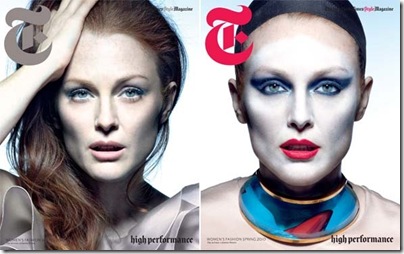
Julianne Moore doesn’t mind calling herself “middle-aged,” says Gaby Wood in British Vogue. “When people say, ‘I’m not middle-aged,’ you want to say, ‘Well, exactly how long do you think you’re going to live?’” the 48-year-old actress says. “It becomes so tedious after a while, this idea that everybody’s so focused on being young. Whenever you ask anybody, ‘Would you want to be 20 again?’ invariably they go, ‘No.’ You don’t want to repeat it—you want to be what you are.” In Moore’s case, youth was not only a time of personal confusion; it was a time when she couldn’t find work. “When I was auditioning for movies in the ’80s, I never got anything. They made a lot of movies about young people doing things, like St. Elmo’s Fire. I got my first movie role when I was 29, which was considered really old. I wasn’t supposed to tell anyone my age. It was horrible—so stupid and awkward—and I found it really oppressive. I was, like, I can’t do this anymore! What is the problem with telling people I’m 30, 31, 32?” She got her breakthrough in indie films, and her career took off after that. Moore’s now fully content with both her professional life and her personal one—she’s married, with two children—and the recent sudden death of friend Natasha Richardson helped put things in perspective. “I’m lucky to be 48, and not be … not here. I’m never going to be 48 again—48’s over after this year.”
“Movie acting was invented less than 100 years ago — movie acting with sound. You know how Harold Bloom says that Shakespeare invented us? It’s a fascinating idea, and you can go quite far with it. You could say that it’s in talking movies that inner life begins to appear. You can see things happen to the faces of people that were neither planned nor rehearsed. This is what Garbo was such a master of: actual thoughts that had not occurred before that particular take. And you can see this taking tremendous leaps with Brando and Clift and then with Streep.”
“The greatest thrill is that moment when a thousand people are sitting in the dark, looking at the same scene, and they are all apprehending something that has not been spoken. That’s the thrill of it, the miracle — that’s what holds us to movies forever. It’s what we wish we could do in real life. We all see something and understand it together, and nobody has to say a word. There’s a good reason that the very best sound an audience can make — in both the theater and the movies — is no sound at all, just absolute silence.”
Meryl Streep said: “What makes Mike so great is one of the hardest things for people temperamentally drawn to directing. People who direct tend to want to be in control, and Mike’s gift is knowing when to take his hands off and just let it happen. A lot of directors are still dealing with the text when you’re on the set. Mike has done all that beforehand, so when you get on the set you feel it’s a secure world where all the architecture is in place. You can jump as hard as you want and the floor won’t give way.”
“I wanted to be a movie star. You can’t say about work that I didn’t try very hard. That really wasn’t true. I’ve always been a great opportunist, but the opportunity was not always there. I had a difficult set of circumstances to deal with, particularly for a movie career. Being gay...just doesn’t work.”
“Everybody sabotages their careers to a certain extent, not consciously, but I don’t think I have more than anyone else. People get distorted ideas of themselves; being in this business, you can’t fail to. Suddenly you think you should be playing the Marlon Brando role in ‘On the Waterfront’ when you should really be playing a Noël Coward role. I think success in show business is a very heady wine when you’re a kid, particularly if it happens small, because you’re always trying to make it grow. There’s no happy moment in it, because you’re just grasping and elbowing, elbowing, elbowing your way to the next stop. And you make lots of wrong decisions because of it.”
VULTURE: What’s the hardest cut you’ve ever had to make?
DARREN ARONOFSKY: The hardest was while making this movie, actually. We had a scene near the end with Mickey in front of the mirror, where he’s talking and he just went to some incredibly deep, dark place. Seriously, it was possibly the finest piece of acting I’ve ever seen in my life. It was absolutely intense. And I had to cut it. It would have totally upset the balance of the film — it was that powerful. It was heartbreaking.
Actors who are photogenic like being photographed, and I’ve come to understand that they make the photograph. I realized when I studied pictures of Marilyn Monroe that it almost didn’t matter who the photographer was. She took charge. It seemed like she was taking the picture. There are other actors, however, who resist being photographed. They feel awkward. It doesn’t seem to them to have anything to do with their work. Meryl Streep and Robert Din Niro are in this category. I have the impression that a photograph seems superficial to them. They associate it with being a star and they think of themselves as actors first. They don’t want to be connected to the star machinery. I think also that actors such as Streep and De Niro got into acting to get away from themselves. They like playing roles and they feel cornered by a photograph. They don’t feel that projecting their personalities is part of what they do. They associate a photograph with selling themselves.
The picture of Meryl Streep in whiteface was made during a session that didn’t start out well. Meryl had only recently become a movie star. I had already done a fashion sitting with her for Vogue, and Life had used a head shot taken from that sitting on their cover a few months earlier. Francesco Scavullo had just shot her for the cover of Time. This round of publicity was for The French Lieutenant’s Woman. Meryl was uncomfortable with all the attention she was getting and she cancelled the first appointment for the shoot, but she was finally persuaded to come to my studio for two and a half hours one morning. She came in and talked about how she didn’t want to be anybody, she was nobody, just an actress. There were a lot of clown books lying around the studio and some white makeup left over from an idea I had for either James Taylor or John Belushi. I told Meryl that she didn’t have to be anybody in particular, and I suggested that maybe she would like to put on whiteface. To be a mime. That set her at ease. She had a role to play. It was her idea to pull at her face.
“…when you are a child who is unwanted or unwelcome, and the essence of what you are seems to be unacceptable, you look for an identity that will be acceptable. Usually this identity is found in faces you are talking to. You make a habit of studying people, finding out the way they talk, the answers that they give and their points of view; then, in a form of self-defense, you reflect what’s on their faces and how they act because most people like to see reflections of themselves.”
"I think the reason there's so much envy is because it's such a competitive marketplace and we believe that if Person A has success, that's a success I'm not going to have.
My experience with envy, in myself and in my patients, is it's usually a signal to you of how important the thing is you want to do. I've never had a patient who was very happy with what they were writing or very excited about a film they were directing that had much envy. If you're sort of engaged with what you're doing you don't care what's on the best seller list. if you feel like nothing's happening in your career or that you're not excited about what you're working on, then I think every success someone else has is a piercing reminder to you of what's not happening for you.
And that's why one of the things I advise patients all the time is to look for solace and gratification in the work that they're doing. I think the process of work saves your butt, because if you're only excited when your screen play gets made into a film that's released, that's going to happen once every five or seven years. And when they do come, your dissatisfaction that they don't make you feel as good as you thought will just disconfirm the value of doing all the work.
Will you be jealous and envious of other people's success? Yes. "
"From a very young age, when a person says, Gee, I'd like to be a writer or I'd like to be an actor or whatever, it seems so grandiose. It seems so elevated. I mean, if you watch Will Smith on screen and you're a kid who says, Gee, I wanna be a movie star just like him, your fantasy is he or she has something you don't have. You're not enough. I think one of the reasons that people read self-help books and stuff is that they have this idea that there's this perfectible version of themselves in the future. And that person will be happy and successful and very secure. Most creative people, when they begin having some success, get a kind of validation like they're on Oprah or the paparazzi follow them or magazines interview them and want to know their position on the environment, but inside themselves they know they're the same schmuck that grew up in some small town looking up at a movie screen wanting to be an actor. So they see a disconnect between the public approbation and validation and their sense of themselves, which is that they're just this regular, insecure, neurotic slug and so someone will find that out. The fear is that it will be found out that they are much less than we thought."
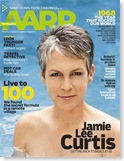
“I want to be older. I actually think there’s an incredible amount of self-knowledge that comes with getting older. I feel way better now than I did when I was 20. I’m stronger, I’m smarter in every way, I’m so much less crazy than I was then.
Years ago my husband and I were at the Golden Globes. I was wearing some borrowed dress that wasn’t me, my hair was done in a way that I never wear my hair, and I had earrings on. And my husband said, ‘You know who is the most beautiful woman in the room?’ And I was hoping he was going to say me. And he pointed across the room at Jessica Tandy. She was sitting at a table wearing a cream-colored silk-shantung pantsuit. Single strand of pearls, short white hair, a little lipstick—nothing else. And I thought, ‘He’s totally right.’ There was none of the pretense, none of the trying so hard.
...The same way that mid-century modern architecture was in the ’50s, I want to be as a human being. New. Different. Challenging the old. Function over frivolity. Clean living. Clean lines."
"The primary focus of this path of choosing wisely...is learning to stay present. Pausing very briefly, frequently throughout the day, is an almost effortless way to do this. For just a few seconds we can be right here. Meditation is another way to train in learning to stay or...learning to come back, to return to the present over and over again."
"In Zen Buddhist painting, ensō symbolizes a moment when the mind is free to simply let the body-spirit create. The brushed ink of the circle is usually done on silk or rice paper in one movement and there is no possibility of modification: it shows the expressive movement of the spirit at that time."







 inner life begins to appear. You can see things happen to the faces of people that were neither planned nor rehearsed. This is what Garbo was such a master of: actual thoughts that had not occurred before that particular take. And you can see this taking tremendous leaps with Brando and Clift and then with Streep.”
 “I wanted to be a movie star. You can’t say about work that I didn’t try very hard. That really wasn’t true. I’ve always been a great opportunist, but the opportunity was not always there. I had a difficult set of circumstances to deal with, particularly for a movie career. Being gay...just doesn’t work.”
 Actors who are photogenic like being photographed, and I’ve come to understand that they make the photograph. I realized when I studied pictures of Marilyn Monroe that it almost didn’t matter who the photographer was. She took charge. It seemed like she was taking the picture. There are other actors, however, who resist being photographed. They feel awkward. It doesn’t seem to them to have anything to do with their work. Meryl Streep and Robert Din Niro are in this category. I have the impression that a photograph seems superficial to them. They associate it with being a star and they think of themselves as actors first. They don’t want to be connected to the star machinery. I think also that actors such as Streep and De Niro got into acting to get away from themselves. They like playing roles and they feel cornered by a photograph. They don’t feel that projecting their personalities is part of what they do. They associate a photograph with selling themselves.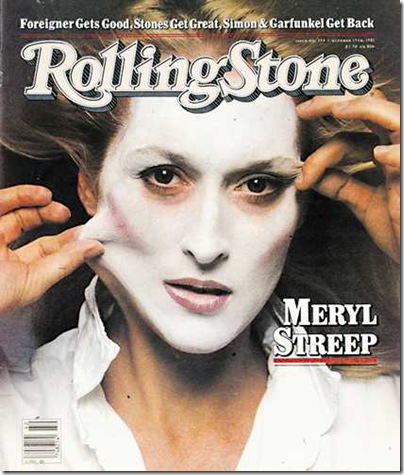
 “…when you are a child who is unwanted or unwelcome, and the essence of what you are seems to be unacceptable, you look for an identity that will be acceptable. Usually this identity is found in faces you are talking to. You make a habit of studying people, finding out the way they talk, the answers that they give and their points of view; then, in a form of self-defense, you reflect what’s on their faces and how they act because most people like to see reflections of themselves.”