Showing posts with label poetry. Show all posts

Saturday, May 14, 2011

The Origin of Change
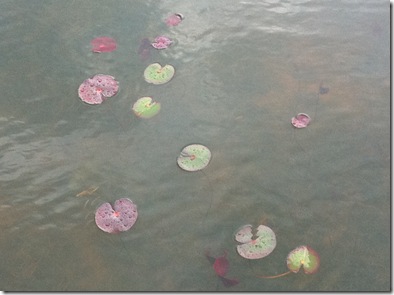
Deer Haven. May 14, 2011

Notes Toward a Supreme Fiction
by Wallace Stevens

IV

Two things of opposite natures seem to depend
On one another, as a man depends
On a woman, day on night, the imagined

On the real. This is the origin of change.
Winter and spring, cold copulars, embrace
And forth the particulars of rapture come.

Music falls on the science like a sense,
A passion that we feel, not understand.
Morning and afternoon are clasped together

And North and South are an intrinsic couple
And sun and rain a plural, like two lovers
That walk away as one in the greenest body.

In solitude the trumpets of solitude
Are not of another solitude resounding;
A little string speaks for a crowd of voices.

The partaker partakes of that which changes him.
The child that touches takes character from the thing,
The body, it touches. The captain and his men

Are one and the sailor and the sea are one.
Follow after, O my companion, my fellow, my self,
Sister and solace, brother and delight.

Monday, May 02, 2011

A Daughter and a Sister

I am
by eight-year-old Ava Schicke from Omaha, Nebraska

I am a daughter and a sister.
I wonder when I will die.
I hear the warm weather coming.
I see stars in the day.
I want to learn my whole ballet dance.
I am a daughter and a sister.

I pretend to be a teacher at home.
I feel like I am a teacher.
I touch hands that are growing.
I worry that I will never change.
I cry when something or someone dies.
I am a daughter and a sister.

I understand that teachers work hard for students.
I say that I don’t like bullies.
I dream about me not moving while trying really hard to run.
I try to become a good friend.
I hope that there is no more dying or killing.
I am a daughter and a sister.

Friday, April 29, 2011

Daybreak in Alabama

by Langston Hughes, from The Collected Poems of Langston Hughes

When I get to be a composer
I'm gonna write me some music about
Daybreak in Alabama
And I'm gonna put the purtiest songs in it
Rising out of the ground like a swamp mist
And falling out of heaven like soft dew.
I'm gonna put some tall tall trees in it
And the scent of pine needles
And the smell of red clay after rain
And long red necks
And poppy colored faces
And big brown arms
And the field daisy eyes
Of black and white black white black people
And I'm gonna put white hands
And black hands and brown and yellow hands
And red clay earth hands in it
Touching everybody with kind fingers
And touching each other natural as dew
In that dawn of music when I
Get to be a composer
And write about daybreak
In Alabama.

[Thanks, Poem-a Day!]

Sunday, April 24, 2011

Life In Itself Is Nothing

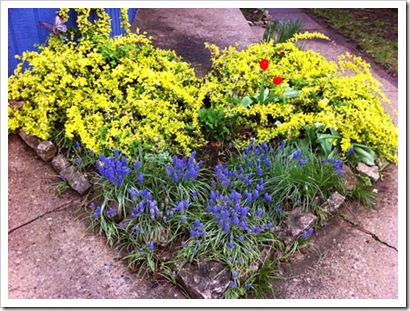
West 2nd Ave., April 24, 2011

Spring
by Edna St. Vincent Millay

To what purpose, April, do you return again?
Beauty is not enough.
You can no longer quiet me with the redness
Of little leaves opening stickily.
I know what I know.
The sun is hot on my neck as I observe
The spikes of the crocus.
The smell of the earth is good.
It is apparent that there is no death.
But what does that signify?
Not only under ground are the brains of men
Eaten by maggots.
Life in itself
Is nothing,
An empty cup, a flight of uncarpeted stairs.
It is not enough that yearly, down this hill,
April
Comes like an idiot, babbling and strewing flowers.

Searching for Heaven

"Heaven and earth don’t exist anymore. The earth is round. The cosmos has no up and down. It is moving constantly. We can no longer fix the stars to create an ideal place. This is our dilemma.

It is natural to search for our beginnings, but not to assume it has one direction. We live in a scientific future that early philosophers and alchemists could not foresee, but they understood very fundamental relationships between heaven and earth, that we have forgotten…North, south, east, and west, up and down are not issues. For me, this also relates to time. Past, present, and future are essentially the same direction. It is about finding symbols that move in all directions.

My spirituality is not New Age. It has been with me since I was a child. I know that in the last few decades religion has been made shiny and new. It’s like a business creating a new product. They are selling salvation. I’m not interested in being saved. I’m interested in reconstructing symbols. It’s about connecting with an older knowledge and trying to discover continuities in why we search for heaven."

~ Anselm Kiefer, from “History of Our World

The Mountain from Terje Sorgjerd on Vimeo.

Three Lilies
by Brooks Haxton, from Uproar: Antiphonies to Psalms

Weeping may endure for a night, but joy cometh in
            the morning. Psalm 30

Before dawn, under a thin moon disappearing
east, the planet Mercury, the messenger
and healer, came up vanishingly
into the blue beyond the garden where
three lilies at the bottom of the yard
arrayed white trumpets on iron stalks
under a slow, slow lightning from the sun.
I stood on a rotten step myself,
and smelled them from a hundred feet away.

Saturday, April 23, 2011

Silence No One Hears

Poem with No Speaker
by Franz Wright, from Earlier Poems

Are you looking
for me? Ask that crow

rowing
across the green wheat.

See those minute air bubbles
rising to the surface

at the still creek's edge—
talk to the crawdad.

Inquire
of the skinny mosquito

on your wall
stinging its shadow,

this lock
of moon

lifting
the hair on your neck.

When the hearts in the cocoon
start to beat,

and the spider begins
its hidden task,

and the seed sends its initial
pale hairlike root to drink,

you'll have to get down on all fours

to learn my new address:
you'll have to place your skull

besides this silence
no one hears.

Wednesday, April 20, 2011

Poetry Doesn’t Need Music; Lyrics Do

Green Finch and Linnet Bird
by Stephen Sondheim, from Sweeney Todd

Green finch and linnet bird,
Nightingale, blackbird,
How is it you sing?
How can you jubilate,
Sitting in cages,

Never taking wing?
Outside the sky waits,
Beckoning, beckoning,
Just beyond the bars,
How can you remain,
Staring at the rain,
Maddened by the stars?
How is it you sing
Anything?
How is it you sing?

Green finch and linnet bird,
Nightingale, blackbird,
How is it you sing?
Whence comes this melody
    constantly flowing?
Is it rejoicing or merely halloing?
Are you discussing
Or fussing
Or simply dreaming?
Are you crowing?
Are you screaming?

Ringdove and robinet,
Is it for wages,
Singing to be sold?
Have you decided it's
Safer in cages,
Singing when you're told?

My cage has many rooms,
Damask and dark.
Nothing there sings,
Not even my lark.
Larks never will, you know,
When they're captive.
Teach me to be more adaptive.

Green finch and linnet bird,
Nightingale, blackbird,
Teach me how to sing.
If I cannot fly,
Let me sing.

*     *     *     *     *

"Lyrics, even poetic ones, are not poems," states Stephen Sondheim in the introduction to Finishing the Hat, a collection of his lyrics from 1954 to 1981. "Poems are written to be read, silently or aloud, not sung. Some lyrics, awash with florid imagery, present themselves as poetry, but music only underscores (yes) the self-consciousness of the effort…Poetry is an art of concision, lyrics of expansion…Poetry doesn't need music; lyrics do."

"Green Finch and Linnet Bird," sung by the character of Johanna in Sweeney Todd, may not be a poem, but to read it without its haunting, angular melody is to "hear" it slightly differently.

~ From Knopf’s Borzoi Reader Poem-a-Day from today. Visit the site to hear actress Kate Levy reading Sondheim’s lyrics.

Monday, April 18, 2011

I Don’t Know

Dawn
by Cloud Cult, from Light Chasers

The airport's clear for a landing.
The snow is melting on the garden.
All our anxieties are in a box I mailed to Pluto.
And I feel like the sun.
Gonna burn it all away.

We rest our heads upon one pillow.
Beg for falling stars to break in our window.
Outside the evergreens are blowing out their birthday candles.
And I feel like the wind.
Gonna blow it all away.

Pray to the 'I Don't Know' that made me.
Protect my Love, protect my friends, protect my baby.
I may have worries, but I'm not going crazy.
I feel like the rain.
Gonna wash it all away.

I can't breathe unless you're in my air.
I'm not here unless you're somewhere near.
When old age calls, we'll share a rocking chair.
And I feel like the dawn.
That light is getting near.

Wednesday, April 06, 2011

No More Goals for You

Horoscopes For the Dead
by Billy Collins, from Horoscopes for the Dead: Poems

Every morning since you fell down on the face of the earth,
I read about you in the newspaper
along with the box scores, the weather, and all the bad news.

Sometimes I am reminded that today
will not be a wildly romantic time for you,
nor will you be challenged by educational goals
nor will you need to be circumspect at the workplace.

Another day, I learn that you will miss
an opportunity to travel and make new friends
though you never cared much about either.

I can’t imagine you ever facing a new problem
with a positive attitude, but you will definitely not
be doing that or anything like that on this weekday in March.
And the same goes for the fun
you might have gotten from group activities,
a likelihood attributed to everyone under your sign.

A dramatic rise in income may be a reason
to treat yourself, but that would apply
more to all the Pisces who are still alive today,
still swimming up and down the stream of life
or suspended in a pool in the shade of an overhanging tree.

But it will come as a relief to learn
that you don’t need to reflect carefully before acting
nor do you have to think more of others,
and never again will creative work take a back seat
to the business responsibilities that you never really had.

And don’t worry today or any other day
about unwanted problems caused by your failure
to interact rationally with your many associates.
No more goals for you, no more pressing matters,
no more money or children, jobs or important tasks,
but then again, you were never thus encumbered.

*     *     *     *     *

Billy Collins was selected as the author of the year by the Bexley Community Book Club and will be giving a reading at Bexley High School April 20 at 7:30pm.

Tuesday, April 05, 2011

Who's This?

Disappearing Act
by Elizabeth Ross Taylor, from Blackbird, Spring 2002

No, soul doesn't leave the body.

My body is leaving my soul.
Tired of turning fried chicken and
coffee to muscle and excrement,
tried of secreting tears, wiping them,
tired of opening eyes on another day,
tired especially of that fleshy heart,
pumping, pumping. More,
that brain spinning nightmares.
Body prepares:
disconnect, unplug, erase.

But here, I think, a smallish altercation
arises.
Soul seems to shake its fist.
Wants brain? Claims dreams and nightmares?
Maintains a codicil bequeathes it shares?

There'll be a fight. A deadly struggle.
We know, of course, who'll win. . . .

But who's this, watching?

[Thanks, Linda!]

Monday, April 04, 2011

The Only Life You Could Save

April 4, 2011

The Journey
by Mary Oliver

One day you finally knew
what you had to do, and began,
though the voices around you
kept shouting
their bad advice —
though the whole house
began to tremble
and you felt the old tug
at your ankles.
“Mend my life!”
each voice cried.
But you didn’t stop.
You knew what you had to do,
though the wind pried
with its stiff fingers
at the very foundations,
though their melancholy
was terrible.                                                                           

It was already late
enough, and a wild night,
and the road full of fallen
branches and stones.
But little by little,
as you left their voices behind,
the stars began to burn
through the sheets of clouds,
and there was a new voice
which you slowly
recognized as your own,
that kept you company
as you strode deeper and deeper
into the world,
determined to do
the only thing you could do —
determined to save
the only life you could save.

Saturday, April 02, 2011

Just Another Phenomenon of Consciousness

Excerpt from “Just One Breath: The Practice of Poetry and Meditation,” by Gary Snyder, Tricycle Magazine, Fall 1991:

snyder Traditions of deliberate attention to consciousness, and of making poems, are as old as humankind. Meditation looks inward, poetry holds forth. One is private, the other is out in the world. One enters the moment, the other shares it. But in practice it is never entirely clear which is doing which.

In any case, we do know that in spite of the contemporary public perception of meditation and poetry as special, exotic, and difficult, they are both as old and as common as grass. The one goes back to essential moments of stillness and deep inwardness, and the other to the fundamental impulse of expression and presentation.

People often confuse meditation with prayer, devotion, or vision. They are not the same. Meditation as a practice does not address itself to a deity or present itself as an opportunity for revelation. This is not to say that people who are meditating do not occasionally think they have received a revelation or experienced visions. They do. But to those for whom meditation is their central practice, a vision or a revelation is seen as just another phenomenon of consciousness and as such is not to be taken as exceptional.

The meditator would simply experience the ground of consciousness, and in doing so avoid excluding or excessively elevating any thought or feeling. To do this one must release all sense of the "I" as experiencer, even the "I" that might think it is privileged to communicate with the divine. It is in sensitive areas such as these that a teacher can be a great help.

Read the entire essay…

Avoiding Interesting Jobs

Inn at Honey Run, March 30, 2011 (Pat Schmitt) p schmidtt

"I consider myself kind of a reporter — one who uses words that are more like music and that have a choreography. I never think of myself as a poet; I just get up and write. For most of my life, I haven't had the structure of an actual job. When I was very young and decided I wanted to try to write as well as I could, I made a great list of all the things I would never have, because I thought poets never made any money. A house, a good car, I couldn't go out and buy fancy clothes or go to good restaurants. I had the necessities. Not that I didn't take some teaching jobs over the years — I just never took any interesting ones, because I didn't want to get interested. That's when I began to get up so early in the morning — you know I'm a 5 A.M. riser — so I could write for a couple of hours and then give my employer my very best second-rate energy...

You have to be in the world to understand what the spiritual is about, and you have to be spiritual in order to truly be able to accept what the world is about...I think about the spiritual a great deal. I like to think of myself as a praise poet....If I have any lasting worth, it will be because I have tried to make people remember what the Earth is meant to look like."

~ Mary Oliver, from "Maria Shriver Interviews the Famously Private Poet Mary Oliver," O Magazine, March 9, 2011

Friday, April 01, 2011

To Really See It

Wherever We Are

Cleveland, March 25, 2011

Residence/Inn
by Daron Larson

The hotel room is roomier
now that we’re older,
largely because of your frequent business travel
which rewards loyalty with extra comforts.

There’s even a small kitchen,
though nothing to eat,
and a living room with a couch
that can become a bed for guests.

I pull back the curtains to let the light in.
You’ve already managed to unpack
everything we’ve brought
and sort it all into the drawers —
a tendency I used to tease you about.

The bathroom counter is organized
(his, his).

The white towels hang perfectly undisturbed.
Our books and electronics wait on our nightstands
(yours, mine).

How can we ignore the similarity
between borrowing and owning?
Is it possible not to notice that
home is wherever we are?

When I get up in the middle of the night
to use the bathroom,
I take care to step over the dog,
even though she’s asleep in the kennel
not far from where we live,
hoping to wake from
the confusion of her disrupted routine.

In the morning, we make the bed.
You find coffee and read the paper
while I try to let go of my story
until the bell rings,
and then again whenever I’m able
after the sound trails off.

On the other side of the door
waits a blend of familiarity and strangeness,
not unlike every other door we have ever
closed or opened,
locked or walked through,
alone or together,
for as long as we both have lived.

Friday, March 18, 2011

Who Needs Them?

Religious Consolation
by John Updike, from Americana and Other Poems

Americana: and Other Poems by John UpdikeOne size fits all. The shape or coloration
of the god or high heaven matters less
than that there is one, somehow, somewhere, hearing
the hasty prayer and chalking up the mite
the widow brings to the temple. A child
alone with horrid verities cries out
for there to be a limit, a warm wall
whose stones give back an answer, however faint.

Strange, the extravagance of it—who needs
those eighteen-armed black Kalis, those musty saints
whose bones and bleeding wounds appall good taste,
those joss sticks, houris, gilded Buddhas, books
Moroni etched in tedious detail?
We do; we need more worlds. This one will fail.

* * * * *
See also: Updike's 'This I Believe' Essay
[Thanks, Suzanne!]

Tuesday, March 15, 2011

A Philosophy of the Present

From “In Search of the Present,” by Octavio Paz (translated by Anthony Stanton), Nobel Lecture, October 8, 1990:

Reflecting on the now does not imply relinquishing the future or forgetting the past: the present is the meeting place for the three directions of time. Neither can it be confused with facile hedonism. The tree of pleasure does not grow in the past or in  the future but at this very moment. Yet death is also a fruit of The death mask of Sir Isaac Newton.the present. It cannot be rejected, for it is part of life. Living well implies dying well. We have to learn how to look death in the face. The present is alternatively luminous and somber, like a sphere that unites the two halves of action and contemplation. Thus, just as we have had philosophies of the past and of the future, of eternity and of the void, tomorrow we shall have a philosophy of the present. The poetic experience could be one of its foundations. What do we know about the present? Nothing or almost nothing. Yet the poets do know one thing: the present is the source of presences.

In this pilgrimage in search of modernity I lost my way at many points only to find myself again. I returned to the source and discovered that modernity is not outside but within us. It is today and the most ancient antiquity; it is tomorrow and the beginning of the world; it is a thousand years old and yet newborn. It speaks in Nahuatl, draws Chinese ideograms from the 9th century, and appears on the television screen. This intact present, recently unearthed, shakes off the dust of centuries, smiles and suddenly starts to fly, disappearing Venus of Willendorf through the window. A simultaneous plurality of time and presence: modernity breaks with the immediate past only to recover an age-old past and transform a tiny fertility figure from the Neolithic into our contemporary. We pursue modernity in her incessant metamorphoses yet we never manage to trap her. She always escapes: each encounter ends in flight. We embrace her and she disappears immediately: it was just a little air. It is the instant, that bird that is everywhere and nowhere. We want to trap it alive but it flaps its wings and vanishes in the form of a handful of syllables. We are left empty-handed. Then the doors of perception open slightly and the other time appears, the real one we were searching for without knowing it: the present, the presence.

[Thanks, Whiskey River!]

Please

The Word That Is a Prayer
by Ellery Akers, from American Life in Poetry: Column 321

One thing you know when you say it:
all over the earth people are saying it with you;
a child blurting it out as the seizures take her,
a woman reciting it on a cot in a hospital.
What if you take a cab through the Tenderloin:
at a street light, a man in a wool cap,
yarn unraveling across his face, knocks at the window;
he says, Please.
By the time you hear what he’s saying,
the light changes, the cab pulls away,
and you don’t go back, though you know
someone just prayed to you the way you pray.
Please: a word so short
it could get lost in the air
as it floats up to God like the feather it is,
knocking and knocking, and finally
falling back to earth as rain,
as pellets of ice, soaking a black branch,
collecting in drains, leaching into the ground,
and you walk in that weather every day.

Sunday, March 13, 2011

The Surprising Interplay of Basic Forces

A collection of direct quotes from reading today.

Found Poem March 13, 2011

I hold the cigarette in my mouth the entire time,
and with the feather boa involved,
there's a sense of danger.

Architects all want to be
philosophers or artists now.
I think they love to hate me.

It was an emotional catastrophe at the time,
being conceived from the inside out,
the fashion industry's disdain for
the great, unwashed masses,
enabling clients to buy shadows of shadows,
sixteen shades of gray.

Over and over complexity from the simplest of rules,
beauty from the surprising interplay of basic forces.
Those are the kinds of patterns that catch my attention.
That turned out to be a fatal miscalculation.

Why are you suddenly awake?

The kind of conversations that
I want to be having
occur best in daytime,
This is a little more challenging —   
and a lot better.

Saturday, March 05, 2011

Steadied by the Darkness

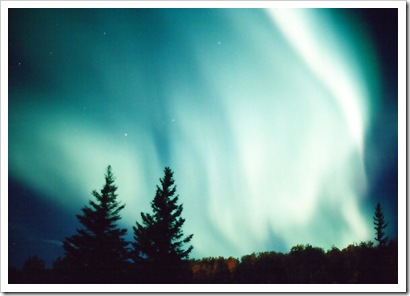
Northern Lights over Fairbanks, Alaska (Stormscape Photography / Michael Phelps)

In the Sleep of Reason
by John Haines (1924 – 2011), from The Owl in the Mask of the Dreamer: Collected Poems

And so I closed that book,
laid down the pen
and closed my eyes.

What had I thought to find,
reading by the light of cyphers,
abstract and piercing
in their constellations?

Nothing that night and the wind
could not have told me,
had I raised my head,
dimmed my lamp, and listened—

I, a thoughtful man, prone
to the dust of bindings,
coughing in the dry sequence
of verse and chapter
(for I had reasons).

And while I was sleeping,
came a small beak at my heart,
like a thorn, insistently
probing . . .

And I in terror awoke,
to know in that room
a tread ceaseless and pacing.

As if from within my being
came this upwelling,
of brute and shouldering forms:

heavy and beastlike, buoyant
and birdlike, but nothing
I could name, they moved
at ease, about and within me . . .

creatures of the starlight,
but also of the mind,
harbor to wolf and warlock.

So much do I remember now:
the pulse of obedient hearts,
hot tongues licking
the night; and I heard,

like a dry wind over leaves,
the scaly rustling of reptiles
coiling and resting . . .
All turned in the lamplight

eyes that never turned from mine
in their bright interrogation
(for I could see them,
and yet they were not there).

And I would speak, my hand
upheld to shield me,
when the shutter clapped
and my lamp blew out—

(was it a natural wind,
or a spirit-breath
lifting the leaves
of heavy trees in the night?)

And all subsided in the hush
that followed, in the calm
of great wings folding
and shadowy forms lying down.

I rose and left that room,
the house of my grief
and my bondage, my book
never again to be opened.

To see as once I saw,
steadied by the darkness
in which I walked
and would make my way.

See also: “John Haines, a Poet of the Wild, Dies at 86,” by Douglas Marin, New York Times, Mar. 5, 2011