Showing posts with label freedom. Show all posts

Saturday, April 23, 2011

Have Mercy

Petition
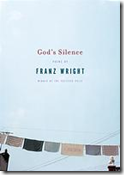
by Franz Wright, from God’s Silence

Kneeling
at the foot of the universe

I ask

from this body
in confusion

and pain (a condition

which You
may recall)

Clothed now in light
clothed in abyss, at the prow
of the desert
killed
into everywhereness —

have mercy

Mercy on us all

Thursday, April 21, 2011

Uncoupling Negative Emotional Reactions from Behavior

From the abstract of a recent study looking at the impact on meditation practice on the decision-making process:

“Human decision-making is often framed as a competition between cognitive and emotional processes in the brain. Deviations from rational processes are believed to derive from inclusion of emotional factors in decision-making.

Here, we investigate whether a group of experienced Buddhist meditators are better equipped to regulate emotional processes compared with controls during economic decision-making in the Ultimatum Game.

We show that meditators accept unfair offers on more than half of the trials, whereas controls only accept unfair offers on one-quarter of the trials…

In summary, when assessing unfairness, meditators activate a different network of brain areas compared with controls enabling them to uncouple negative emotional reactions from their behavior. These findings highlight the clinically and socially important possibility that sustained training in mindfulness meditation may impact distinct domains of human decision-making.”

*     *     *     *     *

See also:

Wednesday, April 20, 2011

Darkness Flooded in Light

The Avett Brothers

There was a dream
One day I could see it
Like a bird in a cage 
I broke in and demanded that somebody free it
And there was a kid, with a head full of doubt
So I scream till I die 
Or the last of those bad thoughts to find me now

There’s a darkness upon you that’s flooded in light
In the fine print they tell you what’s wrong and what's right
And it flies by day and it flies by night
And I’m frightened by those who don’t see it

[Thanks, Dara!]

Poetry Doesn’t Need Music; Lyrics Do

Green Finch and Linnet Bird
by Stephen Sondheim, from Sweeney Todd

Green finch and linnet bird,
Nightingale, blackbird,
How is it you sing?
How can you jubilate,
Sitting in cages,

Never taking wing?
Outside the sky waits,
Beckoning, beckoning,
Just beyond the bars,
How can you remain,
Staring at the rain,
Maddened by the stars?
How is it you sing
Anything?
How is it you sing?

Green finch and linnet bird,
Nightingale, blackbird,
How is it you sing?
Whence comes this melody
    constantly flowing?
Is it rejoicing or merely halloing?
Are you discussing
Or fussing
Or simply dreaming?
Are you crowing?
Are you screaming?

Ringdove and robinet,
Is it for wages,
Singing to be sold?
Have you decided it's
Safer in cages,
Singing when you're told?

My cage has many rooms,
Damask and dark.
Nothing there sings,
Not even my lark.
Larks never will, you know,
When they're captive.
Teach me to be more adaptive.

Green finch and linnet bird,
Nightingale, blackbird,
Teach me how to sing.
If I cannot fly,
Let me sing.

*     *     *     *     *

"Lyrics, even poetic ones, are not poems," states Stephen Sondheim in the introduction to Finishing the Hat, a collection of his lyrics from 1954 to 1981. "Poems are written to be read, silently or aloud, not sung. Some lyrics, awash with florid imagery, present themselves as poetry, but music only underscores (yes) the self-consciousness of the effort…Poetry is an art of concision, lyrics of expansion…Poetry doesn't need music; lyrics do."

"Green Finch and Linnet Bird," sung by the character of Johanna in Sweeney Todd, may not be a poem, but to read it without its haunting, angular melody is to "hear" it slightly differently.

~ From Knopf’s Borzoi Reader Poem-a-Day from today. Visit the site to hear actress Kate Levy reading Sondheim’s lyrics.

Friday, November 12, 2010

Sometimes It Takes Darkness

Árbol de Hierve el Agua. (San Isidro, Oaxaca, noviembre de 2010)

Sweet Darkness
by David Whyte

You must learn one thing.

The world was made to be free in.

Give up all the other worlds
except the one to which you belong.

Sometimes it takes darkness and the sweet
confinement of your aloneness
to learn

anything or anyone
that does not bring you alive

is too small for you.

Sunday, November 07, 2010

Swimming the Freedom

Are you jealous of the
ocean's generosity?

Why would you refuse to
give this joy to anyone?

Fish don't hold the
sacred liquid in cups!

They swim the huge
fluid freedom.

~ Rumi

Friday, October 29, 2010

Containing and Contained by Infinite Space

Excerpts from Antony Gormley (Contemporary Artists) by John Hutchinson, E.H. Gombrich, and Lela B. Njatin:

To Meister Eckhart, art was religion and religion art. Artistic form, in his view, was a revelation of essence, a kind of revelation that is both living and active. “Work,” he wrote, “comes from the outward and from the inner man, but the innermost man takes no part in it. In making a thing the very innermost self of a man comes into outwardness.”

Much of Antony Gormley’s art is based on his understanding of Western and Eastern spiritual traditions, and his work resonates when it is placed in this context. Like Eckhart — or, indeed like Joseph Beuys — Gormley believes that the artist is not a special kind of man, but that every man is a special kind of artist…He works with “types,” with universals, and yet he roots his work in subjective experience…But what concerns Gormley more than anything else, is the paradoxical manner in which man, while containing infinite space, is also contained by it…His sculpture deals with what he sees as the “deep space” of the interior body, yet he is also concerned with “touch as gravity” and “gravity as the attraction that binds us to the earth.” Its key strength, perhaps, lies in the artist’s determination to accept nothing until is has been lived and internalized. Gormley’s work is structured and methodical, preconceived to a certain point, and then realized in the process of making.

To Gormley, the body has a relation to the external space within which it exists as well as to the inner space it contains. And in a [1991] installation made for “Places with a Past,” an exhibition of site-specific art at Charleston, South Carolina, Gormley combined a series of works — Host, Field, Three Bodies, Learning to Think, Fruit and Cord — in order to explore that relationship. The Old City Jail, which contained and became part of the installation, could be described as having the shape of a body: the original rectangular structure is rather like a torso; its later octagonal addition, like a head. And in order to emphasize its parallels with his body cases, which are sometimes connected to the outside world through orifices, Gormley removed the boards and glazing that had sealed up the prison’s doors and windows. This allowed light and sound to enter the prison, to enliven what had hitherto been dark and dormant, and to engage time as an active element in the installation. In the artist’s words, “the building became a catalyst for reflection on liberty and incarceration.”

Old Jail, Charleston, exterior

One the second floor, Field, a set of terracotta figurines, faced a similar vast space that contained only Three Bodies—large metal spheres, made of steel and air, which the aritst has described as “like celestial bodies fallen from the sky.”

American Field, Antony Gormley (1991)

Above Field was Learning to Think, five headless lead body cases that were suspended from the ceiling, in a contradictory evocation of both lynching and ascension. The corresponding space held Host, a room containing mud and sea water — “The surface of the earth described in Genesis…the unformed, the place of possibility, a place waiting for the seed,” according to Gormley

Learning to Think, Antony Gormley (1991)

In the octagonal extension, two related organic forms, Fruit, were hung on either side of a wall. Only one was visible at a time in order “to reconcile opposites not in terms of differentiation but by mirroring,” Hidden from view, and at the center of each sculpture, was a space once occupied by the artist’s own body, linked to the other side, though mouth and genitals, by steel pipes. The final piece was Cord, made of many tubes inside one another — a kind of umbilical lifeline between the “seen” and “unseen.”
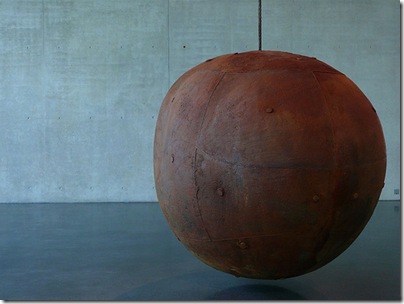
Body & Fruit, 1991/93

In this installation, one of great richness and complexity, Gormley brought into play the full panoply of his ambition. Working with lead and clay, as well as with the four elements, Gormley alluded to physical and spiritual containment, body and mind, outer and inner worlds, feeling and thinking, birth and death, growth and decay. And if the contradictions inherent in Learning to See (1991) Learning to See give strength to the artist’s conception of inner vision, the dualities evoked by the installation at Charleston are subservient to a sense of passage towards expansiveness. The emotional depth of the work can be ascribed to its refusal to exclude either the particular or the universal: it encompasses both historical specificity and a sense of shared human experience. In formal terms, this is achieved by the undermining of the Modernist notion of the self-referential object. While each of the elements of the installation can be separately contemplated, they are most meaningful when perceived as parts of a larger whole. In that sense, they are like parts of a body.

Thursday, August 26, 2010

Practicing What We Preach


Excerpts from Mayor Bloomberg’s remarks at the Annual Ramadan Iftar Dinner at Gracie Mansion, August 24, 2010:

“If we say that a mosque or a community center should not be built near the perimeter of the World Trade Center site, we would compromise our commitment to fighting terror with freedom. We would undercut the values and principles that so many heroes died protecting. We would feed the false impressions that some Americans have about Muslims. We would send a signal around the world that Muslim Americans may be equal in the eyes of the law, but separate in the eyes of their countrymen. And we would hand a valuable propaganda tool to terrorist recruiters, who spread the fallacy that America is at war with Islam."

“The members of our military are men and women at arms, battling for hearts and minds. And their greatest weapon in that fight is the strength of our American values which have already inspired people around the world. But if we don’t practice those values here at home, if we don’t practice what we preach abroad, if we don’t lead by example, we undermine our soldiers. We undermine our foreign policy objectives. And we undermine our national security.”

“While some of [Feisal Abdul Rauf]’s a lot of attention, I want to read to you something that he said that you may not have heard.

At an interfaith memorial service for the martyred journalist Daniel Pearl, Imam Rauf said, ‘If to be a Jew means to say with all one’s heart, mind, and sou, Shema Yisrael Adonai Eloheinu Adonai Echad - Hear, O Israel: the Lord is our God, the Lord is One, not only today I am a Jew, but I have always been one.’ He then continued to say, ‘If to be a Christian is to love the Lord our God with all my heart, mind, and soul, and to love for my fellow human beings what I love for myself, then I am not only a Christian, but I have always been one.’”

“In that spirit, let me declare that we in New York are Jews, and Christians, and Muslims, and we always have been. And above all of that, we are Americans. Each with an equal right to worship and pray where we choose. There is nowhere in the five boroughs of New York City that is off-limit to any religion. And by affirming that basic idea, we will honor America’s values and we will keep New York the most open, diverse, tolerant, and free city in the world.”

Friday, August 06, 2010

Both in the Body and in the Mind

From the introduction to Freeing the Body, Freeing the Mind: Writings on the Connections between Yoga & Buddhism edited by Michael Stone:

Over the years, I’ve found it increasingly frustrating that Yoga is continually reduced to a body practice and Buddhism to a mind practice. This makes no sense at all. Anyone who has practiced deeply in both traditions knows that the Buddha gave attention to the body and Patanjali to the mind, and that both traditions value ethical precepts and commitments as the foundation of an appropriate livelihood.

In the Buddha’s teachings the body serves as the primary object of meditation, so we can study the universe not through books or theory but through our subjective experience. Likewise, the Yoga postures, when practiced with breathing and sensitivity, become opportunities for deep meditative insight because they are designed to calm the nervous system. This grounds us. When we move within the various poses and tune in to the internal energetic patterns of our breath, we are working with the habits of mind as well. The postures we practice in modern Yoga studios have obvious therapeutic benefits at the physiological level, but some teachers and schools seem to have forgotten that the postures also teach us how to work with the mind. And for most of us, our troubles are not simply in the body but primarily in the mind. How can we use the body to study the mind, and work with the mind through the body? By experiencing how the two are completely interrelated.

Read more…

Wednesday, July 28, 2010

Condemned to Freedom

Excerpt from “The Limits of the Coded World,” by William Eggington, New York Times (July 25, 2010):

In Immanuel Kant’s view, the main mistake philosophers before him had made when considering how humans could have accurate knowledge of the world was to forget the necessary difference between our knowledge and the actual subject of that knowledge. At first glance, this may not seem like a very easy thing to forget; for example, what our eyes tell us about a rainbow and what that rainbow actually is are quite different things. Kant argued that our failure to grasp this difference was further reaching and had greater consequences than anyone could have thought.

rainbow Taking again the example of the rainbow, Kant would argue that while most people would grant the difference between the range of colors our eyes perceive and the refraction of light that causes this optical phenomenon, they would still maintain that more careful observation could indeed bring one to know the rainbow as it is in itself, apart from its sensible manifestation. This commonplace understanding, he argued, was at the root of our tendency to fall profoundly into error, not only about the nature of the world, but about what we were justified in believing about ourselves, God, and our duty to others.

The problem was that while our senses can only ever bring us verifiable knowledge about how the world appears in time and space, our reason always strives to know more than appearances can show it. This tendency of reason to always know more is and was a good thing. It is why human kind is always curious, always progressing to greater and greater knowledge and accomplishments. But if not tempered by a respect for its limits and an understanding of its innate tendencies to overreach, reason can lead us into error and fanaticism…

As much as we owe the nature of our current existence to the evolutionary forces Darwin first discovered, or to the cultures we grow up in, or to the chemical states affecting our brain processes at any given moment, none of this impacts on our freedom. I am free because neither science nor religion can ever tell me, with certainty, what my future will be and what I should do about it. The dictum from Sartre…gets it exactly right: I am condemned to freedom. I am not free because I can make choices, but because I must make them, all the time, even when I think I have no choice to make.

Read the entire Opinionator post…

Wednesday, March 24, 2010

The Language of Individual Freedom

Excerpt from “The Broken Society,” by David Brooks, New York Times (March 18, 2010):

Phillip Blond argues that over the past generation we have witnessed two revolutions, both of which liberated the individual and decimated local associations. First, there was a revolution from the left: a cultural revolution that displaced traditional manners and mores; a legal revolution that emphasized individual rights instead of responsibilities; a welfare revolution in which social workers displaced mutual aid societies and self-organized associations.

Then there was the market revolution from the right. In the age of deregulation, giant chains like Wal-Mart decimated local shop owners. Global financial markets took over small banks, so that the local knowledge of a town banker was replaced by a manic herd of traders thousands of miles away. Unions withered.

The two revolutions talked the language of individual freedom, but they perversely ended up creating greater centralization. They created an atomized, segmented society and then the state had to come in and attempt to repair the damage.

The free-market revolution didn’t create the pluralistic decentralized economy. It created a centralized financial monoculture, which requires a gigantic government to audit its activities. The effort to liberate individuals from repressive social constraints didn’t produce a flowering of freedom; it weakened families, increased out-of-wedlock births and turned neighbors into strangers. In Britain, you get a country with rising crime, and, as a result, four million security cameras.

More…

[Thanks Suzanne!]

Friday, March 12, 2010

A Little Flower

“Just living is not enough. One must have sunshine, freedom, and a little flower.”

~ Hans Christian Andersen

Crocus vernus

Snowdrops

Crocus vernus

Steven Cox Flowers

[Thanks Kirstin!]

Thursday, October 22, 2009

What Has the Fighting Been For?

“I am here today because of a conversation I had last June when I was voting. A woman at my polling place asked me, ‘Do you believe in equality for gay and lesbian people?’ I was pretty surprised to be asked a question like that. It made no sense to me. Finally I asked her, ‘What do you think our boys fought for at Omaha Beach?’ I have seen much, so much blood and guts, so much suffering, so much sacrifice. For what? For freedom and equality. These are the values that give America a great nation, one worth dying for.”

~ Philip Spooner, Republican and World War II veteran speaking to Maine's Judiciary Committee in April 2009.

Read more at: Philip Spooner VIDEO: WWII Veteran Makes Case For Gay Marriage

[Thanks David!]

Tuesday, September 22, 2009

No Thing Here

In the seen, there is only the seen,
in the heard, there is only the heard,
in the sensed, there is only the sensed,
in the cognized, there is only the cognized.
Thus you should see that
indeed there is no thing here;

…as you see that there is no thing there,
you will see that
you are therefore located neither in the world of this,
nor in the world of that,
nor in any place
betwixt the two.
This alone is the end of suffering.

~ Buddha, from the Udana

At breakfast on Saturday, the sun slowly crept up the window until it was shining almost directly into my eyes. It occurred to me that while it feels like the sun was moving, it was really the me, the table, the room, the building, and the earth that were all rotating imperceptibly.

Aristarchus's 3rd century BC calculations on the relative sizes of the Earth, Sun and Moon, from a 10th century AD Greek copy. It’s been nearly four hundred years since Galileo began defending heliocentrism, and yet it still does seem to us that we are at the center of the universe. The image of a sphere of water and dirt and plants and animals careening through space remains unsettling. We still go to the beach to watch the sun rise and set. It is challenging to imagine that people living in other time zones are currently sleeping while we are going about our business awake.

If the sun isn’t menacing me or entertaining me, and the ground beneath my feet isn’t stationary, where am I supposed to find a safe place to make my home? Our nervous systems crave certainty and solidity and, in their absence, have created a complex process for representing stability.

It is very useful to accept these illusions, but at some point Prague Orlojwe can’t help seeing through them. We navigate the uncertainty by trying to determine what the absence of true solidity means. Some interpret it as nihilism, others find that there being no thing simply means that every thing is in constant dynamic flux.

Mindfulness practice, seems to be one way that the need for things to be fixed gets eroded gradually. This allows us to live more comfortably inside the illusion as well as being able to experience the wonder of participating in the ongoing flow of the universe.

Monday, July 06, 2009

Something Held Me Back

I Was Always Leaving
by Jean Nordhaus

I was always leaving, I was
about to get up and go, I was
on my way, not sure where.
Somewhere else. Not here.
Nothing here was good enough.

It would be better there, where I
was going. Not sure how or why.
The dome I cowered under
would be raised, and I would be released
into my true life. I would meet there

the ones I was destined to meet.
They would make an opening for me
among the flutes and boulders,
and I would be taken up. That this
might be a form of death

did not occur to me. I only know
that something held me back,
a doubt, a debt, a face I could not
leave behind. When the door
fell open, I did not go through.

From American Life in Poetry: Column 224

Sunday, December 14, 2008

Free

by Virgil Suárez, from 90 Miles

90milesWhen we first arrived in the United States
from Franco's Spain, everything we encountered

or bought had "free" written on it.
The boxes of cereal spoke of a free mystery

surprise, the junk mail came bundled,
and somehow that word sang to us.

My father and I got wise—the word
became cheap, untrustworthy, hollow.

Having been fooled before, we knew what "free"
really meant. We learned lessons the hard way;

nothing free ever came so easily, but my mother—
who had heard stories of people throwing

out television sets, sofas, washing machines,
perfectly good chairs—believed in this land

of plenty where people discarded simply
because things were old or someone

had grown tired of them. She believed
in all that was cast to the curb. A cousin

who cruised the neighborhood streets
for these free goods told her of his finds

over the telephone. On the weekends,
she sent my father and me out to hunt,

to find these throwaways, but we always
came back empty-handed. We never

really looked. We stopped for donuts
or to watch a baseball game at the park.

Now, years later, my father dead, my mother
gets the mail, the catalogs, and she sends

it all up to me in Tallahassee, and she's circled
the word "free" and asks me what the deal is.

Most Sundays I try to convince her once
and for all that there are no deals, that nothing

is free, then there's silence over the line,
and I can hear her thinking otherwise.

She is a woman who wants to cling to something
as simple as a two-for-one deal, the extra, the much

more, lo gratis: these simple things she knows
have kept us going all these exiled years.

[Thanks Garrison Keillor!]

Saturday, April 14, 2007

Asking the Same Questions

From The War of Art by Steven Pressfield:

The artist and the fundamentalist both confront the same issue, the mystery of their existence as individuals. Each asks the same questions: Who am I? Why am I here? What is the meaning of life?

At more primitive stages of evolution, humanity didn’t have to deal with such questions. In the states of savagery, of barbarism, in nomadic culture, medieval society, in the tribe and the clan, one’s position was fixed by the commandments of the community. It was only with the advent of modernity (starting with the ancient Greeks), with the birth of freedom and of the individual, that such matters ascended to the fore.

These are not easy questions. Who am I? Why am I here? They’re not easy because the human being isn’t wired to function as an individual. We’re wired tribally, to act as part of a group. Our psyches are programmed by millions of years of hunter-gatherer evolution. We know what the clan is; we know how to fit into the band and the tribe. What we don’t know is how to be alone. We don’t know how to be free individuals.

...The paradox seems to be, as Socrates demonstrated long ago, that the truly free individual is free only to the extent of his own self-mastery. While those who will not govern themselves are condemned to find masters to govern them.

[Listen]