Showing posts with label Christianity. Show all posts

Saturday, April 23, 2011

Have Mercy

Petition
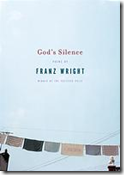
by Franz Wright, from God’s Silence

Kneeling
at the foot of the universe

I ask

from this body
in confusion

and pain (a condition

which You
may recall)

Clothed now in light
clothed in abyss, at the prow
of the desert
killed
into everywhereness —

have mercy

Mercy on us all

Wednesday, October 20, 2010

How are We Going to Be Able to Live Together?

Excerpts from “Restoring Political Civility,” a conversation between Krista Tippet and Richard Mouw (president of Fuller Theological Seminary and a professor of Christian Philosophy and Ethics and author or Uncommon Decency), Being, October 14, 2010:

Richard Mouw: …to be civil comes from civitas and it means learning how to live in the city. The origin with a guy like Aristotle, the ancient philosopher, who said early on, as little children, we have a natural sense of kinship. We have strong positive feelings toward those who are blood relatives, my mother, my father, sisters and brothers, cousins and the like. And then as we grow up, we have some of those same positive feelings that develop toward friends. So we go from kinship and we build on that to a broader sense of friendship where you have that same sense of bonding or something like it that isn't just based on blood relative stuff.

But he said to really grow up, to be a mature human being, is to learn in the public square to have that same sense of bonding to people from other cities, people who are very different than yourself. And that's not just toleration, but is a sense that what I owe to my mother because she brought me into this world, what I owe to my friends because of shared experiences and memories and delights, I also owe to the stranger. Why? Because they're human like me and I got to begin to think of humanness as such as a kind of bonding relationship

…

Krista Tippett: So here's another statement from you about just an essential Christian truth, which is, "In affirming the stranger, we are honoring the image of God."

Richard Mouw: Oh, yeah. That's right. Going back to that Aristotle idea that, you know, we all understand kinship and then we understand friendship, but then there's this person who is neither kin nor friend, but we have encountered them. And what is it that links me to them if it isn't just a lot of good feelings that I have about people like that? What the Bible teaches is that every human being is created in a divine image. And this means that every human being is — you know, this is where I've been thinking more about this lately — is a work of art.

Seeing other people is a kind of exercise in art appreciation. I find that very powerful. I come across a person who isn't just a stranger, but maybe represents a strangeness to me that initially I might feel very alienated from that person, and then to think this is a work of art by the God whom I worship, that God created that person. And it doesn't come easy. I'm kind of aesthetically deprived, so I have to work at it, but it's a very important exercise to engage in.

Krista Tippett: You have been very clear and open across the years, for example, about your theological opposition to gay marriage. I could imagine that someone who is homosexual might hear what you just said and feel that in fact that doesn't find expression when you look at them.

Richard Mouw: Well, and — and it should. I have really tried to emphasize the fact that even in expressing our disagreements — and this is a very complicated thing — but that we're dealing with people who are precious works of divine art. You know, I have argued on a number of occasions and actually gotten some very positive response from folks in the gay-lesbian community that maybe — I even wrote a Newsweek piece on this.

You know, maybe it's time to stop yelling at each other and accusing each other in public and maybe we ought to just sit down and turn the agenda into something like this where I would ask my gay and lesbian activist friends, "what is it about people like me that scare you so much? And that you in turn would listen to me when I say, what is it about what you are advocating that worries me so much about the future of our culture and the world in which my grandchildren are being raised? And that we talk about hopes and fears rather than angrily denouncing each other as homophobes or as people who are engaged in, you know, despicable behavior, but could that shape a very different kind of discussion." As we move toward — the really important question is how are we going to be able to live together in this pluralistic society with at least some better understanding of what motivates us beneath the angry denunciations and things?

Wednesday, August 18, 2010

To Understand the Meek

A poem and an excerpt from an essay by Marry Karr from Sinners Welcome:

Who the Meek are Not

          Not the bristle-bearded Igors bent
under burlap sacks, not peasants knee-deep
          in the rice paddy muck,
not the serfs whose quarter-moon sickles
          make the wheat fall in waves
they don’t get to eat. My friend the Franciscan
          nun says we misread
the word meek in the Bible verse that blesses them.
          To understand the meek
(she says) picture a great stallion at full gallop
          in a meadow, who—
at his master’s voice—seizes up to a stunned
          but instant halt.
So with the strain of holding that great power
          in check, the muscles
along the arched neck eddying,
          and only the velvet ears
prick forward, awaiting the next order.

Facing Altars: Poetry and Prayer
(excerpt)

To confess my unlikely Catholicism in Poetry—the journal that first published some of the godless twentieth-century disillusionaries of J. Alfred Prufrock and his pals—feels like an act of perversion kinkier than any dildo-wielding dominatrix could manage on HBO’s Real Sex Extra. I can’t even blame it on my being a cradle Catholic, some brainwashed escapee of the pleated skirt and communion veil who—after a misspent youth and facing an Eleanor Rigby-like dotage—plodded back into the confession booth some rainy Saturday.

Not victim but volunteer, I converted in 1996 after a lifetime of undiluted agnosticism. Hearing about my baptism, a friend sent me a postcard that read, “Not you on the Pope’s team. Say it ain’t so!” Well, while probably not the late Pope’s favorite Catholic (nor he my favorite Pope), I took the blessing and ate the broken bread. And just as I continue to live in America and vote despite my revulsion for many U.S. policies, I continue to take the sacraments despite my fervent aversion to certain doctrines. Call me a cafeteria Catholic if you like, but to that I’d say, Who isn’t?

Tuesday, August 17, 2010

Capable of Making Distinctions

Excerpt from “The Muslims in the Middle,” editorial by William Dalrymple, New York Times, Aug. 16, 2010:

Most of us are perfectly capable of making distinctions within the Christian world. The fact that someone is a Boston Roman Catholic doesn’t mean he’s in league with Irish Republican Army bomb makers, just as not all Orthodox Christians have ties to Serbian war criminals or Southern Baptists to the murderers of abortion doctors.

Yet many of our leaders have a tendency to see the Islamic world as a single, terrifying monolith. Had the George W. Bush administration been more aware of the irreconcilable differences between the Salafist jihadists of Al Qaeda and the secular Baathists of Saddam Hussein’s Iraq, the United States might never have blundered into a disastrous war, and instead kept its focus on rebuilding post-Taliban Afghanistan while the hearts and minds of the Afghans were still open to persuasion.

Feisal Abdul Rauf of the Cordoba Initiative is one of America’s leading thinkers of Sufism, the mystical form of Islam, which in terms of goals and outlook couldn’t be farther from the violent Wahhabism of the jihadists. His videos and sermons preach love, the remembrance of God (or “zikr”) and reconciliation. His slightly New Agey rhetoric makes him sound, for better or worse, like a Muslim Deepak Chopra. But in the eyes of Osama bin Laden and the Taliban, he is an infidel-loving, grave-worshiping apostate; they no doubt regard him as a legitimate target for assassination.

For such moderate, pluralistic Sufi imams are the front line against the most violent forms of Islam. In the most radical parts of the Muslim world, Sufi leaders risk their lives for their tolerant beliefs, every bit as bravely as American troops on the ground in Baghdad and Kabul do. Sufism is the most pluralistic incarnation of Islam — accessible to the learned and the ignorant, the faithful and nonbelievers — and is thus a uniquely valuable bridge between East and West.

The great Sufi saints like the 13th-century Persian poet Rumi held that all existence and all religions were one, all manifestations of the same divine reality. What was important was not the empty ritual of the mosque, church, synagogue or temple, but the striving to understand that divinity can best be reached through the gateway of the human heart: that we all can find paradise within us, if we know where to look.

Read the entire editorial…


May 20, 2010. Press Conference outside site of planned Cordoba House with Manhattan Borough President Scott Stringer and city government officials in support of the Cordoba House.

Saturday, October 24, 2009

Arithmetic

Rodney Smith of the Seattle Insight Meditation Society in conversation with Vince Horn of Buddhist Geeks (Episode 143: Stepping Out of Self-Deception):

Anything that we think about the world is really coming from the mind.  It is not coming from reality itself.  All of the likes and dislikes that we have of the world are really mental projections onto the world.  They are not coming from the world. And so when you begin to see that, then you begin to decipher how the mind is distorting reality on a constant momentary level...
I think the fraction line is very relevant to what we are talking about, because that fraction line is -- in a spiritual analogy -- the resistance factor.  The upper part of the fraction, or the numerator, which is all things that appear and we latch onto, hold onto, and grasp in life -- all appearances...Meanwhile, there is a common denominator to all of life that is waiting for us...that we have to cross that fraction line in order to experience and in order to embody.  Now crossing that fraction line is the entire spiritual journey.  It is the movement from the numerator toward the denominator that all spiritual paths point.

Much of Buddhism is about seeing the limited quality of anything that has an appearance, anything that has form.  In Christianity, too, Christ says, “Lay not up your treasures where rust does corrupt or thieves let in,” which means the same thing -- don’t focus and invest in the appearances of life.

And when we don’t do that, when we release the need to grasp and hold onto appearances that change, then we start crossing that fraction line and feeling -- and embodying really, because it has never left us -- the common denominator, which is that wholeness, that presence, that all encompassing awareness that is waiting for us...

And we take it as a numerator problem.  We think, “Oh, I just haven’t tried hard enough as a fraction, and that if I really tried hard has a fraction I could get to a whole number.”  And that's not the point.  The point is not to continue to assert the muscles of our numerator, because the numerator will never get us to the denominator.  It's seeing the limitations of the numerator, releasing the need to be, or abide, or grasp at the numerator that eventually evolves us into the common denominator.

Monday, September 28, 2009

Nothing Left Out

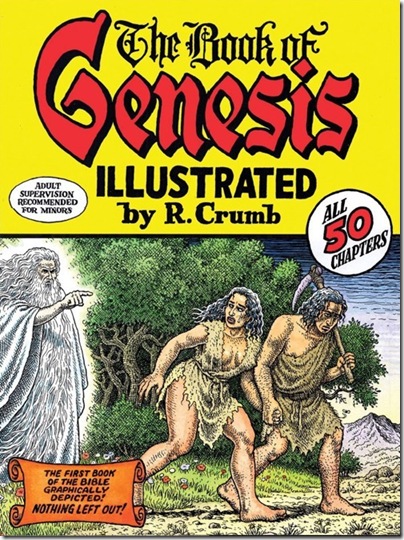
My copy of The Book of Genesis Illustrated by R. Crumb just arrived!

The Book of Genesis

From the introduction:

I, R. CRUMB, THE ILLUSTRATOR OF THIS BOOK, HAVE, TO THE BEST OF MY ABILITY, FAITHFULLY REPRODUCED EVERY WORD OF THE ORIGINAL TEXT, WHICH I DERIVED FROM SEVERAL SOURCES, INCLUDING THE KING JAMES VERSION, BUT MOSTLY FROM ROBERT ALTER’S RECENT TRANSLATION, THE FIVE BOOKS OF MOSES (2004). IN A FEW PLACES I VENTURED TO DO A LITTLE INTERPRETATION OF MY OWN, IF I THOUGHT THE WORDS COULD BE MADE CLEARER, BUT I REFRAINED FROM INDULGING TOO OFTEN IN SUCH “CREATIVITY,” AND SOMETIMES LET IT STAND IN ITS CONVOLUTED VAGUENESS RATHER THAN MONKEY AROUND WITH SUCH A VENERABLE TEXT.

EVERY OTHER COMIC BOOK VERSION OF THE BIBLE THAT I’VE SEEN CONTAINS PASSAGES OF COMPLETELY MADE-UP NARRATIVE AND DIALOGUE, IN AN ATTEMPT TO STREAMLINE AND “MODERNIZE” THE OLD SCRIPTURES, AND STILL, THESE VARIOUS COMIC BOOK BIBLES ALL CLAIM TO ADHERE TO THE BELIEF THAT THE BIBLE IS “THE WORD OF GOD,” OR INSPIRED BY “THE WORD OF GOD,” WHEREAS, I, IRONICALLY, DO NOT BELIEVE THE BIBLE IS “THE WORD OF GOD.” I BELIEVE IT IS THE WORDS OF MEN.

IT IS, NONETHELESS, A POWERFUL TEXT WITH LAYERS OF MEANING THAT REACH DEEP INTO OUR COLLECTIVE CONSCIOUSNESS, OUR HISTORICAL CONSCIOUSNESS, IF YOU WILL. IT SEEMS INDEED TO BE AN INSPIRED WORK, BUT I BELIEVE THAT ITS POWER DERIVES FROM ITS HAVING BEEN A COLLECTIVE ENDEAVOR THAT EVOLVED, AND CONDENSED OVER MANY GENERATIONS BEFORE REACHING ITS FINAL, FIXED FORM AS WE KNOW IT DURING THE “BABYLONIAN EXILE,” CIRCA 600 B.C.E.

…IF MY VISUAL, LITERAL INTERPRETATION OF THE BOOK OF GENESIS OFFENDS OR OUTRAGES SOME READERS, WHICH SEEMS INEVITABLE CONSIDERING THAT THE TEXT IS REVERED BY MANY PEOPLE, ALL I CAN SAY IN MY DEFENSE IS THAT I APPROACHED THIS AS A STRAIGHT ILLUSTRATION JOB, WITH NO INTENTION TO RIDICULE OR MAKE VISUAL JOKES. THAT SAID, I KNOW THAT YOU CAN’T PLEASE EVERYBODY."

* * *

“R. Crumb's Awesome, Affecting Take On Genesis,” by Susan Jane Gilman, NPR (October 16, 2009)

Tuesday, August 11, 2009

I Don’t Ever Want to Have to Say “I Don’t Know” Ever Again

“There's this being called the thing that made the things for which there is no known maker and that causes and directs the events we can't otherwise explain and that doesn't need to have been made and is the one thing from which to ask for things that no human can give and without whom we can't be fully happy and is unlimited by all the laws of physics and never began and will never finish and is invisible but actually everywhere at once and who is so perfect that even if he killed millions of people, including babies, he'd still would be perfect and who is so powerful and magical that he can even make a virgin pregnant if he wanted to."

NonStampCollector

Wednesday, April 15, 2009

The Heart and Soul of Every Religion

Manifesting God “To reject the contemplative dimension of any religion is to reject the religion itself, however loyal one may be to its externals and rituals. This is because the contemplative dimension is the heart and soul of every religion. It initiates the movement into higher states of consciousness.”

~ Father Thomas Keating, from Manifesting God

Saturday, April 11, 2009

Whenever Knowledge Becomes Rigid it Stops Living

Anslem Kiefer in conversation with Michael Auping from Anselm Kiefer: Heaven and Earth:

Religion was a part of my childhood and my youth. It was a very important thing. The rituals and rites were important. I can still do them in Latin. Of course, I knew the Latin before I knew what it meant. But I was involved, like many young people of my generation, in learning religion at an early age.

Later, I discovered that Christian mythology was less complex and less sophisticated than Jewish mythology because the Christians limited their story to make it simple so that they could engage more people and defend their ideas. They had to fight with the Jewish traditions, with the Gnostics. It was a war of the use of knowledge. Resurrexit (1973) The wooden, hand-hewn interior, which appears in many of Keifer's works from this period, is drawn from the converted schoolhouse in the Oden Forest that served as his studio at the time. The stairs, in other words, lead to the door of the artist's atelier. By inscribing resurrexit on the stairs to his studio, Kiefer raises the question of the redemptive role of art. ~ From Disfiguring by Mark C. Taylor

However, it wasn’t just a defense against outside ideas. It was aggressive. Like politics, they wanted to win. You know, the first church in Rome was not defensive and not aggressive. It was quiet. It was spiritual in the sense of seeking a true discussion about God. It was exploring a new idea about humanity. But then there was “iglesias triumphant,” the Triumph of the Church. And then the stones were stacked up and the buildings came, and the construction of the Scholastics, Augustine, and so on. They were very successful in limiting the meaning of the mythology. There were discussions about the Trinity and its meaning. Anyone who had ideas that complicated their specific picture was eliminated. This made Christianity very rigid and not very interesting. Whenever knowledge becomes rigid it stops living.

Volkszählung (Census) 1991 Shelves of lead books filled with peas--representing the counting of a population--represents an enormousy heavy (grave) archive or cemetery (grave) of dead data.

…Since childhood, I had studied the Old Testament, and sometime as a young man I began to read of Jewish mysticism. Then in the mid-1980s, I went to Jerusalem and began to read the books of Gershon Scholem. Beside the fact that kabbalistic stories and interpretations are very interesting, I think my attraction has something to do with the way that I work.

People say that I read a lot, but in some ways I don’t. I read enough to capture images. I read until the story becomes an image. Then I stop reading. I can’t recite a passage, but I can recite it as an image. For an artist it is important to have a strong, complex subject. Kabbala means “knowledge that has been received,” a secret knowledge; but I think of it as images that have been received.

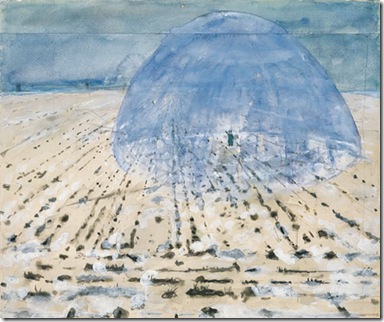
Everyone Stands Under His Own Dome of Heaven -- Both the title of this work and the image of the dome with a lone figure inside refer to Kiefer's view that there is no single system or belief, such as Marxism or Christianity, that is appropriate for all people. "Each man has his own dome, his own perceptions, his own theories," Kiefer has noted.

As I said before, the Christian church hardened in its knowledge and its symbolism at a certain point. The kabbalistic tradition is not one buy many, forming a sophisticated spiritual discipline. It is a paradox of logic and mystical belief. It’s part scholarship, part religion, part magic. For me, it is a spiritual journey anchored by images.

Thursday, April 09, 2009

Mandatum Novum

Today is Maundy Thursday, the Christian holy day commemorating The Last Supper of Jesus with his disciples.

The word Maundy is derived through Middle English, and Old French mandé, from the Latin mandatum. It refers to the "new mandate" given by Jesus to his apostles. The Gospel of John tells the story of Jesus illustrating the significance of this mandate by washing the feet of his disciples before sharing his last meal with them on the night before he was crucified.

Christ Washing the Feet of his Disciples, Rembrandt, c. 1655 Mandatum novum do vobis ut diligatis invicem sicut dilexi vos.

“A new commandment I give unto you, That you love one another as I have loved you.”

John 13:34

Thomas Merton wrote: True emptiness is that which transcends all things and yet is imminent in all. For what seems to be emptiness in this case is pure being. But it's not this or that. Whatever you say of it, it is other than what you say. The character of emptiness, at least for a Christian contemplative, is pure love, pure freedom. Love that is free of everything, not determined by any thing or held down by any special relationship. It's love for love's sake. It's a sharing through the Holy Spirit in the infinite charity of God. And so when Jesus told his disciples to love, he told them to love as universally as the Father who sends rain alike on the just and the unjust. This purity, freedom, and indeterminateness of love is the very essence of Christianity.

Sunday, March 23, 2008

Resurrection is the Heart of Buddhism

From Parallels Between Buddhism and Christianity, a talk given by Shinzen Young:

My teacher Sasaki Roshi used to quite regularly hold Zen retreats at a Trappist Monastery where Father Thomas Keating used to be the abbot. He would go in and put on the Trappist robes and he'd make up Christian kōans for the monks.

The first kōan he gave them was What is your experience of God when you make the sign of the cross?

He would also describe Buddhism in terms of Christianity. He would ask them questions like What was Jesus's experience of God when he was on the cross?

He would say, "Resurrection is the heart of Buddhism. Unless you understand about resurrection, you cannot understand what Buddhism is about. Dying is the easy part. The resurrection is the hard part. Any religion that doesn't teach resurrection is a false religion." He was talking about his own experience which is why he would say it with such conviction.

Do you understand what he meant when he said resurrection is the heart of Buddhism? Well, it goes back to the experience of no self and full self. Allowing the self to dissolve is half of the enlightenment experience. Allowing the self to reform without interference, that's resurrection, isn't it?

Thomas Merton wrote, "All the paradoxes about the contemplative way are reduced to this one: being without desire means being lead by a desire so great that it is incomprehensible. It's too huge to be completely felt. It's a blind desire, which seems like a desire for nothing. Only because nothing can content it. And because it is able to rest in no thing, then it rests, relatively speaking, in emptiness. But not in emptiness as such, emptiness for it's own sake, actually there's no such entity as pure emptiness. And the merely negative emptiness of the false contemplative is a thing, not a nothing."

[It's very true. In other words, the negative emptiness, empty in the sense of your bank account is empty, that's not the emptiness that the meditator is talking about. That's actually a thing.]

"True emptiness is that which transcends all things and yet is imminent in all. For what seems to be emptiness in this case is pure being. But it's not this or that. Whatever you say of it, it is other than what you say. The character of emptiness, at least for a Christian contemplative, is pure love, pure freedom. Love that is free of everything, not determined by any thing or held down by any special relationship. It's love for love's sake. It's a sharing through the Holy Spirit in the infinite charity of God. And so when Jesus told his disciples to love, he told them to love as universally as the Father who sends rain alike on the just and the unjust. This purity, freedom, and indeterminateness of love is the very essence of Christianity."