Showing posts with label marriage. Show all posts

Wednesday, October 20, 2010

How are We Going to Be Able to Live Together?

Excerpts from “Restoring Political Civility,” a conversation between Krista Tippet and Richard Mouw (president of Fuller Theological Seminary and a professor of Christian Philosophy and Ethics and author or Uncommon Decency), Being, October 14, 2010:

Richard Mouw: …to be civil comes from civitas and it means learning how to live in the city. The origin with a guy like Aristotle, the ancient philosopher, who said early on, as little children, we have a natural sense of kinship. We have strong positive feelings toward those who are blood relatives, my mother, my father, sisters and brothers, cousins and the like. And then as we grow up, we have some of those same positive feelings that develop toward friends. So we go from kinship and we build on that to a broader sense of friendship where you have that same sense of bonding or something like it that isn't just based on blood relative stuff.

But he said to really grow up, to be a mature human being, is to learn in the public square to have that same sense of bonding to people from other cities, people who are very different than yourself. And that's not just toleration, but is a sense that what I owe to my mother because she brought me into this world, what I owe to my friends because of shared experiences and memories and delights, I also owe to the stranger. Why? Because they're human like me and I got to begin to think of humanness as such as a kind of bonding relationship

Krista Tippett: So here's another statement from you about just an essential Christian truth, which is, "In affirming the stranger, we are honoring the image of God."

Richard Mouw: Oh, yeah. That's right. Going back to that Aristotle idea that, you know, we all understand kinship and then we understand friendship, but then there's this person who is neither kin nor friend, but we have encountered them. And what is it that links me to them if it isn't just a lot of good feelings that I have about people like that? What the Bible teaches is that every human being is created in a divine image. And this means that every human being is — you know, this is where I've been thinking more about this lately — is a work of art.

Seeing other people is a kind of exercise in art appreciation. I find that very powerful. I come across a person who isn't just a stranger, but maybe represents a strangeness to me that initially I might feel very alienated from that person, and then to think this is a work of art by the God whom I worship, that God created that person. And it doesn't come easy. I'm kind of aesthetically deprived, so I have to work at it, but it's a very important exercise to engage in.

Krista Tippett: You have been very clear and open across the years, for example, about your theological opposition to gay marriage. I could imagine that someone who is homosexual might hear what you just said and feel that in fact that doesn't find expression when you look at them.

Richard Mouw: Well, and — and it should. I have really tried to emphasize the fact that even in expressing our disagreements — and this is a very complicated thing — but that we're dealing with people who are precious works of divine art. You know, I have argued on a number of occasions and actually gotten some very positive response from folks in the gay-lesbian community that maybe — I even wrote a Newsweek piece on this.

You know, maybe it's time to stop yelling at each other and accusing each other in public and maybe we ought to just sit down and turn the agenda into something like this where I would ask my gay and lesbian activist friends, "what is it about people like me that scare you so much? And that you in turn would listen to me when I say, what is it about what you are advocating that worries me so much about the future of our culture and the world in which my grandchildren are being raised? And that we talk about hopes and fears rather than angrily denouncing each other as homophobes or as people who are engaged in, you know, despicable behavior, but could that shape a very different kind of discussion." As we move toward — the really important question is how are we going to be able to live together in this pluralistic society with at least some better understanding of what motivates us beneath the angry denunciations and things?

Monday, September 13, 2010

The Head is an Overstated Organ

Robert Patterson, who has Alzheimer's disease, speaks with his wife, Karen, from StoryCorps:

Robert and Karen Patterson Robert: I feel like I’m the same person, but I know I’m kind of a big load to deal with.

Karen: You know how we talk sometimes about who we really are. What is our essence? Memories are not who you are.

Robert: Well, I think one thing I experience with Alzheimer's is I live in the moment ‘cause I can’t remember what happened yesterday—I can’t remember what happened ten minutes ago, but I’m much more present, I think.

Karen: Do you think about the future?

Robert: I know that there’s probably a bad time that comes in the future. This disease gets more wicked, but I don’t obsess on it. I do a nice job of ignoring it.

Karen: With this disease, you moved from somebody that lived in their head a lot to somebody who lived in their heart.

Robert: The head is an overstated organ; the heart is where all the action is. I remember things that occur in my heart much better than things in my head: having fun with the kids, laughing, our new grandchild.”

Karen: Speaking of this new grandchild, is there something you’d like him to know?

Robert: I would like him to know that I fell in love with him the first time I saw him in the hospital. And every time I see that sweet little face, it just makes me feel good. I’m looking forward to hanging with him and teaching him things that I think are really important. That’s my job for the rest of my life.

Karen: I don’t know if you even remember this, but once we were listening to a book on tape. It talked about the greatest thing you could do if you loved somebody, that you would be the one that was left. And that you would be the one that could care for your lover.

You are not alone. And I’m honored that I’m the one that can care for you. I always will.

Robert: You always have. Thank you.

Saturday, August 28, 2010

From Joy to Joy to Joy

for Aaron & Michelle

michelle-aaron

From Blossoms
by Li-Young Lee, from Rose 

From blossoms comes
this brown paper bag of peaches
we bought from the boy
at the bend in the road where we turned toward  
signs painted PEACHES.

From laden boughs, from hands,
from sweet fellowship in the bins,
comes nectar at the roadside, succulent
peaches we devour, dusty skin and all,
comes the familiar dust of summer, dust we eat.

O, to take what we love inside,
to carry within us an orchard, to eat
not only the skin, but the shade,
not only the sugar, but the days, to hold
the fruit in our hands, adore it, then bite into  
the round jubilance of peach.

There are days we live
as if death were nowhere
in the background; from joy
to joy to joy, from wing to wing,
from blossom to blossom to
impossible blossom, to sweet impossible blossom.

Wednesday, March 17, 2010

With Liberty and Justice for Many

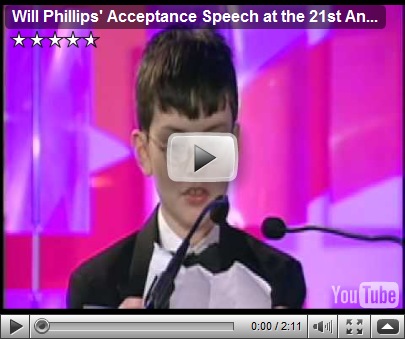
“I accept this award on behalf of those who have been struck down, beaten up, and — instead of attention and praise — have gotten only intolerance, violence, or — even worse — indifference.”

~ Will Phillips, accepting the award for Outstanding TV Journalism Segment at the 21st Annual GLAAD Media Awards in New York on March 13, 2010.


Phillips appeared in the award winning segment "Why Will Won't Pledge Allegiance" from CNN's American Morning on November 16, 2009.

Saturday, February 27, 2010

Why Should It Be Easy?

TOLSTOY
I’ve become convinced that all the world’s religions have a
single organizing principle. Can you guess what it is? Love! Love! Simple...


TOLSTOY
I didn’t come for more recrimination. Despite good cause for alienation between us, I have never stopped loving you.

SOFYA
Of course...

TOLSTOY
God knows you don’t make it easy.

SOFYA
Why should it be easy? I’m the work of your life. You’re the work of mine. It’s what love is.

From The Last Station, based on the novel by Jan Parini, screenplay by Michael Hoffman.

Tuesday, February 16, 2010

Thursday, October 22, 2009

What Has the Fighting Been For?

“I am here today because of a conversation I had last June when I was voting. A woman at my polling place asked me, ‘Do you believe in equality for gay and lesbian people?’ I was pretty surprised to be asked a question like that. It made no sense to me. Finally I asked her, ‘What do you think our boys fought for at Omaha Beach?’ I have seen much, so much blood and guts, so much suffering, so much sacrifice. For what? For freedom and equality. These are the values that give America a great nation, one worth dying for.”

~ Philip Spooner, Republican and World War II veteran speaking to Maine's Judiciary Committee in April 2009.

Read more at: Philip Spooner VIDEO: WWII Veteran Makes Case For Gay Marriage

[Thanks David!]

Saturday, August 15, 2009

Taking Responsibility for Our Own Happiness

From “Those Aren’t Fighting Words, Dear,” by Laura A. Munson, The New York Times, July 31, 2009:

“I don’t love you anymore. I’m not sure I ever did.”

His words came at me like a speeding fist, like a sucker punch, yet somehow in that moment I was able to duck. And once I recovered and composed myself, I managed to say, “I don’t buy it.” Because I didn’t.

He drew back in surprise. Apparently he’d expected me to burst into tears, to rage at him, to threaten him with a custody battle. Or beg him to change his mind.

So he turned mean. “I don’t like what you’ve become.”

Gut-wrenching pause. How could he say such a thing? That’s when I really wanted to fight. To rage. To cry. But I didn’t.

Instead, a shroud of calm enveloped me, and I repeated those words: “I don’t buy it.”

You see, I’d recently committed to a non-negotiable understanding with myself. I’d committed to “The End of Suffering.” I’d finally managed to exile the voices in my head that told me my personal happiness was only as good as my outward success, rooted in things that were often outside my control. I’d seen the insanity of that equation and decided to take responsibility for my own happiness. And I mean all of it.

More…

Friday, June 12, 2009

Asking for Permission