Even though he can’t see, Pete Eckhert demonstrates that he is a visual person through photography. He was the Grand Prize recipient of Artists Wanted: Exposure 2008, an international photography competition, and was awarded $2,008 with a formal reception at Leo Kesting Gallery in New York City on Thursday August 7, 2008.
Eric Molinsky does not like to get caught. One recent afternoon on a Manhattan-bound R train, Mr. Molinsky, a freelance radio producer and inveterate people-watcher, slid into position. He scanned the not-yet-packed car. At one end, two aging New York dames laughed. Mr. Molinsky, 39, set his sights on the blonde.
He is not a stalker. He is an artist who secretly draws fellow subway riders on his iPhone, and has collected scores of New York characters on his blog. “Usually if my cover is blown,” Mr. Molinsky explained, “it’s kind of a slippery slope to the drawing just not really happening in the end.” Using his index finger and the application Sketchbook, he quickly drew a crude black-and-white outline of the woman’s face and then began to add layers of color. A base of skin tone, yellow for her dyed hair, green spectacles.
The woman looked up. “It doesn’t really affect my drawing if they know I’m drawing them,” Mr. Molinsky said. “But it does make me a little bit more self-conscious about it and makes me wonder if they’re going to come over and take a look and maybe say, ‘Hey I don’t look anything like that.’ ”
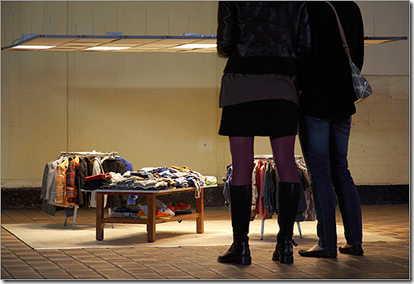
workworkworkworkwork consists of hundreds of objects, including shirts, pottery, paintings, necklaces and magazines that recreate displays of objects for sale that homeless people frequently put on New York sidewalks. (Bing, 2003) The piece is not classified by object, however it is more of a confusion of pieces, each “grouping is ordered in its own special way, as if different senses of order were involved, individual orders—different levels of marketing and presentability.” (Saltz, 1992)
Charles LeDray treats clothes as surrogates for human identity, particularly male identity, and for the many types of work that go into constructing it. As such—and unlike the fashion industry, which is founded on an unblinking faith in the potential of clothes to communicate power, beauty, and self-worth—his work is intensely alive to the pathos clothes can communicate, and to the many senses in which they just don’t . . . quite. . . fit.
LeDray, who was born in Seattle in 1960 and lives and works in New York, gives this “not quite fitting’’ a literal twist. The majority of the clothes he makes and transforms into sculptures are small. Too small to wear, but not so small that they seem precious or cute.
And yes, LeDray makes them. All of them. By hand. Himself.
Today, when the actual making of art objects is frequently displaced from the hands of the nominal creator to various anonymous assistants, there’s an atavistic appeal in LeDray’s displays of virtuosic skill and dedication. But it’s not just a sentimental appeal.
The time LeDray dedicates to the making of his pieces — in some cases as long as three or four years — is as much a conceptual tool as the medium itself. Painstakingly cut, carved, stitched, sewn, and thrown, his sculptures crystallize, through ironic devotion, a sense of pathos. They sharpen our awareness of the expendability of things…
Thinking of the artist working away, with scissors, pins, needle, and thread, I thought of W.S. Merwin’s great poem, “Separation’’:
Your absence has gone through me Like thread through a needle. Everything I do is stitched with its color.
“I take comfort in histories and knowing that something came before me and something will come after me and that I’m just part of it. Sometimes students will say, ‘Well, it’s all been done.’ But I think, who cares? What does that have to do with anything? I wouldn’t be painting if I cared about that. Okay it’s all been done, so what? You have to figure out how to do it for you.”
René Magritte wrote, "To equate my painting with symbolism, conscious or unconscious, is to ignore its true nature. People are quite willing to use objects without looking for any symbolic intention in them, but when they look at paintings, they can't find any use for them. So they hunt around for a meaning to get themselves out of the quandary, and because they don't understand what they are supposed to think when they confront the painting. They want something to lean on, so they can be comfortable. They want something secure to hang on to, so they can save themselves from the void. People who look for symbolic meanings fail to grasp the inherent poetry and mystery of the image. No doubt they sense this mystery, but they wish to get rid of it. They are afraid. By asking ‘what does this mean?’ they express a wish that everything be understandable. But if one does not reject the mystery, one has quite a different response. One asks other things."
"To the extent that my pictures have any value," [Magritte] once said, lobbing a grenade at the experts and explainers, "they do not lend themselves to analysis." He quoted Victor Hugo, "We never see but one side of things." And to this he added, "it's precisely this 'other side' that I'm trying to express."
ART AT STAKE I'll See Your Lorrain and Raise You a Turner (Studio 360)
“The directors of the New Orleans and the Indianapolis art museums have a lot more riding on this weekend's Super Bowl than a couple of bucks in the office pool. After arts blogger [Tyler Green] posed a challenge, they've each put up a treasured painting from their collections. The director of the losing city's museum will have to lend his masterpiece to the winner.”
HARD TARGETS Sports and Masculinity Explored in Art
“The multimedia exhibition Hard Targets, on view January 30–April 11, 2010 at the Wexner Center, surveys provocative artworks produced over the last 25 years that take masculinity and sports as their central themes. Ranging broadly in interest and focus from biology to commodity and locker room to stadium, Hard Targets endeavors to complicate and revise the time-honored archetype of the male athlete as an aggressive, heterosexual, hyper-competitive, emotionally remote subject. Instead, the artists in the show offer opposing views of masculinity and sport, and of the entire theater of athletic play, including the rituals and accoutrements that surround this intimate, and often still male-dominated, world. The more than 70 works—in a wide variety of media, including video, photography, mixed-media sculpture, painting, and installation—range from funny and irreverent to self-effacing and incisive.”
“The 21 artists in the show are Doug Aitken, Matthew Barney, Mark Bradford, Harun Farocki, Andreas Gursky, Douglas Gordon, David Hammons, Brian Jungen, Byron Kim, Jeff Koons, Cary Leibowitz, Glenn Ligon, Kori Newkirk, Catherine Opie (including a new suite of photographs of high school football players produced in Columbus), Philippe Parreno, Paul Pfeiffer (whose 11 exhibited pieces offer a mini-survey of this artist’s work), Collier Schorr, Sam Taylor-Wood, Hank Willis Thomas, and Jonas Wood. In addition, a video work by Joe Sola video will be presented in The Box video space during the first month of the show.”
“Each artist examines the way masculinity is characterized and ‘performed’ in a sporting context, and each suggests that the ways we view and consume sports stars and athletic events are structured by more complex systems of desire and identification than most spectators realize. The works in the exhibition open up alternative, and possibly more democratic, interpretations and inflections of sports and sports fandom than the authorized, often frankly commercial, images that most frequently and forcefully convey the cultural identity of male athletes and athleticism.”
As a youth, [Tino] Sehgal was attracted to the study of dance (how people move) and political economy (how society works). His father, now retired, was an I.B.M. manager from India, his mother a German native and homemaker. Sehgal was born in London and raised primarily in Dusseldorf, Paris and a town close to Stuttgart; he has a younger sister, who grew up to become a philosopher specializing in Alfred North Whitehead. Their father talked with them in English, their mother in German. Sehgal speaks fluent English with a faint German inflection.
When he was an adolescent, Sehgal says, a direct encounter with the political process disenchanted him permanently from parliamentary politics. Friends asked him to speak at a hearing in favor of a transportation initiative in Stuttgart. “I remember seeing the minister of transportation dive and dodge,” he says. “All he could do was administer what the public opinion was, or else he would be voted out in the next election.” If electoral politics could not produce fundamental change, why bother with it? “It’s much more interesting to change the values,” he says. “I was never interested again in parliamentary politics. I became interested in culture.”
This political awakening strengthened his attraction to dance. Aside from its physical appeal, dance, in his eyes, had the virtue of creating something that disappeared at the moment it was produced. “My work comes out of my experiment with myself,” he says. “As a person in the first world, you’re quite heavy as a person in what you use up. Can I actually solve this for myself? Can I have something to do, keep myself interested and not be somebody who is situated outside society, and can I do this without transforming lots of material?”
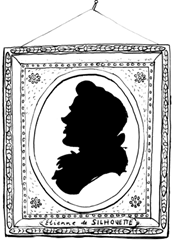
sil·hou·ette n.A shape distinctly outlined by background.
While living in London, Étienne de Silhouette stumbled onto the black-magic secrets of Anglo-Saxon capitalism and fiscal responsibility. He returned to Paris spreading the dark gospel, no more popular on the Champs-Élysées in the mid-1700s than now. Silhouette, however, had the ear of the royal mistress, Madame de Pompadour, through whose devices he was elevated to be Contrôleur général des finances.
To pay down the crushing debt being incurred from the ongoing Seven Years’ War, Silhouette suggested what amounted to an import of the British Window Tax, although he wanted to tax doors too, and just about everything else he could think of. Silhouette also proposed slashing the pay of bureaucrats—again, never a way into the Gallic heart—and even ordered the king to melt down the royal plate.
The most amazing thing about Silhouette’s departure after nine months in the office was that he lasted so long. Parisian ridicule of the finance minister didn’t stop with his fall from grace, and anything made on the cheap was said to be done à la silhouette, including the then-popular method of producing a portrait without having to draw, in which the “artist” traced the subject’s shadow onto a piece of black paper, cut it out, and stuck it in a frame.
Imagine you are wandering through a vast cathedral. Countless stain-glass windows, radiant in the darkness, represent the modes of worship and ways of understanding that humanity has evolved throughout its history. Some windows picture divine presence through personal forms or attributes, and seekers worship these windows with devotion. Other seekers, preferring the way of wisdom, contemplate stained-glass windows that present nothing personal, simply esoteric patterns evoking primal harmony and unity. Devotion and wisdom are alternate ways to enlightenment. Some sacred traditions interweave both ways.
What occurs as we contemplate these cathedral windows? We are really experiencing light, diffused through complicated contexts that have been created, individually and communally, by visionary artisans. And we cannot step outside this cathedral, which is human thinking, because we must depend on some personal and cultural medium. We cannot articulate any experience, even to ourselves, without some process of thinking. This is not imprisonment but simply the nature of light or reality, which expresses itself as experience only through some particular medium.
Each window of devotion or wisdom translates the same radiance of ultimate consciousness by means of personal figures or symbolic patterns unique to itself. Through dedicated contemplation of even a single window, we can attune to light, or reality, and eventually realize that our intrinsic nature is the light. Once realizing the universal cathedral to be flooded with the conscious light of our true nature, once enlightenment has dawned, we are at home everywhere. We have been freed from the competition between worldviews, by understanding the essential equality of all windows of contemplation and the harmony between the ways of wisdom and of devotion. Everywhere in this vast cathedral, through all possible languages and images, we now recognize the light, or consciousness, which we are, which all beings are, which Being is.
Contemplative thinking is not confined to certain fields such as religion, art, or philosophy but flourishes subtly throughout every culture, often obscurely among small circles or secretly within the inner life of individuals who may or may not be aware of any mystical tradition. This ever-deepening way of contemplation, which follows devotion and wisdom to their source, is perhaps the most precious human possibility. The holy person, or shaman, in every culture—poet, musician, saint, warrior—is revered for the powerful touch that awakens and sustains deep thinking and its sense of discovery, freedom, and harmony. The figure of the shaman is a sacrament through which all members of the culture without exception can enter the mood of contemplation.
"Like the roots of a plant reaching down into the ground, filming remains hidden within a complex act, neither to be observed by the spectator nor even completely seen by the filmmaker. It is an act that begins in the filmmaker's eyes and is formed by his gestures in relation to the camera…
The filming is a search for correct contours, and is activated by a physical sense that is similar to trying to find a location that has been seen only once. Memory searches for the right direction. Drawing together details and hints, this sense is nearest to touch in its awareness of proportion. It is this quality in the filming that I compare to the roots of a plant.”
~ Robert Beavers, “La Terra Nuova,” The Searching Measure (University of California, Berkeley Art Museum/Pacific Film Archive, 2004)
“I feel like when I’m performing and I’m really in kind of a state, it’s quite like meditation…especially as a soloist where the forms are precise, but in a different way than when I’m with other people and we’re dependent on each other. But as a soloist I can be very precise and very rigorous and yet at the same time I feel that I’m very open and fluid to what’s happening in the moment. It’s that thing of trying to be really present in experience. In a sense I think that our culture teaches us to describe our experiences, to narrate our experiences, and that’s how we’re one step away from [them]. So in a way, I think that’s why I really like working without words because I think it throws your mind into a very different state.”
"Whatever makes a child want to glue macaroni on a paper plate and paint the assemblage and see it on the refrigerator — that has always been strong in me."
"These Ten Commandments on seeing/drawing were revealed to me on a mountain, but also in a meadow, on a beach and even in the subway. For their revelation did not come all at once, but in installments, as it were, over the years, and always while I was busy drawing, and invariably on holy ground. But that may be because, while drawing, all ground is holy: unseparated from the Whole."
Anna Deavere Smith, from her Chataqua Institution lecture “Looking for Grace,” FORA.tv, September 13, 2009:
I started to think about the conditions that foster creativity. I would say that any modest amount of creativity that I’ve experienced—at least in my adult life—required the following: a restricted environment, uncertainty, independence and responsibility, a lack of safety, the need for change, richness of inner life, need, physical beauty, contradictions, and doubt.
Now, if we were to create a school or community where we wanted to foster creativity, we would probably not seed the growth of those attributes. I think that list would look something like this: an environment where possibility seemed endless, steadiness, a firm foundation, strong mentorship, safety, richness of inner life, provisions, clarity, confidence, and physical beauty.
"My tape recorder and my ear create the necessary distance that allows me to get close to another person."
…in general, good authors have always been fairly miserable. They are now. They were then. It's always been a somewhat alien existence. Most authors still need to have a profession, usually in academia but not always, to sustain themselves. Especially the better ones, who don't want to compromise and just want to write what they feel like writing. But I don't think it has become much more difficult. It has always been difficult. I would not advise any of my friends to become writers as a career.
I think you're an artist because you have to be an artist. I don't think it's ever been easy. It's not easy for musicians. It's not easy for painters. But it has never been easy for those people. When Cézanne showed his first paintings, people laughed at him. They thought they were ludicrous. Van Gogh only sold one painting in his lifetime. To be an artist has always been difficult. To be an artist in the United States has been probably even more difficult than elsewhere because the arts are not considered all that valuable here.
If somebody asks you what you do and you say, "I'm a writer," the next question will be, "But what do you do for a living?"
“My life for the last twenty-eight years is tied up with this like it was for eighteen years being an astronaut or eight years before that being a Navy pilot. I believe in doing what you can, cause I’ll be gone in another ten or fifteen years. Your listeners need to think about this, they’re only going to be here once. Sometimes we think there’s other people around that will make up for what we don’t do. Sure they can. They can mow a lawn. They can drive a car. They can take a job and write an article or something. But they cannot do what’s in the heart of each of your listeners. And if they don’t do it, it will never be done again until time ends. Who knows when that is?”
~ Alan Bean, the fourth man to walk on the moon, from “Moon Artist,” PRI’s The World, July 8, 2009.
“I feel like my last album was really very much about this emotion to want justice. And maybe I go with this emotion as a way to get at how it is to feel injustice—to want justice and to demand it. It’s very strong, this image of a person with a flag, declaring independence. But I’m not interested in politics. I lose interest the microsecond it ceases to be emotional, when something becomes a political movement. What I’m interested in is emotions.”
~ Björk, from Interview Magazine(June/July 2009). Voltaic, a two-CD, two-DVD box set of live recordings from Medúlla and Volta, will be available June 23 from Nonesuch.
"The primary focus of this path of choosing wisely...is learning to stay present. Pausing very briefly, frequently throughout the day, is an almost effortless way to do this. For just a few seconds we can be right here. Meditation is another way to train in learning to stay or...learning to come back, to return to the present over and over again."
"In Zen Buddhist painting, ensō symbolizes a moment when the mind is free to simply let the body-spirit create. The brushed ink of the circle is usually done on silk or rice paper in one movement and there is no possibility of modification: it shows the expressive movement of the spirit at that time."