
Listening to Pi on 3-14
See also:
- How To Transform The Number Pi Into A Song (NPR)
- Celebrating Pi Day
- Pi on Wikipedia
- Clip from Pi by Darren Aronofsky



See also:
Excerpt from “Speaking in Tones,” by Diana Deutsch, Scientific American Mind, July/August 2010:
“…language and music have a lot in common. They are both governed by a grammar, in which basic elements are organized hierarchically into sequences according to established rules. In language, words combine to form phrases, which join to form larger phrases, which in turn combine to make sentences. Similarly, in music, notes combine to form phrases, which connect to form larger phrases, and so on. Thus, to understand either language or music, listeners must infer the structures of the passages they hear, using rules they have assimilated through experience.
In addition, speech has a natural melody called prosody. Prosody encompasses overall pitch level and pitch range, pitch contour (the pattern of rises and falls in pitch), loudness variation, rhythm and tempo. Prosodic characteristics often reflect the speaker’s emotional state. When people are happy or excited, the frequently speak more rapidly, at higher pitches and in wider pitch ranges; when people are sad, they tend to talk more slowly, in a lower voice and with less pitch variation. Prosody also helps us to understand the flow and meaning of speech. Boundaries between phrases are generally marked by pauses, and the endings of phrases tend to be distinguished by lower pitches and slower speech. Moreover, important words are often spoken in higher pitches. Interestingly, some pitch and timing characteristics of spoken language also occur in music, which indicates that overlapping neural circuitries may be involved.”
[See also: Diana Deutsch’s Speech-to-Song Illusion.]
 |
| The appreciation of music requires many of the same brain regions that are involved in the processing of language. These multipurpose regions include Broca’s and Wernicke’s areas. |
Excerpt from “Signing, Singing, Speaking: How Language Evolved,” by Jon Hamilton, NPR: Morning Edition, Aug. 16, 2010:
Another idea about the origin of language is that it came from song. Ani Patel of The Neurosciences Institute in San Diego says this idea just feels right to a lot of people.
"We feel music just taps into this kind of pre-cognitive archaic part of ourselves," he says. So it seems to make sense that music came "before we had this complicated articulate language that we use to do abstract thinking."
Even Charles Darwin "talked about our ancestors singing love songs to each other before we could speak articulate language," Patel says.

"I did it for the fun. I was a young girl and everybody had left and it was wartime. You didn't want to get stuck in a hole in Iowa; you wanted to see what was going on."
~ Margaret Phelan Taylor, on her experience as a Women Airforce Service Pilot, “Female WWII Pilots: The Original Fly Girls,” Morning Edition (3/9/10)
From Anonyponymous: The Forgotten People Behind Everyday Words by John Marciano:
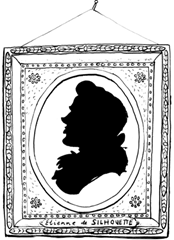
While living in London, Étienne de Silhouette stumbled onto the black-magic secrets of Anglo-Saxon capitalism and fiscal responsibility. He returned to Paris spreading the dark gospel, no more popular on the Champs-Élysées in the mid-1700s than now. Silhouette, however, had the ear of the royal mistress, Madame de Pompadour, through whose devices he was elevated to be Contrôleur général des finances.
To pay down the crushing debt being incurred from the ongoing Seven Years’ War, Silhouette suggested what amounted to an import of the British Window Tax, although he wanted to tax doors too, and just about everything else he could think of. Silhouette also proposed slashing the pay of bureaucrats—again, never a way into the Gallic heart—and even ordered the king to melt down the royal plate.
The most amazing thing about Silhouette’s departure after nine months in the office was that he lasted so long. Parisian ridicule of the finance minister didn’t stop with his fall from grace, and anything made on the cheap was said to be done à la silhouette, including the then-popular method of producing a portrait without having to draw, in which the “artist” traced the subject’s shadow onto a piece of black paper, cut it out, and stuck it in a frame.

David Teie has been developing a theory to explain why music plays on human emotions. His theory is that music relates to the most primitive sounds we make and respond to, like laughter, heartbeats, or a mother's cooing.
Fearful monkey music:
Happy monkey music:
He says, "the paradox is that I distinctly remember thinking once that when they figure out why Puccini makes me cry, I hope I die the day before the news gets out. But the great news about this exploration into music is it's actually more magical and wonderful once you realize how it works."
See also: Music for Cats
Glen Hansard and Marketa Irglova perform a live set as part of NPR’s Tiny Desk Concerts series. Their new CD, Strict Joy, is due to be released at the end of October.
[Thanks Suzie!]
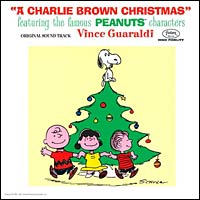 I heard this great piece on NPR this morning about how A Charlie Brown Christmas almost never made it on the air for the first time in 1965. CBS thought that the jazz didn't mix well with traditional carols, that the voices should be provided by professional child actors, and that the tone and themes were too heavy for kids. It turned out that half of the people watching television across the country that night tuned in to watch.
The composer of the soundtrack, Vince Guaraldi, died unexpectedly of a heart attack in 1976. "He was found in a room at the Red Cottage Inn hotel, relaxing between sets at Butterfield's nightclub in Menlo Park, California. Guaraldi had just finished recording the soundtrack for It's Arbor Day, Charlie Brown earlier that afternoon."
He wasn't around to discover that his music had become modern Christmas classics. A remastered edition of the soundtrack, which has never been out of print, has been released this year.

Daron Larson
Freelance Contemplative



