Showing posts with label history. Show all posts

Wednesday, April 06, 2011

Narratives of Grace

Engels (Anselm Kiefer)

“We normally think of history as one catastrophe after another, war followed by war, outrage by outrage — almost as if history were nothing more than all the narratives of human pain, assembled in sequence. And surely this is, often enough, an adequate description. But history is also the narratives of grace, the recountings of those blessed and inexplicable moments when someone did something for someone else, saved a life, bestowed a gift, gave something beyond what was required by circumstance.”

~ Thomas Cahill

Tuesday, January 25, 2011

A Tribute to the Pablo Casals

In 1961, Pablo Casals gave a concert in Kennedy's White House. Tonight, fifty years later, cellist Yo-Yo Ma and pianist Emanuel Ax join with the Kalichstein-Laredo-Robinson Trio to present a tribute to cellist Pablo Casals' 1961 White House concert. "The concert includes Song of the Birds, a Catalan folk song, which Casals performed at the end of every concert following his exile from Spain as a reminder of his yearning for political freedom."


Sunday, December 05, 2010

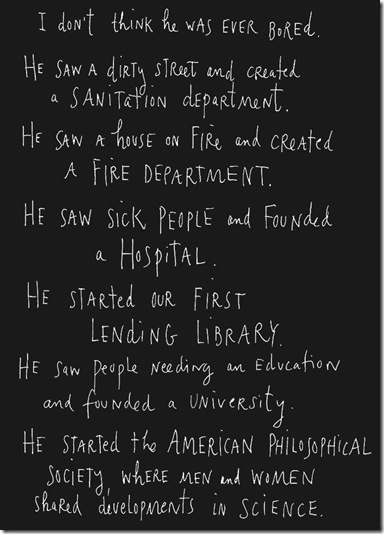
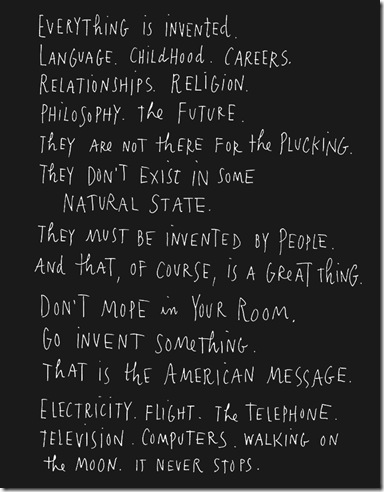
Everything is Invented

From And the Pursuit of Happiness by Maira Kalman:

MKJULY_02b

Saturday, December 04, 2010

A Long, Hard Slog

Lessons from General Grant,” by Francis Wilkinson, The Week, November 26, 2010:

I'm a tragically slow reader, so I choose my books carefully. Lately, I've been reading the memoirs of U.S. Grant, albeit at a tortoise pace that makes my typical slow motion look like an Evelyn Wood demo. I've kept the book bedside for a couple years now, and still Appomattox is nowhere in sight. I move through chapters like heavy artillery through mud.

Yet the pace suits me — and the material. The war was a long, hard slog. And Grant's reflections have such resonance that I keep putting the book down to listen to the echoes. The fight against Mexico in 1846, Grant laments, was a "political" war waged on a false premise. Has a contemporary ring, doesn't it? The general who presided over the greatest destruction of American life in history — more than 600,000 soldiers on both sides died — also surprises with compassion. Contemptuous of slavery and committed to crushing the rebellion, Grant nonetheless has an ample soft spot for the enemy, taking risks to protect his foes' dignity. When Grant is ordered to handle rebels "without gloves" — including evicting Southern civilians from their homes and arresting them — he simply ignores the command. In fact, he fails to make a single arrest, having "deemed it better that a few guilty men should escape than that a great many innocent ones should suffer." It’s hard to resist projecting this thoughtful, anguished titan — a civil libertarian up to his epaulets in carnage — into the era of Guantánamo and Abu Ghraib. Grant didn't shrink from violence, but he didn't surrender principle, either. He did his duty, and he won. I peeked at the ending.

Thursday, December 02, 2010

Volume Zero

The History of England, From The Invasion of Julius Cæsar to the Revolution in 1688 by David Hume [Eight Volumes] “I have, in my place, books about English history. I like the bloodiness of it. I have one set of eight volumes. I read only the first volume, and of that only the first chapter, in which each time I see something else. But really, I am interested only in reading Volume Zero, which has not been written... History could not have started in the places they speak of. History preceded this; it just is not recorded. The beauty of architecture is that it deals with the recessions of the mind, from which comes that which is not yet said and not yet made.

Of all things, I honor beginnings. I believe, though, that what was has always been, and what is has always been, and what will be has always been. I do not think the circumstantial play from year to year, from era to era, has anything to do with what is available to you. The person of old had the same brilliance of mind that we assume we have now. But that which made a thing become manifest for the first time is our great moment of creative happening.”

~ Louis Kahn, from Louis I. Kahn: Writings, Lectures, Interviews

Tuesday, March 09, 2010

To See What Was Going On

Margaret Phelan Taylor

"I did it for the fun. I was a young girl and everybody had left and it was wartime. You didn't want to get stuck in a hole in Iowa; you wanted to see what was going on."

~ Margaret Phelan Taylor, on her experience as a Women Airforce Service Pilot, “Female WWII Pilots: The Original Fly Girls,” Morning Edition (3/9/10)

Friday, February 05, 2010

Nothing Made Modern Science Possible

sifr“Our word cipher, meaning zero or nothing, comes from the Arabic word Sifr, meaning zero. We call our numbers Arabic numerals, but they actually came from India. It was the Arabs, however, who brought the Indian numerals to Europe. It took centuries to convince Europeans to use them, even  though they made calculations easier than using clumsy Roman numerals. Medieval Arab scholars also took the Indian idea of representing zero (the Arabs use a dot, ٠). This enables us to write all numbers with only ten symbols (0 to 9). Without the use of the zero, modern science would be impossible!”

~ Barbara Whitesides, from Sugar Comes from Arabic: A Beginner's Guide to Arabic Letters and Words

[See also: Zero and One & Zero: The Biography of a Dangerous Idea]

Friday, November 27, 2009

Uniting Against an Outside Enemy

From The Writer’s Almanac today:

Pope Urban II preaches the First Crusade at the Council of Clermont. It was on this day in 1095 that Pope Urban II, while on a speaking tour in France, called for the first Crusade to recapture Jerusalem from the Turks. There was no imminent threat. Muslims had occupied Jerusalem for hundreds of years. But Urban II had noticed that Europe was becoming an increasingly violent place, with low-level knights killing each other over their land rights, and he thought that he could bring peace to the Christian world by directing all that violence against an outside enemy. So he made up stories of how Turks in Jerusalem were torturing and killing Christians, and anyone who was willing to join the fight against them would go to heaven.

About 100,000 men from France, Germany, and Italy answered the call, formed into several large groups, and marched across Asia Minor to the Middle East. Nearly half of them died from exhaustion and sickness before they ever reached their destination. They began sacking cities along the way, and they fought among each other for the spoils of each battle. When they reached the trading city of Antioch, they killed almost everyone, including the Christians who lived there. By the time they got to Jerusalem, it had recently fallen into the hands of Egyptians, who were friendly with the Vatican. But the crusaders attacked anyway, killing every Muslim they could find. The Jews in the city gathered in the temple, and the crusaders set it on fire.

Pope Urban II died two weeks later, never hearing the news.

Thursday, November 12, 2009

Creating a Portrait on the Cheap

From Anonyponymous: The Forgotten People Behind Everyday Words by John Marciano:

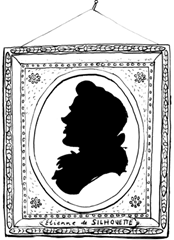
Étienne de Silhouette sil·hou·ette n. A shape distinctly outlined by background.

While living in London, Étienne de Silhouette stumbled onto the black-magic secrets of Anglo-Saxon capitalism and fiscal responsibility. He returned to Paris spreading the dark gospel, no more popular on the Champs-Élysées in the mid-1700s than now. Silhouette, however, had the ear of the royal mistress, Madame de Pompadour, through whose devices he was elevated to be Contrôleur général des finances.

To pay down the crushing debt being incurred from the ongoing Seven Years’ War, Silhouette suggested what amounted to an import of the British Window Tax, although he wanted to tax doors too, and just about everything else he could think of. Silhouette also proposed slashing the pay of bureaucrats—again, never a way into the Gallic heart—and even ordered the king to melt down the royal plate.

The most amazing thing about Silhouette’s departure after nine months in the office was that he lasted so long. Parisian ridicule of the finance minister didn’t stop with his fall from grace, and anything made on the cheap was said to be done à la silhouette, including the then-popular method of producing a portrait without having to draw, in which the “artist” traced the subject’s shadow onto a piece of black paper, cut it out, and stuck it in a frame.

Sunday, October 04, 2009

By Virtue of What We’ve Saved

David Treuer speaking with Krista Tippett in “Language and Meaning—An Ojibwa Story,” Speaking of Faith (October 1, 2009):

I think, for a lot of native people who are involved in language revitalization efforts—which is that a lot of times over thDavid Treuere last 50 or 60 years, a lot of native people define themselves as native by virtue of what they've lost, you know?

I'm native, because I'm poor, because I've, you know, because I was "forced" on a reservation, because I drank powdered milk and grew up in HUD housing, because I've lost my cousins, because I've struggled with alcohol or whatever. And there's validity in that, there really is. But what I really love about language revitalization, what is so key to it, is that it's always been ours. It's never been given to us. Our native languages aren't forced on us. And it's a chance to define ourselves on and in our own terms and in ways that have nothing to do with what's been taken. We can define ourselves by virtue of what we've saved.

…Marcel Proust said that, particularly speaking of writing novels, said that nothing really exists in and of itself in a book, that characters and situations and places only take on life by way of contrast. That's how novels build themselves are through creating contrasts and intentions, resolutions and more contrasts and intentions.

I think the same could be said for life, that nothing exists in and of itself. Everything exists only by way of contrasts. So in and of itself, I think Ojibwe is beautiful. Just the animal sound of the language, how it flows, to the kinds of trickery that those words themselves can bring out…But also in contrast to the English with which we are surrounded, Ojibwe seems all the more precious, you know, all the more beautiful.

Monday, September 28, 2009

Nothing Left Out

My copy of The Book of Genesis Illustrated by R. Crumb just arrived!
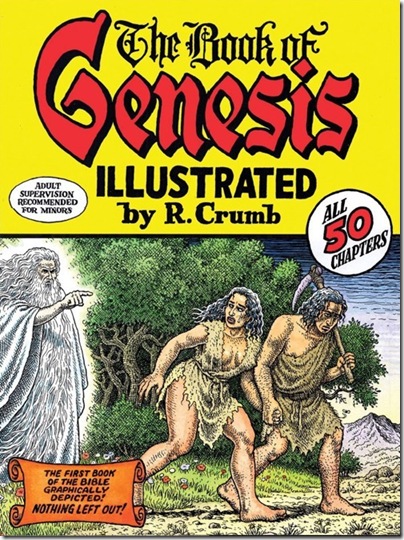
The Book of Genesis

From the introduction:

I, R. CRUMB, THE ILLUSTRATOR OF THIS BOOK, HAVE, TO THE BEST OF MY ABILITY, FAITHFULLY REPRODUCED EVERY WORD OF THE ORIGINAL TEXT, WHICH I DERIVED FROM SEVERAL SOURCES, INCLUDING THE KING JAMES VERSION, BUT MOSTLY FROM ROBERT ALTER’S RECENT TRANSLATION, THE FIVE BOOKS OF MOSES (2004). IN A FEW PLACES I VENTURED TO DO A LITTLE INTERPRETATION OF MY OWN, IF I THOUGHT THE WORDS COULD BE MADE CLEARER, BUT I REFRAINED FROM INDULGING TOO OFTEN IN SUCH “CREATIVITY,” AND SOMETIMES LET IT STAND IN ITS CONVOLUTED VAGUENESS RATHER THAN MONKEY AROUND WITH SUCH A VENERABLE TEXT.

EVERY OTHER COMIC BOOK VERSION OF THE BIBLE THAT I’VE SEEN CONTAINS PASSAGES OF COMPLETELY MADE-UP NARRATIVE AND DIALOGUE, IN AN ATTEMPT TO STREAMLINE AND “MODERNIZE” THE OLD SCRIPTURES, AND STILL, THESE VARIOUS COMIC BOOK BIBLES ALL CLAIM TO ADHERE TO THE BELIEF THAT THE BIBLE IS “THE WORD OF GOD,” OR INSPIRED BY “THE WORD OF GOD,” WHEREAS, I, IRONICALLY, DO NOT BELIEVE THE BIBLE IS “THE WORD OF GOD.” I BELIEVE IT IS THE WORDS OF MEN.

IT IS, NONETHELESS, A POWERFUL TEXT WITH LAYERS OF MEANING THAT REACH DEEP INTO OUR COLLECTIVE CONSCIOUSNESS, OUR HISTORICAL CONSCIOUSNESS, IF YOU WILL. IT SEEMS INDEED TO BE AN INSPIRED WORK, BUT I BELIEVE THAT ITS POWER DERIVES FROM ITS HAVING BEEN A COLLECTIVE ENDEAVOR THAT EVOLVED, AND CONDENSED OVER MANY GENERATIONS BEFORE REACHING ITS FINAL, FIXED FORM AS WE KNOW IT DURING THE “BABYLONIAN EXILE,” CIRCA 600 B.C.E.

…IF MY VISUAL, LITERAL INTERPRETATION OF THE BOOK OF GENESIS OFFENDS OR OUTRAGES SOME READERS, WHICH SEEMS INEVITABLE CONSIDERING THAT THE TEXT IS REVERED BY MANY PEOPLE, ALL I CAN SAY IN MY DEFENSE IS THAT I APPROACHED THIS AS A STRAIGHT ILLUSTRATION JOB, WITH NO INTENTION TO RIDICULE OR MAKE VISUAL JOKES. THAT SAID, I KNOW THAT YOU CAN’T PLEASE EVERYBODY."

* * *

R. Crumb's Awesome, Affecting Take On Genesis,” by Susan Jane Gilman, NPR (October 16, 2009)

Friday, September 12, 2008

And So It Has Always Been

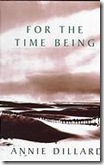
For the Time Being "There were no formerly heroic times, and there was no formerly pure generation. There is no one here but us chickens, and so it has always been: A people busy and powerful, knowledgeable, ambivalent, important, fearful, and self-aware; a people who scheme, promote, deceive, and conquer; who pray for their loved ones, and long to flee misery and skip death.

"It is a weakening and discoloring idea, that rustic people knew God personally once upon a time—or even knew selflessness or courage or literature—but that it is too late for us. In fact, the absolute is available to everyone in every age. There never was a more holy age than ours, and never a less."

~ Annie Dillard, from For the Time Being

Friday, February 22, 2008

Ten Things You Never Knew

...about George Washington, born on this day in 1732:

  1. His dentures were carved from a hippopotamus tusk. They were drilled with a hole to fit over Washington's one remaining tooth, and they rubbed against his natural tooth in such a way that Washington was in constant pain, and so he used an alcoholic solution infused with opium.

  2. Baron von Steuben (left) walks with Gen. George Washington through the Continental Army camp at Valley Forge in 1778, shown in an engraving after Howard Pyle. By the time he reached 30, he had survived malaria, smallpox, pleurisy, dysentery. He was fired at on two separate occasions — and in one of them, his horse was shot out from under him and four bullets punctured his coat. He also fell off a raft into an icy river and nearly drowned.

  3. During the last night of his life, a doctor friend came over to perform an emergency tracheotomy on Washington. Arriving too late, the doctor tried to resurrect Washington by thawing him in cold water, then wrapping him in blankets and rubbing him in order to activate blood vessels, then opening his trachea to inflate his lungs with air, and then transfusing blood from a lamb into him.

  4. He enjoyed playing cards, hunting foxes and ducks, fishing, cockfighting, horse racing, boat racing, and dancing. He bred hound dogs and gave them names like "Sweet Lips" and "Tarter."

  5. Building Mt. VernonHis favorite foods included mashed potatoes with coconut, string beans with mushrooms, cream of peanut soup, salt cod, and pineapples.

  6. He snored very loudly.

  7. He did not wear a powdered wig, as was fashionable at the time. Instead, he powdered his own red-brown hair.

  8. Washington had a speech impediment and was not good at spelling. He would often mix up i's and e's when speaking and in writing.

  9. There are 33 counties, seven mountains, nine colleges, and 121 post offices named after Washington.

  10. He delivered the shortest inaugural address ever. It was only 133 words long and took 90 seconds to deliver.

From The Writer's Almanac (2/22/08)

Tuesday, November 27, 2007

No Imminent Threat

The Siege of Antioch, from a medieval miniature painting, during the First Crusade.From today's The Writer's Almanac with Garrison Keillor:

It was on this day in 1095 that Pope Urban II, while on a speaking tour in France, called for the first Crusade to recapture Jerusalem from the Turks. There was no imminent threat. Muslims had occupied Jerusalem for hundreds of years. But Urban II had noticed that Europe was becoming an increasingly violent place, with low-level knights killing each other over their land rights, and he thought that he could bring peace to the Christian world by directing all that violence against an outside enemy. So he made up stories of how Turks in Jerusalem were torturing and killing Christians, and anyone who was willing to join the fight against them would go to heaven.

About 100,000 men from France, Germany, and Italy answered the call, formed into several large groups, and marched across Asia Minor to the Middle East. Nearly half of them died from exhaustion and sickness before they ever reached their destination. They began sacking cities along the way, and they fought among each other for the spoils of each battle. When they reached the trading city of Antioch, they killed almost everyone, including the Christians who lived there. By the time they got to Jerusalem, it had recently fallen into the hands of Egyptians, who were friendly with the Vatican. But the crusaders attacked anyway, killing every Muslim they could find. The Jews in the city gathered in the temple, and the crusaders set it on fire.

Pope Urban II died two weeks later, never hearing the news. But the crusading would go on for the next 200 years. In the fourth and last Crusade, in 1202, the crusaders never even made it to Jerusalem, but got sidetracked and wound up destroying Constantinople, which was at the time the last great city left over from the Roman Empire.