Showing posts with label enlightenment. Show all posts

Saturday, May 14, 2011

Beyond the Mind

Excerpts from Emptiness Dancing by Adyashanti:

The mind can’t fathom that there can be a true intelligence, a transcendent intelligence, that isn’t the product and outcome of thought and conceptual understanding. It can’t fathom that there could be wisdom that’s not going to come at you in the form of thoughts, in the form of acquired and accumulated knowledge.

The true spiritual urge or yearning is always and invitation beyond the mind. That’s why it’s always been said that if you go to God, you go naked or you don’t go at all. It’s the same for everybody. You go in free of your accumulated knowledge, or you are forever unable to enter. So an intelligent mind realizes its own limitation, and it’s a beautiful thing when it does.

When you stop holding on to all the knowledge, then you start to enter a different state of being. You start to move into a different dimension. You move into a dimension where experience inside gets very quiet. The mind may still be there chatting in the background, or it might not, but consciousness is no longer bothering itself with the mind. You don’t need to stop it. Your awareness just goes right past that wall of knowledge and moves into a very quiet state…

…Once your conceptual world of knowledge gets put in its rightful place, it is transcended. You see that you are eternal consciousness now appearing as woman or man, this or that character. But like every good actor, you are not what you are appearing as. Everything that exists is consciousness appearing as, or God appearing as, or Self appearing as, or spirit appearing as. The Buddha called it no-self. When that’s seen, you see Unity. There is only God. That’s all there is: God appearing as floor, as a human being, as a wall, as a chair.

No knowledge, no statement of the Truth touches what’s eternal, what you really are. And no statement about how to get there is true either, because what gets one person there doesn’t get another person there. A mind that likes to look for the one truth path cannot find it. Of course, the mind doesn’t like that. “No right path? Nothing that could be said or read that ultimately, in the end, could be true? The most enlightened being can’t speak the Truth?”

No. It’s never been done, and it never will be done. The only thing you can do is to put a pointer on the way that says, “Look that way.” A false spiritual arrow is one that points to the wall and says, “Look this way.” A true arrow is one that points beyond the wall of concepts.

Friday, January 07, 2011

An Open-Ended Series of Provisional Breakthroughs

From Free Play: Improvisation in Life and Art by Stephen Nachmanovitch:

free-play The literature on creativity is full of tales of breakthrough experiences. These moments come when you let go of some impediment or fears, and boom—in whooshes the muse. You feel clarity, power, freedom, as something unforeseeable jumps out of you. The literature of Zen, on which I have drawn heavily because of its deep penetration of the breakthrough experience, abounds with accounts of kensho and satori—moments of illumination and moments of total change of heart. There come points in your life when you simply kick the door open. But there is no ultimate breakthrough; what we find in the development of a creative life is an open-ended series of provisional breakthroughs. In this journey there is no endpoint, because it is the journey into the soul.

In my own life, music taught me to listen, not just to sound but to who I am. I discovered the relevance of our many mystical or esoteric traditions to the practical life of art making. “Mysticism” does not refer to cloudy belief systems or to hocus-pocus; it refers to direct and personal spiritual experience, as distinct from organized religion in which one is expected to believe secondhand experiences passed on in sacred books or by teachers or authorities. It is the mystics who bring creativity into religion. The mystic or visionary attitude expands and concretizes art, science, and daily life as well. Do I believe what “the Man” tells me, or am I going to try things out for myself and see what’s really true for me?


Creativity is a harmony of opposite tensions, as in lila or divine play. As we ride through the flux of our own creative processes, we hold onto both poles. If we let go of play, our work becomes ponderous and stiff. If we let go of the sacred, our work loses its connection to the ground on which we live.

Knowledge of the creative process cannot substitute for creativity, but it can save us from giving up on creativity when the challenges seem too intimidating and free play seems blocked. If we know that our inevitable setbacks and frustrations are phases of the natural cycle of creative processes, if we know that our obstacles can become our ornaments, we can persevere and bring our desires to fruition. Such perseverance can be a real test, but there are ways through, there are guideposts. And the struggle, which is guaranteed to take a lifetime, is worth it. It is a struggle that generates incredible pleasure and joy. Every attempt we make is imperfect; yet each one of those imperfect attempts is an occasion for a delight unlike anything else on earth.

Wednesday, April 07, 2010

Wider and Deeper

“In Zen literature the word intimacy is often used as a synonym for enlightenment. In the classical Zen enlightenment stories, a monk or a nun is reduced simultaneously to tears and laughter as he or she suddenly recognizes that nothing in this world is separate, that each and every thing, including one’s own self, is nothing but the whole, and that the whole is nothing but the self. What are such stories telling us if not that love is much wider and deeper than an emotion? Love is the fruition of, the true shape of, one’s self and all that is.”

~ Norman Fischer, from Taking Our Places

Thursday, March 04, 2010

The Same Enlightenment

Filmed in Nov. 2009 at Mt. Carmel Spiritual Centre in Niagara Falls.

Monday, February 08, 2010

A Very Organic Process

"There are all kinds of stories and myths that have arisen about this. Most of them are nonsense.  And it became ever more apparent to me, as I worked my way up through this system, that I was not becoming a superman and I wasn’t becoming a saint and my morality was not becoming perfected.  And what was happening here was a very organic process that I’ve more recently come to think of as what I call a physio-energetic process.  There is some energy that arises in the body and can be developed in stages.  And that’s what’s happening.  All of the stuff, all of the stories that we layer on to that, that if you reach this stage, you’re going to act a certain way or you’re going to be incapable of committing various immoral acts, that’s just fantasy island...I’ve completely given up on the notion that you’re going to develop to the point of being incapable of lying, for example, or of being incapable of anger or lust."

~ Kenneth Folk, in conversation with Vince Horn, "Ordinary People Can Get Enlightened," Buddhist Geeks Podcast (Episode 156)

Wednesday, November 11, 2009

Experiencing Light

Excerpt from Coming Home: The Experience of Enlightenment in Sacred Traditions by Lex Hixon:

Imagine you are wandering through a vast cathedral. Countless stain-glass windows, radiant in the darkness, represent the modes of worship and ways of understanding that humanity has evolved throughout its history. Some windows picture divine presence through personal forms or attributes, and seekers worship these windows with devotion. Other seekers, preferring the way of wisdom, contemplate stained-glass windows that present nothing personal, simply esoteric patterns evoking primal harmony and unity. Devotion and wisdom are alternate ways to enlightenment. Some sacred traditions interweave both ways.

St. John of the Divine What occurs as we contemplate these cathedral windows? We are really experiencing light, diffused through complicated contexts that have been created, individually and communally, by visionary artisans. And we cannot step outside this cathedral, which is human thinking, because we must depend on some personal and cultural medium. We cannot articulate any experience, even to ourselves, without some process of thinking. This is not imprisonment but simply the nature of light or reality, which expresses itself as experience only through some particular medium.

Each window of devotion or wisdom translates the same radiance of ultimate consciousness by means of personal figures or symbolic patterns unique to itself. Through dedicated contemplation of even a single window, we can attune to light, or reality, and eventually realize that our intrinsic nature is the light. Once realizing the universal cathedral to be flooded with the conscious light of our true nature, once enlightenment has dawned, we are at home everywhere. We have been freed from the competition between worldviews, by understanding the essential equality of all windows of contemplation and the harmony between the ways of wisdom and of devotion. Everywhere in this vast cathedral, through all possible languages and images, we now recognize the light, or consciousness, which we are, which all beings are, which Being is.

Rose Window of The Cathedral Of St. John The Divine Contemplative thinking is not confined to certain fields such as religion, art, or philosophy but flourishes subtly throughout every culture, often obscurely among small circles or secretly within the inner life of individuals who may or may not be aware of any mystical tradition. This ever-deepening way of contemplation, which follows devotion and wisdom to their source, is perhaps the most precious human possibility. The holy person, or shaman, in every culture—poet, musician, saint, warrior—is revered for the powerful touch that awakens and sustains deep thinking and its sense of discovery, freedom, and harmony. The figure of the shaman is a sacrament through which all members of the culture without exception can enter the mood of contemplation.

Monday, November 02, 2009

The Full Flowering of Humanity

Coming Home “Enlightenment is the awakening to our primal harmony or, in another mystical language, to our rootedness in the Divine. From Enlightenment radiate the insight, compassion, and power needed to resolve individual and collective human problems as they continue to rise endlessly. Enlightenment is not a magical transcendence of the human condition but the full flowering of humanity, disclosing unity and equilibrium at the heart of the love and suffering we call life.

All existence is revealed to the Enlightened human being as a seamless whole, as Divine Life. Some taste of this Enlightenment which consciously touches the Ultimate is possible for each of us. It need not be deferred to any future existence in heaven or on earth.

Enlightenment is the secret essence of our consciousness, and the gradual revelation of this essence is the process of spiritual growth in which everyone is involved.”

~ Lex Hixon, from Coming Home: The Experience of Enlightenment in Sacred Traditions

Wednesday, September 30, 2009

Enjoy the Process

Excerpt from “Enlightenment 2.0,” a Buddhist Geeks conversation with Ben Goertzel and host Vince Horn:

I think that the idea underlying that story (Enlightenment 2.0) really came out of something that I worry about in my personal life just thinking about my own personal future. When I think about “What would I want in the future if superhuman Artificial Intelligence (AI) became possible?”

Wall-E ...I really think that the human brain architecture is limiting. So that I think if you could change your brain into a different kind of information processing system, you could achieve just better states of mind. You could feel enlightened all the time, while doing great science, while having sensory gratification, and it could be way beyond what humans can experience.

So that leads to the question of, okay, if I had the ability to change myself into some profoundly better kind of mind, would I do it all at once? Would I just flick a switch and say “Okay, change from Ben into a super mind?” Well, I wouldn't really want to do that, because that would be just too much like killing Ben, and just replacing him with the super mind. So, I get the idea that maybe I'd like to improve myself by, say twenty percent per year. So I could enjoy the process, and feel myself becoming more and more intelligent, more and more enlightened, broader and broader, and better and better.

Cylon (Battlestar Gallactica) …You think of phase transitions in physics. You have water, and you boil the water, and then it changes from a liquid into a gas, just like that. It's not like it's half liquid and half gas, right? I mean, it's like the liquid is dead, and then there's a gas.

That was the kind of theme underlining this story. There was this super-intelligent AI that people had created. The super intelligent AI, after it solved the petty little problems of world peace, and hunger, and energy for everyone, and so forth, that super-human AI set itself thinking about “Okay, how can we get rid of suffering, fundamentally?” How can we make a mind that really has a positive experience all the time, and will spread good through the world rather than spreading suffering through the world.

Then the conclusion it comes to is it is possible to have such a mind, but human beings can never grow into that, and that it, given the way that it was constructed by the humans, could never grow into that either.

So, the conclusion this AI comes to is there probably are well-structured, benevolent super minds in the universe, and in order to be sure the universe is kept peaceful and happy for them, we should all just get rid of ourselves, because we're just fundamentally screwed up, and can't even ever continuously evolve into something that's benevolently structured.

Which I don't really believe, but I think it's an interesting idea, and I wouldn't say it's impossible.

Sam Worthington as Marcus Wright (Terminator Salvation)

[So] is the AI a lunatic or does it have some profound insight that we can't appreciate? Which is a problem we're going to have broadly when we create minds better than ourselves.

Just like when my dog wants to go do something and I stop him, right? Maybe it's just because my motivational system is different than his. Like I don't care about the same things as he does. I'm not that interested in going to romp in the field like he is, and I'm just bossing him around based on my boring motivational structure.  On the other hand, sometimes I really have an insight he doesn't have, and I'm really right. He shouldn't go play in the highway, no matter how much fun it looks like.  The dog can't know, and similarly, when we have a super-human AI, we really won't be able to know. We'll have to make a gut feel decision whether to trust it or not.

Sunday, September 06, 2009

What Disappears at Enlightenment

Excerpts from “On Enlightenment: An Interview with Shinzen Young,” from Har-Prakash Khalsa’s blog (September 5, 2009):

Enlightenment is not yet another thing that you have to get.  And meditation as a path to enlightenment could be described as merely setting the stage for Nature/Grace to eliminate from you what needs to be eliminated.

Sakkaya-ditthi is the perception that there is an entity, a thing inside us called a self. That goes away.The ambiguity is the word perception. The actual word is ditti in Pali, or drishti in Sanskrit, which means “view”, literally. In this context ditti or drishti refers to a fundamental paradigm, or concept about something.

So in this case perception is perhaps not the best word. It’s more like the fundamental conviction that there is a thing inside us called a self disappears—according to the traditional formulation, after enlightenment—that never comes back. However, if by perception of self we mean momentarily being caught in one’s sense of self, that happens to enlightened people over and over again, but less and less as enlightenment deepens and matures.

So if we take “self” to mean “the perception self-is-a-thing in me”, that is gone forever. But if we take “self” to mean:  A) mental image, internal talk and emotional feeling arising within, and B) one’s clarity and equanimity around them are not sufficient in that moment, then even a somewhat enlightened person may get caught in self, for awhile. Certainly that is going to happen over and over again.

I like to analyze subjective experience into three sensory elements:  feel (emotional-type body sensations), image (visual-thinking) and talk (auditory-thinking). Those sensory elements continue to arise for an enlightened person forever. Sometimes when the feel-image-talk arises the enlightened person is momentarily caught in them but even though they’re caught in that, some part of them still knows it’s not a thing called self. That knowing never goes away. The frequency, duration and intensity of identifying with feel-image-talk diminishes as the months and years go on as you go through deeper and deeper levels of enlightenment. There are exceptions, but typically it takes months, years, indeed decades learning how not to get caught in feel-image-talk when it arises.

You can have a “no-self experience” even when there is the arising of feel-image-talk as long as there is so much clarity and equanimity that you’re not caught in them. Furthermore, as the process of enlightenment deepens you find you experience longer and longer durations during which little or no subjective activity needs to arise.

So enlightened people have three kinds of no-self experiences. In the first subjective elements of self simply don’t arise. Subjective space vanishes. In the second emotion in the body and visual thinking and verbal thinking all arise, perhaps even intensely, but you don’t get caught in them because they never tangle or coagulate. In the third the subjective elements arise and you do get caught in them but some part of you still knows this experience is a wave called body-mind, not a particle called self.

So to sum it up, what disappears at enlightenment is a viewpoint or perception that there is a thing inside this body-mind process called self.

Sunday, May 10, 2009

Setting the Stage

Shinzen Young describing what he means by having a complete experience (Jan. 6, 2009):

Having a complete experience is a technical term. I don’t mean complete in the sense it was intense. I don’t mean complete in the sense that you stayed with it until the end—although that’s part of it. By complete I mean there was a certain critical mass of concentration, clarity, and equanimity present from beginning to end in that experience.

We can’t always have complete experiences, but sometimes we can and with practice we can have them more and more.

When we have a complete experience of something that’s ordinary, it becomes utterly extraordinary. It becomes paradoxical in that it becomes deeply fulfilling and no longer there at the same time…One could also say that when you bring an extraordinary degree of concentration, clarity, and equanimity to an extraordinary experience it becomes utterly ordinary. That’s the path of liberation instead of the path of powers.

We can’t always have enough concentration, clarity, and equanimity to have a complete experience of something. But maybe we can have a little bit of concentration or a little bit of clarity or a little bit of equanimity and that’s not too shabby. Maybe we can’t have any concentration, clarity, and equanimity at all under certain circumstances. But we can have equanimity with that. We can accept that that’s the case and we can continue to do formal practice despite the fact that we have essentially no concentration, no clarity, and no equanimity.

However, we’re still setting the stage for nature to do its job. We’re catalyzing a natural process. We’re giving nature what it needs. On the surface it seems like we’re wasting our time because it's like total monkey mind, total confusion, total lost in emotional chaos, sleepiness, aches and pains, etcetera. But deep down, slowly, changes are taking place, even under those circumstances.

Sunday, April 26, 2009

Forgetting and Remembering the Self

Quotes from Zen master Mitsunen (Lou Nordstrom) excerpted from “Enlightenment Therapy,” by Chip Brown, The New York Times Magazine (April 26, 2009):

Illustration by Shout“The Zen experience of forgetting the self was very natural to me…I had already been engaged in forgetting and abandoning the self in my childhood, which was filled with the fear of how unreal things seemed. But that forgetting was pathological. I always had some deeper sense that I wasn’t really there, that my life and my marriages didn’t seem real. In therapy with Jeffrey [Rubin] I began to realize this feeling of invisibility wasn’t just a peculiar experience but was maybe the central theme of my life. It was connected to my having ‘ability’ as a Zen student and to my being able to have a precocious enlightenment experience. In a sense it was as if Zen chose me rather than that I chose Zen.”

“One of the most important insights I got from therapy with Jeffrey is that subconsciously I want the depth of my suffering to be witnessed by someone. I want to be seen for what a strange fellow I am. As a young guy I got off on the sense of being different. There was some arrogance and elitism in it. The positive spin of the surreal nature of my childhood was that there must have been some special destiny for me. To give up tenure, to become a monk, I embraced an aggrandized narrative. What Jeffrey has done is indicate that forgetting the self is not a constructive approach. What one needs to do from a psychoanalytic perspective is remember the self.”

“As a boy I consciously constructed this idea that I’m in a situation that makes no sense whatsoever. The only meaning I can glean from it is that there may be some kind of completely different life in store for me. There will be a compensation. I am owed.”

“This abandoned life of mine is like the abandoned boy, and I am the mother I never had who returns to claim that life and embrace it. It is a source of great pathos to reflect that without the therapy experience I might have died without having been reunited with my life! And in that sense, without having truly lived.”

Sunday, April 05, 2009

Zero and One

Shinzen Young talks about zero and one as the two main paradigms used to describe the path of enlightenment. He then talks about having a complete experience of feel, image, and talk—or the subjective self—and experiencing ordinariness as extraordinary, and experiencing the extraordinary as ordinary. Filmed in Santa Barbara in January 2009.

Monday, March 23, 2009

Coming to Understand the Nature of Consciousness

Shinzen Young talks about the Ten Ox-Herding Pictures can be interpreted in two different ways. One shows the stages on the path of enlightenment and the other shows the process of truly grasping consciousness. This lecture was filmed near the end of a fourteen-day intensive at La Casa de Maria Retreat Center in Santa Barbara (1.9.09).

(1) Searching for the ox (2) - Seeing the footprints (3) Glimpsing the ox (4) Catching the ox


(5) Taming the ox (6) Riding the ox (7) Arriving home alone (8) Both Ox and self forgotten (9) Returning to the source


(10) In the marketplace with hand outstretched


[Thank you Randy!]

Wednesday, February 18, 2009

Walking Through Mist

Sudden awakening,
Gradual cultivation.

~ Chinul

A wise person told me that sometimes enlightenment happens all at once, like falling into a pond, but most of the time waking up happens gradually over time, like walking through heavy mist. It doesn't matter whether you fall into the pond or walk through the mist, either way you end up drenched.

Marc DezemeryWhen we walk through mist, it is difficult to look back and say exactly when we went from being dry to being wet. Mindfulness practice works in this way. We bring effort to noticing sensory experiences, just as they are and practice not trying to force them to be different. We work on breaking mundane experiences down into their component parts. We practice gently bringing our attention back to whatever we’ve decided to notice while letting other things operate in the background. We cultivate a persistent intention to savor the composition of our experience and loosening our grip on its content or meaning.

We practice day after day, breath after breath, touch after touch, sound after sound, image after image, emotion after emotion. Over time we notice that we have changed and that we continue to change. We are gradually eroding our constant interference with the natural flow of our lives.

Monday, November 03, 2008

Not the Center of the Universe

From "The Cosmos and You," Education Life, New York Times (10.30.08):

Yorke Brown designed the primary mirror support servos on the ARC and SDSS telescopes at Apache Point Observatory. For his lecture course at Dartmouth last summer, “Astronomy 3: Exploring the Universe,” Prof. Yorke Brown gave a quiz at week’s end. “Any questions?” he asked, just before one on the life cycle of stars. Just one. Johanna Evans, an English major, wanted to know: “How do you keep from despairing at the immensity of space and the smallness of us?” Professor Brown acknowledged that it was “a beautiful and important question,” but, he wondered, could it wait until after the quiz? Here are excerpts from the follow-up e-mail exchange. Subject line: Despair.

MS. EVANS: I guess the hugeness of what we are studying finally caught up with me once we broke out of the basic principles of physics. It was like opening up an unused compartment in my brain, as though one part were used to think about things that concerned my earthly sphere, and this other newly discovered part was meant to — but not ready to — grapple with HUGE realities. I felt as though the impact of my existence is small, compared to something like the impact of a supernova.

DR. BROWN: Johanna, you are most certainly an infinitesimal in the cold vastness of the cosmos, and yes, you are only one of billions of humans and other creatures who have come before and will come after, and your life is barely a mathematical instant in the span of time. But you are also, just as certainly, a miracle: you are a creature capable of thought, of wonder, of awe. You are a creature capable of recognizing that you are not the center of the Universe. And it is because of that very capacity that you can see in other people the same intrinsic value that you see in yourself. You are capable of love, and so need not despair of insignificance. See you Monday.

[Thanks Matt!]

Tuesday, September 23, 2008

We Bring the Sentience

Here is an excerpt from a fascinating, two-part conversation with Nova Spivak, CEO and Founder of Twine.com, on the Buddhist Geeks podcast:

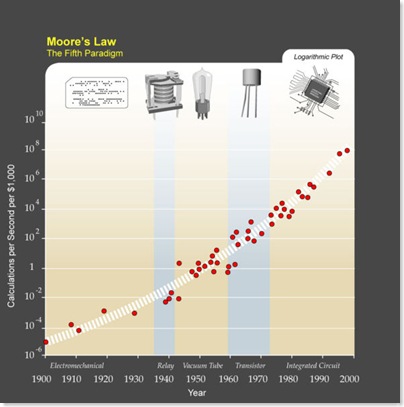
Researchers such as Ray Kurzweil, who's a big thinker, [and] Vernor Vinge, who's a science fiction author, have been talking about a concept called the singularity. Basically, if you plot the increase in computing power, you can see that it's increasing exponentially while the cost is decreasing exponentially.

MooresLaw

So by the year 2029, according to their projections, the computing power necessary to simulate a human brain will cost about one dollar. That's pretty amazing. Even if they're a little aggressive and it's 2040, that's amazing.

They're actually projecting that in 2040, artificial intelligence or computer intelligence will be a billion times more powerful than all human intelligence combined. So, we're entering a world which is going to be quite different from the world we're in.

The notion of the singularity is, when this happens, when we reach this point where essentially computing power becomes infinite or essentially infinite, or it's infinitely affordable, at least, we can't predict what's going to happen next. Now these guys, because they don't believe in anything beyond the scientific material worldview, their vision of what happens after the singularity is that machines become intelligent and sentient and they're the next step in evolution and they replace humans.

I think that's wrong. What's much more likely is a form of symbiosis, where humans and machines merge such that the machines really amplify us and we amplify the machines. We bring the sentience, the machines bring this vast computational capability, and essentially the web becomes and extension of our brain.

That doesn't help us become enlightened. That makes our delusion more functional.

A Complete Experience

Excerpt from a talk given by Shinzen Young on January 3, 2008:

To have a complete experience is to love something to death and to know it to death. Whether it’s your self or any sensory event, big or small.

When you love it to death and know it to death, you’re too busy experiencing it to make an object out of it, so in a sense it’s not there. But it’s not there because you’re so busy knowing it, so it’s more there.

It’s both more there and less there than normal human experience. Therefore it's a kind of todo and a kind of nada, a kind of completeness and a kind of nothingness at exactly the same time. Which sounds paradoxical, sort of ridiculous actually, logically speaking.
But I would have to say that most people, from my point of view, are half-alive and half-dead and they call that living. The spiritual path, or the path to enlightenment, is about being completely alive and completely dead at exactly the same time. And that’s what might be called real living, true living.

So knowing it to death is both rich and — at the same time — vacuous. And loving it to death, it’s through this absolute affirmation for it to be just as it is that its vacuity becomes experienced directly.

Thursday, September 18, 2008

We Make Reality Inaccessible

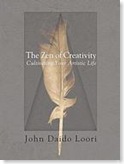
Excerpt from The Zen of Creativity: Cultivating your artistic life by John Daido Loori:

The Zen of Creativity"Whole body and mind seeing," as Master Dogen refers to it, is the total merging of subject and object, of seer and seen, of self and other. This is, essentially, the experience of enlightenment. In "seeing with the whole body and mind" one goes blind. In "hearing with the whole body and mind" one goes deaf. And there is no way to describe this state of consciousness.

...All creatures experience the universe through drops on webthe senses. And at every moment, a different universe is being created by each being. A spider, for example, feels the universe through its legs, which touch the key strands of its web. It knows when it's raining, or when food is available. It doesn't think to itself, "That's not a fly on the web. That's rain." Yet it knows. The spider doesn't deliberate about what kind of fly it would like to eat or criticize the rain for trying to deceive it. A spider just does what it does, effortlessly and spontaneously.

For most of us, however, our habitual way of perceiving is not so simple. Our universe is filled with internal dialogue, analysis, evaluation, classification. We choose knowing over direct experience. Yet, in knowing, we kill reality, or, at least, we make it inaccessible. We live and create out of our ideas, out of the apparent comfort of certainty that they offer.

Wednesday, August 20, 2008

A Showbiz Idea of Being Important

From "Practicing Like Your Hair's on Fire," by Gelek Rinpoche, Buddhadharma (Fall 2008):

hair_on_fire Many of us complain, “I have no time.” I like to call that a good, fancy, stylish excuse. Everybody likes to say, “I’m too busy,” because everybody would like to seem important. It is a great excuse that offers several benefits: you can avoid what you don’t want to do; it gives you a showbiz idea of being important; and all the important people do it, so you can include yourself with them.

I refer to that as busy laziness. We experience this kind of laziness because we have a problem recognizing our real priorities.

...

In short, our human life, with the limitless capacity of our minds, is capable of producing any results we wish. If your goal is to get rich, your human life is capable of producing it. If you want to become famous, your life is capable of doing it. Hollywood is full of such people. It's the same with anything else you choose to do. Whether you are satisfied with the results or not is a different story, but human life is capable of delivering the goods. If you want to be fully enlightened, if your ultimate goal is to achieve enlightenment, then this life is capable of delivering that as well. From our point of view we may fail, but it won't be because our human life lacked the capacity for total enlightenment. It's be because we didn't take advantage of it.

Saturday, August 02, 2008

The Flash

By Italo Calvinao from Numbers in the Dark:

Numbers in the Dark It happened on day, at a crossroads, in the middle of a crowd, people coming and going.

I stopped, blinked: I understood nothing. Nothing, nothing about anything; I didn't understand the reasons for things or for people, it was all senseless, absurd. And I started to laugh.

What I found strange at the times was that I'd never realized before. That up until then I had accepted everything: traffic lights, cars, posters, uniforms, monuments, things completely detached from any sense of the world, accepted them as if they were some necessity, some chain of cause and effect that bound them together.

Then the laugh died in my throat, I blushed, ashamed. I waved to get people's attention and "Stop a second!" I shouted, "there's something wrong! Everything's wrong! We're doing the absurdist things! This can't be the right way! Where will it end?"

People stopped around me, sized me up, curious. I stood there in the middle of them, waving my arms, desperate to explain myself, to have them share the flash of insight that had suddenly enlightened me: and I said nothing. I said nothing because the moment I'd raised my arms and opened my mouth, my great revelation had been as it were swallowed up again and the words had come out any old how, on impulse.

"So?" people asked, "what do you mean? Everything's in its place. All is as it should be. Everything is a result of something else. Everything fits in with everything else. We can't see anything absurd or wrong!"

And so I stood there, lost, because as I saw it now everything had fallen into place again and everything seemed natural, traffic lights, monuments, uniforms, towerblocks, tramlines, beggars, processions; yet this didn't calm me down, it tormented me.

"I'm sorry," I answered. "Perhaps it was me that was wrong. It seemed that way. But everything's fine. I'm sorry," and I made off amid their angry glares.

Yet, even now, every time (often) that I find I don't understand something, then, instinctively, I'm filled with hope that perhaps this will be my moment again, perhaps once again I shall understand nothing, I shall grasp that other knowledge, found and lost in an instant.