“To know how good you are at something requires the same skills as it does to be good at that thing. Which means, if you’re absolutely hopeless at something, you lack exactly the skills that you need to know that you’re absolutely hopeless at it. And this is a profound discovery, that most people who have absolutely no idea what they’re doing have absolutely no idea that they have no idea what they’re doing. It explains a great deal of life.”
"In the course of the play, what I learn — and it's why I view it as a Zen play — is that if you take the time, which often old age and disease forces you to do, you slow down and take the time, you begin to see things differently. Things that might on the surface look mediocre, but that in fact, when you pierce them and delve down into them, are beautiful."
We have all observed the intense absorption of children in play, that wide-eyed concentration in which both the child and the world vanish, and there is only the play. Grown-ups involved in work they love also can experience such moments. It is possible to become what you are doing; these times come when pouf!—out you go, and there is only the work. The intensity of your focused concentration and involvement maintains and augments itself, your physical needs decrease, your gaze narrows, your sense of time stops. You feel alert and alive; effort becomes effortless. You lose yourself in your own voice, in the handling of your tools, in your feelings for the rules. Absorbed in the pure fascination of the game of that particular medium, you forget time and place and who you are. The noun of self becomes a verb. This flashpoint of creation in the present moment is where work and play merge.
Buddhists call this state of absorbed, selfless, absolute concentration samadhi. Samadhi is best known to be attainable through the practice of meditation, thought there is also walking samadhi , cooking samadhi, sandcastle-building samadhi, writing samadhi, fighting samadhi, lovemaking samadhi, flute-playing samadhi. When the self-clinging personality somehow drops away, we are both entranced and alert at the same time.
Babies of our own and other species seem to be often, if not usually, in a state of samadhi, and also have the unique property of putting everyone around them into a state of samadhi as well. Happy, relaxed, unmindful of self, concentrated, the baby envelops us in her own state of divine delight and expansiveness. Even when a baby is squalling and miserable, and making everyone else miserable too, she is whole and thorough about it, and is generating her own special atmosphere of squalling samadhi and misery-making samadhi…
…One of the great ways of emptying the self, along with meditation, dance, love, and play, is tuning a musical instrument. In tuning an instrument we are forced to obliterate outside noises and distractions: As the sound gets closer and closer to the pure vibration we are trying for, as the pitch moves up and down over a smaller and smaller range, we find body and mind progressively dropping away. We enter more and more deeply into the sound. We enter into a kind of trance state. This intensified listening is deep play—total immersion in the game. And once we pick up that instrument to play, our friends the audience will enter into a similar state of mind more readily in proportion to the care we have given to that process of tuning. What we discover, mysteriously, is that in tuning the instrument we tune the spirit.
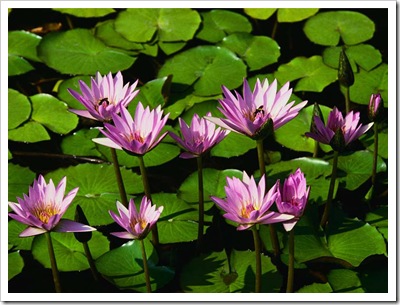
An even simpler samadhi exercise is this: Look at whatever is in front of you and say, “Yes! Yes! Yes!” to it, like Molly Bloom’s life-affirming, love-affirming mantra at the end of Ulysses. The universe of possibilities becomes visibly, tangibly larger, over a period of mere moments. When you say, “No, No, No,” the world gets smaller and heavier. Try it both ways and verify the truth of this very simple method. Look at water lilies or other highly vascular flowering plants. When the sun comes out, the flowers unfold before your eyes; when the sun goes away, they close. What the sun’s radiation and the lilies say to each other, translated through the biophysical language of chlorophyll, sugar, protein, and water, is “Yes! Yes! Yes!”
Shinzen Young describing what he means by having a complete experience (Jan. 6, 2009):
Having a complete experience is a technical term. I don’t mean complete in the sense it was intense. I don’t mean complete in the sense that you stayed with it until the end—although that’s part of it. By complete I mean there was a certain critical mass of concentration, clarity, and equanimity present from beginning to end in that experience.
We can’t always have complete experiences, but sometimes we can and with practice we can have them more and more.
When we have a complete experience of something that’s ordinary, it becomes utterly extraordinary. It becomes paradoxical in that it becomes deeply fulfilling and no longer there at the same time…One could also say that when you bring an extraordinary degree of concentration, clarity, and equanimity to an extraordinary experience it becomes utterly ordinary. That’s the path of liberation instead of the path of powers.
We can’t always have enough concentration, clarity, and equanimity to have a complete experience of something. But maybe we can have a little bit of concentration or a little bit of clarity or a little bit of equanimity and that’s not too shabby. Maybe we can’t have any concentration, clarity, and equanimity at all under certain circumstances. But we can have equanimity with that. We can accept that that’s the case and we can continue to do formal practice despite the fact that we have essentially no concentration, no clarity, and no equanimity.
However, we’re still setting the stage for nature to do its job. We’re catalyzing a natural process. We’re giving nature what it needs. On the surface it seems like we’re wasting our time because it's like total monkey mind, total confusion, total lost in emotional chaos, sleepiness, aches and pains, etcetera. But deep down, slowly, changes are taking place, even under those circumstances.
"I’ve been teaching meditation for two and a half decades, always exploring new ways to improve what I teach. Over the course of those years, I have made a number of interesting discoveries, some of which do not appear in standard books on the subject. One question I struggled with early on was how to make the practice doable by anyone, without watering down its intensity. When people read accounts of traditional monastic training, the usual reaction is, “If that’s what it takes to get enlightenment, I think I’ll wait for a few lifetimes.” And indeed it’s true. Most people have neither the time nor the inclination to do intensive formal meditation practice. Why should they? Isn’t there enough physical and emotional discomfort in ordinary life? Why intentionally seek it out?"
"But the monastery will come to each of us when we have to confront our fears, losses, compulsions and anxieties, or process the aftermath of trauma. The monastery comes to us in the form of emotional crisis, illness or injury, a phobia or a failed relationship. The question is whether we will be in a position to recognize and use it as such. If there were a way to help people maintain continuous quality meditation through intense real world challenges, anyone could experience insight and purification comparable to that of traditional renunciates’ regimes. Basically it boils down to this: Intensity of Challenge multiplied by Sharpness of Mindfulness multiplied by Depth of Equanimity equals the Rate of Psychospiritual Growth. When things are most challenging, we have the opportunity to leap forward in our spiritual development, provided we make use of the challenge."
"The primary focus of this path of choosing wisely...is learning to stay present. Pausing very briefly, frequently throughout the day, is an almost effortless way to do this. For just a few seconds we can be right here. Meditation is another way to train in learning to stay or...learning to come back, to return to the present over and over again."
"In Zen Buddhist painting, ensō symbolizes a moment when the mind is free to simply let the body-spirit create. The brushed ink of the circle is usually done on silk or rice paper in one movement and there is no possibility of modification: it shows the expressive movement of the spirit at that time."





 We have all observed the intense absorption of children in play, that wide-eyed concentration in which both the child and the world vanish, and there is only the play. Grown-ups involved in work they love also can experience such moments. It is possible to become what you are doing; these times come when pouf!—out you go, and there is only the work. The intensity of your focused concentration and involvement maintains and augments itself, your physical needs decrease, your gaze narrows, your sense of time stops. You feel alert and alive; effort becomes effortless. You lose yourself in your own voice, in the handling of your tools, in your feelings for the rules. Absorbed in the pure fascination of the game of that particular medium, you forget time and place and who you are. The noun of self becomes a verb. This flashpoint of creation in the present moment is where work and play merge.