Showing posts with label confusion. Show all posts

Saturday, April 30, 2011

Coping with Chaos by Categorizing

Excerpt from “Chaos Promotes Stereotyping,” by Philip Ball, Nature.com, April 7, 2011:

A study shows that messy surroundings also make people more likely to stereotype others.

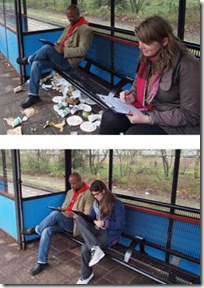
Diederik Stapel and Siegwart Lindenberg, social scientists at Tilburg University in the Netherlands, asked subjects in messy or orderly everyday environments (a street and a railway station) to complete questionnaires that probed their judgements about certain social groups. They found small but significant and systematic differences in the responses: there was more stereotyping in the disorderly areas than the clean ones…

Study subjects sat further away from someone of another race when the train station was a mess.

In one experiment, passers-by in the busy Utrecht railway station were asked to sit in a row of chairs and answer a questionnaire for the reward of a chocolate bar or an apple. The researchers took advantage of a cleaners' strike that had left the station dirty and litter-strewn to create their messy environment; they returned to do the same testing once the strike was over and the station was clean.

In the questionnaires, participants were asked to rate how much certain social groups — Muslims, homosexuals and Dutch people — conformed to qualities that formed part of positive and negative stereotypes, as well as qualities unrelated to stereotypes. For example, the 'positive' stereotypes for homosexuals were (creative, sweet), the 'negative' were (strange, feminine) and the neutral terms were (impatient, intelligent).

As well as probing these responses, the experiment examined unconscious negative responses to race. All the subjects were white, but when they were asked to sit down, one chair at the end of the row was already occupied by a black or white Dutch person. In the messy station, people sat on average further from the black person than the white one, whereas in the clean station there was no statistical difference…

Stapel and Lindenberg say that stereotyping may be an attempt to mentally compensate for mess: "a way to cope with chaos, a mental cleaning device" that partitions other people neatly into predefined categories.

Read the rest of the article…

See also: Broken Windows Theory

Saturday, April 23, 2011

Have Mercy

Petition
by Franz Wright, from God’s Silence

Kneeling
at the foot of the universe

I ask

from this body
in confusion

and pain (a condition

which You
may recall)

Clothed now in light
clothed in abyss, at the prow
of the desert
killed
into everywhereness —

have mercy

Mercy on us all

Saturday, February 12, 2011

Poetry Deal Breakers

A response from Billy Collins to the question, Could you say a little about the deal breakers that keep you from reading a poem?

“Well, the word cicada. I won’t tolerate that. I’m just sick of them. So if I’m reading a poem and I come across the word cicada, I stop. Deal breaker. That’s it. I mean, that’s one easy one to answer.

I guess other poems that I tend not to finish are poems that exhibit a kind of presumptuousness in that the first couple of lines, I feel like I’m suddenly in an ambulance with someone and he or she is being taken to the psychiatric ward and is telling me about some inner psychic terror that their suffering from without having really introduced themselves. And that seems to be a form of kind of psychological bad manners.

I appreciate poems that are clear and then mysterious. I think poems that work for me are poems in which a writer really appreciates and understands the difference between what to be clear about and what to be mysterious about. So what cards to turn over and what cards to leave face down. And if you leave all the cards face down—I mean some poems read that way to me—there’s really no game. It’s just kind of fifty-two bits of obscurity. And if you turn them all over, it’s just too obvious. So I think the manipulation of the clear and the mysterious, in the right way, are deal makers for me.”   

From Billy Collins Live: A Performance at the Peter Norton Symphony Space, April 20, 2005

Sunday, February 06, 2011

Being Lost

Cutting Loose
by William Stafford

Sometimes from sorrow, for no reason,
you sing. For no reason, you accept
the way of being lost, cutting loose from all else and electing a world where you go
where you want to.

Arbitrary, sound comes, a reminder
that a steady center is holding
all else. If you listen, that sound will tell where it is, and you can slide your way past trouble.

Certain twisted monsters
always bar the path—but that’s when you get going best, glad to be lost, learning how real it is
here on the earth, again and again.

*     *     *     *     *

See also:

Lost & Found (1/25/11) -- “In this episode, Radiolab steers its way through a series of stories about getting lost, and asks how our brains, and our hearts, help us find our way back home.”


Wednesday, August 11, 2010

I Have to Call Myself Back

“I’m very bad when it comes to worship. This is just me. This is probably a terrible thing to say [in a church], but I don’t need it very much. I try to live in this kind of presence and a kind of awareness and I have to call myself back time and time again to remembrance of who I am. Partly, I think, all that’s because as a kid, as a Presbyterian, I had to go to church four times on Sunday. That wears out your patience and your ass. I’ve sort of done my stint. But that’s just me. It’s not other people.”

~ Sam Keen, author of In the Absence of God: Dwelling in the Presence of the Sacred

Saturday, June 19, 2010

Like a Strange Dream

Evening Talk
by Charles Simic, from The Book of Gods and Devils

Gods and Devils (1990) Everything you didn’t understand
Made you what you are. Strangers
Whose eye you caught on the street
Studying you. Perhaps they were all-seeing
Illuminati? They knew what you didn’t,
And left you troubled like a strange dream.

Not even the light stayed the same.
Where did all that hard glare come from?
And the scent, as if mythical beings
Were being groomed and fed stalks of hay
On these roofs drifting among the evening clouds.

You didn’t understand a thing!
You loved the crowds at the end of the day
That brought you so many mysteries.
There was always someone you were meant to meet
Who for some reason wasn’t waiting.
Or perhaps they were? But not here, friend.

You should have crossed the street
And followed that obviously demented woman
With the long streak of blood-red hair
Which the sky took up like a distant cry.

Tuesday, May 04, 2010

A Field Guide to Getting Lost

An excerpt from The Ticking Is the Bomb: A Memoir by Nick Flynn:

ticking Here’s a secret: Everyone, if they live long enough, will lose their way at some point. You will lose your way, you will wake up one morning and find yourself lost. This is a hard, simple truth. If it hasn’t happened to you yet consider yourself lucky. When it does, when one day you look around and nothing is recognizable, when you find yourself alone in a dark wood having lost the way, you may find it easier to blame someone else—an errant lover, a missing father, a bad childhood. Or it may be easier to blame the map you were given—folded too many times, out of date, tiny print. You can shake your fist at the sky, call it fate, karma, bad luck, and sometimes it is. But, for the most part, if you are honest, you will only be able to blame yourself. Life can, of course, blindside you, yet often as not we choose to be blind—agency, some call it. If you’re lucky you’ll remember a story you heard as a child, the trick of leaving a trail of breadcrumbs, the idea being that after whatever it is that is going to happen in those woods has happened, you can then retrace your steps, find your way back out. But no one said you wouldn’t be changed, by the hours, the years, spent wandering those woods.

Monday, May 03, 2010

Simple Principles that Guide a System

Excerpt from “Complexity Used to Be So Simple. It Meant Progress,” by David Segal, New York Times, April 30, 2010:

Preparing for the launch of Apollo 11. (NASA)What we need, suggests Brenda Zimmerman, a professor at Schulich School of Business in Ontario, is a distinction between the complicated and the complex. It’s complicated, she says, to send a rocket to the moon — it requires blueprints, math and a lot of carefully calibrated hardware and expertly written software. Raising a child, on the  other hand, is complex. It is an enormous challenge, but math and blueprints  won’t help. Alex's first day of school. Performing hip replacement surgery, she says, is complicated. It takes well-trained personnel, precision and carefully calibrated equipment. Running a health care system, on the other hand, is complex. It’s filled with thousands of parts and players, all of whom must act within a fluid, unpredictable environment. To run a system that is complex, it’s not enough to get the right people and the ideal equipment. It takes a set of simple principles that guide and shape the system. For instance: Teach everyone the best practices of doctors who are really good at hip replacement surgery.

“We get seduced by the complicated in Western society,” Ms. Zimmerman says. “We’re in awe of it and we pull away from the duty to ask simple questions, which we do whenever we deal with matters that are complex.”

Tuesday, November 17, 2009

Blooming, Buzzing, Confusion

“The baby, assailed by eyes, ears, nose, skin, and entrails at once, feels it all as one great blooming, buzzing, confusion.”

~ William James, The Principles of Psychology

Saturday, August 15, 2009

A Context for Correcting Misinformation

Kathleen Hall Jamieson in conversation with Bill Moyers and Drew Altman on Bill Moyers Journal (8.14.09):

unSpun : Finding Facts in a World of Disinformation People who are angry and frustrated and not necessarily well informed in part driven by people who are on the other side of the reform effort. And it's driving into news evocative visuals that are leading the public, I think, to overgeneralize the extent to which there is principal, reasoned dissent from health care reform.

...But when people are shouting at each other, the answer doesn't get through. And when you're impugning the integrity of the person who's answering the questions, the member of Congress, that person's response isn't going to be believed if it is able to be articulated and isn't simply shouted down.

And so it's not creating context in which misinformation on both sides can be corrected. And that's the problem. We don't have a deliberative process here taking place in public to inform public opinion.

Instead, we're potentially distorting it.

Friday, August 14, 2009

No Expectations of Success Now

Solving the Puzzle
by Stephen Dunn, from Loosestrife

Loosestrife: poems I couldn’t make all the pieces fit,
So I threw one away.

No expectations of success now,
None of that worry.

The remaining pieces seemed
to seek their companions.
A design appeared.

I could see the connection
Between the overgrown path
And the dark castle on the hill.

Something in the middle, though,
was missing.

It would have been important once.
I wouldn’t have been able to sleep
without it.

[Spotted on Jonathan Carroll’s blog 8.13.09]

Sunday, May 10, 2009

Setting the Stage

Shinzen Young describing what he means by having a complete experience (Jan. 6, 2009):

Having a complete experience is a technical term. I don’t mean complete in the sense it was intense. I don’t mean complete in the sense that you stayed with it until the end—although that’s part of it. By complete I mean there was a certain critical mass of concentration, clarity, and equanimity present from beginning to end in that experience.

We can’t always have complete experiences, but sometimes we can and with practice we can have them more and more.

When we have a complete experience of something that’s ordinary, it becomes utterly extraordinary. It becomes paradoxical in that it becomes deeply fulfilling and no longer there at the same time…One could also say that when you bring an extraordinary degree of concentration, clarity, and equanimity to an extraordinary experience it becomes utterly ordinary. That’s the path of liberation instead of the path of powers.

We can’t always have enough concentration, clarity, and equanimity to have a complete experience of something. But maybe we can have a little bit of concentration or a little bit of clarity or a little bit of equanimity and that’s not too shabby. Maybe we can’t have any concentration, clarity, and equanimity at all under certain circumstances. But we can have equanimity with that. We can accept that that’s the case and we can continue to do formal practice despite the fact that we have essentially no concentration, no clarity, and no equanimity.

However, we’re still setting the stage for nature to do its job. We’re catalyzing a natural process. We’re giving nature what it needs. On the surface it seems like we’re wasting our time because it's like total monkey mind, total confusion, total lost in emotional chaos, sleepiness, aches and pains, etcetera. But deep down, slowly, changes are taking place, even under those circumstances.

Monday, April 13, 2009

Don’t Know

"Where I am, I don't know, I'll never know, in the silence you don't know, you must go on, I can't go on, I'll go on."

~ Samuel Beckett


Friday, March 20, 2009

Like Waking Up in Another World

by James Tate, from Return to the City of White Donkeys

Return to the City of White Donkeys The Loon

A loon woke me this morning. It was like waking up
in another world. I had no idea what was expected of me.
I waited for instructions. Someone called and asked me
if I wanted a free trip to Florida. I said, "Sure. Can
I go today?" A man in a uniform picked me up in a limousine,
and the next thing I know I'm being chased by an alligator
across a parking lot. A crowd gathers and cheers me on.
Of course, none of this really happened. I'm still sleeping.
I don't want to go to work. I want to know what the loon is
saying. It sounds like ecstasy tinged with unfathomable
terror. One thing is certain: at least they are not speaking
of tax shelters. The phone rings. It's my boss. She says,
"Where are you?" I say, "I don't know. I don't recognize
my surroundings. I think I've been kidnapped. If they make
demands of you, don't give in. That's my professional advice."
Just then, the loon let out a tremendous looping, soaring,
swirling, quadruple whoop. "My god, are you alright?" my
boss said. "In case we do not meet again, I want you to know
that I've always loved you, Agnes," I said. "What?" she said.
"What are you saying?" "Good-bye, my darling. Try to remember me
as your ever loyal servant," I said. "Did you say you loved
me?" she said. I said, "Yes," and hung up. I tried
to go back to sleep, but the idea of being kidnapped had me
quite worked up. I looked in the mirror for signs of torture.
Every time the loon cried, I screamed and contorted my face
in agony. They were going to cut off my head and place it on
a stake. I overheard them talking. They seemed like very
reasonable men, even, one might say, likeable.

Thursday, February 19, 2009

This Churning is Our Journey

Tossing and Turning
By John Updike, from Collected Poems 1953-1993

updike The spirit has infinite facets, but the body
confiningly few sides.
There is the left,
the right, the back, the belly, and tempting
in-betweens, northeasts and northwests,
that tip the heart and soon pinch circulation
in one or another arm.
Yet we turn each time
with fresh hope, believing that sleep
will visit us here, descending like an angel
down the angle our flesh's sextant sets,
tilted toward that unreachable star
hung in the night between our eyebrows, whence
dreams and good luck flow.
Uncross
your ankles. Unclench your philosophy.
This bed was invented by others; know we go
to sleep less to rest than to participate
in the twists of another world.
This churning is our journey.
It ends,
can only end, around a corner
we do not know
we are turning.

Wednesday, January 28, 2009

One Story Becomes Another

Note
by W.S. Merwin

Remember how the naked soul
comes to language and at once knows
loss and distance and believing

then for a time it will not run
with its old freedom
like a light innocent of measure
but will hearken to how
one story becomes another
and will try to hear where
they have emerged from
and where they are heading
as though they were its own legend
running before the words and beyond them
naked and never looking back

through the noise of questions

Sunday, December 21, 2008

Uncertainty

“I wouldn’t ever say whether the priest is innocent or guilty because I saw ‘Doubt’ as being about something larger…What’s so essential about this movie is our desire to be certain about something and say, This is what I believe is right, wrong, black, white. That’s it. To feel confident that you can wake up and live your day and be proud instead of living in what’s really true, which is the whole mess that the world is. The world is hard, and John is saying that being a human on this earth is a complicated, messy thing…And I, personally, am uncomfortable with that messiness, just as I acknowledge its absolute necessity. I find the need to play a part like Father Flynn inescapable, and I only want to do things I’m that passionate about. I know there are actors out there that present themselves as cool cats, but you better take your cool-cat suit off if you want to act. You can’t otherwise.”

~ Philip Seymour Hoffman, from “A Higher Calling,” by Lynn Hirschberg, New York Times Sunday Magazine (12.21.08)

“…I've always been really, deeply interested, because I think I can understand the solace that's available in the whole construct of religion. But I really don't believe in the power of prayer, or things would have been avoided that have happened, that are awful. So it's a horrible position as an intelligent, emotional, yearning human being to sit outside of the available comfort there. But I just can't go there…I have a belief, I guess, in the power of the aggregate human attempt – the best of ourselves. In love and hope and optimism – you know, the magic things that seem inexplicable. Why we are the way we are. I do have a sense of trying to make things better. Where does that come from? And why do some people just seem to want to make other people miserable?”

~ Meryl Streep, from “Meryl Streep: Mother Superior,” by Mick Brown, Daily Telegraph (12.2008)

Tuesday, November 25, 2008

The Ability to Accept the Mess

Jhumpa Lahiri from "Jhumpa Lahiri's Struggle To Feel American," Morning Edition, NPR (11.25.08):

Jhumpa Lahiri I think that what has happened over the years that I've been writing is that with each new story or book, I do feel that I'm able to confront the truth of my life with a little more honesty.

I think that a lot of my upbringing was a lot about denying and hiding and evading and fretting and wanting to make everything fit and make everything easy and wanting to pretend that I wasn't this person or that person or wishing that I were otherwise. Wishing that I looked another way, that I had a different name, and wishing my parents weren't torn between two parts of the globe. And all of that stuff, all of that mess of life, of my life, of my upbringing that I for so long just wanted to put into a box and make it still and make it not what it was. To deny my life in some fundamental way. To pretend that it was something else.

I think that in the years that I've been writing, it has helped me to look the truth in the eye a little bit better each time. And I think that has helped me as a person, the ability to accept the mess, to accept and to understand that I will never be able to fit it into a box. That it will never sit still. That my parents will always be tied to two different parts of the earth and that that is a difficult experience. That is a painful experience. It can be a very enriching experience as well. I think it has been liberating and brought me some peace to just confront that truth, if not to be able to solve it or answer it.

Thursday, October 16, 2008

Willing to be Lost

Excerpt from Ron Carlson Writes a Story:

Ron Carlson Writes a Story

The single largest advantage a veteran writer has over the beginner is this tolerance for not knowing. It’s not style, skill, or any other dexterity. An experienced writer has been in those woods before and is willing to be lost; she knows that being lost is necessary for the discoveries to come. The seasoned writer waits, is patient, listens to her story as it talks to her. Now I’ve started being a little mystical here, and I want to avoid the sense that writing is magic and not work. The story isn’t going to talk to you, but things are going to happen in the heat of writing that cannot be predicted from outside the act itself. Much of a writer’s work is exploration, and that involves so many things he cannot know from the outside. And we all agree that it is more comfortable to be outside the story considering it, than inside the story struggling to see it. Comfort isn’t an issue.

Sunday, October 05, 2008

A Visceral Need for Order

From Talk of the Nation and All Things Considered (10.03.08):

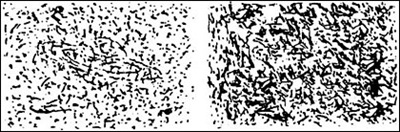
New research shows that when people perceive they have no control over a given situation, they are more likely to see illusions, patterns where none exist and even believe in conspiracy theories. The study suggests that people impose imaginary order when no real order can be perceived.

"People see false patterns in all types of data," says Jennifer Whitson, one of the authors of the report, "This suggests that lacking control leads to a visceral need for order — even imaginary order."

Whitson is an assistant professor of management at the McCombs School of Business in the University of Texas-Austin.

Jennifer Whitson and Adam Galinsky

In short, people who felt that the world was beyond their control became so hungry for patterns and connections that their minds started just making them up.

But Whitson also found one way to help people who are feeling powerless to see the world the way it really is. In a different experiment, she asked volunteers who were feeling a lack of control to talk about a personal value that they consider important.

When these people were shown fuzzy, meaningless images, they did not see imaginary objects.

Maybe this could help in real life, Whitson says. When you're feeling powerless, maybe you should stop and think about what you really care about — something you do have control over.