“Poetry addresses individuals in their most intimate, private, frightened and elated moments. People turn to poetry in times of crisis because it comes closer than any other art form to addressing what cannot be said. In expressing the inexpressible poetry remains close to the origins of language.”
The recent memorial service in Tucson concluded with University of Arizona President Robert Shelton reading this poem by W.S. Merwin, from Present Company:
To the New Year
With what stillness at last you appear in the valley your first sunlight reaching down to touch the tips of a few high leaves that do not stir as though they had not noticed and did not know you at all then the voice of a dove calls from far away in itself to the hush of the morning
so this is the sound of you here and now whether or not anyone hears it this is where we have come with our age our knowledge such as it is and our hopes such as they are invisible before us untouched and still possible
W.S. Merwin from “The Garden & the Sword,” an interview with Joel Whitney, Tricycle Magazine, Winter 2010:
I don’t think we have imagination apart from the environment. And I don’t think we have an existence apart from the environment either. And if the imagination isn’t about our existence, I don’t know what it’s about. It’s not about making money, that’s for sure.
…If you’re looking for neat formulaic answers in Dogen, you don’t find them. You don’t find them in Keizan, either. You have to come at them from a different part of your own mind. That’s the part of Zen practice that’s attractive to me. But it’s not unique to Zen. It’s there in Taoism. It probably was there in parts of the practice that became Greek Orthodoxy, that came out of the desert. The origins of all of those things are extremely ancient; they’re older than what we think of as the beginnings of Buddhism. The origin of Taoism may be completely on its own, but all of them go back to shamanism. And we don’t know know the history of shamanism; it’s all speculation. They link in my mind to things which are incredibly ancient.
…the link between the imagination—which to me is the great pinnacle of humanity, the imagination that makes the arts and makes compassion—is ancient in our species and goes way back. And it’s never been separate. And when you get any aspect of the culture that tries to separate it, it’s destructive and suicidal.
Take them away, names like Buddhism. I’m impatient with them. There’s something beyond all that, beneath all that that they all share, that they all come from. They are branches from a single root. And that’s what one has to pay attention to.
Song Dynasty painting in the Litang style illustrating the theme "Confucianism, Taoism and Buddhism are one." Depicts Taoist Lu Xiujing (left), official Tao Hongjing (right) and Buddhist monk Huiyuan (center, founder of Pure Land) by the Tiger stream. The stream borders a zone infested by tigers that they just crossed without fear, engrossed as they were in their discussion. Realizing what they just did, they laugh together, hence the name of the picture,Three laughing men by the Tiger stream.
Sitting over words very late I have heard a kind of whispered sighing not far like a night wind in pines or like the sea in the dark the echo of everything that has ever been spoken still spinning its one syllable between the earth and silence
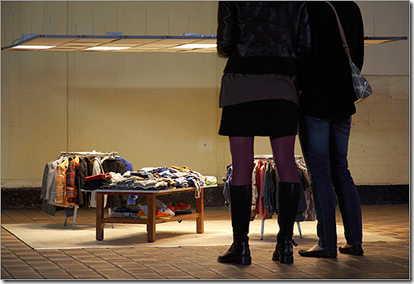
workworkworkworkwork consists of hundreds of objects, including shirts, pottery, paintings, necklaces and magazines that recreate displays of objects for sale that homeless people frequently put on New York sidewalks. (Bing, 2003) The piece is not classified by object, however it is more of a confusion of pieces, each “grouping is ordered in its own special way, as if different senses of order were involved, individual orders—different levels of marketing and presentability.” (Saltz, 1992)
Charles LeDray treats clothes as surrogates for human identity, particularly male identity, and for the many types of work that go into constructing it. As such—and unlike the fashion industry, which is founded on an unblinking faith in the potential of clothes to communicate power, beauty, and self-worth—his work is intensely alive to the pathos clothes can communicate, and to the many senses in which they just don’t . . . quite. . . fit.
LeDray, who was born in Seattle in 1960 and lives and works in New York, gives this “not quite fitting’’ a literal twist. The majority of the clothes he makes and transforms into sculptures are small. Too small to wear, but not so small that they seem precious or cute.
And yes, LeDray makes them. All of them. By hand. Himself.
Today, when the actual making of art objects is frequently displaced from the hands of the nominal creator to various anonymous assistants, there’s an atavistic appeal in LeDray’s displays of virtuosic skill and dedication. But it’s not just a sentimental appeal.
The time LeDray dedicates to the making of his pieces — in some cases as long as three or four years — is as much a conceptual tool as the medium itself. Painstakingly cut, carved, stitched, sewn, and thrown, his sculptures crystallize, through ironic devotion, a sense of pathos. They sharpen our awareness of the expendability of things…
Thinking of the artist working away, with scissors, pins, needle, and thread, I thought of W.S. Merwin’s great poem, “Separation’’:
Your absence has gone through me Like thread through a needle. Everything I do is stitched with its color.
I will tell you what he told me in the years just after the war as we then called the second world war
don't lose your arrogance yet he said you can do that when you're older lose it too soon and you may merely replace it with vanity
just one time he suggested changing the usual order of the same words in a line of verse why point out a thing twice
he suggested I pray to the Muse get down on my knees and pray right there in the corner and he said he meant it literally
it was in the days before the beard and the drink but he was deep in tides of his own through which he sailed chin sideways and head tilted like a tacking sloop
he was far older than the dates allowed for much older than I was he was in his thirties he snapped down his nose with an accent I think he had affected in England
as for publishing he advised me to paper my wall with rejection slips his lips and the bones of his long fingers trembled with the vehemence of his views about poetry
he said the great presence that permitted everything and transmuted it in poetry was passion passion was genius and he praised movement and invention
I had hardly begun to read I asked how can you ever be sure that what you write is really any good at all and he said you can't
you can't you can never be sure you die without knowing whether anything you wrote was any good if you have to be sure don't write
First you must know that the whole of the physical world floats in each of the senses at the same time. Each of them reveals to us a different aspect of the kingdom of change. But none of them reveals the unnamable stillness that unites them. At the heart of change it lies unseeing, unhearing, unfeeling, unchanging, holding within itself the beginning and the end. It is ours. It is our only possession. Yet we cannot take it in to our hands, which change, nor see it with our eyes, which change, nor hear it or taste it or smell it. None of the senses can come to it. Except backwards.
Any more than they can come to each other.
Yet they point the way. And most authoritatively as they disappear.
For [Merwin, poetry] involves more than just the…musical effects…A kind of conceptual harmony is required, a gradual perception of the poem’s ideal shape emerging through draft after draft. “I can’t say what it is, but when it’s right, when it sounds right, then it is right,” he says. “Sometimes getting it right means a whole new aspect of what you’re talking about. And I tell students that writing comes from listening, that poetry comes from listening, and they inevitably say: ‘Listening to what?’ And I say: ‘That’s what you have to find out.’”
One of the great themes that runs through poetry, all poetry, and I think is one of the reasons for poetry, one of the sources of poetry, one of the sources of language, is the feeling of loss. The feeling of losing things. Not being able to hold, keep things. That's what grief is -- the feeling of having lost. Of having something being out of reach. Gone. Inaccessible... But I think that language itself and poetry are born the same way.
I think poetry's about what can't be said and I think that language emerges out of what could not be said. Out of this desperate desire to utter something, to express something inexpressible. Probably grief. Maybe something else. You know, you see a silent photograph of an Iraqi woman who's husband or son or brother has just been killed by an explosion. And you know that if you could hear, you would be hearing one long vowel of grief. Just senseless, meaningless vowel of grief. And that's the beginning of language right there.
Inexpressible sound. And it's antisocial. It's destructive. It's utterly painful beyond expression. And the consonants are the attempts to break it, to control it, to do something with it. And I think that's how language emerged.
Once you arrive it is plain that you do not remember the last time
you are always like that insisting upon beginning upon it all beginning over again as though nothing had really happened as though beginning went on and on as though it were everything until it had begun
you never know who you are the hands of the clock find you and keep going without recognition though what your light reveals when it rises wakes from another time which you appear to have forgotten
travelling all that way blank and nowhere before you came to be with the demands that you bring with you from the beginning
each time it is as though you were the same or almost O unrepeatable one needing nothing yourself and not waiting
They know so much more now about the heart we are told but the world still seems to come one a time one day one year one season and here it is spring once more with its birds nesting in the holes in the walls its morning finding the first time its light pretending not to move always beginning as it goes
Just when I needed you there you were I cannot say how long you have been present all at once color of the day as it comes to be seen color of before face of forgetting color of heaven out of sight within myself leaving me all the time only to return without question never could I live without you never have you belonged to me never do I want you not to be with me you who have been the breath of everyone and each word spoken without needing to know the meaning of any of them or who was speaking when you are the wind where do you start from when you are still where do you go you who became all the names I have known and the lives in which they came and went invisible friend go on telling me again again
When did you stop telling us what we could believe
when did you take that one step only one above all that
as once you stepped out of each of the stories about you one after the other and out of whatever we imagined we knew of you
who were the light to begin with and all of the darkness at the same time and the voice in them calling crying and the enormous answer neither coming nor going but too fast to hear
you let us believe the names for you whenever we heard them you let us believe the stories how death came to be how the light appeared
how the beginning began you let us believe all that
then you let us believe that we had invented you and that we no longer believed in you and that you were only stories that we did not believe
you with no moment for beginning no place to end one step above all that
You spend so much of your time expecting to become someone else always someone who will be different someone to whom a moment whatever moment it may be at last has come and who has been met and transformed into no longer being you and so has forgotten you
meanwhile in your life you hardly notice the world around you lights changing sirens dying along the buildings your eyes intent on a sight you do not see yet not yet there as long as you are only yourself
with whom as you recall you were never happy to be left alone for long
Remember how the naked soul comes to language and at once knows loss and distance and believing
then for a time it will not run with its old freedom like a light innocent of measure but will hearken to how one story becomes another and will try to hear where they have emerged from and where they are heading as though they were its own legend running before the words and beyond them naked and never looking back
As long as we can believe anything we believe in measure we do it with the first breath we take and the first sound we make it is in each word we learn and in each of them it means what will come again and when it is there in meal and in moon and in meaning it is the meaning it is the firmament and the furrow turning at the end of the field and the verse turning with its breath it is in memory that keeps telling us some of the old story about us
"The primary focus of this path of choosing wisely...is learning to stay present. Pausing very briefly, frequently throughout the day, is an almost effortless way to do this. For just a few seconds we can be right here. Meditation is another way to train in learning to stay or...learning to come back, to return to the present over and over again."
"In Zen Buddhist painting, ensō symbolizes a moment when the mind is free to simply let the body-spirit create. The brushed ink of the circle is usually done on silk or rice paper in one movement and there is no possibility of modification: it shows the expressive movement of the spirit at that time."





 Heart
Heart 



 First you must know that the whole of the physical world floats in each of the senses at the same time. Each of them reveals to us a different aspect of the kingdom of change. But none of them reveals the unnamable stillness that unites them. At the heart of change it lies unseeing, unhearing, unfeeling, unchanging, holding within itself the beginning and the end. It is ours. It is our only possession. Yet we cannot take it in to our hands, which change, nor see it with our eyes, which change, nor hear it or taste it or smell it. None of the senses can come to it. Except backwards.

 Once you arrive it is plain
 Just when I needed you
 When did you stop
 You spend so much of your time





