Showing posts with label observations. Show all posts

Friday, April 01, 2011

Wherever We Are

Cleveland, March 25, 2011

Residence/Inn
by Daron Larson

The hotel room is roomier
now that we’re older,
largely because of your frequent business travel
which rewards loyalty with extra comforts.

There’s even a small kitchen,
though nothing to eat,
and a living room with a couch
that can become a bed for guests.

I pull back the curtains to let the light in.
You’ve already managed to unpack
everything we’ve brought
and sort it all into the drawers —
a tendency I used to tease you about.

The bathroom counter is organized
(his, his).

The white towels hang perfectly undisturbed.
Our books and electronics wait on our nightstands
(yours, mine).

How can we ignore the similarity
between borrowing and owning?
Is it possible not to notice that
home is wherever we are?

When I get up in the middle of the night
to use the bathroom,
I take care to step over the dog,
even though she’s asleep in the kennel
not far from where we live,
hoping to wake from
the confusion of her disrupted routine.

In the morning, we make the bed.
You find coffee and read the paper
while I try to let go of my story
until the bell rings,
and then again whenever I’m able
after the sound trails off.

On the other side of the door
waits a blend of familiarity and strangeness,
not unlike every other door we have ever
closed or opened,
locked or walked through,
alone or together,
for as long as we both have lived.

Sunday, March 13, 2011

The Surprising Interplay of Basic Forces

A collection of direct quotes from reading today.

Found Poem March 13, 2011

I hold the cigarette in my mouth the entire time,
and with the feather boa involved,
there's a sense of danger.

Architects all want to be
philosophers or artists now.
I think they love to hate me.

It was an emotional catastrophe at the time,
being conceived from the inside out,
the fashion industry's disdain for
the great, unwashed masses,
enabling clients to buy shadows of shadows,
sixteen shades of gray.

Over and over complexity from the simplest of rules,
beauty from the surprising interplay of basic forces.
Those are the kinds of patterns that catch my attention.
That turned out to be a fatal miscalculation.

Why are you suddenly awake?

The kind of conversations that
I want to be having
occur best in daytime,
This is a little more challenging —   
and a lot better.

Saturday, February 05, 2011

Different Paths

Jitish Kallat's “Public Notice 3” uses phrases from a speech delivered by Swami Vivekananda at the First World’s Parliament of Religions held in The Art Institute of Chicago's Fullerton Hall on September 11, 1893. Words from the address line the steps of the Woman’s Board Grand Staircase in LED lights using the colors from the U.S. Department of Homeland Security’s alert system. The installation is on display through May 1, 2011. Jitish Kallat's "Public Notice 3" (The Art Institute of Chicago, Feb.  4, 2011)

Excerpt from the speech delivered by Vivekananda on September 11, 1893:

I am proud to belong to a religion which has taught the world both tolerance and universal acceptance. We believe not only in universal toleration, but we accept all religions as true. I am proud to belong to a nation which has sheltered the persecuted and the refugees of all religions and all nations of the earth. I am proud to tell you that we have gathered in our bosom the purest remnant of the Israelites, who came to Southern India and took refuge with us in the very year in which their holy temple was shattered to pieces by Roman tyranny. I am proud to belong to the religion which has sheltered and is still fostering the remnant of the grand Zoroastrian nation. I will quote to you, brethren, a few lines from a hymn which I remember to have repeated from my earliest boyhood, which is every day repeated by millions of human beings: "As the different streams having their sources in different paths which men take through different tendencies, various though they appear, crooked or straight, all lead to Thee."

The present convention, which is one of the most august assemblies ever held, is in itself a vindication, a declaration to the world of the wonderful doctrine preached in the Gita: "Whosoever comes to Me, through whatsoever form, I reach him; all men are struggling through paths which in the end lead to me." Sectarianism, bigotry, and its horrible descendant, fanaticism, have long possessed this beautiful earth. They have filled the earth with violence, drenched it often and often with human blood, destroyed civilization and sent whole nations to despair. Had it not been for these horrible demons, human society would be far more advanced than it is now. But their time is come; and I fervently hope that the bell that tolled this morning in honor of this convention may be the death-knell of all fanaticism, of all persecutions with the sword or with the pen, and of all uncharitable feelings between persons wending their way to the same goal.

Saturday, January 29, 2011

Pinned to the Cushion

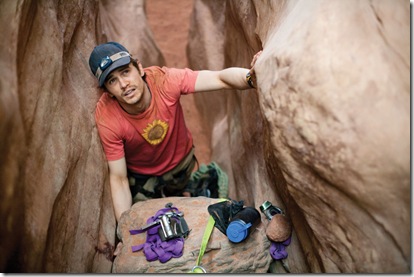
127Hours2

I was completely surprised to discover that Danny Boyle’s 127 Hours is much deeper than just a movie about someone who has to cut his arm off to survive. It’s also a brilliant account of being pinned to a de facto meditation cushion for an involuntary 5-day mindfulness intensive on the nature of thinking, feeling, the self, loving-kindness, and the liberation that can come from yielding to impersonal forces. The boulder deserves an Oscar nomination for a supporting role as both antagonist and teacher. I expected to feel uneasy, but instead I was completely absorbed in the clever depiction of an excruciating subjective experience of one person's suffering.

Aron Ralston said in one interview, "The entrapment created such an appreciation for the frolicking I had been doing until it happened and there was the euphoric feeling of being free and getting my life back again. Because of what happened, I understand what life is. I'm hopeful that people will see something inside of themselves, as well. I was in an extraordinary circumstance and it fundamentally came down to wanting to live and get back to my family. It is about survival, love and freedom — and those things are common in all of us."

The good news is that the profound yet practical insights Ralston carried out of Blue John Canyon can also be gradually cultivated through the consistent development of attentional skills over time. I enthusiastically recommend both the film and the effort required to experience high levels of concentration, sensory clarity, and equanimity without waiting for the conditions to become so extreme.

Tuesday, January 04, 2011

Breaking Apart

Mary & Joseph Retreat Center, Rancho Palos Verdes

One, One, Eleven
by Daron Larson

Midnight is inherently unstable,
so it breaks apart into a new year.
Fireworks explode and set the trees ablaze
with the echoing choir of peafowl wails.
The lights of the grid pulse
like ancient campfire embers in the breeze.

On the first day,
a man squats in prayer
by the side of the road,
his car idles beside him,
music spilling out through an open door.
Eyes closed, he directs his pleas
or his grief or his gratitude
toward the ocean, the source of all life.

In the beginning there was nothing,
as you may have heard,
but it keeps breaking apart and coming back together,
grinding down every skeleton and exoskeleton
into smooth sand
for future generations to walk upon
as they gaze outward and inward with wonder.

My skin is ice.
My heart is molten.
My body rings with the joy of all joys
and aches with the ache of all aches.

Every tear has the taste of all tears.
Every smile has the taste of all smiles.
There is no escape, nor any need to keep trying.

May we all give up the fight against
the coils and recoils
along our journey back home.

Del Cerro Park

Wednesday, October 06, 2010

Transience

"Transience is the force of time that makes a ghost of every experience. There was never a dawn, regardless how beautiful or promising, that did not grow into a noontime. There was never a noon that did not fall into afternoon. There was never an afternoon that did not fade toward evening. There never was a day yet that did not get buried in the graveyard of the night."

~ John O'Donohue

"Círculo" by Joaquín Turina performed by Trio Suleika. Movements: Amanecer (Dawn)-Mediodía (Noon)-Crepúsculo (Twilight). Live from the Bimhuis in Amsterdam, excerpt from the Dutch television programme "VPRO's Vrije Geluiden", February 2006. Trio Suleika consists of pianist Maurice Lammerts van Bueren, violinist Sanne Hunfeld and cellist Pepijn Meeuws.

A Complete Experience of Listening
by Daron Larson

We tend to respect and admire the development of musical performance skills while overlooking the benefits of cultivating a bit of discipline and training of our ability to listen. By default, most of us have developed a stunning and sophisticated repertoire for blocking out the world around us. We allocate the bulk of our attention inwardly toward the stories playing out in our minds.

Instead of seeing this as a flaw to obsess about, we can instead begin to explore the elements of this personal narrative. With consistent practice over time, we can become intimately familiar with its various component parts. We can even gain insight into the process working to edit it all together and making it seem so dramatic and difficult to ignore. We can become fascinated with the composition of this narrative and less caught up in its content. Paradoxically, the more familiar we become with the flow of our thoughts and feelings, the more directly and completely we experience the objective world around us.

At any given moment, we have a limited amount of attention to spend. Just being clear about what we are noticing can begin to change ordinary experience in simple yet profound ways. Listening to music offers a compelling doorway into this perspective. When we focus on one or more aspects of listening, we strengthen our ability to concentrate. When we explore music as an opportunity to cultivate attention, we also strengthen the ability to hear the musicality within the ordinary sounds we encounter in daily life. With consistent practice over time, we can even begin to experience the sense of wonder which sparks the human impulse to create music in the first place.

Explore this strategy from the beginning to end of a piece of music:

Restrict the main focus of your attention to listening to sounds around you and to verbal thinking.

There will almost certainly be additional stimulus in the background (visual activity, mental images, pleasant or unpleasant physical sensations, and sensations in the body that seem to be emotional in nature). There is no need to wrestle with any of these or to try to suppress them in any way. To the best of your ability, allow them to operate in the background while your primary attention rests on external or internal sounds.

Whenever you become aware that your primary attention has become focused on one of these background activities, gently bring it back to listening.

Let your attention drift and wander freely within the acoustic space around you as well as in the space where verbal thinking seems to be take place. This internal space varies for each individual. Not being completely sure if you are identifying it properly is a significant part of the process of becoming more familiar with it. We give musicians time to find their way into virtuosity, right? Give yourself time to become more intimately familiar with where verbal (and visual) thinking occurs.

Every few seconds, try to be as clear as possible whether you are listening to external sounds or internal sounds. Then just hang out with the activity of sound that you’ve noticed. Savor it. External sounds and verbal thinking count equally in this exercise. Try not to prefer one over the other. There is no need to try to suppress thinking. Get acquainted with it as internal sound. What matters is that you bring some effort to noticing where your attention is and whether it is focused externally (out) or inwardly (in).

You can support this process by using mental labels to help clarify and aim your attention. If you notice that your attention is resting on the activity of sounds around you, you can say to yourself in a soft, mentally whispered voice: OUT. If you notice that your attention is resting on the activity of internal conversations, you can say to yourself in a soft, mentally whispered voice: IN.

That’s it! Just keep going until the end of the song and enjoy. Take breaks between practice periods as needed then try again. You might also want to explore some of these alternative strategies.

Friday, September 24, 2010

The Mind Mistakes the Talking for the Doing

I agree with this short talk. Identifying with success is much easier than cultivating the conditions for making it possible. I like to tell people that when they begin to practice mindfulness meditation, it is a good idea to keep it to yourself until the habit is established. It’s similar to waiting to tell your friends and family about a pregnancy until after the first trimester. In fact, the length of a trimester is a great milestone when it comes to consistent meditation practice. Ninety days of consistent practice (as you define it up front) is a great place to start. Wait to tell your people that you’ve been practicing for three months instead of letting them know you are planning to try. The same advice applies to any skill development or regimen.

“Repeated psychology tests have proven that telling someone your goal makes it less likely to happen. Any time you have a goal, there are some steps that need to be done, some work that needs to be done in order to achieve it. Ideally, you should not be satisfied until you had actually done the work. But when you tell someone your goal, and they acknowledge it, psychologists have found that it's called a social reality. The mind is kind of tricked into feeling that it's already done. And then, because you've felt that satisfaction, you're less motivated to do the actual hard work necessary. So this goes against the conventional wisdom that we should tell our friends our goals.”

~ Derek Sivers

Thursday, August 12, 2010

Appreciating Nothing

This presentation was my contribution to Pecha Kucha Night Columbus this evening.

Tuesday, August 10, 2010

A Portable Sanctuary

knob It’s easy to think that the environment needs to be completely still and quiet for meditation to occur. When I first began practicing meditation I would switch off the ringer on our phone and put a Christmas ornament on the knob of the closed bedroom door to alert everyone in the house to try to keep it down until they heard the sound of the gong. Hey, whatever it takes to establish the habit, right? But these kinds of controls can develop into unquestioned necessary ingredients and a kind of literalism that can solidify into obstacles instead of supports.

Do I need to be in a gym to lift something heavy? Do I need to be wearing running clothes to chase down the bus? Do I need to be standing on a yoga mat to notice my breath? It can be interesting to consider how formal meditation practice and the application of the same strategies in the midst of our ordinary experiences relate to and inform each other. We don’t meditate to achieve temporary benefits, but to develop a kind of deep intimacy with how human perception works and how it operates to influence our happiness or misery. It’s not about trying to avoid life, but a means of engaging more directly with it.

When our physical strength increases as a result of lifting weights we don’t have to be standing in the gym to notice it or to put it to use. We just need to keep visiting the gym to maintain and improve it. In the same way, we don’t need to be in a sanctuary in order to cultivate the skills of attention. We cultivate these skills to gradually transform our senses into a sanctuary that we can bring out into world.

After a few months of practice, I no longer needed an ornament on my door. I usually don’t even need to close it. When the phone rings, I let it ring. Of course there are times when I do close the door or turn off my phone, but these feel like options now instead of requirements. I can relax or tighten my grip on allowing distractions and see what happens. Working in this way helps me bring these strategies out into the world. I’m a little more willing to let the cell phones of strangers ring at the grocery store without them preventing me from doing a few reps of concentration and equanimity strengthening exercises while I’m waiting in line.  

Monday, March 29, 2010

Scopophilia

Cleveland International Film Festival, March 27, 2010

We spent the weekend shoulder-to-shoulder with like-minded cinephiles, our collective gaze fixed on the lights flickering on the cave walls.

We watched a butcher in Jerusalem let trouble stir life into his cold bones, confining a nibble of vitality to be preserved forever in a meat locker and the icy waters of a nearby spring.

We watched Joseph Brodsky gazing back at the St. Petersburg of his youth: potatoes, paintings of nudes, shelves of books, his parents dancing after the war, an orchestra of musical instruments floating in the sky like clouds.

We watched a Croatian sniper try to dodge the trajectory of his own bullets while hunting down the traumatized Little Red Riding Hood he had fallen in love with through the scope of his rifle and nearly destroyed.

We watched a Mongolian folk singer search for the lyrics to a song hidden in the unrepeatable archives of fading human memory.

We watched Renaud Capuçon perform Gluck’s Orfeo Melody on a 1737 Guarnerius violin in the Paris subway from 7:57 a.m. to 7:57 p.m to mostly indifferent commuters a couple of days before playing the same piece to a sold-out auditorium in the Théâtre des Champs-Elysées. Our hearts were collectively broken until a blind woman renewed our hope by venturing as close as possible to warm herself in the glow.

We watched, Juan Pujol Garcia, a double agent from Spain and his contrived network of spies convince the Nazis to prepare for an attack on Pas de Calais as the Allied Forces stormed the beaches of Normandy.

We watched art collectors, dealers, galleries, and auction houses enthusiastically inflate the value of contemporary art to staggering and unsustainable heights through secrecy, speculation, tax strategies, and cornering markets.


Cleveland International Film Festival

Saturday, March 20, 2010

A Clock in the Zendo

time ticks
     mind tocks

life gestates
     heart narrates

soul flows
     self knows

ruts in the road
     slowly erode

Wednesday, February 17, 2010

Evidence of Things Unseen

Ruach dances in the backyard.
It blows without swaying
the trees, still
the snow-sifted air reveals
contours of swirling forms,
unique as fingerprints,
transparent arabesques brought to light.
The insubstantial proof, certain as
the scattered footprints
on an ash-dusted temple floor,
of earthly visitation.

Thursday, February 04, 2010

Homeostasis

The chill slipped through my skin
right into my marrow
where it took root and blossomed.
You offered me a drink
of your coffee
which we both know
is much stronger than I can take.

Made me consider how often
people have to weigh a degree of bitterness
against our thirst for warmth.

I met a woman who drinks hot water
every morning.
Says she never really liked coffee
or tea,
but she enjoys cradling a warm mug
in her cold hands.
Says she doesn’t feel like she’s missing anything.

There must be fifty ways
I haven’t yet imagined
to warm these bones.

Friday, January 29, 2010

Belonging, Blooming, and Beginning Again

If worries were stones that could be polished by rolling around repeatedly in our minds, one of the shiniest rocks in my tumbler would have to be wondering where I really belong. Growing up in Wichita, Kansas I was convinced I was being excluded from a much more Technicolor city. In New Mexico I quickly grew bored of the piercingly blue skies and yearned for thunderstorms. Ohio seemed to choose me instead of the other way around. I don't strongly identify with many of the aspects of my life and personality that make easy answers to casual questions about who I am or what I do.

Year-End Retreat 2009, Rancho Palos Verdes

All this becomes especially distressing when I'm convinced that everyone else not only knows for certain where they belong but have also managed to get there. It reminds me of the paradox that throws so many people off about meditation: the way it appears on the outside doesn’t give a very reliable indication of what it feels like on the inside.

I recently had the extravagantly good fortune to practice mindfulness intensively in an idyllic setting near the ocean, with Birds of Paradise thriving in early January, and a few peacocks adding spontaneous local color. Yet I found myself wondering if I really belonged there — even as a visitor.

Year-End Retreat 2009, Rancho Palos VerdesAs much sincere intention as I put into weeding out unrealistic assumptions about life, I've managed to hold onto the notion that some perfect fit exists for each of us. I don't want to blame this on Hollywood or religion or advertising — aren't they all just responding to the strong craving for narrative which seems to be hardwired into our nervous systems? It’s that same inherited impulse toward security and the sense that each of us is actually the main character in this one long reality show.

Practicing mindfulness over time can lead to a direct and deepening awareness that nothing is unchanging. Could this apply to my perpetual desire to belong? What if there really is no satisfying it in the same way we never seem to reach the point of having the right amount of money or time?

What if instead of finding out exactly where I belong, I put my energy into belonging where I find myself at any given moment? This means making ourselves at home scraping snow from the windshield, listening to the hold music, drinking coffee, sitting through another boring meeting, watching a great movie, waiting to see the doctor, washing our hands, and dropping off the recyclables. To really bloom where we find ourselves planted begins with settling in, soaking up whatever our roots can reach, and celebrating the sprouting as well as the whole climb toward blooming.

What would it feel like to at least attempt to notice and accept all the many points along the way — the pleasant episodes as well as the unpleasant ones? If we can practice embracing the hundreds of different places we find ourselves each day (physically, mentally, emotionally), then we're well on our way to belonging wherever we go.

Tuesday, October 27, 2009

Present but Elsewhere

Flying Distracted
by Daron Larson

Can we honestly claim to be shocked
by attention’s prolonged absence
from the cockpit?

It never really left.

It was merely present but elsewhere,
at the same time,
behind a secure door.

Deadly altitudes and velocities
feel thin and inert
from the inside,
just like outsized economic expansions
which are always too good to be true.

What lures us with adrenaline
quickly turns stale and dull.

Look at us, for example,
waiting in the cabin
for a better or more familiar city
to loom up from the
sleeping patchwork earth.

No longer dressed for Sunday,
we look like pole dancers and suckers
who lost it all in Vegas,
too short on time to wash or comb our hair, 
busy toying with the restrictions on electronic devices.

We are all flying distracted
     until jolted awake
          by contact with the ground,
               speed dialing anyone who will answer
                    to let the other passengers know
                         we are special,
                              we are adored,
                                   we are still alive.

Tuesday, September 22, 2009

No Thing Here

In the seen, there is only the seen,
in the heard, there is only the heard,
in the sensed, there is only the sensed,
in the cognized, there is only the cognized.
Thus you should see that
indeed there is no thing here;

…as you see that there is no thing there,
you will see that
you are therefore located neither in the world of this,
nor in the world of that,
nor in any place
betwixt the two.
This alone is the end of suffering.

~ Buddha, from the Udana

At breakfast on Saturday, the sun slowly crept up the window until it was shining almost directly into my eyes. It occurred to me that while it feels like the sun was moving, it was really the me, the table, the room, the building, and the earth that were all rotating imperceptibly.

Aristarchus's 3rd century BC calculations on the relative sizes of the Earth, Sun and Moon, from a 10th century AD Greek copy. It’s been nearly four hundred years since Galileo began defending heliocentrism, and yet it still does seem to us that we are at the center of the universe. The image of a sphere of water and dirt and plants and animals careening through space remains unsettling. We still go to the beach to watch the sun rise and set. It is challenging to imagine that people living in other time zones are currently sleeping while we are going about our business awake.

If the sun isn’t menacing me or entertaining me, and the ground beneath my feet isn’t stationary, where am I supposed to find a safe place to make my home? Our nervous systems crave certainty and solidity and, in their absence, have created a complex process for representing stability.

It is very useful to accept these illusions, but at some point Prague Orlojwe can’t help seeing through them. We navigate the uncertainty by trying to determine what the absence of true solidity means. Some interpret it as nihilism, others find that there being no thing simply means that every thing is in constant dynamic flux.

Mindfulness practice, seems to be one way that the need for things to be fixed gets eroded gradually. This allows us to live more comfortably inside the illusion as well as being able to experience the wonder of participating in the ongoing flow of the universe.

Wednesday, March 18, 2009

If you lived here…

There's no place like home.When I was growing up, our summer vacations were usually opportunities to visit family members who had moved away from Wichita. We knew we weren’t in Kansas anymore when the landscape suddenly became three dimensional. When we visited an uncle in Colorado, my parents would wake my brother and me up as soon as they spotted mountain peaks in the distance. When we traveled to Missouri, the centrifugal force created by the winding roads would rock us awake. These contrasts seemed so exotic that we would get caught up in discovering details that seemed so much more interesting than things back home.

I remember seeing real estate advertisements that taunted us with the idea that if we actually lived there, we’d be living the good life without having to go anywhere but out our own front door. A life lived in a land of perpetual vacation sounds great to kids, but adults realize that the magic carpet would wear thin under the ceaseless traipsing of guests through their living room.

Continue reading…

Wednesday, March 04, 2009

Waiting for the Weekend

People who practice mindfulness strategies like to talk about the various small habits of resistance we all tend to accumulate. We point out the dangers of putting off our happiness until some point in the future. But isn’t there some value in motivating ourselves through unpleasant tasks and activities by imagining the relief that will follow? Is there really anything wrong with taking a bit of comfort during a tedious meeting or lecture on Wednesday morning by imagining how much fun we’re planning to have on Friday evening?

The answer has to do with our assumptions about the skills of paying attention. What is the point of learning to stay in the present more often? Isn’t this just one more trendy drop in the ocean of self-improvement strategies that fail to live up to their promises?

Continue reading…

Monday, February 23, 2009

Recognition

Billy Batson and the Council of EldersI liked how the top Oscars were awarded last night. Having a pantheon of previous category winners, each carefully matched with a nominee, was a satisfying blend of grandiosity and tenderness. It did ride a fine line between cool and awkward, but the words of praise from the respected role models with established reputations were more moving and memorable than most of the acceptance speeches. I was moved by the reactions of the nominees. I can’t think of any other consolation prize that has allowed participants to walk away with such affirmation and dignity.

What a curse it must be for the entire world to know you crave something that you do not get. Most of us are fortunate to experience a significantly smaller circle of praise and embarrassment.

We live in a niche market world now. It’s a silly tradition to select one performance from the year and pretend it was the best. If you see movies outside the mainstream, you know that many truly artistic performances go unnoticed by the majority. So much talent never finds a large audience.

But we like to build pedestals. I’m not sure that’s an entirely bad thing. Around the time of the presidential election, I heard Harry Shearer talking about how he can’t do worthy impersonation of Barack Obama until he figures out who Obama is impersonating. It’s true, isn’t it? Consciously or unconsciously, we are all emulating the people we admire.

My favorite acknowledgment last night came from one acting goddess to another. Sophia Loren said that Meryl Streep’s name has become synonymous with the highest standards of her craft. It made me think about how much influence we really do have in creating the perception of ourselves in the minds of others.

Who would you most want to summarize and approve of your efforts and accomplishments?

What would you like your name to mean?

What one thing could you do today to increase your odds of ever finding even a small audience of respect?

Wednesday, February 18, 2009

Walking Through Mist

Sudden awakening,
Gradual cultivation.

~ Chinul

A wise person told me that sometimes enlightenment happens all at once, like falling into a pond, but most of the time waking up happens gradually over time, like walking through heavy mist. It doesn't matter whether you fall into the pond or walk through the mist, either way you end up drenched.

Marc DezemeryWhen we walk through mist, it is difficult to look back and say exactly when we went from being dry to being wet. Mindfulness practice works in this way. We bring effort to noticing sensory experiences, just as they are and practice not trying to force them to be different. We work on breaking mundane experiences down into their component parts. We practice gently bringing our attention back to whatever we’ve decided to notice while letting other things operate in the background. We cultivate a persistent intention to savor the composition of our experience and loosening our grip on its content or meaning.

We practice day after day, breath after breath, touch after touch, sound after sound, image after image, emotion after emotion. Over time we notice that we have changed and that we continue to change. We are gradually eroding our constant interference with the natural flow of our lives.