
Showing posts with label wisdom. Show all posts

Saturday, January 29, 2011

Pinned to the Cushion
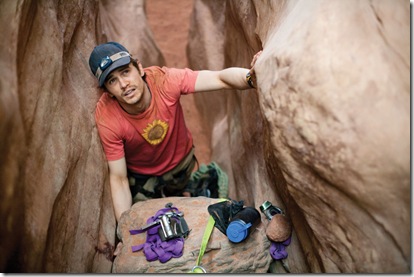
127Hours2

I was completely surprised to discover that Danny Boyle’s 127 Hours is much deeper than just a movie about someone who has to cut his arm off to survive. It’s also a brilliant account of being pinned to a de facto meditation cushion for an involuntary 5-day mindfulness intensive on the nature of thinking, feeling, the self, loving-kindness, and the liberation that can come from yielding to impersonal forces. The boulder deserves an Oscar nomination for a supporting role as both antagonist and teacher. I expected to feel uneasy, but instead I was completely absorbed in the clever depiction of an excruciating subjective experience of one person's suffering.

Aron Ralston said in one interview, "The entrapment created such an appreciation for the frolicking I had been doing until it happened and there was the euphoric feeling of being free and getting my life back again. Because of what happened, I understand what life is. I'm hopeful that people will see something inside of themselves, as well. I was in an extraordinary circumstance and it fundamentally came down to wanting to live and get back to my family. It is about survival, love and freedom — and those things are common in all of us."

The good news is that the profound yet practical insights Ralston carried out of Blue John Canyon can also be gradually cultivated through the consistent development of attentional skills over time. I enthusiastically recommend both the film and the effort required to experience high levels of concentration, sensory clarity, and equanimity without waiting for the conditions to become so extreme.

Friday, November 19, 2010

Getting Right with Tao

A Contemporary Spin on the Tao Te Ching
by Ron Hogan

#28

getting-right-with-tao If you are strong,
but remain sensitive,
power will flow through you.
With that power,
you'll always be right with Tao:
It's like a whole new life.

If you are idealistic,
but stay rooted in reality,
you are an example to others.
Set that example,
and you'll always be right with Tao:
There is no limit to what you can do.

If you are honorable,
but remain humble,
you will see things as they are.
If you see things as they are,
you'll always be right with Tao:
Your life will become simple,
yet full of potential.

Let Tao show you
how to get right with Tao,
so your slightest gesture
can change the world.

*     *     *     *     *

#16

Keep your head clear.
Stay calm.
Watch as everything happens around you.

Everything reverts to its original state,
which was nothing.
And when something becomes nothing,
it gets right with Tao.

If you don't understand that,
you're going to screw up somewhere down the line.
If you figure it out, you'll always know what to do.

If you get right with Tao,
you won't be afraid to die,
because you know you will.

Tuesday, October 05, 2010

The Power of Mindful Awareness

"The goal of becoming a better person is within the reach of us all, at every moment. The tool for emerging from the primitive yoke of conditioned responses to the tangible freedom of the conscious life lies just behind our brow. We need only invoke the power of mindful awareness in any action of body, speech, or mind to elevate that action from the unconscious reflex of a trained creature to the awakened choice of a human being who is guided to a higher life by wisdom."

~ Andrew Olendzki, Unlimiting Mind: The Radically Experiential Psychology of Buddhism

Here is a video interview from May 2010 in which Andrew Olendzki discusses his book with Tricycle’s Joan Duncan Oliver.


[Thanks, Whiskey River!]

Wednesday, September 29, 2010

This is the Time

Two of six excellent letters of advice to new college students from “Ditch Your Laptop, Dump Your Boyfriend,” New York Times, September 25, 2010:
College is your chance to see what you’ve been missing, both in the outside world and within yourself. Use this time to explore as much as you can.
Take classes in many different subjects before picking your major. Try lots of different clubs and activities. Make friends with people who grew up much poorer than you, and others much richer. Date someone of a different race or religion. (And no, hooking up at a party doesn’t count.) Spend a semester abroad or save up and go backpacking in Europe or Asia.
Somewhere in your childhood is a gaping hole. Fill this hole. Don’t know what classical music is all about? That’s bad. Don’t know who Lady Gaga is? That’s worse. If you were raised in a protected cocoon, this is the time to experience the world beyond.
College is also a chance to learn new things about yourself. Never been much of a leader? Try forming a club or a band.
The best things I did in college all involved explorations like this. I was originally a theater major but by branching out and taking a math class I discovered I actually liked math, and I enjoyed hanging out with technical people.
By dabbling in leadership — I ran the math club and directed a musical — I learned how to formulate a vision and persuade people to join me in bringing it to life. Now I’m planning to become an entrepreneur after graduate school. It may seem crazy, but it was running a dinky club that set me on the path to seeing myself as someone who could run a business.
Try lots of things in college. You never know what’s going to stick.
— TIM NOVIKOFF, Ph.D. student in applied mathematics at Cornell

*     *     *     *     *
Devices have become security blankets. Take the time to wean yourself.
SmartSign.com
Start by scheduling a few Internet-free hours each day, with your phone turned off. It’s the only way you’ll be able to read anything seriously, whether it’s Plato or Derrida on Plato. (And remember, you’ll get more out of reading Derrida on Plato if you read Plato first.) This will also have the benefit of making you harder to reach, and thus more mysterious and fascinating to new friends and acquaintances.
When you leave your room for class, leave the laptop behind. In a lecture, you’ll only waste your time and your parents’ money, disrespect your professor and annoy whoever is trying to pay attention around you by spending the whole hour on Facebook.
You don’t need a computer to take notes — good note-taking is not transcribing. All that clack, clack, clacking ... you’re a student, not a court reporter. And in seminar or discussion sections, get used to being around a table with a dozen other humans, a few books and your ideas. After all, you have the rest of your life to hide behind a screen during meetings.
— CHRISTINE SMALLWOOD, Ph.D. student in English and American literature at Columbia

Friday, June 25, 2010

Stepping Stones

Stepping Stones Crossing the River Duddon to Seathwaite

"Some people spend their entire lives reading but never get beyond reading the words on the page, they don’t understand that the words are merely stepping stones placed across a fast-flowing river, and the reason they’re there is so that we can reach the farther shore, it’s the other side that matters.”

José Saramago

Tuesday, May 18, 2010

Unsarcastic Advice

From Steve Hannah,  C.E.O. of The Onion, from “If Plan B Fails, Go Through The Alphabet,” an interview with Adam Bryant, New York Times (May 14, 2010):

Steve Hannah, photo by Tony Cenicola/The New York Times “…never, ever do anything to deprive a human being of their dignity in work, in life. Always praise in public and criticize in private. You might be tempted, for example, when you’re letting someone go, to say something that would diminish the value of their work. Don’t ever do that.

…when you’re faced with something that’s really difficult and you think you’re at the end of your tether, there’s always one more thing you can do to influence the outcome of this situation. And then after that there’s one more thing. The number or possible options is only limited by your imagination…

Find what you really love to do and then go after it — relentlessly. And don’t fret about the money. Because what you love to do is quite likely what you’re good at. And what you’re good at will likely bring you financial reward eventually.

I’ve seen too many people who have plotted a career, and often what’s at the heart of all that plotting is nothing other than a stack of dollar bills. You need to be happy in order to be good, and you need to be good in order to succeed. And when you succeed, there’s a good chance you’ll get paid.

And while you’re at it, read. A lot. Start with Plato. He was a very practical man.”

Read the rest of this interview…

Sunday, May 16, 2010

The Way You Are

“You know how unhappy you would be if you thought that the way you are is not okay? I started out my life like that. I don’t want to end up my life like that.”

~ Bill Withers, from Still Bill

Sunday, May 02, 2010

Finding Words

Mai's Quiet Zone, 2004

Dr. Alan Dienstag from “Alzhiemer’s, Memory, and Meaning,” in conversation with Krista Tippett on Speaking of Faith, March 26, 2009:

I was working with a woman who actually first brought her sister to see me. Her name was Ann, and she wanted, her sister to join one of the writing groups [for people in the early stages of Alzheimer’s], but her sister wasn't right for it. About two years later, she came back, and she [herself] had been diagnosed with Alzheimer's. And so I started to work with her, and she joined one of my support groups.

She was in the group for a long time, and then it just became impossible for her to participate. The conversation was moving too fast. She just didn't have the language. She couldn't string together more than a sentence or two, and it just wasn't working. And so she had to leave the group.

Her husband, who was just extraordinarily devoted to her, really wanted her to maintain her connection with me. It was very helpful that I had known her before. And she would bring photo albums in. She would do a little tchotchke tour of my office. You know, when it wasn't really possible to talk about things, she would kind of walk around and we would look at objects. She was very taken by the birds outside the window. I mean, that was the kind of time that we spent together.

And then even that became difficult. She was one of those people who started to kind of retreat into almost a mask-like blankness. It was harder and harder to access her. And so we were reaching the end of that time, and I was talking to her husband, telling him that I just didn't think that it was a really fruitful way for her to spend her time and so on.

So it was around that time, and I was going on vacation, and she loved the beach and I loved the beach and this was something that we used to connect about.

As I was leaving I said, "Ann, I'm going to the beach. I'm going to be away for a while." And she smiled and her face kind of lit up.

I said, "What do you love about the beach?"

She kind of drifted away, as she did, and she got very quiet. And again I waited and I thought, well, you know, she can't really answer that question.

And she turned to me and she said, "There's some kind of music that lives there."
