Showing posts with label education. Show all posts

Wednesday, March 23, 2011

Using Technology to Humanize the Classroom

“By removing the one size fits all lecture from the classroom and letting students have a self-paced lecture at home, and then when you go to the classroom, letting them do work, having the teacher walk around, having the peers actually be able to interact with each other, these teachers have used technology to humanize the classroom.”

~ Sal Khan, of Khan Academy

Sunday, February 20, 2011

Strangers No More

This 39-minute film about a school in south Tel Aviv gets my vote for best Oscar-nominated documentary short subject. The principal and teachers of Bialik-Rogozin School enthusiastically embrace the challenges of educating children from all over the world, many of whom have experienced extraordinary violence, loss, and displacement. It is a remarkable and inspiring study of resilience nurtured by providing a safe environment, finding common ground in the midst of dizzying diversity, and igniting passion for learning.

Strangers No More Movie Trailer - Bialik Rogozin School from Simon & Goodman Picture Co. on Vimeo.

Saturday, January 22, 2011

The Most Essential School Supply

My brother, David, works for Communities in Schools in Wichita, Kansas. He and my nephews, food4kidsLeo and Levi, are featured in this public service announcement for a food program sponsored by the Kansas Food Bank. Food-4-Kids works with community schools to provides weekend food supplements to help keep kids engaged in school by addressing chronic hunger.

Food 4 Kids foodbags contain healthy, kid-friendly snacks that require no preparation such as:

  • Peanut Butter (12-ounce jar) and a sleeve of crackers
  • Beans and franks (pop-top can)
  • Beef Jerky (1 ounce)
  • Cereal (1-ounce bowl or box)
  • Fruit cups (peaches, applesauce, etc)
  • Raisins (snack-size boxes)
  • Pudding cups
  • Juice boxes (apple, orange, or other juice)
  • Milk (aseptic pack boxes that do not require refrigeration)
  • Cereal bars or granola bars

“Because the most essential school supply is food.”

Tuesday, October 26, 2010

Can’t Read if We Don’t Teach Them


Lyrics from Shine
by John Legend, for the documentary Waiting for “Superman”

So dark, but I see sparks, if we don't snuff them out.
We gotta let them flame, let them speak their name.
Let them reach up to the clouds.
Can't eat if we don't feed them.
Can't read if we don't teach them.
There's no line if we just hide them.
Don't just let them die.

Let them shine.
Let them shine on.
Let them shine.
Let them shine on.

Stars flicker in the distance, lonely out in space.
They sing out when we're not listening, because we don't see their face.
We can let them die, we can make them high.
Hold the little miracles that live inside.
Let them shine.

Tuesday, October 19, 2010

We All Have the Capacity

“Kids will take a chance and if they don’t know they’ll have a go. Am I right? They’re not frightened of being wrong. Now I don’t mean to say that being wrong is the same thing as being creative. What we do know is if you’re not prepared to be wrong, you will never come up with anything original. By the time they get to be adults, most kids have lost that capacity. They have become frightened of being wrong. And we run our companies this way. We stigmatize mistakes. And we’re now running national education systems where mistakes are the worst thing you can make. And the result is that we are educating people out of their creative capacities. Picasso once said that ‘All children are born artists. The problem is to remain an artist as we grow up.’ I believe this passionately. We don’t grow into creativity, we grow out of it. Or rather, we get educated out of it.”

~ Ken Robinson

“This animate was adapted from a talk given at the RSA by Sir Ken Robinson, world-renowned education and creativity expert and recipient of the RSA's Benjamin Franklin award.”

Thursday, October 14, 2010

Taming Extremism by Promoting Education

Excerpt from “What Oman Can Teach Us,” by Nicholas D. Kristof, New York Times, October 13, 2010:

oman In short, one of the lessons of Oman is that one of the best and most cost-effective ways to tame extremism is to promote education for all.

Many researchers have found links between rising education and reduced conflict. One study published in 2006, for example, suggested that a doubling of primary school enrollment in a poor country was associated with halving the risk of civil war. Another found that raising the average educational attainment in a country by a single grade could significantly reduce the risk of conflict.

Sorry if this emphasis on education sounds like a cliché. It’s widely acknowledged in theory, and President Obama pledged as a candidate that he would start a $2 billion global education fund. But nothing has come of it. Instead, he’s spending 50 times as much this year alone on American troops in Afghanistan — even though military solutions don’t have as good a record in trouble spots as education does.

The pattern seems widespread: Everybody gives lip service to education, but nobody funds it.

Wednesday, September 29, 2010

This is the Time

Two of six excellent letters of advice to new college students from “Ditch Your Laptop, Dump Your Boyfriend,” New York Times, September 25, 2010:
College is your chance to see what you’ve been missing, both in the outside world and within yourself. Use this time to explore as much as you can.
Take classes in many different subjects before picking your major. Try lots of different clubs and activities. Make friends with people who grew up much poorer than you, and others much richer. Date someone of a different race or religion. (And no, hooking up at a party doesn’t count.) Spend a semester abroad or save up and go backpacking in Europe or Asia.
Somewhere in your childhood is a gaping hole. Fill this hole. Don’t know what classical music is all about? That’s bad. Don’t know who Lady Gaga is? That’s worse. If you were raised in a protected cocoon, this is the time to experience the world beyond.
College is also a chance to learn new things about yourself. Never been much of a leader? Try forming a club or a band.
The best things I did in college all involved explorations like this. I was originally a theater major but by branching out and taking a math class I discovered I actually liked math, and I enjoyed hanging out with technical people.
By dabbling in leadership — I ran the math club and directed a musical — I learned how to formulate a vision and persuade people to join me in bringing it to life. Now I’m planning to become an entrepreneur after graduate school. It may seem crazy, but it was running a dinky club that set me on the path to seeing myself as someone who could run a business.
Try lots of things in college. You never know what’s going to stick.
— TIM NOVIKOFF, Ph.D. student in applied mathematics at Cornell

*     *     *     *     *
Devices have become security blankets. Take the time to wean yourself.
SmartSign.com
Start by scheduling a few Internet-free hours each day, with your phone turned off. It’s the only way you’ll be able to read anything seriously, whether it’s Plato or Derrida on Plato. (And remember, you’ll get more out of reading Derrida on Plato if you read Plato first.) This will also have the benefit of making you harder to reach, and thus more mysterious and fascinating to new friends and acquaintances.
When you leave your room for class, leave the laptop behind. In a lecture, you’ll only waste your time and your parents’ money, disrespect your professor and annoy whoever is trying to pay attention around you by spending the whole hour on Facebook.
You don’t need a computer to take notes — good note-taking is not transcribing. All that clack, clack, clacking ... you’re a student, not a court reporter. And in seminar or discussion sections, get used to being around a table with a dozen other humans, a few books and your ideas. After all, you have the rest of your life to hide behind a screen during meetings.
— CHRISTINE SMALLWOOD, Ph.D. student in English and American literature at Columbia

Thursday, September 16, 2010

Measuring Non-Standard Forms of Intelligence

UCLA professor Mike Rose from “The Meaning of Intelligence,” a conversation with Krista Tippett, Speaking of Faith, August 26, 2010:

ruler It's like we have a ruler that is very precise for half of its width or length. Right? I'm interested in those folks that don't do well on those kinds of tests, that don't do well on the standard IQ test or don't do so well on the SAT test, let's say. What I want to know is what they know that's not being reflected in that test.

Or another angle on it is, I want to find out more about what didn't happen in their educations that made them do poorly on that test or in their life experience.

So let's take the IQ test…If someone does well on an IQ test, that certainly tells us something, right? They've got some smarts; there's no doubt about it.

But think of the folks who might not do so well on those kinds of tests because they didn't have a lot of formal schooling — and everybody admits that there's a direct correlation between amount of formal schooling and how well you do on tests like that. There's an intimate connection between those two things. So they didn't have a lot of formal schooling. They haven't had a lot of experience taking those kinds of tests.

They also don't invest as much in them. Those of us who have been through a ton of schooling, we've been socialized to know that when one of those things appears in front of us, we better try our damnedest to do well on it.

So there's all kinds of reasons through which we can explain somebody not doing so well on a test like that, reasons other than some intellectual deficiency. So then I say I'm interested in, well, gee, what happens when we go out into the world  with this person and we watch them work, let's say, or we watch them raise kids, or we watch them figure out how to make their way through the day or some complicated social relationships. What emerges that bespeaks of intelligence? What goes on right under our noses that bespeaks of some kind of smarts?

So the plumber who reaches up inside of the wall of an old building where he cannot see and he can only feel, and through feeling around the structures in there, feeling the rust, feeling moisture if there's any, feeling the way the thing is structured, he's visualizing what's back there that he can't see and then bringing a knowledge base to bear on trying to figure out what the problem may be. Think of what a complex set of mental operations are involved in that.

Or the hairstylist who is presented with someone who comes in and they have a botched dye job, let's say. And the stylist — and this woman said this to me when I was watching her work — she said, "The first thing I asked myself was what was that previous stylist trying to accomplish?" So what an interesting question to ask.

And what an interesting problem-solving road that takes her down. Now those kinds of things are not going to be picked up on an IQ instrument. They're not structured to get to that stuff. But those are certainly manifestations of intelligence.

Tuesday, July 20, 2010

An Inability to Conceive of Alternatives

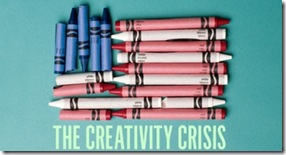
Excerpt from “The Creativity Crisis,” by Po Bronson and Ashley Merryman, Newsweek (July 10, 2010):

For the first time, research shows that American creativity is declining. What went wrong—and how we can fix it. In early childhood, distinct types of free play are associated with high creativity. Preschoolers who spend more time in role-play (acting out characters) have higher measures of creativity: voicing someone else’s point of view helps develop their ability to analyze situations from different perspectives. When playing alone, highly creative first graders may act out strong negative emotions: they’ll be angry, hostile, anguished. The hypothesis is that play is a safe harbor to work through forbidden thoughts and emotions.

In middle childhood, kids sometimes create paracosms—fantasies of entire alternative worlds. Kids revisit their paracosms repeatedly, sometimes for months, and even create languages spoken there. This type of play peaks at age 9 or 10, and it’s a very strong sign of future creativity. A Michigan State University study of MacArthur “genius award” winners found a remarkably high rate of paracosm creation in their childhoods.

From fourth grade on, creativity no longer occurs in a vacuum; researching and studying become an integral part of coming up with useful solutions. But this transition isn’t easy. As school stuffs more complex information into their heads, kids get overloaded, and creativity suffers. When creative children have a supportive teacher—someone tolerant of unconventional answers, occasional disruptions, or detours of curiosity—they tend to excel. When they don’t, they tend to underperform and drop out of high school or don’t finish college at high rates.

They’re quitting because they’re discouraged and bored, not because they’re dark, depressed, anxious, or neurotic. It’s a myth that creative people have these traits. (Those traits actually shut down creativity; they make people less open to experience and less interested in novelty.) Rather, creative people, for the most part, exhibit active moods and positive affect. They’re not particularly happy—contentment is a kind of complacency creative people rarely have. But they’re engaged, motivated, and open to the world.

The new view is that creativity is part of normal brain function. Some scholars go further, arguing that lack of creativity—not having loads of it—is the real risk factor. In his research, Runco asks college students, “Think of all the things that could interfere with graduating from college.” Then he instructs them to pick one of those items and to come up with as many solutions for that problem as possible. This is a classic divergent-convergent creativity challenge. A subset of respondents, like the proverbial Murphy, quickly list every imaginable way things can go wrong. But they demonstrate a complete lack of flexibility in finding creative solutions. It’s this inability to conceive of alternative approaches that leads to despair. Runco’s two questions predict suicide ideation—even when controlling for preexisting levels of depression and anxiety.

In Runco’s subsequent research, those who do better in both problem-finding and problem-solving have better relationships. They are more able to handle stress and overcome the bumps life throws in their way. A similar study of 1,500 middle schoolers found that those high in creative self-efficacy had more confidence about their future and ability to succeed. They were sure that their ability to come up with alternatives would aid them, no matter what problems would arise.

  • See also: Forget Brainstorming What you think you know about fostering creativity is wrong. A look at what really works.

Wednesday, May 12, 2010

Stone Soup

lost-books-of-the-odyssey “It never struck me that writing was something anyone could teach you—or if anyone could, it was the great masters, which meant going to the library and reading with great care the authors I most loved and admired. It struck me that an MFA program could be not just helpful but actually harmful.

There’s an orthodoxy of style at MFA programs, and it’s a style that turns me off. It’s the stone soup parable. Lots of people who don’t really know what they’re doing tear your work to shreds. No matter how robust you are, it has to be a painful experience and change your work, and probably not in a good way. I’m all in favor of grad school for surgeons and car mechanics, but less so as we get towards art, where I don’t think it does much good.”

~ Zachary Mason, computer scientist and author of The Lost Books of the Odyssey, from “Trojan Horse in Silicon Valley,” by Hara Estroff Marano, Psychology Today, May/June 2010

Thursday, February 18, 2010

The Standard for All Kinds of Things

Mr. Lee's 5th & 6th grade class, Sunnyside Elementary, Wichita, Kansas, 1976/77.

“Children—and humans, everybody—all need both windows and mirrors in their lives: mirrors through which you can see yourself and windows through which you can see the world. And minority children have not had mirrors.

That has placed them at a disadvantage. If you want to call white children majority children—[they] have had only mirrors. That has placed them at a disadvantage also…Because they live on a planet that is more window than mirror. And they have tended to believe that the planet is a planet like them or people who wish to be like them. And it’s not necessarily so.

It’s a mistake to believe oneself one’s only valid participator in life, that that is the standard, the standard for human is white. I tell children the standard for flowers is many-colored; the standard for all kinds of things is many-colored. That is also the standard for humans, though they have not been taught that.”

~ Lucille Clifton, from “She Could Tell You Stories,” interview by Hilary Holladay, Poetry Foundation (April 11, 1998)

Monday, February 15, 2010

A Textbook Example

Excerpt from ''How Christian Were the Founders?” by Russell Shorto, New York Times (February 11, 2009):

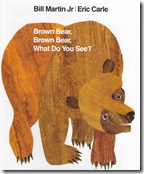
brown-bear“Brown Bear, Brown Bear, What Do You See?” It’s not an especially subversive-sounding title, but the author of this 1967 children’s picture book, Bill Martin Jr., lost his place in the Texas social-studies guidelines at last month’s board meeting due to what was thought to be un-American activity — to be precise, “very strong critiques of capitalism and the American system.” Martin, the creator of 300 children’s books, was removed from the list of cultural figures approved for study by third graders in the blizzard of amendments offered by board members…

…The [Texas school] board has the power to accept, reject or rewrite the [Texas Essential Knowledge and Skills], and over the past few years, in language arts, science and now social studies, the members have done all of the above. Yet few of these elected overseers are trained in the fields they are reviewing. “In general, the board members don’t know anything at all about content,” Tom Barber, the textbook executive, says. Kathy Miller, the watchdog, who has been monitoring the board for 15 years, says, referring to Don McLeroy and another board member: “It is the most crazy-making thing to sit there and watch a dentist and an insurance salesman rewrite curriculum standards in science and history. Last year, Don McLeroy believed he was smarter than the National Academy of Sciences, and he now believes he’s smarter than professors of American history.”

In this case, one board member sent an e-mail message with a reference to “Ethical Marxism,” by Bill Martin, to another board member, who suggested that anyone who wrote a book with such a title did not belong in the TEKS. As it turned out, Bill Martin and Bill Martin Jr. are two different people. But by that time, the author of “Brown Bear, Brown Bear” was out. “That’s a perfect example of these people’s lack of knowledge,” Miller says. “They’re coming forward with hundreds of amendments at the last minute. Don McLeroy had a four-inch stack of amendments, and they all just voted on them, whether or not they actually knew the content. What we witnessed in January was a textbook example of how not to develop textbook standards.”

Wednesday, February 03, 2010

Being More Interested

gardner "You should focus on being more interested than interesting.”

~ John Gardner

Wednesday, September 09, 2009

Let Your Failures Teach You

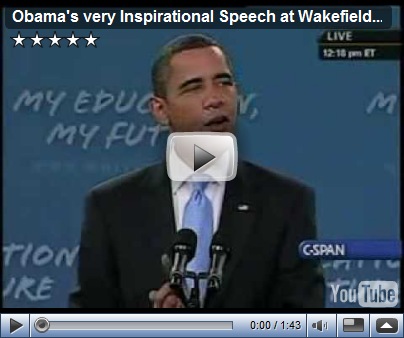
Wakefield High School
Arlington, Virginia
September 8, 2009

Complete speech: text, video

Producers of Knowledge and Doubt

Excerpts from “The University’s Crisis of Purpose,” by Drew Gilpin Faust, New York Times (September 1, 2009):

John_Harvard_statue_at_Harvard_UniversityHigher education is not about results in the next quarter but about discoveries that may take — and last — decades or even centuries. Neither the abiding questions of humanistic inquiry nor the winding path of scientific research that leads ultimately to innovation and discovery can be neatly fitted within a predictable budget and timetable.

Universities are meant to be producers not just of knowledge but also of (often inconvenient) doubt. They are creative and unruly places, homes to a polyphony of voices. But at this moment in our history, universities might well ask if they have in fact done enough to raise the deep and unsettling questions necessary to any society.

Since the 1970s there has been a steep decline in the percentage of students majoring in the liberal arts and sciences, and an accompanying increase in preprofessional undergraduate degrees. Business is now by far the most popular undergraduate major, with twice as many bachelor’s degrees awarded in this area than in any other field of study. In the era of economic constraint before us, the pressure toward vocational pursuits is likely only to intensify.

As a nation, we need to ask more than this from our universities. Higher learning can offer individuals and societies a depth and breadth of vision absent from the inevitably myopic present. Human beings need meaning, understanding and perspective as well as jobs. The question should not be whether we can afford to believe in such purposes in these times, but whether we can afford not to.

Sunday, September 06, 2009

Seasoned Advice for New College Students

Excerpts from “College Advice, From People Who Have Been There Awhile,” Week in Review, New York Times (September 6, 2009):

Stanley Fish Stanley Fish (teaching since 1962): I would advise students to take a composition course even if they have tested out of it. I have taught many students whose SAT scores exempted them from the writing requirement, but a disheartening number of them couldn’t write and an equal number had never been asked to. They managed to get through high-school without learning how to write a clean English sentence, and if you can’t do that you can’t do anything.

I give this advice with some trepidation because too many writing courses today teach everything but the craft of writing and are instead the vehicles of the instructor’s social and political obsessions. In the face of what I consider a dereliction of pedagogical duty, I can say only, “Buyer beware.” If your writing instructor isn’t teaching writing, get out of that class and find someone who is.

Martha Nussbaum Martha Nussbaum (teaching since 1975): It’s easy to think that college classes are mainly about preparing you for a job. But remember: this may be the one time in your life when you have a chance to think about the whole of your life, not just your job. Courses in the humanities, in particular, often seem impractical, but they are vital, because they stretch your imagination and challenge your mind to become more responsive, more critical, bigger. You need resources to prevent your mind from becoming narrower and more routinized in later life. This is your chance to get them.

Gary Wills Garry Wills (teaching since 1962): Read, read, read. Students ask me how to become a writer, and I ask them who is their favorite author. If they have none, they have no love of words.

Thursday, June 04, 2009

The Workshop is a Process

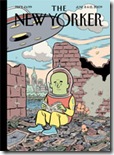
From "Show or Tell: Should Creative Writing Be Taught?" by Louis Menand, The New Yorker (June 8, 2009)

The New Yorker June 8 & 15, 2009 Creative-writing programs are designed on the theory that students who have never published a poem can teach other students who have never published a poem how to write a publishable poem. The fruit of the theory is the writing workshop, a combination of ritual scarring and twelve-on-one group therapy where aspiring writers offer their views of the efforts of other aspiring writers. People who take creative-writing workshops get course credit and can, ultimately, receive an academic degree in the subject; but a workshop is not a course in the normal sense—a scene of instruction in which some body of knowledge is transmitted by means of a curricular script. The workshop is a process, an unscripted performance space, a regime for forcing people to do two things that are fundamentally contrary to human nature: actually write stuff (as opposed to planning to write stuff very, very soon), and then sit there while strangers tear it apart. There is one person in the room, the instructor, who has (usually) published a poem. But workshop protocol requires the instructor to shepherd the discussion, not to lead it, and in any case the instructor is either a product of the same process—a person with an academic degree in creative writing—or a successful writer who has had no training as a teacher of anything, and who is probably grimly or jovially skeptical of the premise on which the whole enterprise is based: that creative writing is something that can be taught.

Friday, April 24, 2009

Hidden in Plain Sight All Around Us

Excerpts from David Foster Wallace’s 2005 Kenyon Commencement Address which has been recently published by Little, Brown under the title This is Water:

This is Water There are these two young fish swimming along and they happen to meet an older fish swimming the other way, who nods at them and says "Morning, boys. How's the water?" And the two young fish swim on for a bit, and then eventually one of them looks over at the other and goes "What the hell is water?"

...a huge percentage of the stuff that I tend to be automatically certain of is, it turns out, totally wrong and deluded. I have learned this the hard way, as I predict you graduates will, too.

Here is just one example of the total wrongness of something I tend to be automatically sure of: everything in my own immediate experience supports my deep belief that I am the absolute center of the universe; the realest, most vivid and important person in existence. We rarely think about this sort of natural, basic self-centeredness because it's so socially repulsive. But it's pretty much the same for all of us. It is our default setting, hard-wired into our boards at birth. Think about it: there is no experience you have had that you are not the absolute center of. The world as you experience it is there in front of YOU or behind YOU, to the left or right of YOU, on YOUR TV or YOUR monitor. And so on. Other people's thoughts and feelings have to be communicated to you somehow, but your own are so immediate, urgent, real.

...Probably the most dangerous thing about an academic education—least in my own case—is that it enables my tendency to over-intellectualize stuff, to get lost in abstract argument inside my head, instead of simply paying attention to what is going on right in front of me, paying attention to what is going on inside me.

As I'm sure you guys know by now, it is extremely difficult to stay alert and attentive, instead of getting hypnotized by the constant monologue inside your own head (may be happening right now). Twenty years after my own graduation, I have come gradually to understand that the liberal arts cliché about teaching you how to think is actually shorthand for a much deeper, more serious idea: learning how to think really means learning how to exercise some control over how and what you think. It means being conscious and aware enough to choose what you pay attention to and to choose how you construct meaning from experience. Because if you cannot exercise this kind of choice in adult life, you will be totally hosed. Think of the old cliché about quote the mind being an excellent servant but a terrible master.

...And I submit that this is what the real, no bullshit value of your liberal arts education is supposed to be about: how to keep from going through your comfortable, prosperous, respectable adult life dead, unconscious, a slave to your head and to your natural default setting of being uniquely, completely, imperially alone day in and day out. That may sound like hyperbole, or abstract nonsense. Let's get concrete. The plain fact is that you graduating seniors do not yet have any clue what "day in day out" really means. There happen to be whole, large parts of adult American life that nobody talks about in commencement speeches. One such part involves boredom, routine, and petty frustration. The parents and older folks here will know all too well what I'm talking about.

...But of course there are all different kinds of freedom, and the kind that is most precious you will not hear much talk about much in the great outside world of wanting and achieving...The really important kind of freedom involves attention and awareness and discipline, and being able truly to care about other people and to sacrifice for them over and over in myriad petty, unsexy ways every day.

...It is about the real value of a real education, which has almost nothing to do with knowledge, and everything to do with simple awareness; awareness of what is so real and essential, so hidden in plain sight all around us, all the time, that we have to keep reminding ourselves over and over.

"This is water."

"This is water."

Wednesday, March 04, 2009

Starting Over

“If you wanted to create an education environment that was Dr. John Medinadirectly opposed to what the brain was good at doing, you probably would design something like a classroom. If you wanted to create a business environment that was directly opposed to what the brain was good at doing, you probably would design something like a cubicle. And if you wanted to change things, you might have to tear down both and start over. In many ways, starting over is what this book is about.”

~ Dr. John Medina, from Brain Rules: 12 Principles for Surviving and Thriving at Work, Home, and School

Tuesday, September 02, 2008

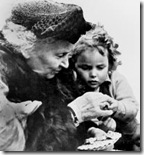
The Work of Education

maria_montessori "Establishing lasting peace is the work of education; all politics can do is keep us out of war."

~ Maria Montessori

From The Writer's Almanac (8.31.08):

"...today there are more than 5,000 Montessori schools in the United States, 300 of which are public schools. A study in 2006 published in the journal Science tested public school children in inner-city Milwaukee, some who had won a district lottery to attend the public Montessori school, and a separate control group who had entered the Montessori lottery but did not get picked. (This was to account for differences in home environment between the sorts of parents who want their children to attend Montessori; in this study, every participant's parents had wanted their child to enroll in Montessori.)"

"The study showed that five-year-olds who attended Montessori had better vocabulary and math skills, as well as better social problem-solving skills — that when presented with stories of behavior dilemmas, Montessori children used 'a higher level of reasoning by referring to justice or fairness to convince the other child' to share. Twelve-year-old Montessori children were deemed to have written essays that were 'significantly more creative' and that employed 'significantly more sophisticated sentence structures' than their non-Montessori peers, though their spelling and grammar skills were at an equal level."