Showing posts with label New Yorker. Show all posts

Friday, April 15, 2011

Real Life

Phil Stutz describing the 96 Hour Academy Awards Principle to Kim Masters on KCRW’s The Business (April 4, 2011):

My rules of life are there’s uncertainty, there’s pain and it requires constant effort. You can’t abrogate those rules. I don’t care how many Academy Awards you’ve won. I find the high lasts roughly 96 hours. After that, the person’s a little bit stunned because life is going on just as it was, they just can’t believe it. And once in a while, they’ll really crash badly. The principle isn’t a treatment for it. I just try to warn them in advance. If they get nominated, I put them in the army to prepare.

*     *     *     *     *

Barry Michael describes the Realm of Illusion (New Yorker):

Our culture denies reality. It suggests that you can live in a world that is free of hardship. The media portray the beautiful people who inhabit this world. Their lives seem like glossy magazine photographs—airbrushed, like a “perfect moment” frozen in time. Phil Stutz was the first person I heard give this mythical world a name: the Realm of Illusion. We’re trained to feel like failures if our lives don’t resemble this ideal world.

But there’s a way to accept the imperfections of real life and still feel good about yourself: First, you must face the truth about reality.

Phil encapsulated this truth in the drawing above. The Realm of Illusion is depicted above the line. The stick figure is you on a quest for the perfect life (symbolized by the square with the dotted line). This realm is just an image. It has no more depth or movement than a still photograph.

Real life is below the line. Each circle represents an event (one project, one confrontation, even one day). The black dots inside each circle are turds. That means that no event is perfect; pain, uncertainty, loss are always with us. But, whether you consider an event a success or a failure, life will keep moving and produce another event. It’s this constant movement that gives life its creative power.

Look at the picture every morning. It reminds you that the Realm of Illusion doesn’t exist. No one’s life is without turds, no matter how successful people appear to be. Practice projecting yourself into the illusion at the top and then forcing yourself downward into the flawed (but alive) reality at the bottom. You’ll develop the following strengths:

  1. You’ll become more accepting of yourself and stop judging yourself against an impossible standard.
  2. You’ll deal with difficulties calmly and rationally as a natural part of life.
  3. You’ll begin to feel a sacred kind of wisdom in events, even the bad ones. This builds faith.

See also: “Hollywood Shadows: A Cure for Blocked Screenwriters,” by Dana Goodyear, New Yorker, March 21, 2011

Saturday, November 13, 2010

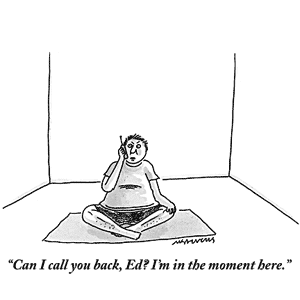
In the Moment

Mick Stevens

Friday, August 06, 2010

A Pervasive Sense of Dread and Guilt

Excerpt from “The Publication of ‘Hiroshima’ in The New Yorker,” by Steve Rothman:

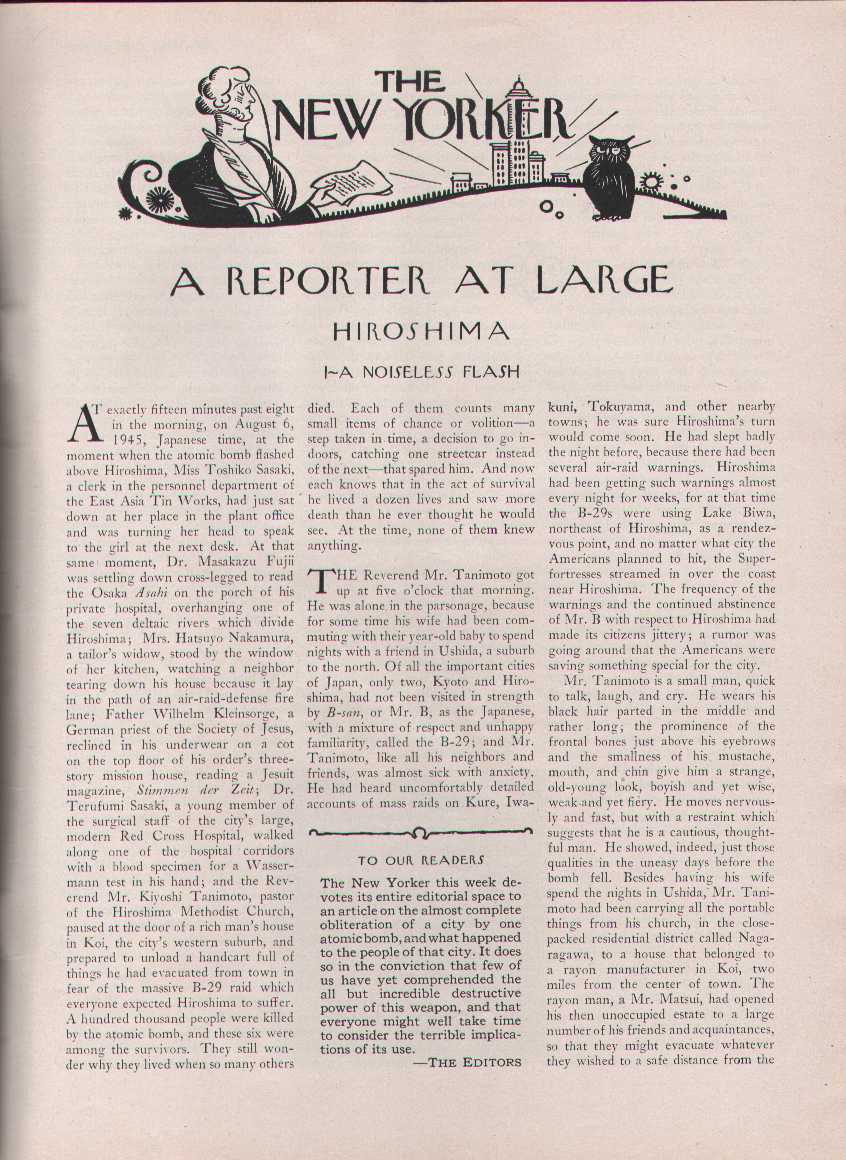
New Yorker cover, August 31, 2946 A year after World War II ended, a leading American weekly magazine published a striking description of what life was like for those who survived a nuclear attack. The article, simply titled "Hiroshima," was published by The New Yorker in its August 31, 1946 issue. The thirty-one thousand word article displaced virtually all other editorial matter in the issue.

"Hiroshima" traced the experiences of six residents who survived the blast of August 6, 1945 at 8: 15 am. There was a personnel clerk, Miss Toshiko Sasaki; a physician, Dr. Masakazu Fujii; a tailor's widow with three small children, Mrs. Hatsuyo Nakamura; a German missionary priest, Father Wilhelm Kleinsorge; a young surgeon, Dr. Terufumi Sasaki; and a Methodist pastor, the Reverend Mr. Kiyoshi Tanimoto. The article told the story of their experiences, starting from when the six woke up that morning, to what they were doing the moment of the blast and the next few hours, continuing through the next several days and then ending with the situations of the six survivors several months later.

The article, written by John Hersey, created a blast of its own in the publishing world. The New Yorker sold out immediately, and requests for reprints poured in from all over the world. Following publication, "Hiroshima" was read on the radio in the United States and abroad. Other magazines reviewed the article and referred their readers to it. The Book-of-the-Month Club sent a copy of the article in book form to its entire membership as a free selection. Later that fall, "Hiroshima" was published as a book by Alfred A. Knopf and has remained in print ever since.

"Hiroshima" was not the first exposure that readers had to the events that took place on August 6. Many articles in the popular press described the destruction of the city, such as a Collier's story published in the spring of 1946 crammed full of details about the power of the atom bombs dropped on Hiroshima and Nagasaki ("at a distance of 4,200 feet—about eight tenths of a mile—the pressure was 2,160 pounds a square foot") and anecdotes about the horrific effects of nuclear weapons on human beings ("Men in black-striped shirts were burned in strips. Heat stenciled dress figures onto the bodies of women."). Collier's also included an artist's rendition of the effect of a nuclear blast on downtown Manhattan. But most of these stories steered clear of details that would help readers identify with the dead or the survivors. Usually, "the statistics of devastation and death were simply recited as prefatory to a plea for international control, civil defense, or some other cause. On a canvas whose broadbrush background scenes were already familiar, Hersey etched several vividly realized foreground figures.

The direct effect of "Hiroshima" on the American public is difficult to gauge. No mass movement formed as a result of the article, no laws were passed, and reaction to the piece probably didn't have any specific impact on U.S. military strategy or foreign policy. But certainly the vivid depictions in the book must have been a strong contributor to a pervasive sense of dread (and guilt) about nuclear weaponry felt by many Americans ever since August 1945.

hiroshima-ny

Thursday, June 04, 2009

The Workshop is a Process

From "Show or Tell: Should Creative Writing Be Taught?" by Louis Menand, The New Yorker (June 8, 2009)

The New Yorker June 8 & 15, 2009 Creative-writing programs are designed on the theory that students who have never published a poem can teach other students who have never published a poem how to write a publishable poem. The fruit of the theory is the writing workshop, a combination of ritual scarring and twelve-on-one group therapy where aspiring writers offer their views of the efforts of other aspiring writers. People who take creative-writing workshops get course credit and can, ultimately, receive an academic degree in the subject; but a workshop is not a course in the normal sense—a scene of instruction in which some body of knowledge is transmitted by means of a curricular script. The workshop is a process, an unscripted performance space, a regime for forcing people to do two things that are fundamentally contrary to human nature: actually write stuff (as opposed to planning to write stuff very, very soon), and then sit there while strangers tear it apart. There is one person in the room, the instructor, who has (usually) published a poem. But workshop protocol requires the instructor to shepherd the discussion, not to lead it, and in any case the instructor is either a product of the same process—a person with an academic degree in creative writing—or a successful writer who has had no training as a teacher of anything, and who is probably grimly or jovially skeptical of the premise on which the whole enterprise is based: that creative writing is something that can be taught.

Thursday, February 01, 2007

The Paradox of Acting [and Life]

This comment from John Lahr's delicious essay on stagefright ("Petrified," The New Yorker, Aug. 28, 2006) reminds me of the simulatenous yet contradictory skills developed through meditation which contribute to regular life becoming gradually more awake:

"The paradox of acting is that, like surfing, it requires both relaxation and concentration. If there is concentration without relaxation, or relaxation without concentration, the performance doesn't work."
Lahr quotes pianist Charles Rosen who sees "stagefright as an inevitable and appropriate result of a vituoso's perfectionism."

'Stagefright is not merely symbolically but functionally necessary, like the dread of a candidate before an examination or a job interview, both designed essentially as a test of courage. Stagefright, like epilepsy, is a divine ailment, a sacred madness...It is a grace that is sufficient in the old Jesuit sense -- that is, insufficient by itself but a necessary condition for success.'