Showing posts with label film. Show all posts

Thursday, May 19, 2011

Prayer About Everyone and Everything

Roger Ebert, from “A Prayer Beneath the Tree of Life,” Chicago Sun Times, May17, 2011:

Terrence Malick's new film is a form of prayer. It created within me a spiritual awareness, and made me more alert to the awe of existence. I believe it stands free from conventional theologies, although at its end it has images that will evoke them for some people. It functions to pull us back from the distractions of the moment, and focus us on mystery and gratitude…

Many films diminish us. They cheapen us, masturbate our senses, hammer us with shabby thrills, diminish the value of life. Some few films evoke the wonderment of life's experience, and those I consider a form of prayer. Not prayer ‘to’ anyone or anything, but prayer ‘about’ everyone and everything. I believe prayer that makes requests is pointless. What will be, will be. But I value the kind of prayer when you stand at the edge of the sea, or beneath a tree, or smell a flower, or love someone, or do a good thing. Those prayers validate existence and snatch it away from meaningless routine…

What Malick does in The Tree of Life is create the span of lives. Of birth, childhood, the flush of triumph, the anger of belittlement, the poison of resentment, the warmth of forgiving. And he shows that he feels what I feel, that it was all most real when we were first setting out, and that it will never be real in that way again.”

See also: Metacritic

We Will Protect What We Fall In Love With

“I've been filming time-lapse flowers 24 hours a day, seven days a week, for over 35 years. To watch them move is a dance I'm never going to get tired of. It fills me with wonder, and it opens my heart. Beauty and seduction, I believe, is nature's tool for survival, because we will protect what we fall in love with. Their relationship is a love story that feeds the Earth. It reminds us that we are a part of nature, and we're not separate from it.”

~ Louie Schwartzberg, from “The Hidden Beauty of Pollination,” TED, March 2011

Saturday, April 16, 2011

How Is It That the Innocent Survive

Excerpt from "Wicked’s Gregory Maguire on What Turns a Story into a Fairy Tale":

You might say that every fairy tale at its heart is the story of growing up, of a protagonist successfully navigating the treacherous path through the woods from innocence to experience without being eaten by the wolves. For children a fairy tale is about hope. They don’t yet know if they are going to make it. They read fairy tales as being about what might happen, that they might have the strengths to make it through the woods and fight the dragons, and end up in the castle with the princess or the prince. Adults look at fairy tales differently, because, if they are adults, presumably they have made it to that safety zone of having survived their childhoods. They look back at fairy tales with a combination of nostalgia––because don’t we all love something about our childhoods anyway, including the mystery of what was going to be on the other side of childhood––and a sort of clinical curiosity. We want to know how is it that the innocent survive when they are really so clueless. We love to read about how people became who they became, how Picasso became Picasso, or how Elizabeth Taylor became Elizabeth Taylor. As adults, let’s face it, even if we have make it to adult life, we are still not sure exactly who we are. To look back at the story of a fairy tale, which is to look back at the story of a path from cluelessness to potency, can continue to give us courage.

Erik Christian Haugaard, a Danish writer who is now dead, said in a speech once, “The Fairy tale always takes the side of the weak against the mighty. There is no such thing as a fascist fairy tale. A fascist fairy tale would be an absurdity.” There is something essential about that fact. The protagonist can’t be dominating or mean or the bully of the playground. There might be new fairy tales, but there are some eternals that have to exist. If they don’t exist, what we see is not a fairy tale––it is something else. The absolute requirement of a fairy tale may be that the protagonist has to be in some way less strong and more humble than other people in the story. But as long as that is in existence than the form of a fairy tale can change infinitely and it will always be recognizable by anyone who hears the words “once upon a time.”

See also: Director Joe Wright explains the surprising five films that inspired the making of Hanna.

Saturday, April 09, 2011

Wherever They Are

“Wildflowers don't move to find the sun's rays. God makes them fecund wherever they are.”

~ Frère Christian de Chergé, from Of Gods and Men

Friday, April 01, 2011

To Really See It

Sunday, March 27, 2011

Each Unhappy Family is Unique

The Hedgehog (France) was my favorite film of the eight we saw over the weekend at the 36th Cleveland International Film Festival. Other favorites were Special Treatment (France) and Illegal (Belgium). My favorite documentary was The Children of Chabannes.


See also:

Thursday, March 24, 2011

Humans Together

Cleveland International Film Festival March 24 — April 3, 2011


"In a world where there are no longer books we have almost all of us read, the movies we have almost all of us seen are perhaps the richest cultural bond we have. They go on haunting us for years the way our dreams go on haunting us. In a way they are our dreams. The best of them remind us of human truths that would not seem as true without them. They help to remind us that we are all of us humans together."


~ Frederick Buechner, from Beyond Words

Sunday, February 20, 2011

Strangers No More

This 39-minute film about a school in south Tel Aviv gets my vote for best Oscar-nominated documentary short subject. The principal and teachers of Bialik-Rogozin School enthusiastically embrace the challenges of educating children from all over the world, many of whom have experienced extraordinary violence, loss, and displacement. It is a remarkable and inspiring study of resilience nurtured by providing a safe environment, finding common ground in the midst of dizzying diversity, and igniting passion for learning.

Strangers No More Movie Trailer - Bialik Rogozin School from Simon & Goodman Picture Co. on Vimeo.

Wednesday, February 09, 2011

In Between

Sofia Coppola, speaking with Kurt Anderson about Somewhere on Studio 360 (Jan. 7, 2011):

“[The main character] is based on a bunch of different movie star actors that I’ve known or met or heard stories about and mixed them all together. He’s become famous recently and he’s doing a press conference for a movie he’s done called Berlin Agenda so you get the idea he’s done some kind of big action movie that he’s not very proud of. I never want to show him making a movie. It’s not really about the film business, but that’s the backdrop. I try to think of things that the actors would do in between films like get a head plaster cast, or sometimes they learn strange skills. You hear stories about actors having romances with their leading ladies and I thought, what happens when they have to get back together a year later for a reshoot or a press junket. Everything’s heightened when you’re doing a movie and then it’s over.”

“I like in life how so much is conveyed by the way someone gives a look or a glance. I think a lot of times in movies, people explain all their feelings, but in life you’re not always able to articulate a lot of things. And part of the fun of making films is telling the story in a visual way.”


Monday, February 07, 2011

Like a Brick in Your Pocket

Playwright David Lindsay-Abaire got the idea for Rabbit Hole after hearing stories about couples who had lost their children. He was the father of a young child himself and he remembered something Marsha Norman suggested when he was studying at Julliard. “She said, if you want to write a good play, write about the thing that frightens you the most.”

In this scene from the movie based on the play, Becca (Nicole Kidman) and her mother Nat (Dianne Wiest) have started packing up toys and clothes that belonged to Becca’s son, Danny, who was killed in a car accident about eight months earlier.

I really like this scene because it explores an insight into grief that applies broadly to a variety of losses that we all eventually face.

BECCA

Mom? Does it go away?

NAT

What.

BECCA

This feeling. Does it ever go away?

NAT

No. I don’t think it does. Not for me it hasn’t. And that’s going on eleven years.

It changes though.

BECCA

How?

NAT

I don’t know. The weight of it, I guess. At some point it becomes bearable. It turns into something you can crawl out from under. And carry around—like a brick in your pocket. And you forget it every once in a while, but then you reach in for whatever reason and there it is: “Oh right. That.” Which can be awful . But not all the time. Sometimes it’s kinda . . . Not that you like it exactly, but it’s what you have instead of your son, so you don’t wanna let go of it either. So you carry it around. And it doesn’t go away, which is . . .

BECCA

What.

NAT

Fine . . . actually.

Saturday, January 29, 2011

Pinned to the Cushion

127Hours2

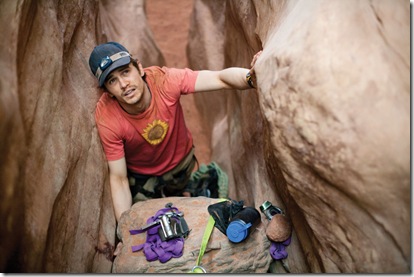
I was completely surprised to discover that Danny Boyle’s 127 Hours is much deeper than just a movie about someone who has to cut his arm off to survive. It’s also a brilliant account of being pinned to a de facto meditation cushion for an involuntary 5-day mindfulness intensive on the nature of thinking, feeling, the self, loving-kindness, and the liberation that can come from yielding to impersonal forces. The boulder deserves an Oscar nomination for a supporting role as both antagonist and teacher. I expected to feel uneasy, but instead I was completely absorbed in the clever depiction of an excruciating subjective experience of one person's suffering.

Aron Ralston said in one interview, "The entrapment created such an appreciation for the frolicking I had been doing until it happened and there was the euphoric feeling of being free and getting my life back again. Because of what happened, I understand what life is. I'm hopeful that people will see something inside of themselves, as well. I was in an extraordinary circumstance and it fundamentally came down to wanting to live and get back to my family. It is about survival, love and freedom — and those things are common in all of us."

The good news is that the profound yet practical insights Ralston carried out of Blue John Canyon can also be gradually cultivated through the consistent development of attentional skills over time. I enthusiastically recommend both the film and the effort required to experience high levels of concentration, sensory clarity, and equanimity without waiting for the conditions to become so extreme.

Thursday, October 28, 2010

A Useful Anyone

A Very Long Engagement (2004)

Cast of Thousands
by Sandra Beasley, from I Was the Jukebox

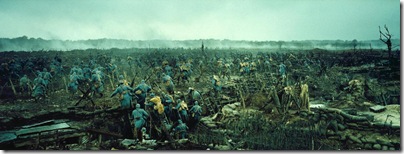
When they make a movie of this war
I am minute ninety-seven, soot tears
applied with a Q-tip, the one whose roof
collapses on her head before
her pie is done. Look how I look at you—
the apple and the apple’s knife still rolled
into my skirt, eyes wide as gin. The blast,
then ash. The director cried Cut!
More ash, he said, and they bombed me again.
My death is the clip they send to the Academy;
later they will kill me in Spanish, then French.
I will die on mute, on airplanes, row after row
of my tiny, touchscreened dying. My love,
I have joined the cast of thousands: me
and the plucky urchin, the scared infantryman,
me and the woman whose laminated beauty
sells gyros on every Greek storefront—
a useful anyone who advances the story,
then drops away. In your dream
six months from now I’ll make a cameo
as the customer with an unfocused smile,
offering a twenty as the register
begins to shake and smolder under your hands.
The coins will rise and spit silver into the air.
They buried my village a house at a time,
unable to sort a body holding from a body held,
and in minute ninety-six you can see me raise
my arms as if to keep the sky from falling.

Kirstin O'Carroll in Public Enemies (2009)

Sunday, September 05, 2010

The Screen is Always There

Canton Place, Ohio (1980), Hiroshi SugimotoExcerpt from Not Always So: Practicing the True Spirit of Zen, by Shunryu Suzuki:

Our everyday life is like a movie playing on the wide screen. Most people are interested in the picture on the screen without realizing there is a screen. When the movie stops and you don't see anything anymore, you think, "I must come again tomorrow evening. I will come back and see another show." When you are just interested in the movie on the screen and it ends, then you expect another show tomorrow, or maybe you are discouraged because there is nothing good on right now. You don't realize the screen is always there.

But when you are practicing, you realize that your mind is like a screen. If the screen is colorful—colorful enough to attract people—then it will not serve its purpose. So to have a screen which is not colorful—to have a pure, plain white screen—is the most important point. But most people are not interested in the pure white screen.

I think it is good to be excited by seeing a movie. To some extent you can enjoy the movie because you know that it is a movie. Even though you have no idea of the screen, still your interest is based on an understanding that this is a movie with a screen and there is a projector or something artificial. So you can enjoy it. That is how we enjoy our life. If you have no idea of the screen or the projector, perhaps you cannot see it as a movie.

Zazen practice is necessary to know the kind of screen you have and to enjoy our life as you enjoy movies in the theater. You are not afraid of the screen. You do not have any particular feeling for the screen, which is just a white screen. So you are not afraid of your life at all. You enjoy something you are afraid of. You enjoy something that makes you angry or that makes you cry, and you enjoy the crying and the anger too.

If you have no idea of the screen, then you will be afraid of enlightenment. "What is it? Oh, my!" [laughter] If someone attains enlightenment, you may ask him about the experience, you may say,"Oh, no! That is not for me." But it is just a movie. Something for you to enjoy. And if you want to enjoy the movie, you should know that it is the combination of film and light and white screen,and that the most important thing is the plain white screen.

The white screen is not something that you can actually attain; it is something you always have. The reason you don't feel you have it is because your mind is too busy to realize it. Once in a while you should stop all your activities and [notice your] screen. That is zazen. That is the foundation of our everyday life and our meditation practice.

See also: A Shining Screen

Tuesday, June 22, 2010

See More, Hear More, Feel More

The first five seconds of this IMAX 3D countdown summarizes the mindfulness strategy I practice and share. Shinzen Young has been saying for years that the development of basic attentional skills through working with ordinary sensory experiences can lead to a life lived in higher definition. Of course IMAX can only enhance your awareness of the objective world by increasing the intensity, while Shinzen’s strategies also address your awareness of the subjective world—as well as the interplay between the two—while strengthening your ability to remain open to the full range of intensity and subtlety. It’s similar to the difference between watching marathon runners cross a finish line versus training to run one yourself.

“There are actually two reasons why people in general are out of touch with their subjective experiences: They have ‘low definition’ bodies and they are continuously fixated in thought, especially verbal thought. Of course, there’s nothing intrinsically wrong with thinking. Indeed complex thought is evolution’s wonderful gift to humankind, giving our species special powers that the others lack. Thought per se is not the problem. The problem is the driven and fixated way in which we think. Fortunately, both low definition in the body and compulsive fixation in the mind can be remedied through systematic practice of mindfulness.”

~ Shinzen Young, from Bringing the Monastery Home

Monday, June 21, 2010

Leaving Unreconciled

“I don’t believe you should leave a film feeling reconciled. Hollywood and business interests want that. You leave feeling good, reconciled. I’d like to see films that didn’t try to reconcile audiences. There is no such thing and it would soften the impact of the film. I want it to be harsh. You’re supposed to reflect on the issues.”

~ Roy Andersson, from the commentary of his film Songs from the Second Floor


Friday, May 14, 2010

The Attention to the Mundane

"I think the easiest way to talk about the movie is to say it's a character study set in New York City. You are looking at the world through the lens of one girl during one week of her life. The movie focuses on the small gestures, like the silent ­moments when two people's hands almost touch. These small gestures and the attention to the mundane create a huge tension. I wouldn't necessarily say it's a love story as much as a story about being young and asking, 'How do I react to the world? How do I deal with myself?'"

~ Zoe Kazan, from an interview with Jacob Osterhout for NYDailyNews.com (March 13, 2010)

Saturday, April 03, 2010

Poetry Blows the Roof Off at CIFF


From “Louder Than a Film Festival,” by Clint O’Connor, The Plain Dealer (March 29, 2010):

Poetry, let alone high school poetry, is not supposed to outshine flashy films from around the globe. But "Louder Than a Bomb," a documentary about the inspiring teens of a huge poetry slam in Chicago, thrilled the audiences and judges at the 34th Cleveland International Film Festival.

The movie, which had its world premiere here, won both the Roxanne T. Mueller Audience Choice Award for best film, and the Greg Gund Memorial Standing Up Film Competition, which honors movies about social justice and activism, and includes a $5,000 prize for co-directors Jon Siskel and Greg Jacobs.

More…

Monday, March 29, 2010

Scopophilia

Cleveland International Film Festival, March 27, 2010

We spent the weekend shoulder-to-shoulder with like-minded cinephiles, our collective gaze fixed on the lights flickering on the cave walls.

We watched a butcher in Jerusalem let trouble stir life into his cold bones, confining a nibble of vitality to be preserved forever in a meat locker and the icy waters of a nearby spring.

We watched Joseph Brodsky gazing back at the St. Petersburg of his youth: potatoes, paintings of nudes, shelves of books, his parents dancing after the war, an orchestra of musical instruments floating in the sky like clouds.

We watched a Croatian sniper try to dodge the trajectory of his own bullets while hunting down the traumatized Little Red Riding Hood he had fallen in love with through the scope of his rifle and nearly destroyed.

We watched a Mongolian folk singer search for the lyrics to a song hidden in the unrepeatable archives of fading human memory.

We watched Renaud Capuçon perform Gluck’s Orfeo Melody on a 1737 Guarnerius violin in the Paris subway from 7:57 a.m. to 7:57 p.m to mostly indifferent commuters a couple of days before playing the same piece to a sold-out auditorium in the Théâtre des Champs-Elysées. Our hearts were collectively broken until a blind woman renewed our hope by venturing as close as possible to warm herself in the glow.

We watched, Juan Pujol Garcia, a double agent from Spain and his contrived network of spies convince the Nazis to prepare for an attack on Pas de Calais as the Allied Forces stormed the beaches of Normandy.

We watched art collectors, dealers, galleries, and auction houses enthusiastically inflate the value of contemporary art to staggering and unsustainable heights through secrecy, speculation, tax strategies, and cornering markets.


Cleveland International Film Festival

Tuesday, March 23, 2010

Enchanted by the Trick and the Story

How the Puppets from Fantastic Mr. Fox Were Made [Slide Show] by Julian Sancton, Vanity Fair, 11.23.2009

Wes Anderson discussing the appeal of stop-motion animation with Michael Specter from The Making of Fantastic Mr. Fox: A Film by Wes Anderson Based on the Book by Roald Dahl:

The thing I’ve always loved with stop-motion, more than anything else, is puppets that have fur, and actually not only that. I also like the fighting skeletons in, maybe it’s Jason and the Argonauts, or maybe it’s one of the Sinbad movies where they have the fighting skeletons. But I have always like — I love the way King Kong, the old King Kong, looked, with his fur – the animators call it “boiling.” And for some reason, the whole magical aspect of stop-motion was one of those things where you can see the trick — I mean, you know the Cocteau movies? The visual effects in Beauty and the Beast, for instance, are things where you can really see that a person is behind this wall sticking their arm through it, holding a torch, and the film is running backwards, and so that is how this light is coming on, or the mirror is actually water. You know, those kinds of effects, where you can see what it is, have always been the most fascinating and mesmerizing and moving to me. And with stop-motion, the whole film is that sort of thing in a way, to my mind. So I guess, to the degree that that makes any sense, that’s more or less where it comes from for me. That magical effect where you can see how it is accomplished — where at one and the same time you are enchanted by the trick to the effect and by the story itself. I have no idea why this concept means so much to me.

Wednesday, March 10, 2010

Not Beyond Your Imagination

James Cameron, in conversation with Elvis Mitchell for a special online edition of The Treatment, recorded live at a benefit for the Natural Resources Defense Council:


“I’ve always believed in exploration. I’ve always believed in that sense of going beyond and looking where we haven’t looked. I think the film connects that way in a number of different ways. There’s one line I hate and studios love to use: Beyond your imagination. It’s not beyond your imagination. People have great imaginations. They have great dreams when they’re kids. You can fly when you’re a kid in your dreams. As you grow up, your dreams somewhat diminish and you don’t fly as much in your dreams. I wanted to go back to that childlike dream state in this movie because I think we all kind of connect at that level. And so I wanted to create essentially a lucid dream that would connect us all at some kind of unconscious level.”

*     *     *

“We were tasked with designing all these creatures and plants and everything for this movie. And every time we thought we had a great idea somebody would bring in a photograph or some bit of nature here had beat us to the idea. Ultimately, at the end of a two-year design process, we had to just admit with great humility that nature’s imagination was better than the combined imagination of the best visual artists on the planet that I had gathered to make Avatar. And it’s true.”

*     *     *

In his talk at TED 2010, James Cameron “reveals his childhood fascination with the fantastic — from reading science fiction to deep-sea diving — and how it ultimately drove the success of his blockbuster hits Aliens, The Terminator, Titanic and Avatar.”