Showing posts with label self. Show all posts

Thursday, May 19, 2011

The Self as Both a Thing and a Process

Excerpt from “Psychological Self vs. No-Self,” by Ron Crouch, Buddhist Geeks, May 19, 2011:

psych-self The self in Western psychology is viewed as that function of the mind that helps us to organize our experiences. It takes raw sense data, memories, and other cognitive functions and turns them into recognizable narratives. It is critical for everything that we do. Without a strong sense of self, we literally could not make sense of anything that happens to us.

What is fascinating is that in the western psychological view, the “self” or the “executive function” is actually a process and not really a thing. It waxes and wanes all the time, goes into the foreground and background of awareness depending on how much we need it, disappears when we sleep, is not the same as it was when we were little, much less the same as it was last year, and is even subtly different than it was last week.

So far, this should make a lot of sense to both psychologists and meditators. But here is where things get interesting: we all know that processes are not solid and change all the time, yet in this particular process there is a nagging sense that there is a solid permanent “me” hiding in that process somewhere. As if the process itself were a real solid thing in the same way that a table or chair is.

It is this unshakable sense of a solid “me” in the midst of this process that is the “self” that is referred to in the Dharma. When we talk about “no-self” in Buddhism, we are pointing to this sense of a solid self in and calling it an illusion. The process of “selfing” is real, the belief that it is somehow a permanent “me” is not.

To help understand how important this illusion is imagine that another mental process had this same illusion tied to it. Take memory for example. When we experience a memory we know that it isn’t “real” in the sense that it does not have a reality outside or our mental functioning. We know that memories come and go, are subject to change and can be forgotten. But what if every time you remembered something you assumed that the memory itself was “real” in the same way that a table or chair is real. That it was substantial and lasting. Even though you could not literally see or experience the memory with your five senses, you still had the unshakable belief that it was a real and solid thing that is supposed to last. Wouldn’t this be a set-up for frustration? Memories slip and slide out of consciousness and like every other mental function they are subject to dramatic change. If we expected them to never go away and always be there, we would constantly be in distress. This is exactly what is happening with us in terms of the self-process.

While the self-process creates narratives that organize our experiences into something recognizable, the illusion of self is inserted as a main character into all these narratives. We expect the character to be the same all the time, to never change or go away, to be “real.” And yet each moment we are running into a stark reality: the self is not as real as we believe it to be, and it certainly does not last. Over time this sense of solid “me” becomes the most salient feature of all of our experience and our greatest source of anxiety. The fact that we see this constantly changing process as a solid “me” creates endless problems for us because it sets up a never-ending fight between us and reality (and reality never loses).

What is odd is that according to psychology, this sense of a solid self is not an issue. In fact it is not really addressed at all. One part of the psychological literature explains that the self is a cognitive process like any other, and then another part of the literature goes on about protecting and promoting a healthy “self.” The fact that we are taking a process and turning it into a solid thing in our minds is simply not addressed.

In psychology, this point may have been missed because of the bias to study and theorize about pathology rather than health. The illusions and problems inherent in a “normally” functioning mind just don’t get a lot of research lab-time. So most theory in psychology works to get damaged selves back to “normal functioning.” Buddhism on the other hand, starts with the assumption that normal functioning is full of suffering caused by a false sense of self, and works to get people from a state of “normal” to enlightened.

Read entire essay here…

Sunday, May 15, 2011

Reasoning Is Suffused With Emotion

Excerpt from “The Science of Why We Don’t Believe Science,” by Chris Mooney, Mother Jones, April 18, 2011:

The theory of motivated reasoning builds on a key insight of modern neuroscience. Reasoning is actually suffused with emotion (or what researchers often call "affect"). Not only are the two inseparable, but our positive or negative feelings about people, things, and ideas arise much more rapidly than our conscious thoughts, in a matter of milliseconds—fast enough to detect with an EEG device, but long before we're aware of it. That shouldn't be surprising: Evolution required us to react very quickly to stimuli in our environment. It's a "basic human survival skill," explains political scientist Arthur Lupia of the University of Michigan. We push threatening information away; we pull friendly information close. We apply fight-or-flight reflexes not only to predators, but to data itself.

Illustration by Jonathon Rosen

We're not driven only by emotions, of course—we also reason, deliberate. But reasoning comes later, works slower—and even then, it doesn't take place in an emotional vacuum. Rather, our quick-fire emotions can set us on a course of thinking that's highly biased, especially on topics we care a great deal about.

Consider a person who has heard about a scientific discovery that deeply challenges her belief in divine creation—a new hominid, say, that confirms our evolutionary origins. What happens next, explains political scientist Charles Taber of Stony Brook University, is a subconscious negative response to the new information—and that response, in turn, guides the type of memories and associations formed in the conscious mind. "They retrieve thoughts that are consistent with their previous beliefs," says Taber, "and that will lead them to build an argument and challenge what they're hearing."

In other words, when we think we're reasoning, we may instead be rationalizing. Or to use an analogy offered by University of Virginia psychologist Jonathan Haidt: We may think we're being scientists, but we're actually being lawyers. Our "reasoning" is a means to a predetermined end—winning our "case"—and is shot through with biases. They include "confirmation bias," in which we give greater heed to evidence and arguments that bolster our beliefs, and "disconfirmation bias," in which we expend disproportionate energy trying to debunk or refute views and arguments that we find uncongenial.

That's a lot of jargon, but we all understand these mechanisms when it comes to interpersonal relationships. If I don't want to believe that my spouse is being unfaithful, or that my child is a bully, I can go to great lengths to explain away behavior that seems obvious to everybody else—everybody who isn't too emotionally invested to accept it, anyway. That's not to suggest that we aren't also motivated to perceive the world accurately—we are. Or that we never change our minds—we do. It's just that we have other important goals besides accuracy—including identity affirmation and protecting one's sense of self—and often those make us highly resistant to changing our beliefs when the facts say we should.

Read entire article here…

Saturday, May 14, 2011

Beyond the Mind

Excerpts from Emptiness Dancing by Adyashanti:

The mind can’t fathom that there can be a true intelligence, a transcendent intelligence, that isn’t the product and outcome of thought and conceptual understanding. It can’t fathom that there could be wisdom that’s not going to come at you in the form of thoughts, in the form of acquired and accumulated knowledge.

The true spiritual urge or yearning is always and invitation beyond the mind. That’s why it’s always been said that if you go to God, you go naked or you don’t go at all. It’s the same for everybody. You go in free of your accumulated knowledge, or you are forever unable to enter. So an intelligent mind realizes its own limitation, and it’s a beautiful thing when it does.

When you stop holding on to all the knowledge, then you start to enter a different state of being. You start to move into a different dimension. You move into a dimension where experience inside gets very quiet. The mind may still be there chatting in the background, or it might not, but consciousness is no longer bothering itself with the mind. You don’t need to stop it. Your awareness just goes right past that wall of knowledge and moves into a very quiet state…

…Once your conceptual world of knowledge gets put in its rightful place, it is transcended. You see that you are eternal consciousness now appearing as woman or man, this or that character. But like every good actor, you are not what you are appearing as. Everything that exists is consciousness appearing as, or God appearing as, or Self appearing as, or spirit appearing as. The Buddha called it no-self. When that’s seen, you see Unity. There is only God. That’s all there is: God appearing as floor, as a human being, as a wall, as a chair.

No knowledge, no statement of the Truth touches what’s eternal, what you really are. And no statement about how to get there is true either, because what gets one person there doesn’t get another person there. A mind that likes to look for the one truth path cannot find it. Of course, the mind doesn’t like that. “No right path? Nothing that could be said or read that ultimately, in the end, could be true? The most enlightened being can’t speak the Truth?”

No. It’s never been done, and it never will be done. The only thing you can do is to put a pointer on the way that says, “Look that way.” A false spiritual arrow is one that points to the wall and says, “Look this way.” A true arrow is one that points beyond the wall of concepts.

Monday, May 02, 2011

A Daughter and a Sister

I am
by eight-year-old Ava Schicke from Omaha, Nebraska

I am a daughter and a sister.
I wonder when I will die.
I hear the warm weather coming.
I see stars in the day.
I want to learn my whole ballet dance.
I am a daughter and a sister.

I pretend to be a teacher at home.
I feel like I am a teacher.
I touch hands that are growing.
I worry that I will never change.
I cry when something or someone dies.
I am a daughter and a sister.

I understand that teachers work hard for students.
I say that I don’t like bullies.
I dream about me not moving while trying really hard to run.
I try to become a good friend.
I hope that there is no more dying or killing.
I am a daughter and a sister.

Sunday, May 01, 2011

Before & After: My Imperfection is My Nature

Photograph by Amy Arbus for The New York Times

From “Last-Minute Doubts, New York City,” interviews by Joanna Miller, The New York Times, May 1, 2011:

ANNA MEDVEDEVA, 24: The photo was taken the night before my breast-augmentation, chin- and neck-liposuction surgeries, and I was very confused and was thinking, What are you doing with yourself, girl? I spent all that day at home preparing for surgery. I was alone with my fear that night, and I was thinking that I wanted to change my decision. So I tried on the bandage that I would have to wear on my face after the surgery. I felt scared and called my best friend, who really helped me so much. My friend and I talked as Amy took pictures of me. In some, I was nude, and when the light went through the window from the street and I saw myself, I thought, I’m already perfect. My imperfection is my nature. Now, after everything is done, I love it so much. I look to the mirror, and I’m like: “Wow, you’re so sexy. I want you, girl.”

AMY ARBUS: A week before this photo session, Anna told me she was having plastic surgery, and I asked to do before-and-after pictures. Toward the end of this shoot, she started getting nervous about the surgery, and I said, “You can still change your mind.” She was on the phone a lot with her girlfriend, and when we were done, she was looking to see if she had heard back, and that’s when I took that picture. It was the last one I took.

Saturday, April 23, 2011

Silence No One Hears

Poem with No Speaker
by Franz Wright, from Earlier Poems

Are you looking
for me? Ask that crow

rowing
across the green wheat.

See those minute air bubbles
rising to the surface

at the still creek's edge—
talk to the crawdad.

Inquire
of the skinny mosquito

on your wall
stinging its shadow,

this lock
of moon

lifting
the hair on your neck.

When the hearts in the cocoon
start to beat,

and the spider begins
its hidden task,

and the seed sends its initial
pale hairlike root to drink,

you'll have to get down on all fours

to learn my new address:
you'll have to place your skull

besides this silence
no one hears.

Friday, April 08, 2011

Room to Grow

April 7, 2011

“Loneliness is the human condition. Cultivate it. The way it tunnels into you allows your soul room to grow. Never expect to outgrow loneliness. Never hope to find people who will understand you, someone to fill that space. An intelligent, sensitive person is the exception, the very great exception. If you expect to find people who will understand you, you will grow murderous with disappointment. The best you’ll ever do is to understand yourself, know what it is that you want, and not let the cattle stand in your way.”

~ Janet Fitch, from White Oleander

Tuesday, April 05, 2011

Who's This?

Disappearing Act
by Elizabeth Ross Taylor, from Blackbird, Spring 2002

No, soul doesn't leave the body.

My body is leaving my soul.
Tired of turning fried chicken and
coffee to muscle and excrement,
tried of secreting tears, wiping them,
tired of opening eyes on another day,
tired especially of that fleshy heart,
pumping, pumping. More,
that brain spinning nightmares.
Body prepares:
disconnect, unplug, erase.

But here, I think, a smallish altercation
arises.
Soul seems to shake its fist.
Wants brain? Claims dreams and nightmares?
Maintains a codicil bequeathes it shares?

There'll be a fight. A deadly struggle.
We know, of course, who'll win. . . .

But who's this, watching?

[Thanks, Linda!]

Wednesday, February 16, 2011

Be Still While You are Still Alive

Year-End Retreat 2009, Rancho Palos Verdes

In Silence
by Thomas Merton, from The Strange Islands

Be still.
Listen to the stones of the wall.
Be silent, they try
to speak your

name.
Listen
to the living walls.

Who are you?
Who
are you? Whose
silence are you?

Who (be quiet)
are you (as these stones
are quiet). Do not
think of what you are
still less of
what you may one day be.

Rather
be what you are (but who?)
be the unthinkable one
you do not know.

O be still, while
you are still alive,
and all things live around you

speaking (I do not hear)
to your own being,
speaking by the unknown
that is in you and in themselves.

“I will try, like them
to be my own silence:
and this is difficult. The whole
world is secretly on fire. The stones
burn, even the stones they burn me.
How can a man be still or
listen to all things burning?
How can he dare to sit with them
when all their silence is on fire?”

Friday, February 11, 2011

You are Not the Stuff of Which You are Made

From “Richard Dawkins on Our ‘Queer’ Universe,” TED Talks, Sep. 2006:

"Steve Grand, in his book, Creation: Life and How to Make It, is positively scathing about our preoccupation with matter itself. We have this tendency to think that only solid, material things are really things at all. Waves of electromagnetic fluctuation in a vacuum seem unreal. Victorians thought the waves had to be waves in some material medium -- the ether. But we find real matter comforting only because we've evolved to survive in Middle World, where matter is a useful fiction. A whirlpool, for Steve Grand, is a thing with just as much reality as a rock.

In a desert plain in Tanzania, in the shadow of the volcano Ol Donyo Lengai, there's a dune made of volcanic ash. The  beautiful thing is that it Mesquite Sand Dunes, Death Valleymoves bodily. It's what's technically known as a barchan, and the entire dune walks across the desert in a westerly direction at a speed of about 17 meters per year. It retains its crescent shape and moves in the direction of the horns. What happens is that the wind blows the sand up the shallow slope on the other side, and then, as each sand grain hits the top of the ridge, it cascades down on the inside of the crescent, and so the whole horn-shaped dune moves.

Steve Grand points out that you and I are, ourselves, more like a wave than a permanent thing. He invites us, the reader, to "think of an experience from your childhood -- something you remember clearly, something you can see, feel, maybe even smell, as if you were really there. After all, you really were there at the time, weren't you? How else would you remember it? But here is the bombshell: You weren't there. Not a single atom that is in your body today was there when that event took place. Matter flows from place to place and momentarily comes together to be you. Whatever you are, therefore, you are not the stuff of which you are made. If that doesn't make the hair stand up on the back of your neck, read it again until it does, because it is important."

[Thanks, Pete!]

Saturday, January 29, 2011

Pinned to the Cushion

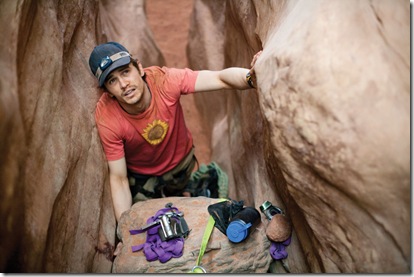
127Hours2

I was completely surprised to discover that Danny Boyle’s 127 Hours is much deeper than just a movie about someone who has to cut his arm off to survive. It’s also a brilliant account of being pinned to a de facto meditation cushion for an involuntary 5-day mindfulness intensive on the nature of thinking, feeling, the self, loving-kindness, and the liberation that can come from yielding to impersonal forces. The boulder deserves an Oscar nomination for a supporting role as both antagonist and teacher. I expected to feel uneasy, but instead I was completely absorbed in the clever depiction of an excruciating subjective experience of one person's suffering.

Aron Ralston said in one interview, "The entrapment created such an appreciation for the frolicking I had been doing until it happened and there was the euphoric feeling of being free and getting my life back again. Because of what happened, I understand what life is. I'm hopeful that people will see something inside of themselves, as well. I was in an extraordinary circumstance and it fundamentally came down to wanting to live and get back to my family. It is about survival, love and freedom — and those things are common in all of us."

The good news is that the profound yet practical insights Ralston carried out of Blue John Canyon can also be gradually cultivated through the consistent development of attentional skills over time. I enthusiastically recommend both the film and the effort required to experience high levels of concentration, sensory clarity, and equanimity without waiting for the conditions to become so extreme.

Thursday, January 20, 2011

A Creature in the River of Knowledge

Monologue from a fictional neuroscientist speaking at an imagined Aspen Ideas Festival/TED Talk event, from “Social Animal,” by David Brooks, New Yorker, Jan. 17. 2011:

“I guess I used to think of myself as a lone agent, who made certain choices and established certain alliances with colleagues and friends…Now, though, I see things differently. I believe we inherit a great river of knowledge, a flow of patterns coming from many sources. The information that comes from deep in the evolutionary past we call genetics. The information passed along from hundreds of years ago we call culture. The information passed along from decades ago we call family, and the information offered months ago we call education. But it is all information that flows through us. The brain is adapted to the river of knowledge and exists only as a creature in that river. Our thoughts are profoundly molded by this long historic flow, and none of us exists, self-made, in isolation from it.

Columbia River plume “And though history has made us self-conscious in order to enhance our survival prospects, we still have deep impulses to erase the skull lines in our head and become immersed directly in the river. I’ve come to think that flourishing consists of putting yourself in situations in which you lose self-consciousness and become fused with other people, experiences, or tasks. It happens sometimes when you are lost in a hard challenge, or when an artist or a craftsman becomes one with the brush or the tool. It happens sometimes while you’re playing sports, or listening to music or lost in a story, or to some people when they feel enveloped by God’s love. And it happens most when we connect with other people. I’ve come to think that happiness isn’t really produced by conscious accomplishments. Happiness is a measure of how thickly the unconscious parts of our minds are intertwined with other people and with activities. Happiness is determined by how much information and affection flows through us covertly every day and year.”

Read the entire piece here…

Saturday, January 15, 2011

Where Work and Play Merge

From Free Play: Improvisation in Life and Art by Stephen Nachmanovitch:

We have all observed the intense absorption of children in play, that wide-eyed concentration in which both the child and the world vanish, and there is only the play. Grown-ups involved in work they love also can experience such moments. It is possible to become what you are doing; these times come when pouf!—out you go, and there is only the work. The intensity of your focused concentration and involvement maintains and augments itself, your physical needs decrease, your gaze narrows, your sense of time stops. You feel alert and alive; effort becomes effortless. You lose yourself in your own voice, in the handling of your tools, in your feelings for the rules. Absorbed in the pure fascination of the game of that particular medium, you forget time and place and who you are. The noun of self becomes a verb. This flashpoint of creation in the present moment is where work and play merge.
Buddhists call this state of absorbed, selfless, absolute concentration samadhi. Samadhi is best known to be attainable through the practice of meditation, thought there is also walking samadhi , cooking samadhi, sandcastle-building samadhi, writing samadhi, fighting samadhi, lovemaking samadhi, flute-playing samadhi. When the self-clinging personality somehow drops away, we are both entranced and alert at the same time.

Babies of our own and other species seem to be often, if not usually, in a state of samadhi, and also have the unique property of putting everyone around them into a state of samadhi as well. Happy, relaxed, unmindful of self, concentrated, the baby envelops us in her own state of divine delight and expansiveness. Even when a baby is squalling and miserable, and making everyone else miserable too, she is whole and thorough about it, and is generating her own special atmosphere of squalling samadhi and misery-making samadhi

…One of the great ways of emptying the self, along with meditation, dance, love, and play, is tuning a musical instrument. In tuning an instrument we are forced to obliterate outside noises and distractions: As the sound gets closer and closer to the pure vibration we are trying for, as the pitch moves up and down over a smaller and smaller range, we find body and mind progressively dropping away. We enter more and more deeply into the sound. We enter into a kind of trance state. This intensified listening is deep play—total immersion in the game. And once we pick up that instrument to play, our friends the audience will enter into a similar state of mind more readily in proportion to the care we have given to that process of tuning. What we discover, mysteriously, is that in tuning the instrument we tune the spirit.

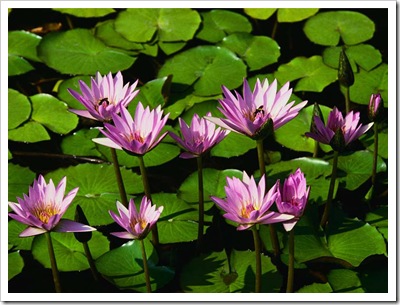
An even simpler samadhi exercise is this: Look at whatever is in front of you and say, “Yes! Yes! Yes!” to it, like Molly Bloom’s life-affirming, love-affirming mantra at the end of Ulysses. The universe of possibilities becomes visibly, tangibly larger, over a period of mere moments. When you say, “No, No, No,” the world gets smaller and heavier. Try it both ways and verify the truth of this very simple method. Look at water lilies or other highly vascular flowering plants. When the sun comes out, the flowers unfold before your eyes; when the sun goes away, they close. What the sun’s radiation and the lilies say to each other, translated through the biophysical language of chlorophyll, sugar, protein, and water, is “Yes! Yes! Yes!”

Tuesday, December 28, 2010

Struck

“I had been my whole life a bell, and never knew it until at that moment I was lifted and struck."

~ Annie Dillard

Monday, December 27, 2010

Put the Lid on the Kettle

You Suspect This Could Be Yours
by Rumi, translated by Daniel Liebert

you suspect this could be yours
with a little contrivance

only death to contrivance
will avail you

something good or bad
always comes out of you
it is agony to be still;
the spool turns
when mind pulls the thread

let the water settle;
you will see moon and stars
mirrored in your being

when the kettle boils
fire is revealed
when the millstone turns
the river shows its power

put the lid on the kettle
and be filled
with the boiling of love.

Tuesday, November 16, 2010

Sitting in a Pool of Me

Excerpts from Question Your Thinking, Change The World: Quotations from Byron Katie:

questionyourthinking We’re often quite sure about what other people need to do, how they should live, and whom they should be with. We have 20/20 vision about others, but not about ourselves. When you do The Work, you see who you are by seeing who you think other people are. Eventually you come to see that everything outside you is a reflection of your own thinking. You are the storyteller, the projector of all stories, and the world is the projected image of your thoughts.

*     *     *     *     *

We only fear what we are—what we haven’t gone inside and taken a look at and met with understanding. If I think you might see me as boring, it would frighten me, because I haven’t investigated that thought. So it’s not people who frighten me, it’s me that frightens me. That’s my job, until I investigate and stop this fear for myself. The worst that can happen is that I think you think about me what I think about myself. So I am sitting in a pool of me.

*     *     *     *     *

I like to ask, “Are you breathing yourself?” No? Well, maybe you’re not thinking yourself or making decisions either. Maybe it doesn’t move until it moves, like a breath, like the wind. And you tell the story of how you are doing it, so you can keep yourself from the awareness that you are nature, flowing perfectly. Who would you be without the story that you need to make a decision?

*     *     *     *     *

No one has ever been able to control their thinking, although people may tell the story of how they have. I don’t let go of my thoughts—I meet them with understanding, then they let go of me.

*     *     *     *     *

The ego is terrified of the truth. And the truth is that the ego doesn’t exist.

Friday, October 29, 2010

Containing and Contained by Infinite Space

Excerpts from Antony Gormley (Contemporary Artists) by John Hutchinson, E.H. Gombrich, and Lela B. Njatin:

To Meister Eckhart, art was religion and religion art. Artistic form, in his view, was a revelation of essence, a kind of revelation that is both living and active. “Work,” he wrote, “comes from the outward and from the inner man, but the innermost man takes no part in it. In making a thing the very innermost self of a man comes into outwardness.”

Much of Antony Gormley’s art is based on his understanding of Western and Eastern spiritual traditions, and his work resonates when it is placed in this context. Like Eckhart — or, indeed like Joseph Beuys — Gormley believes that the artist is not a special kind of man, but that every man is a special kind of artist…He works with “types,” with universals, and yet he roots his work in subjective experience…But what concerns Gormley more than anything else, is the paradoxical manner in which man, while containing infinite space, is also contained by it…His sculpture deals with what he sees as the “deep space” of the interior body, yet he is also concerned with “touch as gravity” and “gravity as the attraction that binds us to the earth.” Its key strength, perhaps, lies in the artist’s determination to accept nothing until is has been lived and internalized. Gormley’s work is structured and methodical, preconceived to a certain point, and then realized in the process of making.

To Gormley, the body has a relation to the external space within which it exists as well as to the inner space it contains. And in a [1991] installation made for “Places with a Past,” an exhibition of site-specific art at Charleston, South Carolina, Gormley combined a series of works — Host, Field, Three Bodies, Learning to Think, Fruit and Cord — in order to explore that relationship. The Old City Jail, which contained and became part of the installation, could be described as having the shape of a body: the original rectangular structure is rather like a torso; its later octagonal addition, like a head. And in order to emphasize its parallels with his body cases, which are sometimes connected to the outside world through orifices, Gormley removed the boards and glazing that had sealed up the prison’s doors and windows. This allowed light and sound to enter the prison, to enliven what had hitherto been dark and dormant, and to engage time as an active element in the installation. In the artist’s words, “the building became a catalyst for reflection on liberty and incarceration.”

Old Jail, Charleston, exterior

One the second floor, Field, a set of terracotta figurines, faced a similar vast space that contained only Three Bodies—large metal spheres, made of steel and air, which the aritst has described as “like celestial bodies fallen from the sky.”

American Field, Antony Gormley (1991)

Above Field was Learning to Think, five headless lead body cases that were suspended from the ceiling, in a contradictory evocation of both lynching and ascension. The corresponding space held Host, a room containing mud and sea water — “The surface of the earth described in Genesis…the unformed, the place of possibility, a place waiting for the seed,” according to Gormley

Learning to Think, Antony Gormley (1991)

In the octagonal extension, two related organic forms, Fruit, were hung on either side of a wall. Only one was visible at a time in order “to reconcile opposites not in terms of differentiation but by mirroring,” Hidden from view, and at the center of each sculpture, was a space once occupied by the artist’s own body, linked to the other side, though mouth and genitals, by steel pipes. The final piece was Cord, made of many tubes inside one another — a kind of umbilical lifeline between the “seen” and “unseen.”

Body & Fruit, 1991/93

In this installation, one of great richness and complexity, Gormley brought into play the full panoply of his ambition. Working with lead and clay, as well as with the four elements, Gormley alluded to physical and spiritual containment, body and mind, outer and inner worlds, feeling and thinking, birth and death, growth and decay. And if the contradictions inherent in Learning to See (1991) Learning to See give strength to the artist’s conception of inner vision, the dualities evoked by the installation at Charleston are subservient to a sense of passage towards expansiveness. The emotional depth of the work can be ascribed to its refusal to exclude either the particular or the universal: it encompasses both historical specificity and a sense of shared human experience. In formal terms, this is achieved by the undermining of the Modernist notion of the self-referential object. While each of the elements of the installation can be separately contemplated, they are most meaningful when perceived as parts of a larger whole. In that sense, they are like parts of a body.

Wednesday, October 20, 2010

An Expression of the Whole Realm of Nature

Harrison West. October 20, 2010

"We suffer from a hallucination, from a false and distorted sensation of our own existence as living organisms. Most of us have the sensation that ‘I myself’ is a separate center of feeling and action, living inside and bounded by the physical body — a center which ‘confronts’ an ‘external’ world of people and things, making contact through the senses with a universe both alien and strange. Everyday figures of speech reflect this illusion. ‘I came into this world.’ ‘You must face reality.’ ‘The conquest of nature.’

This feeling of being lonely and very temporary visitors in the universe is in flat contradiction to everything known about man (and all other living organisms) in the sciences. We do not come into this world; we come out of it, as leaves from a tree. As the ocean ‘waves,’ the universe ‘peoples.’ Every individual is an expression of the whole realm of nature, a unique action of the total universe. This fact is rarely, if ever, experienced by most individuals. Even those who know it to be true in theory do not sense or feel it, but continue to be aware of themselves as isolated egos inside bags of skin.”

~ Alan Watts, from The Book: On the Taboo Against Knowing Who You Are

[Thanks, Whiskey River!]

Tuesday, October 19, 2010

Obliterating Boundaries

Home. October 19, 2010“More than ever, I have come to appreciate how deeply and passionately most of us live within ourselves. Our attachments are ferocious. Our loves overwhelm us, define us, obliterate the boundaries between ourselves and others.”

~ Paul Auster, from I Thought My Father was God: And Other True Stories from NPR’s National Story Project

[Thanks, Mary!]

Wednesday, October 13, 2010

The Combustion of Egoistic Delusions

Excerpt from “This Very Moment,” by Charlotte Joko Beck, from Ordinary Magic: Everyday Life as Spiritual Path:

Back in the 1920s, when I was maybe eight or ten years old, and living in New Jersey where the winters are cold, we had a furnace in our house that burned coal. It was a big event on the block when the coal truck rolled up and all this stuff poured down the coal chute into the coal bin. I learned that there are two kinds of coal: one was called anthracite or hard coal, and the other was lignite, soft coal. My father told me about the difference in the way those two kinds of coal burned. Anthracite burns cleanly, leaving little ash. Lignite leaves lots of ash. When we burned lignite, the cellar became covered with soot and some of it got upstairs into the living room.

What does this have to do with our practice? Practice is about breaking our exclusive identification with ourselves. This process has sometimes been called purifying the mind. To “purify the mind” doesn’t mean that you become holy or other than you are; it means to strip away that which keeps a person—or furnace—from functioning best.  The furnace functions best with hard coal. But unfortunately what we’re full of is soft coal. There’s a saying in the Bible: “He is like a refiner’s fire.” It’s a common analogy, found in other religions as well. To sit in meditation is to be in the middle of a refining fire. Eido Roshi said once, “This meditation hall is not a peaceful haven, but a furnace room for the combustion of our egoistic delusions.” A meditation hall is not a place for bliss and relaxation, but a furnace room for the combustion of our egoistic delusions. What tools do we need to use? Only one. We’ve all heard of it, yet we use it very seldom. It’s called attention.

Attention is the cutting, burning sword, and our practice is to use that sword as much as we can. None of us is very willing to use it; but when we do—even for a few minutes—some cutting and burning take place. All practice aims to increase our ability to be attentive, not just in meditation but in every moment of our life.