Showing posts with label God. Show all posts

Saturday, May 14, 2011

I Will Be Who I Will Be

Excerpt from “Exodus: Cargo of Hidden Stories,” Being,  April 14, 2011:

Krista Tippett: Let's talk about also the very mysterious name of God when Moses encounters God in the burning bush. He says, "Who should I tell them I saw?" And the name that comes back now, or the way it's often translated in English is, "I am who I am." I've also heard it translated, "I am becoming who I am ehyeh-asher-ehyehbecoming." How do you read what is said? And say it for me in Hebrew as well, if you would?

Avivah Zornberg: Yes. It's Ehyeh-Asher-Ehyeh, and literally it just means, I will be who I will be. And I think there's just no getting around it. Some of these translations are just mistranslations.

Ms. Tippett: Right, yes. And they don't help, do they?

Dr. Zornberg: They really don't because, actually, God is being evasive. God is saying, “I'm not giving you a handle.” You want a handle of some kind to hold on to, to say, "Now I've got him." That's a name. And instead he answers, "I am the very principle of becoming, of allowing the possible to happen."

Listen to the unedited conversation…

Beyond the Mind

Excerpts from Emptiness Dancing by Adyashanti:

The mind can’t fathom that there can be a true intelligence, a transcendent intelligence, that isn’t the product and outcome of thought and conceptual understanding. It can’t fathom that there could be wisdom that’s not going to come at you in the form of thoughts, in the form of acquired and accumulated knowledge.

The true spiritual urge or yearning is always and invitation beyond the mind. That’s why it’s always been said that if you go to God, you go naked or you don’t go at all. It’s the same for everybody. You go in free of your accumulated knowledge, or you are forever unable to enter. So an intelligent mind realizes its own limitation, and it’s a beautiful thing when it does.

When you stop holding on to all the knowledge, then you start to enter a different state of being. You start to move into a different dimension. You move into a dimension where experience inside gets very quiet. The mind may still be there chatting in the background, or it might not, but consciousness is no longer bothering itself with the mind. You don’t need to stop it. Your awareness just goes right past that wall of knowledge and moves into a very quiet state…

…Once your conceptual world of knowledge gets put in its rightful place, it is transcended. You see that you are eternal consciousness now appearing as woman or man, this or that character. But like every good actor, you are not what you are appearing as. Everything that exists is consciousness appearing as, or God appearing as, or Self appearing as, or spirit appearing as. The Buddha called it no-self. When that’s seen, you see Unity. There is only God. That’s all there is: God appearing as floor, as a human being, as a wall, as a chair.

No knowledge, no statement of the Truth touches what’s eternal, what you really are. And no statement about how to get there is true either, because what gets one person there doesn’t get another person there. A mind that likes to look for the one truth path cannot find it. Of course, the mind doesn’t like that. “No right path? Nothing that could be said or read that ultimately, in the end, could be true? The most enlightened being can’t speak the Truth?”

No. It’s never been done, and it never will be done. The only thing you can do is to put a pointer on the way that says, “Look that way.” A false spiritual arrow is one that points to the wall and says, “Look this way.” A true arrow is one that points beyond the wall of concepts.

Friday, September 17, 2010

Let Everything Happen, Just Keep Going

Two poems from Rainer Maria Rilke’s Book of Hours translated by Joanna Macy, from “A Wild Love for the World,” Being, September 16, 2010":

Onto a Vast Plain
[listen]

You are not surprised at the force of the storm—
you have seen it growing.
The trees fless. Their flight
sets the boulevards streaming. And you know:
he whom they flee is the one
you move toward. All your senses
sing him, as you stand at the window.

The weeks stood still in summer.
The trees' blood rose. Now you feel
it wants to sink back
into the source of everything. You thought
you could trust that power
when you plucked the fruit:
now it becomes a riddle again
and you again a stranger.

Summer was like your house: you know
where each thing stood.
Now you must go out into your heart
as onto a vast plain. Now
the immense loneliness begins.

The days go numb, the wind
sucks the world from your senses like withered leaves.

Through the empty branches the sky remains.
It is what you have.
Be earth now, and evensong.
Be the ground lying under that sky.
Be modest now, like a thing
ripened until it is real,
so that he who began it all
can feel you when he reaches for you.

Go to the Limits of Your Longing
[listen]

God speaks to each of us as he makes us,
then walks with us silently out of the night.

These are the words we dimly hear:

You, sent out beyond your recall,
go to the limits of your longing.
Embody me.

Flare up like flame
and make big shadows I can move in.

Let everything happen to you: beauty and terror.
Just keep going. No feeling is final.
Don't let yourself lose me.

Nearby is the country they call life.
You will know it by its seriousness.

Give me your hand.

Tuesday, September 07, 2010

The Torah and the Golden Rule

From The Great Transformation: The Beginning of Our Religious Traditions by Karen Armstrong:

The Great Transformation on Google Books …the most progressive Jews in Palestine were the Pharisees, who developed some of the most inclusive and advanced spiritualities of the Jewish Axial Age. They believed that the whole of Israel was called to be a holy nation of priests and that God could be experienced in the humblest home as well as in the temple. He was present in the smallest details of daily life, and Jews could approach him without elaborate ritual. They could atone for their sins by acts of loving-kindness rather than animal sacrifice. Charity was the most important commandment of the law. Perhaps the greatest of the Pharisees was Rabbi Hillel (c. 80 BCE-30 CE), who migrated to Palestine from Babylonia. In his view, the essence of the Torah was not the letter of the law but it’s spirit, which he summed up in the Golden Rule. In a famous Talmudic story, it was said that one day a pagan approached Hillel and promised to convert to Judaism if the rabbi could teach him the entire Torah while he stood on one leg. Hillel replied simply: “What is hateful to yourself, do not to your fellow man. That is the whole of the Torah and the remainder is but commentary. Go learn it.”

*     *     *     *     *

From “Modern Lessons From Hillel,” All Things Considered, September 7, 2010 :

“Not much is known about the life of the rabbi and Talmudic scholar Hillel, who lived 2,000 years ago, but his teachings have shaped Judaism. Rabbi Joseph Telushkin's forthcoming book Hillel: If Not Now, When? argues that Hillel has as much to teach the 21 Century as he did his own.”

Wednesday, August 11, 2010

Look Back with Firm Eyes

shaving 

Self Portrait
by David Whyte, from Fire In the Earth

It doesn't interest me if there is one God
or many gods.
I want to know if you belong or feel
abandoned.
If you know despair or can see it in others.
I want to know
if you are prepared to live in the world
with its harsh need
to change you. If you can look back
with firm eyes
saying this is where I stand. I want to know
if you know
how to melt into that fierce heat of living
falling toward
the center of your longing. I want to know
if you are willing
to live, day by day, with the consequence of love
and the bitter
unwanted passion of your sure defeat.
I have been told, in that fierce embrace, even
the gods speak of God.

I Have to Call Myself Back

“I’m very bad when it comes to worship. This is just me. This is probably a terrible thing to say [in a church], but I don’t need it very much. I try to live in this kind of presence and a kind of awareness and I have to call myself back time and time again to remembrance of who I am. Partly, I think, all that’s because as a kid, as a Presbyterian, I had to go to church four times on Sunday. That wears out your patience and your ass. I’ve sort of done my stint. But that’s just me. It’s not other people.”

~ Sam Keen, author of In the Absence of God: Dwelling in the Presence of the Sacred

Friday, August 06, 2010

The Stage is too Big

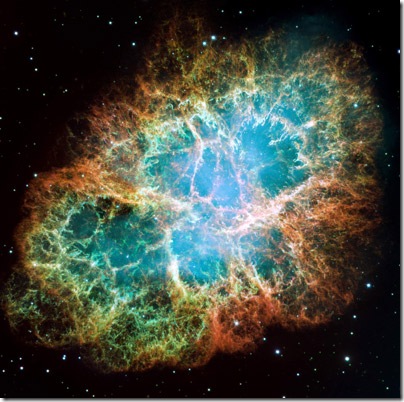
This mosaic image of the Crab Nebula was taken by the Hubble Space Telescope.

“It doesn’t seem to me that this fantastically marvelous universe, this tremendous range of time and space, and different kinds of animals, and all the different planets, and all these atoms with all their motions, and so on, all this complicated thing can merely be a stage so that God can watch human beings struggle for good and evil—which is the view that religion has. The stage is too big for the drama.”

~ Richard Feynman, speaking in 1959, quoted by James Gleick in Genius: The Life and Science of Richard Feynman (1992)

Sunday, February 14, 2010

The Highest Form of Intimacy

Excerpts from “A Monotheistic Model of Love,” by Gilla Nissan, Parabola (Spring 2010):

parabola-35-1 In B’re-sheet, Genesis, during the process of the creation of the world, it is said that God separated the water into two: sha-ma-yim, the water of above, and ma-yim, the water below. The Zohar: The Book of Splendor, a collection of works ascribed to Simon Bar Yochai of the second century CE, goes on to say that the lower waters missed and longed for the higher waters and so cried out to unite back with them. The Hebrew words reflect this deep relationship: mayim, meaning water, and shamayim, meaning sky.

God tried several times to create the world. He used equal measures of compassion, che-sed, and judgment, din. More than once the world collapsed until He incorporated an extra measure of ra-cha-mim, another word for compassion. Without love the world cannot exist, yet we humans were given freedom to love or not to love. God so wants to be known and be loved out of free will; forced love is no love at all.

*     *     *

The Hebrew language has gender; we refer to God in the  masculine; although, in His true nature He is William Gesenius's Hebrew punctuation (i.e., Yahweh)without gender. In the Tetragrammaton, Yud Hey Vav Heh, the unutterable name of God, the letters vav and heh represent the male and female forces of providence. The male force is that which acts upon the world, while the female force is that which allows the world to be receptive to God’s power. We refer to God as Him because we want Him to act upon the world through the male force of providence. The Hebrew word for Divine Presence, on the other hand, is She-chi-nah, a feminine noun.

*     *     *
Rodin's Le Baiser (The Kiss) in the Tuileries Garden in Paris According to the Zohar, love begins with a physical attraction, then communication and speech. A kiss is the merging of one breath with another. As closeness occurs, the lovers stop speaking and are merely aware of each other’s breath. Finally, they come even closer, to the point of physical contact, and their communication becomes a kiss. Here they are aware of each other’s life force. Kissing, explains the modern mystic Rabbi Aryeh Kaplan, is a natural consequence of increased intimacy in speech. Two mouths come closer and closer, and progress from speech to breath to the kiss. The kiss, then, is the highest form of intimacy.

The Zohar describes four levels in the intimacy of love: physical attraction, speech, breath, and the kiss. These same four levels exist in the relationship of a person with the Divine. These levels are to this day reflected in the structure of the daily services in the synagogue and private prayer, moving the worshipper from one level of intimacy to another. The impact is deeply profound when one’s ka-va-nah, intention, is aligned with the words.

Monday, September 28, 2009

Nothing Left Out

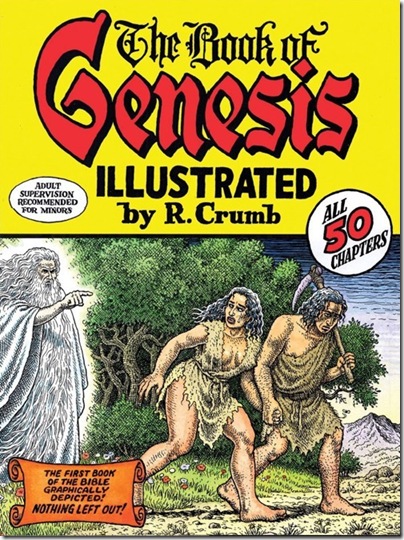
My copy of The Book of Genesis Illustrated by R. Crumb just arrived!

The Book of Genesis

From the introduction:

I, R. CRUMB, THE ILLUSTRATOR OF THIS BOOK, HAVE, TO THE BEST OF MY ABILITY, FAITHFULLY REPRODUCED EVERY WORD OF THE ORIGINAL TEXT, WHICH I DERIVED FROM SEVERAL SOURCES, INCLUDING THE KING JAMES VERSION, BUT MOSTLY FROM ROBERT ALTER’S RECENT TRANSLATION, THE FIVE BOOKS OF MOSES (2004). IN A FEW PLACES I VENTURED TO DO A LITTLE INTERPRETATION OF MY OWN, IF I THOUGHT THE WORDS COULD BE MADE CLEARER, BUT I REFRAINED FROM INDULGING TOO OFTEN IN SUCH “CREATIVITY,” AND SOMETIMES LET IT STAND IN ITS CONVOLUTED VAGUENESS RATHER THAN MONKEY AROUND WITH SUCH A VENERABLE TEXT.

EVERY OTHER COMIC BOOK VERSION OF THE BIBLE THAT I’VE SEEN CONTAINS PASSAGES OF COMPLETELY MADE-UP NARRATIVE AND DIALOGUE, IN AN ATTEMPT TO STREAMLINE AND “MODERNIZE” THE OLD SCRIPTURES, AND STILL, THESE VARIOUS COMIC BOOK BIBLES ALL CLAIM TO ADHERE TO THE BELIEF THAT THE BIBLE IS “THE WORD OF GOD,” OR INSPIRED BY “THE WORD OF GOD,” WHEREAS, I, IRONICALLY, DO NOT BELIEVE THE BIBLE IS “THE WORD OF GOD.” I BELIEVE IT IS THE WORDS OF MEN.

IT IS, NONETHELESS, A POWERFUL TEXT WITH LAYERS OF MEANING THAT REACH DEEP INTO OUR COLLECTIVE CONSCIOUSNESS, OUR HISTORICAL CONSCIOUSNESS, IF YOU WILL. IT SEEMS INDEED TO BE AN INSPIRED WORK, BUT I BELIEVE THAT ITS POWER DERIVES FROM ITS HAVING BEEN A COLLECTIVE ENDEAVOR THAT EVOLVED, AND CONDENSED OVER MANY GENERATIONS BEFORE REACHING ITS FINAL, FIXED FORM AS WE KNOW IT DURING THE “BABYLONIAN EXILE,” CIRCA 600 B.C.E.

…IF MY VISUAL, LITERAL INTERPRETATION OF THE BOOK OF GENESIS OFFENDS OR OUTRAGES SOME READERS, WHICH SEEMS INEVITABLE CONSIDERING THAT THE TEXT IS REVERED BY MANY PEOPLE, ALL I CAN SAY IN MY DEFENSE IS THAT I APPROACHED THIS AS A STRAIGHT ILLUSTRATION JOB, WITH NO INTENTION TO RIDICULE OR MAKE VISUAL JOKES. THAT SAID, I KNOW THAT YOU CAN’T PLEASE EVERYBODY."

* * *

R. Crumb's Awesome, Affecting Take On Genesis,” by Susan Jane Gilman, NPR (October 16, 2009)

Tuesday, August 11, 2009

I Don’t Ever Want to Have to Say “I Don’t Know” Ever Again

“There's this being called the thing that made the things for which there is no known maker and that causes and directs the events we can't otherwise explain and that doesn't need to have been made and is the one thing from which to ask for things that no human can give and without whom we can't be fully happy and is unlimited by all the laws of physics and never began and will never finish and is invisible but actually everywhere at once and who is so perfect that even if he killed millions of people, including babies, he'd still would be perfect and who is so powerful and magical that he can even make a virgin pregnant if he wanted to."

NonStampCollector

Sunday, July 26, 2009

Reverse Engineering of Religion

"...religions are an important natural phenomenon. We should study them with the same intensity that we study all the other important natural phenomena...Today's religions are brilliantly designed. They're immensely powerful social institutions and many of their features can be traced back to earlier features that we can really make sense of by reverse engineering. And, as with the cow, there's a mixture of evolutionary design, designed by natural selection itself, and intelligent design -- more or less intelligent design -- redesigned by human beings who are trying to redesign their religions."

~ Dan Dennett, from TED Talks (February 2006)

Mr. Dennet't’s book Breaking the Spell: Religion as a Natural Phenomenon was reviewed by Leon Wieseltier in “The God Genome,” New York Times (February 19, 2006).

Tuesday, June 16, 2009

Laughing With

Regina Spektor’s CD Far is due out next week (6/23). 
[Stream it. Explore it.]

God can be funny
When told he’ll give you money if you just pray the right way
And when presented like a genie who does magic like Houdini
Or grants wishes like Jiminy Cricket and Santa Claus
God can be so hilarious

Wednesday, September 17, 2008

A Different Level of Acceptance to What Is

"I talk about God all the time in class, and I'm pretty confident in my relationship with God. And therefore, I'm comfortable using the word. But when I define spirit, it's that which exists within that's of truth and love. And so when I refer to grace or to spirit or to God, I'm talking of truth and love."

"It comes down to this for me: You can't get to God through your head, at least in my experience. I might come back in 20 years and say, you know, 'Remember everything I was saying at 41? I was totally wrong.' But how I've experienced it is that you can't get to God through your head, because it's determined by your five senses, so therefore we're limited to what we know, what we see, what we've experienced here on earth."

"For me, I've only been able to get to God through my heart, not through what I know but through what I feel because feelings lead to surrender. Surrender allows you to step into that unknown state where there's a different level of acceptance to what is rather than what you're choosing it to be. So for me, you release the tension, it opens you up to feelings, feelings connect you to surrender, and suddenly you're hearing with a new ear that moves beyond human interpretation but to spiritual perception which is infinite and limitless."

~ Seane Corn, from "Yoga: Meditation in Action," Speaking of Faith (9.11.08)

Thursday, March 06, 2008

Homecoming

"When you think about language and you think about consciousness, it's just incredible to think that we can make any sounds that can reach over across to each other at all...I think the beauty of being human is that we're incredibly, intimately near each other. We know about each other, but yet we do not know or never can know what it's like inside another person. And it's amazing, you know, here am I sitting in front of you now, looking at your face, you're looking at mine and yet neither of us have ever seen our own faces. And that in some way, thought is the face that we put on the meaning that we feel and that we struggle with and that the world is always larger and more intense and stranger than our best thought will ever reach. And that's the mystery of poetry, you know, is poetry tries to draw alongside the mystery as it's emerging and somehow bring it into presence and into birth."

...

"That's what I call spirituality, the art of homecoming. So it's St. Augustine's phrase, Deus intimior intimo meo — "God is more intimate to me than I am to myself." Then you go to Meister Eckhart, and you get the other side of it which you must always keep together with it, where in Middle High German, he says (in German) that means, "God becomes and God unbecomes," or translated it means that God is only our name for it and the closer we get to it the more it ceases to be God. So then you are on a real safari with the wildness and danger and otherness of God.

"And I think when you begin to get a sense of the depth that is there then your whole heart wakens up. You know, I mean, I love Irenaeus' thing from the second century, which said, the Glory of the human being — "The glory of God is the human being fully alive." And I think in our culture that one of the things that we are missing is that these thresholds where we can encounter this, and where we move into new change in our lives, there are no rituals to help us to recognize them or to cross them worthily."

-- John O'Donohue in conversation with Krista Tippett on Speaking of Faith (2.28.08).

Friday, December 14, 2007

Making an Object of God

Rick Scibelli Jr. for The New York Times

"Enlightenment? I don’t like the subject at all...but the question really is, what is satori in the first place? About satori, I believe you can find all sorts of different descriptions of it in the bookstore if you go there and I feel a lot more coming to the bookstores, a lot more different descriptions."

“Buddhism does not acknowledge the existence of a world-creating God. But having said that, Buddhism does not at the same time reject the existence of God.

"There are a lot of different books out there. But the moment someone says the truth or God is an object or takes it as an object, that is already a mistake. God is neither object nor subject. The moment you say any little thing about God, you’re already making an object of God and Buddhism cautions you about that. At that moment you’re making an idiot out of God, you’re making a fool out of God."

--- Sasaki Roshi, "A Very Old Zen Master and His Art of Tough Love," Ralph Blumenthal, The New York Times (12.9.07)