Showing posts with label Buddhism. Show all posts

Saturday, May 14, 2011

Beyond the Mind

Excerpts from Emptiness Dancing by Adyashanti:

The mind can’t fathom that there can be a true intelligence, a transcendent intelligence, that isn’t the product and outcome of thought and conceptual understanding. It can’t fathom that there could be wisdom that’s not going to come at you in the form of thoughts, in the form of acquired and accumulated knowledge.

The true spiritual urge or yearning is always and invitation beyond the mind. That’s why it’s always been said that if you go to God, you go naked or you don’t go at all. It’s the same for everybody. You go in free of your accumulated knowledge, or you are forever unable to enter. So an intelligent mind realizes its own limitation, and it’s a beautiful thing when it does.

When you stop holding on to all the knowledge, then you start to enter a different state of being. You start to move into a different dimension. You move into a dimension where experience inside gets very quiet. The mind may still be there chatting in the background, or it might not, but consciousness is no longer bothering itself with the mind. You don’t need to stop it. Your awareness just goes right past that wall of knowledge and moves into a very quiet state…

…Once your conceptual world of knowledge gets put in its rightful place, it is transcended. You see that you are eternal consciousness now appearing as woman or man, this or that character. But like every good actor, you are not what you are appearing as. Everything that exists is consciousness appearing as, or God appearing as, or Self appearing as, or spirit appearing as. The Buddha called it no-self. When that’s seen, you see Unity. There is only God. That’s all there is: God appearing as floor, as a human being, as a wall, as a chair.

No knowledge, no statement of the Truth touches what’s eternal, what you really are. And no statement about how to get there is true either, because what gets one person there doesn’t get another person there. A mind that likes to look for the one truth path cannot find it. Of course, the mind doesn’t like that. “No right path? Nothing that could be said or read that ultimately, in the end, could be true? The most enlightened being can’t speak the Truth?”

No. It’s never been done, and it never will be done. The only thing you can do is to put a pointer on the way that says, “Look that way.” A false spiritual arrow is one that points to the wall and says, “Look this way.” A true arrow is one that points beyond the wall of concepts.

Saturday, April 23, 2011

To Cultivate Attention

Excerpts from "Buddha Nature: Living in Attention," by Ken McLeod:

"It seems to me that the intention of all these practices is to cultivate attention, either by practicing attention directly or by removing what prevents attention from developing. Once attention is present, appropriate action, skillful means, bodhicitta, everything else flows quite naturally. There is no need for minute dissections of Buddhist ethics or philosophy. The phrase ‘Be there or be square’ acquired a new meaning for me. Very simply, attention reveals buddha nature and enables it to manifest in our lives...

Once I shifted my effort to paying attention to what was arising, doors started to open. I began to see a little more clearly what was going on. I'd had to let go of old ways of looking at things, some that I had learned in the course of my training, others going back much further to family patterns. The patterns became apparent. The function and purpose of the patterns also became apparent...

Bring the attention to what is arising and we know, directly, what needs to be done. This changed not only my own practice but how I tried to teach others. The source of that knowing is buddha nature. And the practice is very simple in principle: strip away whatever prevents it from manifesting.

Read the entire essay...

[Thanks, Kit !]

Monday, April 11, 2011

Still Not Found

A Buddhist priest prays for the souls of the victims still not found in the rubble, Yamada, Japan.

A Buddhist priest prays for the souls of the victims still not found in the rubble, Yamada, Japan. (New York Times)

See also: To Be Bothered and Perception, Intense City

Sunday, December 12, 2010

Branches from a Single Root

W.S. Merwin from “The Garden & the Sword,” an interview with Joel Whitney, Tricycle Magazine, Winter 2010:

I don’t think we have imagination apart from the environment. And I don’t think we have an existence apart from the environment either. And if the imagination isn’t about our existence, I don’t know what it’s about. It’s not about making money, that’s for sure.

…If you’re looking for neat formulaic answers in Dogen, you don’t find them. You don’t find them in Keizan, either. You have to come at them from a different part of your own mind. That’s the part of Zen practice that’s attractive to me. But it’s not unique to Zen. It’s there in Taoism. It probably was there in parts of the practice that became Greek Orthodoxy, that came out of the desert. The origins of all of those things are extremely ancient; they’re older than what we think of as the beginnings of Buddhism. The origin of Taoism may be completely on its own, but all of them go back to shamanism. And we don’t know know the history of shamanism; it’s all speculation. They link in my mind to things which are incredibly ancient.

…the link between the imagination—which to me is the great pinnacle of humanity, the imagination that makes the arts and makes compassion—is ancient in our species and goes way back. And it’s never been separate. And when you get any aspect of the culture that tries to separate it, it’s destructive and suicidal.

Take them away, names like Buddhism. I’m impatient with them. There’s something beyond all that, beneath all that that they all share, that they all come from. They are branches from a single root. And that’s what one has to pay attention to.

Huxisanxiaotu

Song Dynasty painting in the Litang style illustrating the theme "Confucianism, Taoism and Buddhism are one." Depicts Taoist Lu Xiujing (left), official Tao Hongjing (right) and Buddhist monk Huiyuan (center, founder of Pure Land) by the Tiger stream. The stream borders a zone infested by tigers that they just crossed without fear, engrossed as they were in their discussion. Realizing what they just did, they laugh together, hence the name of the picture,Three laughing men by the Tiger stream.

Tuesday, October 05, 2010

The Power of Mindful Awareness

"The goal of becoming a better person is within the reach of us all, at every moment. The tool for emerging from the primitive yoke of conditioned responses to the tangible freedom of the conscious life lies just behind our brow. We need only invoke the power of mindful awareness in any action of body, speech, or mind to elevate that action from the unconscious reflex of a trained creature to the awakened choice of a human being who is guided to a higher life by wisdom."

~ Andrew Olendzki, Unlimiting Mind: The Radically Experiential Psychology of Buddhism

Here is a video interview from May 2010 in which Andrew Olendzki discusses his book with Tricycle’s Joan Duncan Oliver.


[Thanks, Whiskey River!]

Thursday, August 12, 2010

Appreciating Nothing

This presentation was my contribution to Pecha Kucha Night Columbus this evening.

Friday, August 06, 2010

Both in the Body and in the Mind

From the introduction to Freeing the Body, Freeing the Mind: Writings on the Connections between Yoga & Buddhism edited by Michael Stone:

Over the years, I’ve found it increasingly frustrating that Yoga is continually reduced to a body practice and Buddhism to a mind practice. This makes no sense at all. Anyone who has practiced deeply in both traditions knows that the Buddha gave attention to the body and Patanjali to the mind, and that both traditions value ethical precepts and commitments as the foundation of an appropriate livelihood.

In the Buddha’s teachings the body serves as the primary object of meditation, so we can study the universe not through books or theory but through our subjective experience. Likewise, the Yoga postures, when practiced with breathing and sensitivity, become opportunities for deep meditative insight because they are designed to calm the nervous system. This grounds us. When we move within the various poses and tune in to the internal energetic patterns of our breath, we are working with the habits of mind as well. The postures we practice in modern Yoga studios have obvious therapeutic benefits at the physiological level, but some teachers and schools seem to have forgotten that the postures also teach us how to work with the mind. And for most of us, our troubles are not simply in the body but primarily in the mind. How can we use the body to study the mind, and work with the mind through the body? By experiencing how the two are completely interrelated.

Read more…

Sunday, July 18, 2010

Not Different

Spring, Summer, Fall, Winter...and Spring

“Form is emptiness; emptiness is form. Form is not different than emptiness; emptiness is not different than form.”

~ Heart Sutra

Friday, May 07, 2010

Essence of the Circle

Tibetan Sand Mandalas

“The Tibetan art form of sand painting is an ancient and sacred practice intended to uplift and benefit not only every person who sees it, but also to bless the environment. It is referred to as a mandala of colored powders. The Sanskrit term mandala is the name for this circular representation of spiritual truths. The Tibetan name is kyil-khor meaning essence of the circle.”

From the web page of Losang Samten, who created this center panel of the Kalachakra Mandala in the new Ohio Union of the Ohio State Campus this week.

Losang Samten

We all helped dismantle the panel this afternoon…

…and scattered the sand into Mirror Lake to bless the campus.

mirror-lake-1

Here is a time-lapse video of an entire Kalachakra Mandala.

Kalachakra mandala created by Losang Samten

Here’s another example.

5 Dhyani Buddhas from peacefeather imagery on Vimeo.

Description of the above design from Mandalas: Sacred Art and Geometry

Wednesday, March 17, 2010

Become What You Are

Excerpt from the introduction of Taking Our Places: The Buddhist Path to Truly Growing Up by Norman Fischer:

Time is strange. We live within it, depend on it, take it for granted, yet it relentlessly passes, and our lives slip through our fingers moment by moment. Where does time come from, and where does it go? How is it that every moment we are different, we grow, we develop, we are born, we die? What are we supposed to be doing with this life?

After many years of grappling with these questions during the course of my long spiritual journey, I have come to have a feeling for their answers. We don’t really know what appears, what time is, where it goes. But we are here to try to understand. And we all have our own way of understanding, and of expressing that understanding through the living of our lives.

Each of us has a place in this world. Taking that place, I have come to feel, is our real job as human beings. We are not generic people, we are individuals, and when we appreciate that fact completely and allow ourselves to embrace it and grow into it fully, we see that taking our unique place in this world is the one thing that gives us a sense of ultimate fulfillment.

Bantu tribesmen, it is said, sneak into the rooms of their children as they sleep and whisper in their ears, “Become what you are.”

To take our place is to mature, to grow into what we are. Mostly we take maturity for granted, as if it were something that comes quite naturally and completely as our bodies grow and our minds and hearts fill up with life experience. In fact, however, few of us are truly mature individuals; few of us really occupy our places. We are merely living out a dream of maturity, a set of received notions and images that passes for adulthood. What does it really mean to grow up? How do we do the work that will nurture a truly mature heart from which can flow healing words and deeds? Each of our lives depends on our undertaking the exploration that these questions urge us toward. And the mystery is that the whole world depends on each of us to take this human journey.

Saturday, February 20, 2010

A Refuge

Excerpt from Turning the Wheel: Essays on Buddhism and Writing by Charles R. Johnson:

Turning the Wheel These cultural questions, so eloquently expressed by Du Bois and King (and many others), which pose the ancient, pre-Socratic problem of how shall we live, consumed my imagination and intellectual interests from adolescence into adulthood. They kept me up late at night. They colored my perceptions of all I saw and heard in the 1960s and 1970s. They were behind my first practicing meditation when I was fourteen, falling in love with philosophy when I was eighteen, and equally behind my turn to writing novels at twenty-two. This historic devotion to freedom by black America’s finest leaders also prepared me in my depths for embracing the Buddhist Dharma as the most revolutionary and civilized of possible human choices, as the logical extension of King’s dream of the “beloved community,” and Du Bois’s “vision of what the world could be if it was really a beautiful world.”

Were it not for the Buddhadharma, I’m convinced that, as a black American and an artist, I would not have been able to successfully negotiate my last half century of life in this country. Or at least not with a high level of creative productivity, working in a spirit of metta toward all sentient beings, and selfless service to others as a creator, teacher, husband, father, son, colleague, student, lecturer, editor, neighbor, friend, and citizen, which, in my teens, were ideals I decided I valued more than anything else. The obstacles, traps, and racial minefields faced by black men in a society that has long demonized them as violent, criminal, stupid, bestial, lazy, and irresponsible are well-documented…

Charles R. Johnson For me, Buddhism has always been a refuge, as it was intended to be: a place to continually refresh my spirit, stay centered and at peace, which enabled me to work joyfully and without attachment even in the midst of turmoil swirling round me on all sides, through “good” times and “bad.” So I am thankful for the perennial wisdom in its two-millennia-old sutras; the phenomenological insights of Shakyamuni himself into the nature of suffering, craving, and dualism; the astonishing beauty of Sanskrit, which I’ve been privileged to study now for five years; and the methods of different forms of meditational practice, the benefits of which fill whole libraries.

Saturday, December 19, 2009

Offering the Self

This poem is a retelling of one of the Jātaka tales, Asian folktales which recount various acts of self-sacrifice performed by earlier incarnations of the Buddha. I came across this poem in Norman Fischer’s Talks on Dogen's Genjokoan published in "Moon in a Dewdrop" (Part 4).

The Rabbit in the Moon
by Ryōkan Taigu

Moon rabbit It took place in a world long long ago they say:
a monkey, a rabbit, and a fox struck up a friendship,
morning frolicking field and hill,
evenings coming home to the forest,
living thus while the years went by,
when Indra, sovereign of the skies,
hearing of this,
curious to know if it was true,
turned himself into an old man,
tottering along,
made his way to where they were.

“You three,” he said, “are of separate species
yet play together with a single heart.
If what I’ve heard is true,
pray save an old man who’s hungry!”
then he set his staff aside,
sat down to rest.

Simple enough, they said, and presently
the monkey appeared from the grove behind
bearing nuts he’d gathered there,
and the fox returned from the rivulet in front,
clamped in his jaws a fish he’d caught.

But the rabbit,
though he hopped and hopped everywhere
couldn’t find anything at all,
while the others cursed him
because his heart was not like theirs.

Miserable me! he thought,
and then he said
“Monkey, go cut me firewood!
Fox, build me a fire with it!”
and when they’d done what he’d asked,
he flung himself into the midst of the flames,
made himself an offering
for an unknown man.

When the old man saw this his heart withered.
He looked up to the sky,
cried aloud,
then sank to the ground,
and in a while,
beating his breast, said to the others,

“Each of you three friends has done his best,
but what the rabbit did touches me the most!”

Then he made the rabbit whole again
and gathering the dead body up in his arms,
took it and laid it to rest in the palace of the moon.

From that time till now
the story’s been told,
this tale of
how the rabbit came to be in the moon,
and even I
when I hear it
find the tears
soaking the sleeve of my robe.

Wednesday, December 16, 2009

Something Fresh and Inspired

Excerpts from Opening to You: Zen-Inspired Translations of the Psalms by Norman Fischer:

Opening to You “I call them ‘Zen-inspired’ because I approach them the only way I can: as a Zen practitioner, with a Zen eye. But I have not tried to rewrite the Psalms as Zen philosophy. Quite the opposite. My intention has been to learn from them, to expand my own understanding under their influence. Nevertheless, although my way of life and understanding have been thoroughly saturated by Zen, I am still a Westerner, so I have found in the Psalms a very familiar music that seems to express my own approach to enlightenment: the passionate, prickly, and lively noise that naturally seems to rise from the silent depths of my own heart.”


“I do not think I am unusual. Western Buddhists are Buddhists, yes, but they are also Westerners. This makes a big difference. It is why Buddhism in the West is and will continue to be different from what it has been in Asia. No matter how much Westerners try to immerse themselves in the Buddhism presented to them by their Asian teachers (and expressed in the Asian texts), they will always see it colored by Western concepts and views and by a Western feeling for life. You could view this as a problem, a distortion of real Buddhism, and I know that many Asian Buddhist teachers think that Westerners just don’t ‘get’ Buddhism and that it will take several generations for them to get it. While this is a reasonable way to look at it, I prefer to see the problem as an advantage and to view the inevitable mixing of Western and Asian Buddhist perspectives as something fresh and inspired, rather than somehow incorrect.”

*     *     *

Psalm 1

Happy is the one who walks otherwise
Than in the manner of the heedless
Who stands otherwise
Than in the way of the twisted
Who does not sit in the seat of the scornful
But finds delight in the loveliness of things
And lives by that pattern all day and all night —

For this one is like a tree planted near a stream
That gives forth strong fruit in season
And whose leaf doesn’t wither
And whose branches spread wide —

Not so the heedless

They are like chaff scattered by the wind
Endlessly driven, they cannot occupy their place
And so can never be seen or embraced
And they can never be joined

What you see is always lovely and remembered
But the way of heedlessness is oblivion

Psalm 23

You are my shepherd, I am content
You lead me to rest in the sweet grasses
To lie down by the quiet waters
And I am refreshed

You lead me down the right path
The path that unwinds in the pattern of your name

And even if I walk through the valley of the shadow of death
I will not fear
For you are with me
Comforting me with your rod and your staff
Showing me each step

You prepare a table for me
In the midst of my adversity
And moisten my head with oil

Surely my cup is overflowing
And goodness and kindness will follow me
All the days of my life
And in the long days beyond
I will always live in your house

*     *     *

Meredith Monk was inspired by these translations, “by the upward-seeking forms of spiritual structures around the world, and by Ann Hamilton’s Tower in Sonoma, California” to write her Songs of Ascension.  

Friday, November 20, 2009

Life Changes

Excerpt from We Are Not Temples by Matthew Dickman, from All-American Poem:

My friend, a Buddhist, tells me
that life is constantly changing
and that my struggle against it
is the cause of all my suffering. That and wanting
what I do not have, being less than excited about what I do,
and the shaky delusions
of an invented reality in which I probably live
most of my days. She’s right.
Life changes. The sacred becomes, after many years, secular
and then turns back around as if it has forgotten its keys,
becoming sacred all over again.

Turn the car around by Misserion

Thursday, November 05, 2009

You’ve Been Contemplative

From Buddha's Brain: The Practical Neuroscience of Happiness, Love, and Wisdom by Rick Hanson, Ph.D. with Richard Mendius, MD:

Buddha's Brain There’s been a growing interest in the contemplative traditions, which have been investigating the mind—and thus the brain—for thousands of years, quieting the mind/brain enough to catch its softest murmurs and developing sophisticated ways to transform it. If you want to get good at anything, it helps to study those who have already mastered that skill, such as top chefs on TV if you like to cook.

Therefore, if you’d like to feel more happiness, inner strength, clarity, and peace, it makes sense to learn from contemplative practitioners—both dedicated lay people and monastics—who’ve really pursued the cultivation of these qualities.

Although “contemplative” may sound exotic, you’ve been contemplative if you’ve ever meditated, prayed, or just looked at the stars with a sense of wonder. The world has many contemplative traditions, most of which are associated with its major religions, including Christianity, Judaism, Islam, Hinduism, and Buddhism…

…scientists, clinicians, and contemplatives have already learned a great deal about the brain states that underlie wholesome mental states and how to activate those brain states. These important discoveries give you a great ability to influence your own mind. You can use that ability to reduce any distress or dysfunction, increase well-being, and support spiritual practice; these are the central activities of what could be called the path of awakening, and our aim is to use brain science to help you travel far and well upon it.

Thursday, October 29, 2009

On Making a Raft

Matt & Daron Portaging in the Adirondaks (July 2009)

"How useful this raft has been to me! For it was in dependence on this raft that, making an effort with my hands and feet, I have crossed over to safety on the further shore. Why don't I, having hoisted it on my head or carrying on my back, go wherever I like?"

~ Buddha

Why would one make and use a raft to cross a river only to haul it uselessly around as a burden? This is often our unskillful practice, says Stephen Batchelor. We use spiritual practice to encounter life with freshness and openness, not clinging to any particular method, just as we do not carry around a raft after having crossed a river. Each moment is an opportunity to practice. If we truly embody the practice, we can act appropriately and spontaneously in every situation.

@c4chaos

Saturday, October 24, 2009

Arithmetic

Rodney Smith of the Seattle Insight Meditation Society in conversation with Vince Horn of Buddhist Geeks (Episode 143: Stepping Out of Self-Deception):

Anything that we think about the world is really coming from the mind.  It is not coming from reality itself.  All of the likes and dislikes that we have of the world are really mental projections onto the world.  They are not coming from the world. And so when you begin to see that, then you begin to decipher how the mind is distorting reality on a constant momentary level...

I think the fraction line is very relevant to what we are talking about, because that fraction line is -- in a spiritual analogy -- the resistance factor.  The upper part of the fraction, or the numerator, which is all things that appear and we latch onto, hold onto, and grasp in life -- all appearances...Meanwhile, there is a common denominator to all of life that is waiting for us...that we have to cross that fraction line in order to experience and in order to embody.  Now crossing that fraction line is the entire spiritual journey.  It is the movement from the numerator toward the denominator that all spiritual paths point.

Much of Buddhism is about seeing the limited quality of anything that has an appearance, anything that has form.  In Christianity, too, Christ says, “Lay not up your treasures where rust does corrupt or thieves let in,” which means the same thing -- don’t focus and invest in the appearances of life.

And when we don’t do that, when we release the need to grasp and hold onto appearances that change, then we start crossing that fraction line and feeling -- and embodying really, because it has never left us -- the common denominator, which is that wholeness, that presence, that all encompassing awareness that is waiting for us...

And we take it as a numerator problem.  We think, “Oh, I just haven’t tried hard enough as a fraction, and that if I really tried hard has a fraction I could get to a whole number.”  And that's not the point.  The point is not to continue to assert the muscles of our numerator, because the numerator will never get us to the denominator.  It's seeing the limitations of the numerator, releasing the need to be, or abide, or grasp at the numerator that eventually evolves us into the common denominator.

Monday, October 19, 2009

An Observable Trail

From “The Cloud Chamber,” by Zen Master Barry Magid:

cloud-chamber A cloud chamber is a device particle physicists use to study subatomic particles that cannot be observed directly. But as they pass through the chamber, the particles bump into the cloud droplets, leaving an observable trail.

The Zendo serves as our cloud chamber, and the trail we watch out for is a trail of anger, pain and disappointment. These traces let us know that an expectation — even an unconscious expectation about how we should be, be treated, be able to handle ourselves, etc. — has passed through. Because even if we can't initially put our finger on an exact way to put the expectation into words, we know when we're in pain or angry.

Zendo Gradually, the more we study the traces in the Zendo cloud chamber, the more we will be able to discern patterns of expectation, patterns we call our core beliefs.
And then, as we notice them more and more directly, we can notice and label them simply as arising and passing thoughts, thoughts that do not need to be changed or eliminated, but simply watched as part of our mental landscape.

And at last we are present in that landscape, not because we have designed or learned to control it, but because we ourselves are the landscape and are at home in ourselves.

[Thanks Jeanne!]

Tuesday, August 11, 2009

How Good Things Could Be

From Mastering the Core Teachings of the Buddha (the blook) by Daniel Ingram:

Try this little exercise the next time some kind of strong and seemingly useless or unskillful emotion arises. First, stabilize precisely on the sensations that make it up and perhaps even allow these to become stronger if this helps you to examine them more clearly. Find where these are in the body, and see as clearly as possible what sorts of images and story lines are associated with these physical sensations. Be absolutely clear about the full magnitude of the suffering in these, how long each lasts, that these sensations are observed and not particularly in one’s control.

Now, find the compassion in it. Take a minute or two (no more) to reflect on why this particular pattern of sensations seems to be of some use even though it may not seem completely useful in its current form. Is there a wish for yourself or others to be happy in these sensations? Is there a wish for the world to be a better place? Is there a wish for someone to understand something important? Is there a wish for things to be better than they are? Is there a wish to find pleasure, tranquility, or the end of suffering? Sit with these questions, with the sensations that make them up, allowing them to be strong enough for you to see what is going on but not so strong that you become completely overwhelmed by them.

Notice that fear has in it the desire to protect us or those about whom we care. Anger wants the world to be happy and work well or for justice to be done. Frustration comes from the caring sensations of anger being thwarted. Desire is rooted in the wish to be happy. Judgment comes from the wish for things to conform to high standards. Sadness comes from the sense of how good things could be. I could go on like this for a whole book.

Actively reflecting along these lines, sit with this compassionate wish, acknowledge it, and feel the compassionate aspect of it. Allow the actual sensations that seem to be fundamental to wanting to be directly understood as and where they are. Remember that this same quality of compassion is in all beings, in all their unskillful and confused attempts to find happiness and the end of suffering. Sit for a bit with this reflection as it relates directly to your experience.

Then, examine the mental sensations related to the object that you either wish for (attraction), wish to get away from (aversion), or wish would just be able to be ignored (ignorance). Examine realistically if this will fundamentally help yourself and others and if these changes are within your power to bring about. If so, then plan and act with as much compassion and kindness as possible.

Remember then that all the rest of the suffering of that emotional pattern is created by your mind and its confusion, and vow to channel its force into developing morality, concentration, and wisdom.

Tuesday, July 28, 2009

Fundamental Reality

From “Buddhism and Quantum Physics,” by Christian Thomas  Kohl, The Buddhist Channel (July 22, 2009):

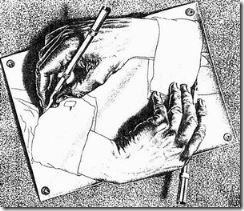
Drawing Hands, a 1948 lithograph by M. C. Escher

If you don’t believe in a creator, nor in the laws of nature, nor in a permanent object, nor in an absolute subject, nor in both, nor in any of it, in what do you believe then? What remains that you can consider a fundamental reality? The answer is simple; it is so simple that we barely consider it being a philosophical statement: things depend upon other things. For instance, a thing is dependent upon its cause. There is no effect without a cause and no cause without an effect. There is no fire without fuel, no action without an actor and vice versa. Things are dependent upon other things; they are not identical with each other, nor do they break up into objective and subjective parts.

This Buddhist concept of reality is often met with disapproval and considered incomprehensible. But there are modern modes of thought with points of contact. For instance, there is a discussion in quantum physics about fundamental reality. What is fundamental in quantum physics: particles, waves, field of force, law of nature, mindsets or information? Quantum physics came to a result that is expressed by the key words of complementarity, interaction and entanglement.

According to these concepts there are no independent quantum objects, just complementary ones; they are at the same time waves and particles. Quantum objects interact with others, and they are entangled even when they are separated at a far distance. Without being observed philosophically, quantum physics has created a physical concept of reality. According to that concept, the fundamental reality is an interaction of systems that interact with other systems and with their own components.

Gary Larson, March 23, 1984

"Ohhhhhhh...Look at that, Schuster...Dogs are so cute when they try to comprehend quantum mechanics."