Showing posts with label anicca. Show all posts

Tuesday, May 11, 2010

Somebody and Nobody

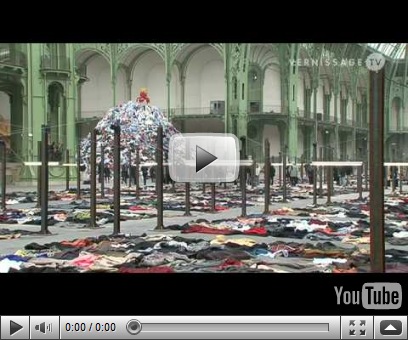
“No Man’s Land,” is an installation by Christian Boltanski which open this Friday at the Park Avenue Armory in Manhattan. The work was titled “Personnes” when it was staged at the Grand Palais in Paris at the beginning of the year.

“Personnes,” the artist says, “is a very strange word because it means, at the same time, somebody and nobody…The idea was to make something about the finger of God and about chance.”
From “Exploring Mortality With Clothes and a Claw,” Dorothy Spears, New York Times, May 9, 2010):

“Every few minutes, in an act meant to resonate with the arbitrariness of death and survival, the crane’s giant claw will pluck a random assortment of shirts, pants and dresses from the mound then release them to flap back down haphazardly. Visitors can watch the action — set to a ceaseless, reverberating soundtrack of thousands of human heartbeats — from ground level, standing amid dozens of 15-by-23-foot plots of discarded jackets that extend in all directions from the mound and that may evoke refugee or death camps. Behind the visitors, a 66-foot-long, 12-foot-high wall made from 3,000 stacked cookie tins will cut off views of the exit.”

Christian Boltanski:

“We are all so complicated, and then we die. We are a subject one day, with our vanities, our loves, our worries, and then one day, abruptly, we become nothing but an object, an absolutely disgusting pile of shit. We pass very quickly from one stage to the next. It's very bizarre. It will happen to all of us, and fairly soon too. We become an object you can handle like a stone, but a stone that was someone.”

Friday, May 07, 2010

Essence of the Circle

Tibetan Sand Mandalas

“The Tibetan art form of sand painting is an ancient and sacred practice intended to uplift and benefit not only every person who sees it, but also to bless the environment. It is referred to as a mandala of colored powders. The Sanskrit term mandala is the name for this circular representation of spiritual truths. The Tibetan name is kyil-khor meaning essence of the circle.”

From the web page of Losang Samten, who created this center panel of the Kalachakra Mandala in the new Ohio Union of the Ohio State Campus this week.

Losang Samten

We all helped dismantle the panel this afternoon…

…and scattered the sand into Mirror Lake to bless the campus.

mirror-lake-1

Here is a time-lapse video of an entire Kalachakra Mandala.

Kalachakra mandala created by Losang Samten

Here’s another example.

5 Dhyani Buddhas from peacefeather imagery on Vimeo.

Description of the above design from Mandalas: Sacred Art and Geometry

Tuesday, September 22, 2009

No Thing Here

In the seen, there is only the seen,
in the heard, there is only the heard,
in the sensed, there is only the sensed,
in the cognized, there is only the cognized.
Thus you should see that
indeed there is no thing here;

…as you see that there is no thing there,
you will see that
you are therefore located neither in the world of this,
nor in the world of that,
nor in any place
betwixt the two.
This alone is the end of suffering.

~ Buddha, from the Udana

At breakfast on Saturday, the sun slowly crept up the window until it was shining almost directly into my eyes. It occurred to me that while it feels like the sun was moving, it was really the me, the table, the room, the building, and the earth that were all rotating imperceptibly.

Aristarchus's 3rd century BC calculations on the relative sizes of the Earth, Sun and Moon, from a 10th century AD Greek copy. It’s been nearly four hundred years since Galileo began defending heliocentrism, and yet it still does seem to us that we are at the center of the universe. The image of a sphere of water and dirt and plants and animals careening through space remains unsettling. We still go to the beach to watch the sun rise and set. It is challenging to imagine that people living in other time zones are currently sleeping while we are going about our business awake.

If the sun isn’t menacing me or entertaining me, and the ground beneath my feet isn’t stationary, where am I supposed to find a safe place to make my home? Our nervous systems crave certainty and solidity and, in their absence, have created a complex process for representing stability.

It is very useful to accept these illusions, but at some point Prague Orlojwe can’t help seeing through them. We navigate the uncertainty by trying to determine what the absence of true solidity means. Some interpret it as nihilism, others find that there being no thing simply means that every thing is in constant dynamic flux.

Mindfulness practice, seems to be one way that the need for things to be fixed gets eroded gradually. This allows us to live more comfortably inside the illusion as well as being able to experience the wonder of participating in the ongoing flow of the universe.

Tuesday, June 30, 2009

No Time


Check out Jeff Scher’s blog, The Animated Life.

From “The Parade,” June 29, 2009:

The streets of the city are a non-stop parade of humanity. It’s a kind of grand, unchoreographed ballet of human locomotion. One of the great pleasures and measures of being urban is losing yourself in the crowd, with your feet and mind wandering, alone in your head but elbow to elbow with an inexhaustible supply of strangers…

We can’t help it. We are fascinated by faces and bodies alike. Every face tells a story, and the story is a mystery. The clues abound and we read them instinctively in the blink of an eye. We categorize one another as bums, businessmen, tourists, models, etc., almost unconsciously. But what fun it is to stare, and revel in the passing faces, reading wardrobe, ethnicity, posture, age. Indeed, it’s a feast with every possible variation of the species on parade. By walking in their midst we too become a part of the constantly changing people-scape and offer our own version of the mystery.

Read the whole post and watch the related video...

[Thanks Kit!]

Friday, January 16, 2009

Panta Rei

“Everything flows.”

~ Heraclitus (ca. 535–475 BC)

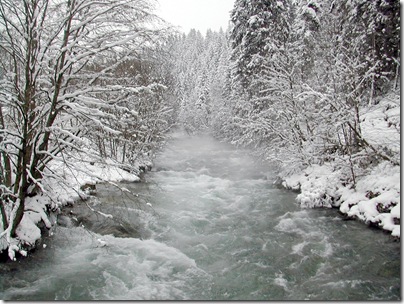
  After all, one does not step into the same river twice. Waters disperse and come together again ... They keep flowing on and flowing away.

Thursday, January 01, 2009

2008 in 40 Seconds

Images and sounds captured at the same spot in Oslo, Norway over the past year.

by Eirik Solheim

Tuesday, September 23, 2008

Forever to Reach


by Pictures & Sound

There's a long line in front of me
Stretching out into infinity
And behind me it's the same thing

It takes a lot of strength to not collapse
As endless moments endlessly pass
And to make the most of where you're at
And realize…

It took forever to reach and a moment to pass
Forever to reach and a moment to pass
It took forever to reach and a moment to pass
And now forever to vanish

We all travel at the speed of life
Hoping someday that we might arrive
But we're arriving all the time, all the time

The seasons turn and the rivers run
What we do now is what we will become
The young grow old and the old grow young
It's called life

It took forever to reach and a moment to pass
Forever to reach and a moment to pass
It took forever to reach and a moment to pass
And now forever to vanish

Close your eyes right now and count to ten
You're a different person than you were just then
We'll never get this chance again

It took forever to reach and a moment to pass
And now forever to vanish

It took forever to reach and a moment to pass
And now forever to vanish

Thursday, May 22, 2008

Impermanence

Impermanence "How do you convey a sense of change? How do you convey that everything in our lives — everything — is constantly changing and that one cannot hold on to anything? And certainly the impulse was coming from the sense of the preciousness of life and that every moment is the only moment that we have."

~ Meredith Monk, discussing her recent work, Impermanence, with Lara Pellegrinelli on All Things Considered (May 13, 2008)

Sunday, January 20, 2008

Fleeting Beauty

"A self-taught chef and artist, Jim Denevan draws inspiration from the earth to create sensual works of fleeting beauty—culinary installations in sunny farmlands across America and large-scale art pieces on the wave-swept sands of coastal beaches."

Jim Denevan

"When I'm doing a drawing, I'm personifying the place that is empty. A place that is unmarked." -- Jim Denevan

Monday, July 16, 2007

Ratatouille

Remy, A young rat with a refined sense of taste wants to become a chef. His family doesn’t understand why he can’t be content with eating trash and contributing to the common good of the pack. Remy’s father, Django, takes him to the exterminator shop with dead rats in the window.

DJANGO: The world we live in belongs to the enemy, we must live carefully. We look out for our own kind, Remy. When all is said and done, we're all we've got.

REMY: No. Dad, I don't believe it. You're telling me that the future is - can only be - more of this?

DJANGO: This is the way things are; you can't change nature.

REMY: Change is nature, Dad. The part that we can influence. And it starts when we decide.

DJANGO: [Remy turns to leave] Where are you going?

REMY: Hopefully, forward.

Reviews

Tuesday, January 09, 2007

Iroha Uta

This ancient Japanese poem contains each of the phonemes from the Gojuuonzu (50-Sound Chart) and illustrates a core concept in Buddhism - impermanence (anicca). School children in Japan are taught it the way American children learn to recite the alphabet.


Iroha Uta

Iro wa nioedo, chirinuru wo
Waga-yo tare-zo tsune-naran?
Ui no okuyama kyookoete
Asaki yume miji, ei mo sezu


The Flower Song
Translated by Shinzen Young

Bright indeed the flowers may be, but surely not for long.
In this life, who indeed, will not someday be gone?
Passing beyond the furthest peak in the Province of Shifting Streams,
No longer will I drunken speak, nor gaze at shallow dreams.