Showing posts with label perception. Show all posts

Thursday, May 19, 2011

The Self as Both a Thing and a Process

Excerpt from “Psychological Self vs. No-Self,” by Ron Crouch, Buddhist Geeks, May 19, 2011:

psych-self The self in Western psychology is viewed as that function of the mind that helps us to organize our experiences. It takes raw sense data, memories, and other cognitive functions and turns them into recognizable narratives. It is critical for everything that we do. Without a strong sense of self, we literally could not make sense of anything that happens to us.

What is fascinating is that in the western psychological view, the “self” or the “executive function” is actually a process and not really a thing. It waxes and wanes all the time, goes into the foreground and background of awareness depending on how much we need it, disappears when we sleep, is not the same as it was when we were little, much less the same as it was last year, and is even subtly different than it was last week.

So far, this should make a lot of sense to both psychologists and meditators. But here is where things get interesting: we all know that processes are not solid and change all the time, yet in this particular process there is a nagging sense that there is a solid permanent “me” hiding in that process somewhere. As if the process itself were a real solid thing in the same way that a table or chair is.

It is this unshakable sense of a solid “me” in the midst of this process that is the “self” that is referred to in the Dharma. When we talk about “no-self” in Buddhism, we are pointing to this sense of a solid self in and calling it an illusion. The process of “selfing” is real, the belief that it is somehow a permanent “me” is not.

To help understand how important this illusion is imagine that another mental process had this same illusion tied to it. Take memory for example. When we experience a memory we know that it isn’t “real” in the sense that it does not have a reality outside or our mental functioning. We know that memories come and go, are subject to change and can be forgotten. But what if every time you remembered something you assumed that the memory itself was “real” in the same way that a table or chair is real. That it was substantial and lasting. Even though you could not literally see or experience the memory with your five senses, you still had the unshakable belief that it was a real and solid thing that is supposed to last. Wouldn’t this be a set-up for frustration? Memories slip and slide out of consciousness and like every other mental function they are subject to dramatic change. If we expected them to never go away and always be there, we would constantly be in distress. This is exactly what is happening with us in terms of the self-process.

While the self-process creates narratives that organize our experiences into something recognizable, the illusion of self is inserted as a main character into all these narratives. We expect the character to be the same all the time, to never change or go away, to be “real.” And yet each moment we are running into a stark reality: the self is not as real as we believe it to be, and it certainly does not last. Over time this sense of solid “me” becomes the most salient feature of all of our experience and our greatest source of anxiety. The fact that we see this constantly changing process as a solid “me” creates endless problems for us because it sets up a never-ending fight between us and reality (and reality never loses).

What is odd is that according to psychology, this sense of a solid self is not an issue. In fact it is not really addressed at all. One part of the psychological literature explains that the self is a cognitive process like any other, and then another part of the literature goes on about protecting and promoting a healthy “self.” The fact that we are taking a process and turning it into a solid thing in our minds is simply not addressed.

In psychology, this point may have been missed because of the bias to study and theorize about pathology rather than health. The illusions and problems inherent in a “normally” functioning mind just don’t get a lot of research lab-time. So most theory in psychology works to get damaged selves back to “normal functioning.” Buddhism on the other hand, starts with the assumption that normal functioning is full of suffering caused by a false sense of self, and works to get people from a state of “normal” to enlightened.

Read entire essay here…

Saturday, May 07, 2011

Direct Contact

May 7, 2011

From “Purpose and Method of Vipassana Meditation,” by Shinzen Young:

The essence of this practice can be stated as a simple formula: ordinary experience plus mindfulness plus equanimity yields insight and purification. In this formula, each term is defined very precisely. Ordinary experience is defined as hearing, seeing, smelling, tasting, the feeling body and the thinking mind. Mindfulness is defined as specificity in awareness, clarity in awareness, continuity in awareness, richness in awareness, precision in awareness. Equanimity is defined as not interfering with the flow of the senses at any level, including the level of preconscious processing.

When sufficient mindfulness and equanimity are brought to bear on ordinary experience, we arrive at purification and insight. And, as a result of the purification and insight, our intrinsic happiness, our true birthright and spiritual reality, gets uncovered and we discover that what we thought was the world of phenomena—the world of time, space, and matter—turns out to really be a world of spiritual energy, and that we are in direct contact with it moment by moment. Because, when the senses become purified, when the inner conflicts—at all levels—have been broken up, the flow of these ordinary senses turns into a prayer, a mantra, a sacred song, and we find that, just by living our life, we are in moment-by-moment contact with the Source. In the Christian contemplative tradition this is called the "practice of the presence of God." In the Jewish mystical tradition it is called briah yesh me ayn—the experience of things (yesh) being continuously created (briah) from no-thing (ayn), that is, from God.

For most people the senses are opaque. A window is opaque if it is covered by soot; light can't come through. The soot is craving, aversion, and ignorance. When that's cleared away, the ordinary senses become literally transparent. It is very hard to describe what this is like. Hearing returns to being part of the effortless flow of nature, seeing returns to being part of the effortless flow of nature, and likewise with smelling, tasting, the body sensations whether they are pleasant, unpleasant, or neutral, they all go back to being part of "God's breath" so to speak.

Even the thinking process returns to being part of this effortless flow. At the beginning stages of meditation one is very concerned with overcoming the wandering thoughts in order to develop enough calm and concentration to be able to practice mindfulness. But when you get further along in the process there will be no necessity whatsoever to have a still mind because the ordinary flow of thought will be experienced as not different from the activity of the Source.

Read more…

One’s Own Perception

From “Ratmechanics,” by Katy Bowman:

We humans may not whisk, but we do have a very similar system in our body. It’s called the proprioceptive system.

Proprioception means “one’s own perception.” No, it’s not like your opinion or anything like that, but it is the ability for one part of your body to know where it is relative to the other parts. Unlike the rat, who is using the deformation of its whiskers to create an image of what is external (similar to a dolphin using sonar to “see” shapes in front of it as it is swimming), we use our proprioceptive system to create an image of what is internal, or inside the skin. Propriception works in the same way as the whiskers though. The deformation of the joints and muscles sends information to the receptors (proprioceptors) within the moving muscles and their joints. That information about a change in skeletal position then travels via our neurons to the brain to create an image.

Read more…

See also:

[Thanks, Kit!]

We Create the World

"When you have an awareness of anything internally, you perceive that externally. We really do, I believe, create the world that we live in. The word ‘eye’, in its Sanskrit and Hebrew root, means fountain. In other words, this is not an organ that's receiving vibrations from what's out there going through the brain and being interpreted. It's a projector."

~ Hubert Selby, Jr., from Memories, Dreams & Addictions. Interview with Ellen Burstyn. Special feature on Requiem for a Dream, Director's Cut DVD release. (2001)

See also: A List of Indignities

Tuesday, March 15, 2011

A Philosophy of the Present

From “In Search of the Present,” by Octavio Paz (translated by Anthony Stanton), Nobel Lecture, October 8, 1990:

Reflecting on the now does not imply relinquishing the future or forgetting the past: the present is the meeting place for the three directions of time. Neither can it be confused with facile hedonism. The tree of pleasure does not grow in the past or in  the future but at this very moment. Yet death is also a fruit of The death mask of Sir Isaac Newton.the present. It cannot be rejected, for it is part of life. Living well implies dying well. We have to learn how to look death in the face. The present is alternatively luminous and somber, like a sphere that unites the two halves of action and contemplation. Thus, just as we have had philosophies of the past and of the future, of eternity and of the void, tomorrow we shall have a philosophy of the present. The poetic experience could be one of its foundations. What do we know about the present? Nothing or almost nothing. Yet the poets do know one thing: the present is the source of presences.

In this pilgrimage in search of modernity I lost my way at many points only to find myself again. I returned to the source and discovered that modernity is not outside but within us. It is today and the most ancient antiquity; it is tomorrow and the beginning of the world; it is a thousand years old and yet newborn. It speaks in Nahuatl, draws Chinese ideograms from the 9th century, and appears on the television screen. This intact present, recently unearthed, shakes off the dust of centuries, smiles and suddenly starts to fly, disappearing Venus of Willendorf through the window. A simultaneous plurality of time and presence: modernity breaks with the immediate past only to recover an age-old past and transform a tiny fertility figure from the Neolithic into our contemporary. We pursue modernity in her incessant metamorphoses yet we never manage to trap her. She always escapes: each encounter ends in flight. We embrace her and she disappears immediately: it was just a little air. It is the instant, that bird that is everywhere and nowhere. We want to trap it alive but it flaps its wings and vanishes in the form of a handful of syllables. We are left empty-handed. Then the doors of perception open slightly and the other time appears, the real one we were searching for without knowing it: the present, the presence.

[Thanks, Whiskey River!]

Sunday, December 05, 2010

The Impact of Meditation on Attention

Excerpts from Roundtable: Meeting of the Minds, Tricycle Magazine, Spring 2005:

Richard Davidson: Our initial work certainly indicates that meditation changes brain function. One of our hopes now is that a broader range of scientists will be inspired to examine the potential impact of contemplative practice on different behavioral domains. One of our goals is to launch studies that look at the impact of meditation on attention and the brain systems that support it.

We’ve been talking with experts who do experiments in which, for example, a person is required to focus on a specific object and ignore distractions. One question is whether training in meditation facilitates one’s capacity to do this, and, if it does, which parts of the brain are being affected.

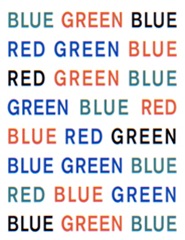
There are well-developed procedures in cognitive psychology for exploring such questions. The classic one is the Stroop Test. In one version of this test, the word “green” might be printed on a card in red, and the subject’s task would be to name the color in which the word was printed (red), ignoring the meaning of the word (green). Classically, people are slower in responding when the color of a word is inconsistent with the name of the word than when the two are the same: when the word “green” is printed in green, people are able to say “green” faster than when they’re looking at the word “green” printed in red. What this requires is that we inhibit our automatic response and focus our attention on the instructions given by the experimenter.

B. Alan Wallace: Shamatha [a meditative practice of calming the mind] is specifically aimed at controlling attention. When the word pops up, if you’re able to control your attention, you can say to yourself, “I’m not going to see the whole word. I’m going to focus on the middle of the word and ask only one question: What is its color?” If you’re looking at the whole word, the meaning of the word will compete for your attention, and you’ll be slowed down.

Attention training has broad applications. It would be helpful in the fields of education, mental health, and athletics as well as increasing individual creativity and problem-solving skills. And attention practice is crucial for cultivating the profound virtues of the heart and mind—lovingkindness, compassion, bodhicitta [awakened mind], and the realization of emptiness.

If, when anger or another afflictive emotion arises, you can say to yourself, “Never mind the object of my anger and the context; isn’t this interesting?” and investigate your own emotional state instead of merely reacting, you can also cultivate greater emotional balance and mental health.”

[Thanks, Jeanne!]

Tuesday, November 30, 2010

Attention Training

Excerpt from “Living in Buddha Standard Time,” a Buddhist Geeks conversation with Lama Surya Das (October 4, 2010):

Most people have had an experience of time slowing down, maybe like in a traffic accident or while they’re falling from a height, or tumbling over beneath the waves and drowning or something. Or, if you’re in pain, a minute seems like an hour. What’s the saying? The watched pot never seems to boil. You know, while you’re waiting for the pot to boil, if you go away it boils right away. You like have to hurry back it seems. But if you sit there, watching it, it seems never to boil.

Time is so elastic, and it’s not just that it’s speeded up in this era; it could also be slowed down if we’re more aware. Maybe you’ve experienced that on some drug or something. Maybe you’ve experienced it in a dream or a vision. Time can also be very slow motion. The outer slowing down of time with slow motion film and all is just an image of how this feels internally, when you’re more aware. By sharpening you’re awareness, processing the frames of awareness like a movie frame. Every step seems to be slower, you can be very aware of lifting and moving your foot forward and shifting the weight in your abdomen and putting down the other foot and stepping on it—without walking slower, by shifting the mind, by more sharp and quick awareness. Not thinking faster, but with quicker awareness.

This is attention training. This is awareness training. This is part of samadhi or focused awareness. We can train ourselves in this way to be aware of more mind moments within one second or one minute. To be aware of the space between thoughts, not just the thoughts that we’re caught in, and so on. And to slow down a little and to be more present so we can choose how and if to respond to stimuli, not just blindly reacting. The secret of mindful anger management is creating some space between the outer stimulus and your reaction, so you can choose how and when to respond.

I think that time is very elastic, and…what did Einstein say? Time slows down so much when you’re waiting to see if you can take that first kiss from a girl. That’s Albert Einstein by the way, I’m not making it up. So he doesn’t just talk about e=mc2 and how at the speed of light all mass is fused and so on, time and space continuum and different dimensions. He was actually saying that when you are keenly present and aware and involved wholly in something, when you’re on the edge of your mental seat, time seems to slow down, like waiting to see if you can kiss that girl, when you’re young.

Tuesday, August 24, 2010

The Way We Perceive

Ludwig Wittgenstein "That it doesn't strike us at all when we look around us, move about in space, feel our own bodies, shows how natural these things are to us. We do not notice that we see space perspectively or that our visual field is in some sense blurred towards the edges. It doesn't strike us and never can strike us because it is the way we perceive. We never give it a thought and it's impossible we should, since there is nothing that contrasts with the form of our world. What I wanted to say is it's strange that those who ascribe reality only to things and not to our ideas move about so unquestioningly in the world as idea and never long to escape from it."
~ Ludwig Wittgenstein

See also: Hidden in Plain Sight All Around Us

Monday, August 16, 2010

Off the Grid in Search of the Holy Grail

“Attention is the holy grail. Everything that you’re conscious of, everything you let in, everything you remember and you forget, depends on it.”

~ University of Utah psychology professor David Strayer, from “Outdoors and Out of Reach, Studying the Brain,” by Matt Richtel, New York Times (August 15, 2010)

PS Dozens of people responded to New York Time’s challenge to try giving up technology and report back about the experience. Check out their stories at The Unplugged Challenge.

[Thanks, Kit!]

Monday, August 09, 2010

Satisfied with the Mystery

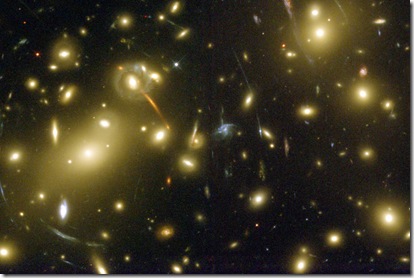
Abell 2218: A Galaxy Cluster Lens

"The most beautiful experience we can have is the mysterious. It is the fundamental emotion that stands at the cradle of true art and true science. Whoever does not know it and can no longer wonder, no longer marvel, is as good as dead, and his eyes are dimmed. It was the experience of mystery—even if mixed with fear—that engendered religion. A knowledge of the existence of something we cannot penetrate, our perceptions of the profoundest reason and the most radiant beauty, which only in their most primitive forms are accessible to our minds: it is this knowledge and this emotion that constitute true religiosity. In this sense, and only this sense, I am a deeply religious man...I am satisfied with the mystery of life's eternity and with a knowledge, a sense, of the marvelous structure of existence—as well as the humble attempt to understand even a tiny portion of the Reason that manifests itself in nature."

~ Albert Einstein, from The World as I See It


[Thanks for the Einstein quote, Liv!]

Monday, August 02, 2010

The Natural Dramatic Urge

Excerpts from Three Uses of the Knife: On the Nature and Purpose of Drama by David Mamet:

It is our nature to dramatize. At least once a day wee reinterpret the weather—an essentially impersonal phenomenon—into an expression of our current view of the universe: “Great. It’s raining. Just when I’m blue. Isn’t that just like life?”

Or we say: “I can’t remember when it was this cold,” in order to forge a bond with our contemporaries. Or we say: “When I was a lad the winters were longer,” in order to avail ourselves of one of the delights of aging.

The weather is impersonal, and we both understand it and exploit it as dramatic, i.e., having a plot, in order to understand its meaning for the hero, which is to say for ourselves.

We dramatize the weather, the traffic, and other impersonal phenomena by employing exaggeration, ironic juxtaposition, inversion, projection, all the tools the dramatist uses to create, and the psychoanalyst uses to interpret, emotionally significant phenomena.

We dramatize an incident by taking events and reordering them, elongating them, compressing them, so that we understand their personal meaning to us—to us as the protagonist of the individual drama we understand our life to be.

If you said, “I waited at the bus today,” that probably wouldn’t be dramatic. If you said, “I waited at the bus stop for a long time today,” that might be a little more dramatic. If you said, “The bus came quickly today,” that wouldn’t be dramatic (and there would be no reason to say it). But you might say, “Do you know how quickly that bus came today?”—and all of a sudden, we’re taking the events of life and using dramatic tools.

“I waited half an hour for a bus today” is a dramatic statement. It means: “I waited that amount of time sufficient for me to be sure you will understand it was ‘too long.’”

(And this is a fine distinction, for the utterer cannot pick a time too short to be certain that understanding is communicated, or too long for the hearer to accept it as appropriate—at which point it becomes not drama but farce. So the ur-dramatist picks unconsciously, and perfectly, as it is our nature to do, the amount of time that allows the hearer to suspend his or her disbelief—to accept that the half-hour wait is not outside the real of probability, yet is within the parameters of the unusual. The hearer then accepts the assertion for the enjoyment it affords, and a small perfectly recognizable play has been staged and appreciated.")

*     *     *     *     *

We can see the natural dramatic urge in newspaper quotes of a film’s grosses. The dramatic urge—our impulse to structure cause and effect in order to increase our store of practical knowledge about the universe—is absent in the film itself, but emerges spontaneously in our proclamation of a natural ocurring drama between films.

*     *     *     *     *

jumping-on-a-bedChildren jump around at the end of the day, to expend the last of that day’s energy. The adult equivalent, when the sun goes down, is to create or witness drama—which is to say, to order the universe into a comprehensible form. Our sundown play/film/gossip is the day’s last exercise of that survival mechanism. In it we attempt to discharge any residual perceptive energies in order to sleep. We will have drama in that spot, and it it’s not forthcoming we will cobble it together out of nothing.

Wednesday, July 28, 2010

Sublime Illusion

Sunset on Volunteer Mountain

photo by Pez Owen

From Eckhart Tolle’s Findhorn Retreat: Stillness Amidst the World:

“The sun never sets. It is only an appearance due to the observer’s limited perspective. And yet, what a sublime illusion it is.”

* * * * *

“The original reason for art is the sacred—to be a portal, an access point for the sacred. When you see it or experience it, you experience yourself. In it you see yourself reflected. In true art, the formless is shining through the form.

Ultimately, it is not everybody’s purpose to create works of art. It is much more important for you to become a work of art. Your whole life, your very being, becomes transparent so that the formless can shine through. That happens when you are no longer totally identified with the world of form.

It happens when you have access to the realm of stillness within yourself. Then something emanates through the form that is not the form.”

Condemned to Freedom

Excerpt from “The Limits of the Coded World,” by William Eggington, New York Times (July 25, 2010):

In Immanuel Kant’s view, the main mistake philosophers before him had made when considering how humans could have accurate knowledge of the world was to forget the necessary difference between our knowledge and the actual subject of that knowledge. At first glance, this may not seem like a very easy thing to forget; for example, what our eyes tell us about a rainbow and what that rainbow actually is are quite different things. Kant argued that our failure to grasp this difference was further reaching and had greater consequences than anyone could have thought.

rainbow Taking again the example of the rainbow, Kant would argue that while most people would grant the difference between the range of colors our eyes perceive and the refraction of light that causes this optical phenomenon, they would still maintain that more careful observation could indeed bring one to know the rainbow as it is in itself, apart from its sensible manifestation. This commonplace understanding, he argued, was at the root of our tendency to fall profoundly into error, not only about the nature of the world, but about what we were justified in believing about ourselves, God, and our duty to others.

The problem was that while our senses can only ever bring us verifiable knowledge about how the world appears in time and space, our reason always strives to know more than appearances can show it. This tendency of reason to always know more is and was a good thing. It is why human kind is always curious, always progressing to greater and greater knowledge and accomplishments. But if not tempered by a respect for its limits and an understanding of its innate tendencies to overreach, reason can lead us into error and fanaticism…

As much as we owe the nature of our current existence to the evolutionary forces Darwin first discovered, or to the cultures we grow up in, or to the chemical states affecting our brain processes at any given moment, none of this impacts on our freedom. I am free because neither science nor religion can ever tell me, with certainty, what my future will be and what I should do about it. The dictum from Sartre…gets it exactly right: I am condemned to freedom. I am not free because I can make choices, but because I must make them, all the time, even when I think I have no choice to make.

Read the entire Opinionator post…

Sunday, July 18, 2010

Emptiness and Fullness

“We realize this life as something always off its balance, something in transition, something that shoots out of a darkness through a dawn into a brightness that we feel to be the dawn fulfilled. In the very midst of the continuity our experience comes as an alteration. ‘Yes,’ we say at the full brightness, ‘this is what I just meant.’ ‘No,’ we feel at the dawning, ‘this is not yet the full meaning, there is more to come.’ In every crescendo of sensation, in every effort to recall, in every progress towards the satisfaction of desire, this succession of an emptiness and fullness that have reference to each other and are one flesh is the essence of the phenomenon.”

~ William James, from A Pluralistic Universe (Chapter 7: The Continuity of Experience)

Friday, June 04, 2010

Time Standing Still

Excerpt from “Time,” Radiolab (February 25, 2005).

Robert Krulwich: And to you, I guess, the joy of time—the deepest most ecstatic version of it—is when you lose it completely.

Jay Griffiths: I think that’s absolutely right. And I think that’s something in prayer, in meditation, in art—and in love, actually— is that people lose that very fretful, ticking-off-sense of clock time. And what you fall into is something transcendent. All that you have to have done is loved somebody to know that. And to hold them for half an hour and you can know that half an hour has lasted an eternity.

Robert: Time standing still at a moment like that is like a really swollen now.

Jay: Yes! Exactly. Exactly. And that in a sense that’s when the moment meets the eternal. That is all that matters is just this moment that you’re holding in your hand. 

Thursday, May 27, 2010

Playing the Role of the Illusionist

Excerpt from Seeing Red by Nicholas Humphrey:

seeing-red

I dare say belief in mind-body duality may not be “accidental” in the least.

In the wider world, there are two sorts of “illusion”—accidental and contrived. There are cases where we get things wrong as the result of bad luck, and cases where we are the victims of deliberate trickery. When, for example, we see a stick in water as being bent, or when we think we are moving as the train beside us pulls away, it is a matter of bad luck. We are applying rules of inference in situations where our information is inaccurate or incomplete. But no one is trying to delude us.

When, however, we see a stage magician bending a metal spoon without touching it, or when we feel the table at a spiritualist seance lifting off the ground, it is a matter of intentional trickery. We may, again, be applying rules of inference in situations where our information is inaccurate or incomplete. But this time there is an illusionist who wants us to get it wrong.

Now, with belief in mind-body duality, which kind of illusion is it? The general view among materialist philosophers has always been that it is an illusion of the first kind, an honest—if regrettable—error. But how about if it is an illusion of the second kind, a deliberate trick!

Could it be? Only of course if there were to be an active agency behind it, playing the role of the illusionist. But who or what could possibly be doing this? And what interest could they have in encouraging individual humans to believe in a non-physical world?

The immediate, but unhelpful answer, might be that, since it is a case of self-delusion, the illusionist must lie within the subject’s own brain. The more interesting answer might be that, insofar as the brain is designed by genes, the illusionist is the subject’s own genes. But in that case, the ultimate answer must surely be that the illusionist is Nature herself, working through natural selection.

Monday, May 24, 2010

Seeing Double

wind-blowing

“Could not the age-old rift between spirit/mind and matter, soul and body, freedom and necessity, etc. be an expression of no more than a basic dualism which seems to be universally present in the structure of human language, i.e. the separation of noun and verb (or subject and predicate) in which the description of a unified natural process or phenomenon entails its verbal division into static and process aspects respectively? The manner in which this descriptive procedure may make us see double as it were, becomes more apparent with sentences such as ‘The wind is blowing’ or ‘The fire is burning,’ where it is easy to see that the blowing is the wind, and that the burning is the fire. Is it not possible that the epiphenomenon of mind may have arisen in a way similar to the ‘wind’ and ‘fire,’ to stand above thoughts, feelings, memories, actions and experiences? If so this linguistic illusion has had the profoundest consequences for [mankind] and for the history of this planet.”

~ Ronald Wong, from a letter to the editor of New Scientist in response to “The Shadow of the Mind,” by John Taylor, September 30, 1971

Wednesday, April 21, 2010

Slowing Down Remembrance of Things Fast

“…fear does not actually speed up our rate of perception or mental processing. Instead, it allows us to remember what we do experience in greater detail. Since our perception of time is based on the number of things we remember, fearful experiences thus seem to unfold more slowly.”

From “How the Brain Stops Time,” by Jeff Wise, Psychology Today, March 13, 2010

Stetson C, Fiesta MP, & Eagleman DM. (2007). Does time really slow down during a frightening event? PloS One. 2 (12).

Sunday, April 18, 2010

A Period of Stagnation

Excerpts from “The Boring Age,” by Michael Lind, Time, March 11, 2010:

Illustration by Kelly Blair for TIME We like to believe we live in an era of unprecedented change: technological innovation is proceeding at a rate with no parallel in all of human history. The information revolution and globalization are radically disruptive. Just as Barack Obama would like to be a transformational President, so the rest of us like the idea that we live in a thrilling epoch of transformation. But the truth is that we are living in a period of stagnation.

Surprisingly, this stasis is most evident in an area where we assume we are way ahead of our predecessors: technology. In fact, the gadgets of the information age have had nothing like the transformative effects on life and industry that indoor electric lighting, refrigerators, electric and natural gas ovens and indoor plumbing produced in the early to mid-20th century. Is the combination of a phone, video screen and keyboard really as revolutionary as the original telephone, the original television set or the original typewriter was?

…I predict that in the year 2050, the nation-state will still be the dominant form of political organization, with a few new nation-states added to the U.N. The U.S. will still be the dominant global economic and military power, even if China has a somewhat larger GDP because of its larger population. Most energy will still be derived from fossil fuels, and nuclear power will account for an increasing share of global electricity production, while wind and solar power will still be negligible. Most people will get from place to place by means of cars, buses, taxis and planes, not fixed rail. Thanks to biotech advances, people will live longer and healthier lives, and consequently the largest single occupation in 2050 will be — drumroll, please — nursing!

I know, that's a boring vision of the future compared with a Chinese century in which everybody is a genetically modified immortal who rides monorails and eats algae grown in skyscrapers. But hey, in the future, phones will be really cool.

More…

Sunday, March 21, 2010

Nature Guards Its Secrets

Spring Equinox 2010

Look Again
by Sarah Lindsay, from Twigs and Knucklebones 

I know how little I know
from observation:
that the dog sleeping on the rug
with pure concentration
will be sleeping, each time I look up,
in a different direction,

that five wart-lidded mushrooms
can form on the lawn
in the time rain takes
to shift from falling to fallen,

that my eyes are too slow
to track shooting stars, too quick
to spy continental drift,
and Earth conceals its spin
by spinning me with it,

that a tree won’t let me
see its growth, only its height,
that hairs on my head go singly gray
only by night.