Showing posts with label Richard Davidson. Show all posts

Sunday, December 05, 2010

The Impact of Meditation on Attention

Excerpts from Roundtable: Meeting of the Minds, Tricycle Magazine, Spring 2005:

Richard Davidson: Our initial work certainly indicates that meditation changes brain function. One of our hopes now is that a broader range of scientists will be inspired to examine the potential impact of contemplative practice on different behavioral domains. One of our goals is to launch studies that look at the impact of meditation on attention and the brain systems that support it.

We’ve been talking with experts who do experiments in which, for example, a person is required to focus on a specific object and ignore distractions. One question is whether training in meditation facilitates one’s capacity to do this, and, if it does, which parts of the brain are being affected.

There are well-developed procedures in cognitive psychology for exploring such questions. The classic one is the Stroop Test. In one version of this test, the word “green” might be printed on a card in red, and the subject’s task would be to name the color in which the word was printed (red), ignoring the meaning of the word (green). Classically, people are slower in responding when the color of a word is inconsistent with the name of the word than when the two are the same: when the word “green” is printed in green, people are able to say “green” faster than when they’re looking at the word “green” printed in red. What this requires is that we inhibit our automatic response and focus our attention on the instructions given by the experimenter.

B. Alan Wallace: Shamatha [a meditative practice of calming the mind] is specifically aimed at controlling attention. When the word pops up, if you’re able to control your attention, you can say to yourself, “I’m not going to see the whole word. I’m going to focus on the middle of the word and ask only one question: What is its color?” If you’re looking at the whole word, the meaning of the word will compete for your attention, and you’ll be slowed down.

Attention training has broad applications. It would be helpful in the fields of education, mental health, and athletics as well as increasing individual creativity and problem-solving skills. And attention practice is crucial for cultivating the profound virtues of the heart and mind—lovingkindness, compassion, bodhicitta [awakened mind], and the realization of emptiness.

If, when anger or another afflictive emotion arises, you can say to yourself, “Never mind the object of my anger and the context; isn’t this interesting?” and investigate your own emotional state instead of merely reacting, you can also cultivate greater emotional balance and mental health.”

[Thanks, Jeanne!]

Monday, February 01, 2010

Happiness Not as a Trait But as a Skill

Computer monitors display imaged data in the control room of the fMRI scanner at the Keck Laboratory for Functional Brain Imaging and Behavior.
© UW-Madison University Communications  (
Photo by  Jeff Miller) “Now we mostly have monks and other religious figures preaching about these ideas [compassion training]. It's quite another thing to have a hard-nosed neuroscientist like me suggest that such training may have beneficial consequences for how we act toward others as well as promoting health. Most people accept the idea that regular physical exercise is something they should do for the remainder of their lives. Imagine how different things might be if we accepted the notion that the regular practice of mental exercises to strengthen compassion is something to incorporate into everyday life…I've been talking about happiness not as a trait but as a skill, like tennis. If you want to be a good tennis player, you can't just pick up a racket—you have to practice."

~ Richard Davidson, from “This Is Your Brain on Happiness,” by Penelope Green, O, The Oprah Magazine (March 1, 2008)

Tuesday, May 26, 2009

This is Your Brain on Prayer and Meditation

Quotes from “Prayer May Reshape Your Brain ... And Your Reality," by Barbara Bradley Hagerty, NPR (May 20, 2009):

your_brain_on_god

"The more you focus on something — whether that's math or auto racing or football or God — the more that becomes your reality, the more it becomes written into the neural connections of your brain...What we need to do is study those moments where people feel that they're getting beyond their brain, and understanding what's happening in the brain from a scientific perspective, what's happening in the brain from their spiritual perspective..."

~ Andrew Newberg, a neuroscientist at the University of Pennsylvania, who has been scanning the brains of religious people for more than a decade.

"It's as if the present moment expands to fill all of eternity, that there has never been anything but this eternal now."

~ Michael Baime, a doctor at the University of Pennsylvania and a Tibetan Buddhist who has meditated at least an hour a day for the past 40 years.

"You can sculpt your brain just as you'd sculpt your muscles if you went to the gym. Our brains are continuously being sculpted, whether you like it or not, wittingly or unwittingly."

~ Richard Davidson, a neuroscientist at the University of Wisconsin

[Thanks Connie! Thanks Pete!]

Wednesday, March 26, 2008

People Can Develop Skills that Promote Happiness and Compassion

A news release yesterday from the University of Wisconsin-Madison reports findings from a research study on the effects of compassion meditation on brain circuitry:

Cultivating compassion and kindness through meditation affects brain regions that can make a person more empathetic to other peoples' mental states, say researchers at the University of Wisconsin-Madison.

Published March 25 in the Public Library of Science One, the study was the first to use functional magnetic resonance imaging (fMRI) to indicate that positive emotions such as loving-kindness and compassion can be learned in the same way as playing a musical instrument or being proficient in a sport. The scans revealed that brain circuits used to detect emotions and feelings were dramatically changed in subjects who had extensive experience practicing compassion meditation.

The research suggests that individuals - from children who may engage in bullying to people prone to recurring depression - and society in general could benefit from such meditative practices, says study director Richard Davidson, professor of psychiatry and psychology at UW-Madison and an expert on imaging the effects of meditation.

Various techniques are used in compassion meditation, and the training can take years of practice. The controls in this study were asked first to concentrate on loved ones, wishing them well-being and freedom from suffering. After some training, they then were asked to generate such feelings toward all beings without thinking specifically about anyone.

Each of the 32 subjects was placed in the fMRI scanner at the UW-Madison Waisman Center for Brain Imaging, which Davidson directs, and was asked to either begin compassion meditation or refrain from it. During each state, subjects were exposed to negative and positive human vocalizations designed to evoke empathic responses as well as neutral vocalizations: sounds of a distressed woman, a baby laughing and background restaurant noise.
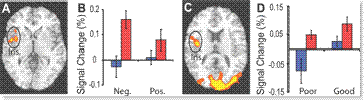
journal.pone.0001897.g002 Figure 2. Meditation modulates right insula response to emotional sounds: Average response in (Insula) for experts (red) and novices (blue)

The scans revealed significant activity in the insula - a region near the frontal portion of the brain that plays a key role in bodily representations of emotion - when the long-term meditators were generating compassion and were exposed to emotional vocalizations. The strength of insula activation was also associated with the intensity of the meditation as assessed by the participants.
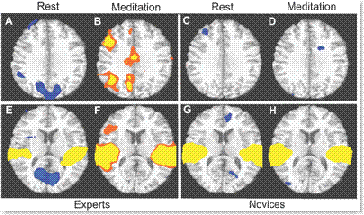
journal.pone.0001897.g004 Areas showing a negative (dark blue, blue) or positive (orange, yellow) impulse response on average across 10 seconds in responses to all emotional sounds for the 15 novices and 15 experts at z=31 compared to baseline (figs. A–D) and z = 13 (figs. E–H)

"The insula is extremely important in detecting emotions in general and specifically in mapping bodily responses to emotion - such as heart rate and blood pressure - and making that information available to other parts of the brain," says Davidson, also co-director of the HealthEmotions Research Institute.

Activity also increased in the temporal parietal juncture, particularly the right hemisphere. Studies have implicated this area as important in processing empathy, especially in perceiving the mental and emotional state of others.

"Both of these areas have been linked to emotion sharing and empathy," Davidson says. "The combination of these two effects, which was much more noticeable in the expert meditators as opposed to the novices, was very powerful."

The findings support Davidson and Lutz's working assumption that through training, people can develop skills that promote happiness and compassion.

"People are not just stuck at their respective set points," he says. "We can take advantage of our brain's plasticity and train it to enhance these qualities."

Meditation instruction given to participants
As described in Dr. Matthieu Ricard's instructions for novices: “During the training session, the subject will think about someone he cares about, such as his parents, sibling or beloved, and will let his mind be invaded by a feeling of altruistic love (wishing well-being) or of compassion (wishing freedom from suffering) toward these persons. After some training the subject will generate such feeling toward all beings and without thinking specifically about someone. While in the scanner, the subject will try to generate this state of loving kindness and compassion.”

Friday, July 27, 2007

Train Your Mind

"We have no idea how much plasticity there really is in the human brain until we see what intense mental training, not some weekly meditation session, can accomplish. We've gotten this idea, in Western culture, that we can change our mental status by a once-a-week, forty-five minute intervention, which is completely cockamamy. Athletes and musicians train many hours every day. As a neuroscientist, I have to believe that engaging in compassion meditation every day for an hour each day would change your brain in important ways. To deny that without testing it, to accept the null hypothesis, is simply bad science."

"I believe that neuroplasticity will reshape psychology in the coming years. Much of psychology had accepted the idea of a fixed program unfolding in the brain, one that strongly shapes behavior, personality, and emotional states. That view is just shattered by the discoveries of neuroplasticity. Neuroplasticity will be the counterweight to the determanistic view (that genes have behavior on a short leash). The message I take from my own work is that I have a choice in how I react, that who I am depends on the choices I make, and that who I am is therefore my responsibility."

Richard Davidson, Ph.D University of Wisconsin-Madison quoted by Sharon Begley in her book Train Your Mind, Change Your Brain. [From Kit]