Showing posts with label Matthieu Ricard. Show all posts

Tuesday, February 16, 2010

Developing Our Human Qualities

Excerpt from “Matthieu Ricard: Meditate Yourself Better,” by Curtis Abraham, New Scientist (Feb. 3, 2010)

Matthieu Ricard (Photo: Angeles Nassar) “Experiments have indicated that the region of the brain associated with emotions such as compassion shows considerably higher activity in those with long-term meditative experience. These discoveries suggest that basic human qualities can be deliberately cultivated through mental training. The study of the influence of mental states on health, which was once considered fanciful, is now an increasing part of the scientific research agenda.

Twenty minutes of daily practice can contribute significantly to a reduction of anxiety and stress, the tendency to become angry and the risk of relapse in cases of severe depression. Thirty minutes a day over the course of eight weeks results in a considerable strengthening of the immune system and of one's capacity for concentration. It also speeds up the healing of psoriasis and decreases arterial tension in people suffering from hypertension.

Why should we bother to meditate? The answer is that we all have the potential for positive change, which largely remains untapped. That's a great pity, because we know the virtue of training and learning. We spend years going to school and training in things like sports, but for some strange reason we don't think that the same need applies to developing and optimizing our human qualities.”

[Thanks Alex!]

Sunday, November 22, 2009

Giving Happiness, Receiving Happiness

Cognitive develpmental neuroscientist Adele Diamond, speaking with Krista Tippett from “Learning, Doing, Being: A New Science of Education,” Speaking of Faith, November 19, 2009:


My husband who came with me to Dharamsala said, "If you're going to give [the Dalai Lama] a present, I want to give him a present, too." He wanted to give him a kite because he didn't think the Dalai Lama got to spend enough time playing.

And so then he found online that he could get a package of ten plain, undecorated kites very inexpensively. Vancouver kids with kitesHe asked me if I could find classes of school children to decorate them. I contacted a colleague, Kim Schonert-Reichl, and she helped me find a class of children with developmental disorders, many of them ADHD, who were either not on medication or on reduced medication because they were doing mindfulness.

They had heard of the Dalai Lama, and they were very excited to be decorating these kites. And there were two children per kite. On one side, they did self portraits, so it looked like a Picasso because half of the kite is one child's face and half of the kite is the other child's face.

My husband brings all these to Dharamsala and we get a private audience with His Holiness Adele Diamond, her husband, and Dalai Lama with kite pictureand we had the wisdom not to bring all the kites with us to the audience because the Dalai Lama said thank you but it was very clear he wasn't going to fly any kites; he's was going to put them in a drawer.

After that we went to visit Matthieu Ricard at Katmandu, where he has a Tibetan monastery. And he has many humanitarian projects in connection with that and one of them are schools for poor children. Any background, doesn't matter, religious or ethnic. They call it Bamboo Schools because the buildings are all made out of bamboo. So we went to these bamboo schools and we brought the rest of the kites and we gave them to the children there.

They had never flown kites before, and they were so happy to be flying these kites. And Matthieu was so happy to see the children so happy. And we took photos and videos and I brought them back to the class in Vancouver to the children who had been studying mindfulness and I showed them the pictures and they were so happy to see how happy they had made the other children.


Previous posts related to other topics from this interview:

Sunday, November 15, 2009

Resources to Deal with the Ups and Downs

Matthieu Ricard “I think we should clearly see what are the inner conditions that foster a genuine sense of flourishing, of fulfillment, that the quality of every instant of your life has a certain quality that you appreciate fully. So, you see, it's very different from imagining that constant happiness will be a kind of euphoria or endless succession of pleasant experiences. That's more like a recipe for exhaustion than happiness...

Pleasure depends very much on circumstances, on what triggers it. Then it's a sensation in a way. So, sensation changes from pleasurable to neutral and to unpleasurable...you can experience pleasure at the cost of other's suffering. So it's very vulnerable to the change of other circumstances. It doesn't help you to face the other circumstances better.

[But we can] think of happiness as a way of being that gives you the resources to deal with the ups and downs of life, that pervades all the emotional states, including sadness.”

~ Matthieu Ricard, from “The ‘Happiest’ Man in the World,” Speaking of Faith, November 12, 2009

A Tibetan dancer from Shechen Monastery in Nepal during a sacred dance performance in France. 2004.

Photographs by Matthieu Ricard

Monday, November 02, 2009

Endogenous Repair

From "Stem Cells: Untold Stories,” a conversation between Doris Taylor and Krista Tippett, Speaking of Faith, October 29, 2009:

Building Hearts + Lengthening Telomeres from Speaking of Faith on Vimeo.

"What we think impacts who we are. We know that. We know that, whether it's what we think makes us grumpy or what we think makes us happy. And we're learning that those have an impact on our physical body. Stress ages your stem cells. There's science out there from some of the best laboratories in the world showing that the way a cell knows how old it is, is it has a little piece of DNA, chromosome, right? On the end of that chromosome is a little piece of DNA called a telomere. And every time your cell divides, that gets shorter. And when it reaches a certain point, it says, "Oops. I'm old. Time to die." Well, stress makes that piece of DNA get shorter. So stress literally ages your stem cells. If you believe that's true, and it is, it also ought to be possible to reverse stress and make your cells younger...

[Matthieu Ricard] is doing some studies with some people at the University of Wisconsin where he and a number of his colleagues meditate, and as they meditate they measure differences in their brainwaves. And I basically said I would predict that those very same things that when you meditate and you have positive brainwave changes would also have an effect on your stem cells. He very graciously -- and this is an N of one -- let us measure cells in his blood before and after meditation. And what we found was a huge increase in the number of positive stem cells in blood. Largest increase I've ever seen, after fifteen minutes of meditation...

It's all about endogenous repair...

We have inflammation going on inside our blood vessels, inside our organs, inside our tissues. And I think those are nature's cues to say, "Send me cells." Well, I would also say that meditation is essentially doing that without the inflammation. It's nature's way of sending those cells to the sites where you need them in a way to turn down the negative aspects of stress. So stress in my mind is another word for inflammation. I would say inflammation is the physiologic consequence of stress."

Wednesday, March 26, 2008

People Can Develop Skills that Promote Happiness and Compassion

A news release yesterday from the University of Wisconsin-Madison reports findings from a research study on the effects of compassion meditation on brain circuitry:

Cultivating compassion and kindness through meditation affects brain regions that can make a person more empathetic to other peoples' mental states, say researchers at the University of Wisconsin-Madison.

Published March 25 in the Public Library of Science One, the study was the first to use functional magnetic resonance imaging (fMRI) to indicate that positive emotions such as loving-kindness and compassion can be learned in the same way as playing a musical instrument or being proficient in a sport. The scans revealed that brain circuits used to detect emotions and feelings were dramatically changed in subjects who had extensive experience practicing compassion meditation.

The research suggests that individuals - from children who may engage in bullying to people prone to recurring depression - and society in general could benefit from such meditative practices, says study director Richard Davidson, professor of psychiatry and psychology at UW-Madison and an expert on imaging the effects of meditation.

Various techniques are used in compassion meditation, and the training can take years of practice. The controls in this study were asked first to concentrate on loved ones, wishing them well-being and freedom from suffering. After some training, they then were asked to generate such feelings toward all beings without thinking specifically about anyone.

Each of the 32 subjects was placed in the fMRI scanner at the UW-Madison Waisman Center for Brain Imaging, which Davidson directs, and was asked to either begin compassion meditation or refrain from it. During each state, subjects were exposed to negative and positive human vocalizations designed to evoke empathic responses as well as neutral vocalizations: sounds of a distressed woman, a baby laughing and background restaurant noise.
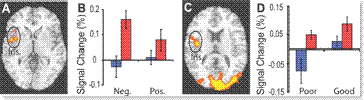
journal.pone.0001897.g002 Figure 2. Meditation modulates right insula response to emotional sounds: Average response in (Insula) for experts (red) and novices (blue)

The scans revealed significant activity in the insula - a region near the frontal portion of the brain that plays a key role in bodily representations of emotion - when the long-term meditators were generating compassion and were exposed to emotional vocalizations. The strength of insula activation was also associated with the intensity of the meditation as assessed by the participants.
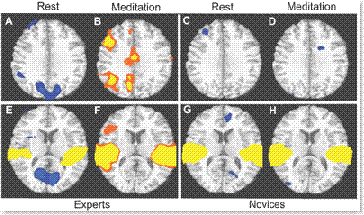
journal.pone.0001897.g004 Areas showing a negative (dark blue, blue) or positive (orange, yellow) impulse response on average across 10 seconds in responses to all emotional sounds for the 15 novices and 15 experts at z=31 compared to baseline (figs. A–D) and z = 13 (figs. E–H)

"The insula is extremely important in detecting emotions in general and specifically in mapping bodily responses to emotion - such as heart rate and blood pressure - and making that information available to other parts of the brain," says Davidson, also co-director of the HealthEmotions Research Institute.

Activity also increased in the temporal parietal juncture, particularly the right hemisphere. Studies have implicated this area as important in processing empathy, especially in perceiving the mental and emotional state of others.

"Both of these areas have been linked to emotion sharing and empathy," Davidson says. "The combination of these two effects, which was much more noticeable in the expert meditators as opposed to the novices, was very powerful."

The findings support Davidson and Lutz's working assumption that through training, people can develop skills that promote happiness and compassion.

"People are not just stuck at their respective set points," he says. "We can take advantage of our brain's plasticity and train it to enhance these qualities."

Meditation instruction given to participants
As described in Dr. Matthieu Ricard's instructions for novices: “During the training session, the subject will think about someone he cares about, such as his parents, sibling or beloved, and will let his mind be invaded by a feeling of altruistic love (wishing well-being) or of compassion (wishing freedom from suffering) toward these persons. After some training the subject will generate such feeling toward all beings and without thinking specifically about someone. While in the scanner, the subject will try to generate this state of loving kindness and compassion.”

Tuesday, November 21, 2006

Imagining Happiness

From Happiness: A Guide to Developing Life's Most Important Skill
by Matthieu Ricard

To imagine happiness as the achievement of all our wishes and passions is to confuse the legitimate aspiration to inner fulfillment with a utopia that inevitably leads to frustration.

In affirming that "happiness is the satisfaction of all our desires" in all their "multiplicity," "degree," and "duration," Kant dismisses it from the outset to the realm of the unachievable. When he insists that happiness is the condition of one for whom "everything goes according to his wish and will" we have to wonder about the mystery whereby anything might go according to our wishes and will.

Even if, ideally, the satisfaction of all our desires were achievable, it would lead not to happiness but in the creation of new desires or, just as likely, to indifference, disgust, or even depression. Why depression? If we were to convince ourselves that satisfying all our whims would make us happy, the collapse of that delusion would make us doubt the very existence of happiness.

If I have more than I could possibly need and I am still not happy, happiness must be impossible. That's a good example of how far we can go in fooling ourselves about the causes of happiness. The fact is that without inner peace and wisdom, we have nothing we need to be happy.