



Showing posts with label medicine. Show all posts
Showing posts with label medicine. Show all posts
Tuesday, March 08, 2011

Saturday, February 19, 2011
Saturday, January 22, 2011
Loosening the Grip of Emotions
From “Anxiety? Banish the Thought,” The Week Magazine: Health & Science, Jan. 20, 2011:
So many Americans suffer from anxiety and depression that antidepressants like Prozac and Zoloft have become household terms. But new research suggests that mindfulness therapy—a 
“I was skeptical at first,” Stefan Hofmann, a psychology professor at Boston University, tells the Los Angeles Times. “I wondered, ‘Why on earth should this work?’”
Yet after reviewing 39 studies on the practice involving 1,140 patients, Hofmann’s team concluded that mindfulness therapy 
It doesn’t work for everyone, but experts have found that training patients to observe their own immediate thoughts can often loosen the grip emotions have on their minds—MRI scans of patients’ brains display shifts in mental activity.
Jordan Elliott, a 26-year-old marketer, began mindfulness therapy for debilitating anxiety four years ago; he now meditates for 10 minutes each morning and has stopped taking Prozac. “When a negative thought pops off in my head,” he says, “I say to myself, ‘There’s a thought. And feelings aren’t facts.’”
* * * * *
See also:
- “Depression and Anxiety are visitors. They are not your true nature.” ~ Amita Schmidt, from Mindfulness for Depression
- Full Catastrophe Living: Using the Wisdom of Your Body and Mind to Face Stress, Pain, and Illness by Jon Kabat-Zinn, Ph.D.
- The Mindfulness & Acceptance Workbook for Anxiety: A Guide to Breaking Free from Anxiety, Phobias & Worry Using Acceptance & Commitment Therapy by John Forsyth and George Eifert
- A Mindfulness-Based Stress Reduction Workbook by Bob Stahl, Ph.D. and Elisha Goldstein, Ph.D.
- The Mindful Path through Worry and Rumination: Letting Go of Anxious and Depressive Thoughts by Sameet Kumar, Ph.D.
- The Mindful Way through Depression: Freeing Your Mind from Chronic Unhappiness by Mark Williams, Ph.D. et al.
Friday, December 24, 2010
Capturing the Patient’s Attention
Dr. Richard Fratianne, from “Art and Medicine,” produced by Kerrie Hillman, Studio 360, December 10, 2010:
The problem is music therapy is not compensated by either governmental programs or private insurance policies, because there just isn't very much science in music therapy — yet. And so, I thought that it might be interesting to see if we could prove the value of music therapy in the burn center where pain and anxiety are really very, very high.

Obviously, we can give pain medication, we can give sedatives and tranquilizers, but if it's a really painful dressing change there's no way you can relieve all of the pain except under anesthesia and you can't anesthetize a patient two or three times a day. The body won't tolerate it.
Music requires and integration of many parts of the brain. There's the motor part that's the physical response to playing or tapping to the rhythm of music. Then there's the limbic system, the emotional response to hearing music that brings forth feelings and thoughts and ideas. But also there's rhythm, there's tempo, there's melody — all of these things have to be integrated at the same time to appreciate music. It's amazing how the brain can do this.
The reason we need a professional music therapist to intervene in these painful procedures is that by their training they're able to capture the patient's attention. We call that entrainment. It is actively involving the patient in the musical experience. Because when their mind is diverted to participating in the therapy, they cannot think about the pain.
The earlier research just asked the patient before and after a musical experience, “Do you feel better yet?” That doesn’t really prove anything. It’s only when you’re dealing with patients like we’re dealing with in the burn unit that you can clearly identify changes in their response with music therapy. And we have done that.
One of our latest studies is utilizing the measurements of a stress hormone which is one of the products of the adrenal gland in response to stress. We know when patients are highly stressed these levels go up. And we’re measuring to see whether music therapy can actually depress those levels of the hormone. And our initial studies have shown that.
What we’re doing is new. We know that. And that’s why it’s exciting, because it is new. But the music can have a calming effect on people. How it works is still being discovered.
Thursday, October 07, 2010
Repairing Smiles, Changing Lives
Smile Pinki
Directed by Megan Mylan
In Hindi and Bhojpuri with English subtitles
39 minutes
© 2008 Principe Productions
“Pinki is a five-year old girl in rural India born desperately poor and with a cleft lip. The simple surgery that can cure her is a distant dream until she meets Pankaj, a social worker traveling village to village gathering patients for a hospital that provides free surgery to thousands each year. Told in a vibrant vérité style, this real-world fairy tale follows its wide-eyed protagonist on a journey from isolation to embrace.”
Smile Pinki from Andrew Girgis on Vimeo.
Learn more about Smile Train.
[Thanks, Alex!]
Thursday, December 10, 2009
Nothing Stays the Same
Excerpts from "The Medicalization Of Mundane Experience: The 'Syndrome' Syndrome," by Ellen Langer, The Huffington Post, December 8, 2009:
There are actually 97 named syndromes. As a culture, I think we have the syndrome syndrome—the naming of sensations. This kind of naming has a hidden downside in that it may actually cause ill health.
There are syndromes that have been categorized and those that haven't, [but] what all of [them]... have in common is that people who are given these diagnoses probably feel some relief in knowing that their discomfort is "real." (Of course, it's real. Why should we think psychological discomfort is any less real than physical discomfort?) The problem is that once symptoms are given a name they run the risk of becoming more permanent than they might otherwise have to be.
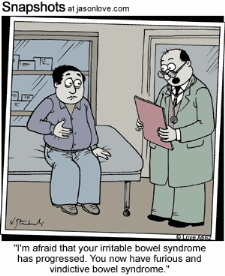
These syndromes are evidence of the medicalization of mundane experience. Sensations fluctuate. Sometimes they are there and sometimes not; sometimes their felt effects are great and sometimes not. By naming them we tend to hold them still and overlook all of this variability. If we mindfully attended to the changes we would at least stand a chance of healing them ourselves...
Nothing stays the same so no matter what the syndrome or disease, we can gain control in this way by mindfully attending to the variability and then questioning why the change occurred. If everything becomes a syndrome, we give up this control over our health. The cure, then, for the Syndrome Syndrome is to become mindful.
[Thanks Kit!]
Monday, November 02, 2009
Endogenous Repair
From "Stem Cells: Untold Stories,” a conversation between Doris Taylor and Krista Tippett, Speaking of Faith, October 29, 2009:
Building Hearts + Lengthening Telomeres from Speaking of Faith on Vimeo.
"What we think impacts who we are. We know that. We know that, whether it's what we think makes us grumpy or what we think makes us happy. And we're learning that those have an impact on our physical body. Stress ages your stem cells. There's science out there from some of the best laboratories in the world showing that the way a cell knows how old it is, is it has a little piece of DNA, chromosome, right? On the end of that chromosome is a little piece of DNA called a telomere. And every time your cell divides, that gets shorter. And when it reaches a certain point, it says, "Oops. I'm old. Time to die." Well, stress makes that piece of DNA get shorter. So stress literally ages your stem cells. If you believe that's true, and it is, it also ought to be possible to reverse stress and make your cells younger...
[Matthieu Ricard] is doing some studies with some people at the University of Wisconsin where he and a number of his colleagues meditate, and as they meditate they measure differences in their brainwaves. And I basically said I would predict that those very same things that when you meditate and you have positive brainwave changes would also have an effect on your stem cells. He very graciously -- and this is an N of one -- let us measure cells in his blood before and after meditation. And what we found was a huge increase in the number of positive stem cells in blood. Largest increase I've ever seen, after fifteen minutes of meditation...
It's all about endogenous repair...
We have inflammation going on inside our blood vessels, inside our organs, inside our tissues. And I think those are nature's cues to say, "Send me cells." Well, I would also say that meditation is essentially doing that without the inflammation. It's nature's way of sending those cells to the sites where you need them in a way to turn down the negative aspects of stress. So stress in my mind is another word for inflammation. I would say inflammation is the physiologic consequence of stress."
Thursday, October 15, 2009
Persistent Improvements
From “How Mindfulness Can Make for Better Doctors,” by Pauline W. Chen, M.D., New York Times (October 15, 20090:
Last month, The Journal of the American Medical Association published the results of a study examining the effects of a year-long course for primary care physicians on mindfulness, that ability to be in the zone and present in the moment purposefully and without judgment. Seventy physicians enrolled and participated in the four components of the course — mindfulness meditation; writing sessions; discussions; and lectures on topics like managing conflict, setting boundaries and self-care.
The effects of the sessions were dramatic. The participating doctors became more mindful, less burned out and less emotionally exhausted. But two additional findings surprised the investigators. Several of the improvements persisted even after the yearlong course ended. And, those changes correlated with a significant increase in attributes that contribute to patient-centered care, such as empathy and valuing the psychosocial factors that might affect a patient’s illness experience.
[Thanks Kit!]
Monday, September 28, 2009
Mindfulness Training Improves Attitudes about Patients and Their Care
Excerpt from “Mindful Meditation, Shared Dialogues Reduce Physician Burnout,” News Room - University of Rochester Medical Center (September 22, 2009):
Training in mindfulness meditation and communication can alleviate the psychological distress and burnout experienced by many physicians and can improve their well-being, University of Rochester Medical Center researchers report in this week’s issue of the Journal of the American Medical Association (JAMA).

The training also can expand a physician’s capacity to relate to patients and enhance patient-centered care, according to the researchers, who were led by Michael S. Krasner, M.D., associate professor of Clinical Medicine.
“From the patient’s perspective, we hear all too often of dissatisfaction in the quality of presence from their physician. From the practitioner’s perspective, the opportunity for deeper connection is all too often missed in the stressful, complex, and chaotic reality of medical practice,” Krasner said. “Enhancing the already inherent capacity of the physician to experience fully the clinical encounter—not only its pleasant but also its most unpleasant aspects—without judgment but with a sense of curiosity and adventure seems to have had a profound effect on the experience of stress and burnout. It also seems to enhance the physician’s ability to connect with the patient as a unique human being and to center care around that uniqueness.
“Cultivating these qualities of mindful communication with colleagues, anectodotally, had an unexpected benefit of combating the practitioners’ sense of isolation and brought forth the very experiences that are such a rich source of meaning in the life of the clinician,” he said.
Subscribe to:
Posts (Atom)




