Showing posts with label science. Show all posts

Sunday, May 15, 2011

Reasoning Is Suffused With Emotion

Excerpt from “The Science of Why We Don’t Believe Science,” by Chris Mooney, Mother Jones, April 18, 2011:

The theory of motivated reasoning builds on a key insight of modern neuroscience. Reasoning is actually suffused with emotion (or what researchers often call "affect"). Not only are the two inseparable, but our positive or negative feelings about people, things, and ideas arise much more rapidly than our conscious thoughts, in a matter of milliseconds—fast enough to detect with an EEG device, but long before we're aware of it. That shouldn't be surprising: Evolution required us to react very quickly to stimuli in our environment. It's a "basic human survival skill," explains political scientist Arthur Lupia of the University of Michigan. We push threatening information away; we pull friendly information close. We apply fight-or-flight reflexes not only to predators, but to data itself.

Illustration by Jonathon Rosen

We're not driven only by emotions, of course—we also reason, deliberate. But reasoning comes later, works slower—and even then, it doesn't take place in an emotional vacuum. Rather, our quick-fire emotions can set us on a course of thinking that's highly biased, especially on topics we care a great deal about.

Consider a person who has heard about a scientific discovery that deeply challenges her belief in divine creation—a new hominid, say, that confirms our evolutionary origins. What happens next, explains political scientist Charles Taber of Stony Brook University, is a subconscious negative response to the new information—and that response, in turn, guides the type of memories and associations formed in the conscious mind. "They retrieve thoughts that are consistent with their previous beliefs," says Taber, "and that will lead them to build an argument and challenge what they're hearing."

In other words, when we think we're reasoning, we may instead be rationalizing. Or to use an analogy offered by University of Virginia psychologist Jonathan Haidt: We may think we're being scientists, but we're actually being lawyers. Our "reasoning" is a means to a predetermined end—winning our "case"—and is shot through with biases. They include "confirmation bias," in which we give greater heed to evidence and arguments that bolster our beliefs, and "disconfirmation bias," in which we expend disproportionate energy trying to debunk or refute views and arguments that we find uncongenial.

That's a lot of jargon, but we all understand these mechanisms when it comes to interpersonal relationships. If I don't want to believe that my spouse is being unfaithful, or that my child is a bully, I can go to great lengths to explain away behavior that seems obvious to everybody else—everybody who isn't too emotionally invested to accept it, anyway. That's not to suggest that we aren't also motivated to perceive the world accurately—we are. Or that we never change our minds—we do. It's just that we have other important goals besides accuracy—including identity affirmation and protecting one's sense of self—and often those make us highly resistant to changing our beliefs when the facts say we should.


Read entire article here…

Thursday, May 05, 2011

Noise-Canceling Life's Din With Meditation

Noise Canceling, Without Headphones
by Roni Caryn Rabin
The New York Times
May 2, 2011

Stephanie Nash's Posture-Pedia

Studies have found that meditation helps prevent the recurrence of depression, perhaps by producing changes in parts of the brain associated with learning and anxiety. A new study suggests that meditation may modulate brain waves called alpha rhythms, which help regulate the transmission of sensory input from the surrounding environment.

Harvard researchers randomly assigned 12 healthy adults to an eight-week course of training in meditation-based stress reduction or to a control group whose participants did not meditate.

At regular intervals, researchers used an imaging technique called magnetoencephalography to measure electrical currents in an area of the brain that processes signals from the left hand. During the tests, each participant was asked to direct his attention to his or her left hand or left foot.

After eight weeks, the brain scans showed that alpha rhythms changed more quickly and in a more pronounced way in participants who had been meditating.

“If you’re reading something in a noisy environment and you want to be in a bubble, you might use your alpha rhythms like a volume knob, to turn down the volume on neurons that represent sound from the outside world,” said Catherine E. Kerr, a neuroscientist at Harvard Medical School and a co-author of the report, published April 21 in the journal Brain Research Bulletin. “We all do this to some extent, but it turns out that meditators become much more skilled at it.”

See also: Hear Out Daily Workout

Monday, May 02, 2011

Benefits Beyond Relaxation

Excerpts from “How Meditation Might Ward Off the Effects of Ageing,” by Jo Marchant, The Guardian,  April 24, 2011:

The assumption that meditation simply induces a state of relaxation is "dead wrong", says Charles Raison. Brain-imaging studies suggest that it triggers active processes within the brain, and can cause physical changes to the structure of regions involved in learning, memory, emotion regulation and cognitive processing.

The question of how the immaterial mind affects the material body remains a thorny philosophical problem, but on a practical level, "our understanding of the brain-body dialogue has made jaw-dropping advances in the last decade or two," says Raison. One of the most dramatic links between the mind and health is the physiological pathways that have evolved to respond to stress, and these can explain much about how meditation works.

When the brain detects a threat in our environment, it sends signals to spur the body into action. One example is the "fight or flight" response of the nervous system. When you sense danger, your heart beats faster, you breathe more rapidly, and your pupils dilate. Digestion slows, and fat and glucose are released into the bloodstream to fuel your next move. Another stress response pathway triggers a branch of the immune system known as the inflammatory response.

These responses might help us to run from a mammoth or fight off infection, but they also damage body tissues. In the past, the trade-off for short bursts of stress would have been worthwhile. But in the modern world, these ancient pathways are continually triggered by long-term threats for which they aren't any use, such as debt, work pressures or low social status. "Psychological stress activates these pathways in exactly the same way that infection does," says Raison…

Meditation seems to be effective in changing the way that we respond to external events. After short courses of mindfulness meditation, people produce less of the stress hormone cortisol, and mount a smaller inflammatory response to stress. One study linked meditators' lower stress to changes in the amygdala —a  brain area involved in fear and the response to threat.

Read the entire article here…

See also: Shamatha Project

Sunday, April 24, 2011

Searching for Heaven

"Heaven and earth don’t exist anymore. The earth is round. The cosmos has no up and down. It is moving constantly. We can no longer fix the stars to create an ideal place. This is our dilemma.

It is natural to search for our beginnings, but not to assume it has one direction. We live in a scientific future that early philosophers and alchemists could not foresee, but they understood very fundamental relationships between heaven and earth, that we have forgotten…North, south, east, and west, up and down are not issues. For me, this also relates to time. Past, present, and future are essentially the same direction. It is about finding symbols that move in all directions.

My spirituality is not New Age. It has been with me since I was a child. I know that in the last few decades religion has been made shiny and new. It’s like a business creating a new product. They are selling salvation. I’m not interested in being saved. I’m interested in reconstructing symbols. It’s about connecting with an older knowledge and trying to discover continuities in why we search for heaven."

~ Anselm Kiefer, from “History of Our World

The Mountain from Terje Sorgjerd on Vimeo.

Three Lilies
by Brooks Haxton, from Uproar: Antiphonies to Psalms

Weeping may endure for a night, but joy cometh in
            the morning. Psalm 30

Before dawn, under a thin moon disappearing
east, the planet Mercury, the messenger
and healer, came up vanishingly
into the blue beyond the garden where
three lilies at the bottom of the yard
arrayed white trumpets on iron stalks
under a slow, slow lightning from the sun.
I stood on a rotten step myself,
and smelled them from a hundred feet away.

Saturday, February 19, 2011

Our Minds Create the Medicine

Professor Funk’s YouTube Channel

Spectacularly Complex

Whole ColumnComputer model of a single neocortical column from a rat's brain (Photo: IBM)

Excerpt from Portraits of the Mind: Visualizing the Brain from Antiquity to the 21st Century by Carl Schoonover:

This image shows the three-dimensional configuration of ten thousand simulated neurons that constitute a single neocortical column—an anatomical unit barely wider than the head of a pin. The neocortical column, believed to be a building block of the cerebral cortex, is a mere millimeter cubed, and is repeated countless times across the expanse of the human neocortex.

Since there is simply no way to gain full experimental insight into a process at this large a scale, the Blue Brain Project was launched in 2005 in collaboration with IBM to produce a computer simulation of it. It is so spectacularly complex that a dedicated state-of-the-art supercomputer is required to keep track of all the phenomena as they recurrently influence one another; even with this computational firepower, it still takes about one hundred seconds to simulate a single second of activity.

In order to make it as realistic as possible, a wide variety of factors in included in the simulation: genetics, the shape of the dendrites, and the neurophysiological characteristics imparted by their ion channel composition. Here we see the Blue Brain’s cortical column in action: Each dendrite is simulated individually and rendered so that its color (ranging from blue to red) represents its voltage at one moment in time.

The long-term goal of the project is to uncover the broad principles of the brain function and dysfunction by simulating the entire brain of mammals, including that of humans.

<a href="http://www.macromedia.com/go/getflashplayer">Click to install the plugin</a>

Zooming Out, Highlighting a Single Neuron
Blue Brain Project video

Thursday, February 17, 2011

Rising to the Virtue of Compassion

“Our culture is obsessed with perfection and with hiding problems. But what a liberating thing to realize that our problems, in fact, are probably our richest sources for rising to this ultimate virtue of compassion. Towards bringing compassion towards the joys and sufferings of others…Compassion can’t be reduced to sainthood any more than it can be reduced to pity…Compassion is equally at home in the secular as well as in the religious. So I will paraphrase Einstein and say that the future of humanity needs [the technology of compassion] as much as it needs all the others that have now connected us and set before us the terrifying and wondrous possibility of actually becoming one human race.”

~ Krista Tippett, from “Reconnecting with Compassion,” TED, Nov. 2010 

Friday, February 11, 2011

You are Not the Stuff of Which You are Made

From “Richard Dawkins on Our ‘Queer’ Universe,” TED Talks, Sep. 2006:

"Steve Grand, in his book, Creation: Life and How to Make It, is positively scathing about our preoccupation with matter itself. We have this tendency to think that only solid, material things are really things at all. Waves of electromagnetic fluctuation in a vacuum seem unreal. Victorians thought the waves had to be waves in some material medium -- the ether. But we find real matter comforting only because we've evolved to survive in Middle World, where matter is a useful fiction. A whirlpool, for Steve Grand, is a thing with just as much reality as a rock.

In a desert plain in Tanzania, in the shadow of the volcano Ol Donyo Lengai, there's a dune made of volcanic ash. The  beautiful thing is that it Mesquite Sand Dunes, Death Valleymoves bodily. It's what's technically known as a barchan, and the entire dune walks across the desert in a westerly direction at a speed of about 17 meters per year. It retains its crescent shape and moves in the direction of the horns. What happens is that the wind blows the sand up the shallow slope on the other side, and then, as each sand grain hits the top of the ridge, it cascades down on the inside of the crescent, and so the whole horn-shaped dune moves.

Steve Grand points out that you and I are, ourselves, more like a wave than a permanent thing. He invites us, the reader, to "think of an experience from your childhood -- something you remember clearly, something you can see, feel, maybe even smell, as if you were really there. After all, you really were there at the time, weren't you? How else would you remember it? But here is the bombshell: You weren't there. Not a single atom that is in your body today was there when that event took place. Matter flows from place to place and momentarily comes together to be you. Whatever you are, therefore, you are not the stuff of which you are made. If that doesn't make the hair stand up on the back of your neck, read it again until it does, because it is important."

[Thanks, Pete!]

Sunday, January 23, 2011

It’s All About the Coyote

Part of a discussion between Michael Barrier, author of Hollywood Cartoons: American Animation in Its Golden Age, and Radiolab producer Pat Walters from “The Universe Knows My Name,” from Radiolab, Jan. 11, 2011:

Michael Barrier: [Wile E. Coyote] is an extraordinarily human animal.

Pat Walters: And not just like in the facial expressions that he made and ways that he’d look at the camera a lot, but actually, it kind of was about the predicaments he found himself in. Take for example this one really famous cartoon (at 4:20 in the clip below). Like always, Coyote has got a plan. He has made a painting of the road. He’s put this painting right at the edge of the cliff.

MB: The idea being that the Road Runner would run through the painting, gravity would take hold of him, and he would plunge into the chasm…Instead, the Road Runner runs into the painting as if the road were actually continuing. But when the coyote tries to follow the Road Runner into the painting, he runs through the painting and falls…Gravity isn’t this uniformly indifferent force. It’s a malignant force that comes in and out of play according to how inconvenient it can be for the coyote…He’s chasing the Road Runner, but the universe is his opponent.

PW: And that’s kind of what makes the coyote seems so human. He’s in that situation that all of us feel like we’re in sometimes. Like the very laws of physics are against us.

MB: It’s almost a primitive way of thinking, but I think all of us lapse into this, you know, How can this happen? You can’t be human and not feel that way.

*     *     *     *     *

Cartoon Physics, part 1
by Nick Flynn, from Some Ether

Children under, say, ten, shouldn't know
that the universe is ever-expanding,
inexorably pushing into the vacuum, galaxies

swallowed by galaxies, whole

solar systems collapsing, all of it
acted out in silence. At ten we are still learning

the rules of cartoon animation,

that if a man draws a door on a rock
only he can pass through it.
Anyone else who tries

will crash into the rock. Ten-year-olds
should stick with burning houses, car wrecks,
ships going down -- earthbound, tangible

disasters, arenas

where they can be heroes. You can run
back into a burning house, sinking ships

have lifeboats, the trucks will come
with their ladders, if you jump

you will be saved. A child

places her hand on the roof of a schoolbus,
& drives across a city of sand. She knows

the exact spot it will skid, at which point
the bridge will give, who will swim to safety
& who will be pulled under by sharks. She will learn

that if a man runs off the edge of a cliff
he will not fall

until he notices his mistake.

Sunday, December 12, 2010

The Questions are Deeper

Neo stopping bullets “Hackerdom rewards spontaneity, curiosity and ingenuity. Science rewards rigor and forging solid bedrock to stand on — which means a lot of carefully dotting i’s and crossing t’s. Although scientific questions are harder, more abstract and tend to have less immediate influence in the world, the questions are deeper and the answers so uplifting and transcendently beautiful that contact with them is a genuine spiritual experience.”

~ Virgil Griffith, from “Looking for the Real Mark Zuckerberg,” by Virginia Heffernan, New York Times Sunday Magazine, December 12, 2010

Friday, October 29, 2010

The Best Our Species Can Do

lambda=hmv

Duality
by Georges Whitesides, from No Small Matter: Science on the Nanoscale

We’re burdened by a curious conditioning that blinds us to one of the greatest — perhaps the greatest — of  art forms. We live for poetry; we live in terror of equations.

We see a poem, and we try it on for size: we read a line or two; we roll it around in our mind; we see how it fits and tastes and sounds. We may not like it, and let it drop, but we enjoy the encounter and look forward to the next. We see an equation, and it is as if we’d glimpsed a tarantula in the baby’s crib. We panic.

An equation can be a thing of such beauty and subtlety that only a poem can equal it. As an evocation of reality — as the shortest of descriptions, but describing worlds — it is hard to beat the most artful of poems and, equally, of equations. They are the best our species can do.

Equations are the poetry that we use to describe the behavior of electrons and atoms, just as we use poems to describe ourselves. Equations may be all we have: sometimes word fail, since words best describe what we have experienced, and behaviors at the smallest scale are forever beyond our direct experience.

Consider Margaret Atwood:

You fit into me
Like a hook in an eye

A fish hook
An open eye

Consider Louis de Broglie (a twentieth-century physicist, and an architect of quantum mechanics):

λ = h/mv

Read the equation as if it were poetry — a condensed description of a reality we can only see from the corner of our eye. The “equals” sign is the equivalent of “is,” and makes the equation a sentence: “A moving object is a wave.” Huh? What did you just say? How can that be?

It’s an idea worth trying on for size. Poetry describes humanity with a human voice; equations describe a reality beyond the reach of words. Playing a fugue, and tasting fresh summer tomatoes, and writing poetry, and falling in love all ultimately devolve into molecules and electrons, but we cannot yet (and perhaps, ever) trace that path from one end (from molecules) to other (us). Not with poetry, nor with equations. But each guides us part way.

Of course, not all equations are things of beauty: some are porcupines, some are plumber’s helpers, and some are tarantulas.

*     *     *     *

I’m a chemist. My universe is nuclei and electrons, and the almost endless ways they can assemble. Atoms are just at the border between ordinary, macroscopic matter and matter dominated by the Alice-in-Wonderland rules of quantum mechanics. Electrons, in particular, have the unnerving property of having mass and charge but no extent — no size. There’s no tiny BB down in their core, as there is a nucleus sitting at the center of an atom. “Ah,” you say, “that’s strange. If there’s nothing there, what is it that has a mass? And what’s charged?” Good question…

…As a chemist, I’ve come to uneasy terms with the weirdness of electrons and photons, and with their ability to meld into the ordinariness of macroscopic things. But sometimes, lying awake in a strange hotel room at 4 a.m., considering what I might say that I really understand about anything, I fret that the answer is: almost nothing.

Wednesday, October 20, 2010

At the Core

Sam Harris (Photo by Jonathan Alcorn / Zuma) “I see nothing irrational about seeking the states of mind that lie at the core of many religions. Compassion, awe, devotion and feelings of oneness are surely among the most valuable experiences a person can have…Ecstasy, rapture, bliss, concentration, a sense of the sacred—I’m comfortable with all of that…I think all of that is indispensable and I think it’s frankly lost on much of the atheist community.”

~ Sam Harris, from “Sam Harris Believes in God,” Newsweek, October 18, 2010

Thursday, October 07, 2010

Repairing Smiles, Changing Lives

Smile Pinki
Directed by Megan Mylan
In Hindi and Bhojpuri with English subtitles
39 minutes
© 2008 Principe Productions

“Pinki is a five-year old girl in rural India born desperately poor and with a cleft lip. The simple surgery that can cure her is a distant dream until she meets Pankaj, a social worker traveling village to village gathering patients for a hospital that provides free surgery to thousands each year. Told in a vibrant vérité style, this real-world fairy tale follows its wide-eyed protagonist on a journey from isolation to embrace.”

Smile Pinki from Andrew Girgis on Vimeo.

Learn more about Smile Train.

[Thanks, Alex!]

Friday, September 10, 2010

Look More Closely

Water drop, Felice Frankel

“We glance, and turn away without noticing. We don’t ever really see, and then we forget what we have seen. Water drips from faucets; candles burn; yeast makes bread rise; a tiny, living mouse — pursuing its tiny murine intentions — runs across a floor that was once a living tree; the sun consumes itself.

We don’t notice.

Look more closely, and everyday events bloom into a reality so transfixingly marvelous that you can’t look away. Life becomes something we don’t understand that happens in ordinary matter. Ordinary matter happens somehow when atoms get together. Atoms build themselves from electrons and nuclei, following rules that flummox intuition. Electrons and nuclei are strange avatars of yet stranger fish swimming in a darker sea.
But whatever it all is — this amazing assembly we so flippantly nickname ‘reality’ — is all there is, and all we are.”

~ Georges Whitesides, from No Small Matter: Science on the Nanoscale 


"I'm sort of a visual ambassador in the sense that I'm using a language, that is the pictorial language, to get people to be less intimidated about what is going on in the laboratories. Photographing science is definitely about showing evidence, but the photography itself, the process is sort of a metaphor for the discovery in science. Most of this stuff, you come to the assignment and you think you have a way you're going to do it, and then you don't do it that way. You discover another way to do it. And in the process you see things. Isn't that fun?"

~ Felice Frankel, on her method for capturing the images that appear in the book, No Small Matter: Science on the Nanoscale, which she co-wrote with Harvard chemist George Whitesides. (Studio 360, 09/10/2010).

See also: Slideshows from 2020 Science and Science Friday

Monday, August 09, 2010

Satisfied with the Mystery

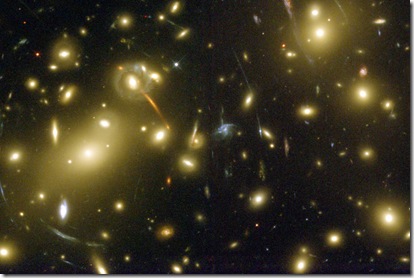
Abell 2218: A Galaxy Cluster Lens

"The most beautiful experience we can have is the mysterious. It is the fundamental emotion that stands at the cradle of true art and true science. Whoever does not know it and can no longer wonder, no longer marvel, is as good as dead, and his eyes are dimmed. It was the experience of mystery—even if mixed with fear—that engendered religion. A knowledge of the existence of something we cannot penetrate, our perceptions of the profoundest reason and the most radiant beauty, which only in their most primitive forms are accessible to our minds: it is this knowledge and this emotion that constitute true religiosity. In this sense, and only this sense, I am a deeply religious man...I am satisfied with the mystery of life's eternity and with a knowledge, a sense, of the marvelous structure of existence—as well as the humble attempt to understand even a tiny portion of the Reason that manifests itself in nature."

~ Albert Einstein, from The World as I See It


[Thanks for the Einstein quote, Liv!]

Friday, August 06, 2010

The Stage is too Big

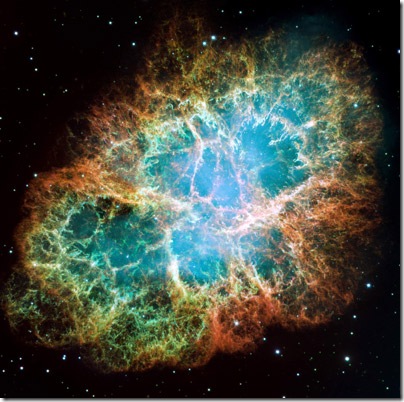
This mosaic image of the Crab Nebula was taken by the Hubble Space Telescope.

“It doesn’t seem to me that this fantastically marvelous universe, this tremendous range of time and space, and different kinds of animals, and all the different planets, and all these atoms with all their motions, and so on, all this complicated thing can merely be a stage so that God can watch human beings struggle for good and evil—which is the view that religion has. The stage is too big for the drama.”

~ Richard Feynman, speaking in 1959, quoted by James Gleick in Genius: The Life and Science of Richard Feynman (1992)

Monday, May 24, 2010

A Strange and Hidden Relationship


“In mathematics, the parabola is a conic section, the intersection of a right circular conical surface and a plane to a generating straight line of that surface. Given a point (the focus) and a corresponding line (the directrix) on the plane, the locus of points in that plane that are equidistant from them is a parabola. The parabola has many important applications, from automobile headlight reflectors to the design of ballistic missiles.”

Sunday, April 18, 2010

A Period of Stagnation

Excerpts from “The Boring Age,” by Michael Lind, Time, March 11, 2010:

Illustration by Kelly Blair for TIME We like to believe we live in an era of unprecedented change: technological innovation is proceeding at a rate with no parallel in all of human history. The information revolution and globalization are radically disruptive. Just as Barack Obama would like to be a transformational President, so the rest of us like the idea that we live in a thrilling epoch of transformation. But the truth is that we are living in a period of stagnation.

Surprisingly, this stasis is most evident in an area where we assume we are way ahead of our predecessors: technology. In fact, the gadgets of the information age have had nothing like the transformative effects on life and industry that indoor electric lighting, refrigerators, electric and natural gas ovens and indoor plumbing produced in the early to mid-20th century. Is the combination of a phone, video screen and keyboard really as revolutionary as the original telephone, the original television set or the original typewriter was?

…I predict that in the year 2050, the nation-state will still be the dominant form of political organization, with a few new nation-states added to the U.N. The U.S. will still be the dominant global economic and military power, even if China has a somewhat larger GDP because of its larger population. Most energy will still be derived from fossil fuels, and nuclear power will account for an increasing share of global electricity production, while wind and solar power will still be negligible. Most people will get from place to place by means of cars, buses, taxis and planes, not fixed rail. Thanks to biotech advances, people will live longer and healthier lives, and consequently the largest single occupation in 2050 will be — drumroll, please — nursing!

I know, that's a boring vision of the future compared with a Chinese century in which everybody is a genetically modified immortal who rides monorails and eats algae grown in skyscrapers. But hey, in the future, phones will be really cool.

More…

Wednesday, February 24, 2010

How Things Are and Which Things Matter

Excerpt from Everybody’s Story: Wising Up to the Epic of Evolution by Loyal Rue:

The most fundamental sources of self-understanding are found at the level of story. To put the thesis even more directly: if we are to respond effectively to the global problematique then we must attend to our stories, for in the story of a culture we find its most profound expression of wisdom.


Perhaps this thesis exaggerates the case. Is it possible that stories can make a decisive difference in the viability of our species? Is story that fundamental to human existence? It is difficult to believe otherwise once we stop to consider the many ways in which our lives are shaped by stories.

We legitimate institutions and values in their name, we wage wars in their defense, we judge ourselves and others by their standards, we take pains that our children will learn them well, we draw inspiration from their examples, we construct our hopes and fears under their influence, and so on. It would not be extreme to say that we negotiate our way through life by the guidance of our stories.

We humans are the only species to tell stories, and so far as anyone knows every recognizable human community has fostered storytelling traditions. Thus we appear to be in the presence of a trait that is both universally and exclusively human, suggesting that what humans are has something to do with their stories.

If these ideas hold up – that is, if storytelling is an essential human activity bestowing substance and form on the lives we have – then it follow that changes at this level of human thought will be among the most profound and far-reaching we can imagine. Thus we have good reason to believe that appropriate changes at the level of story might hold the power of reorientation needed for enhancing human solidarity and cooperation…

…I want to suggest that the profound sense of story bears a deep relation to the basic functions of the central nervous system. I am saying that if we can picture what the brain does for an individual organism then we shall have a way to think about what story does for a cultural tradition.

All brains (human or otherwise) do essentially the same thing, that is, they take some measure of how things are in the external environment and then use this information to devise behaviors that will be more or less conducive to the interests of the organism. Brains that have become specialized for symbolic interaction do not suddenly depart from this basic function, they just continue it in a new domain, the domain of culture.

Indeed, human culture just is the result of assessing and addressing the environment with the aid of symbols. In every particular human culture, therefore, we may expect to find (and do find) two basic types of ideas: ideas about how things are in the world, and ideas about which things matter for human existence.

This principle may be extended by the assertion that a culture exists as a coherent entity to the extent that its members share common ideas about how things are and which things matter. A further implication is that the important difference between cultures may be measured in terms of incompatible ideas about reality and value.

Monday, February 22, 2010

Slow-Motion Coalescence

co·a·lesce
To come together so as to form one whole; unite.

[Latin coalēscere: co-, co- + alēscere, to grow, inchoative of alere, to nourish.]

A water drop filmed in ultra-slow-motion at 2000 frames per second.