Showing posts with label Anselm Kiefer. Show all posts

Sunday, April 24, 2011

Searching for Heaven

"Heaven and earth don’t exist anymore. The earth is round. The cosmos has no up and down. It is moving constantly. We can no longer fix the stars to create an ideal place. This is our dilemma.

It is natural to search for our beginnings, but not to assume it has one direction. We live in a scientific future that early philosophers and alchemists could not foresee, but they understood very fundamental relationships between heaven and earth, that we have forgotten…North, south, east, and west, up and down are not issues. For me, this also relates to time. Past, present, and future are essentially the same direction. It is about finding symbols that move in all directions.

My spirituality is not New Age. It has been with me since I was a child. I know that in the last few decades religion has been made shiny and new. It’s like a business creating a new product. They are selling salvation. I’m not interested in being saved. I’m interested in reconstructing symbols. It’s about connecting with an older knowledge and trying to discover continuities in why we search for heaven."

~ Anselm Kiefer, from “History of Our World

The Mountain from Terje Sorgjerd on Vimeo.

Three Lilies
by Brooks Haxton, from Uproar: Antiphonies to Psalms

Weeping may endure for a night, but joy cometh in
            the morning. Psalm 30

Before dawn, under a thin moon disappearing
east, the planet Mercury, the messenger
and healer, came up vanishingly
into the blue beyond the garden where
three lilies at the bottom of the yard
arrayed white trumpets on iron stalks
under a slow, slow lightning from the sun.
I stood on a rotten step myself,
and smelled them from a hundred feet away.

Wednesday, April 06, 2011

Narratives of Grace

Engels (Anselm Kiefer)

“We normally think of history as one catastrophe after another, war followed by war, outrage by outrage — almost as if history were nothing more than all the narratives of human pain, assembled in sequence. And surely this is, often enough, an adequate description. But history is also the narratives of grace, the recountings of those blessed and inexplicable moments when someone did something for someone else, saved a life, bestowed a gift, gave something beyond what was required by circumstance.”

~ Thomas Cahill

Tuesday, September 14, 2010

Don’t Look to Be Saved

Volkszählung (Census), by Anselm Kiefer, 1991“The books are to remind us what asses and fools we are. They're Caesar's praetorian guard, whispering as the parade roars down the avenue, 'Remember, Caesar, thou art mortal.' Most of us can't rush around, talk to everyone, know all the cities of the world, we haven't time, money or that many friends. The things you're looking for…are in the world, but the only way the average chap will ever see ninety-nine per cent of them is in a book. Don't ask for guarantees. And don't look to be saved in any one thing, person, machine, or library. Do your own bit of saving, and if you drown, at least die knowing you were headed for shore.”

~ From Fahrenheit 451 by Ray Bradbury

Thursday, December 10, 2009

Transformers of the Earth

From Duino Elegies by Rainer Maria Rilke, translated by Stephen Mitchell:

The First Elegy

Who, if I cried out, would hear me among the angels'
hierarchies? and even if one of them pressed me
suddenly against his heart: I would be consumed
in that overwhelming existence. For beauty is nothing
but the beginning of terror, which we are still just able to 
     endure,
and we are so awed because it serenely disdains
to annihilate us. Every angel is terrifying.
     And so I hold myself back and swallow the call-note
of my dark sobbing. Ah, whom can we ever turn to
in our need? Not angels, not humans,
and already the knowing animals are aware
that we are not really at home in
our interpreted world. Perhaps there remains for us
some tree on a hillside, which every day we can take
into our vision; there remains for us yesterday's street
and the loyalty of a habit so much at ease
when it stayed with us that it moved in and never left.
     Oh and night: there is night, when a wind full of infinite  
     space
gnaws at our faces. Whom would it not remain for—that
     longed-after,
mildly disillusioning presence, which the solitary heart
so painfully meets. Is it any less difficult for lovers?
But they keep on using each other to hide their own fate.
     Don't you know yet? Fling the emptiness out of your arms into the spaces we breathe; perhaps the birds
will feel the expanded air with more passionate flying.

*     *     *

Commenting on this passage in a letter written thirteen years later, Rilke describes the angel in greater detail:

Anselm Kiefer, Die Ordnung der Engel/The Hierarchy of Angels, 1985–87. The “angel” of the Elegies has nothing to do with the angel of the Christian heaven (it has more in common with the angel figures of Islam). The angel of the Elegies is that creature in whom the transformation of the visible into the invisible, which we are accomplishing, already appears in its completion. For the angel of the Elegies, all the towers and palaces of the past are existent because they have long been invisible, and the still-standing towers and bridges of our reality are already invisible, although still (for us) physically lasting. The angel of the Elegies is that being who guarantees the recognition in the invisible of a higher order of reality.—Therefore “terrifying” for us, because we, its lovers and transformers, still cling to the visible.—All the worlds in the Duino Elegies & The Sonnets of Orpheus universe are plunging into the invisible as into their next-deeper reality; a few stars intensify immediately and pass away in the infinite consciousness of the angels—, others are entrusted to beings who slowly and laboriously transform them, in whose terrors and delights they attain their next invisible realization. We, let it be emphasized once more, we, in the sense of the Elegies, are these transformers of the earth; our whole existence, the flights and plunges of our love, everything, qualifies us for this task (beside which there is, essentially, no other).

Saturday, April 11, 2009

Whenever Knowledge Becomes Rigid it Stops Living

Anslem Kiefer in conversation with Michael Auping from Anselm Kiefer: Heaven and Earth:

Religion was a part of my childhood and my youth. It was a very important thing. The rituals and rites were important. I can still do them in Latin. Of course, I knew the Latin before I knew what it meant. But I was involved, like many young people of my generation, in learning religion at an early age.

Later, I discovered that Christian mythology was less complex and less sophisticated than Jewish mythology because the Christians limited their story to make it simple so that they could engage more people and defend their ideas. They had to fight with the Jewish traditions, with the Gnostics. It was a war of the use of knowledge. Resurrexit (1973) The wooden, hand-hewn interior, which appears in many of Keifer's works from this period, is drawn from the converted schoolhouse in the Oden Forest that served as his studio at the time. The stairs, in other words, lead to the door of the artist's atelier. By inscribing resurrexit on the stairs to his studio, Kiefer raises the question of the redemptive role of art. ~ From Disfiguring by Mark C. Taylor

However, it wasn’t just a defense against outside ideas. It was aggressive. Like politics, they wanted to win. You know, the first church in Rome was not defensive and not aggressive. It was quiet. It was spiritual in the sense of seeking a true discussion about God. It was exploring a new idea about humanity. But then there was “iglesias triumphant,” the Triumph of the Church. And then the stones were stacked up and the buildings came, and the construction of the Scholastics, Augustine, and so on. They were very successful in limiting the meaning of the mythology. There were discussions about the Trinity and its meaning. Anyone who had ideas that complicated their specific picture was eliminated. This made Christianity very rigid and not very interesting. Whenever knowledge becomes rigid it stops living.

Volkszählung (Census) 1991 Shelves of lead books filled with peas--representing the counting of a population--represents an enormousy heavy (grave) archive or cemetery (grave) of dead data.

…Since childhood, I had studied the Old Testament, and sometime as a young man I began to read of Jewish mysticism. Then in the mid-1980s, I went to Jerusalem and began to read the books of Gershon Scholem. Beside the fact that kabbalistic stories and interpretations are very interesting, I think my attraction has something to do with the way that I work.

People say that I read a lot, but in some ways I don’t. I read enough to capture images. I read until the story becomes an image. Then I stop reading. I can’t recite a passage, but I can recite it as an image. For an artist it is important to have a strong, complex subject. Kabbala means “knowledge that has been received,” a secret knowledge; but I think of it as images that have been received.

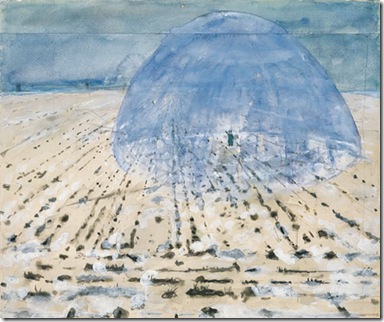
Everyone Stands Under His Own Dome of Heaven -- Both the title of this work and the image of the dome with a lone figure inside refer to Kiefer's view that there is no single system or belief, such as Marxism or Christianity, that is appropriate for all people. "Each man has his own dome, his own perceptions, his own theories," Kiefer has noted.

As I said before, the Christian church hardened in its knowledge and its symbolism at a certain point. The kabbalistic tradition is not one buy many, forming a sophisticated spiritual discipline. It is a paradox of logic and mystical belief. It’s part scholarship, part religion, part magic. For me, it is a spiritual journey anchored by images.

Monday, November 20, 2006

The Bureaucracy of Mass Murder

From Holocaust archive tells many new stories (Arthur Max, Associated Press):

Half a dozen buildings in Bad Arolsen, a German spa town, houses an immense archive of the victims of Nazi persecution. The documents are maintained by the International Tracing Service which is connected to the International Committee of the Red Cross.

The fifty million pages of files include “scraps of paper, transport lists, registration books, labor documents, medical and death registers make reference to 17.5 million individuals caught up in the machinery of persecution, displacement, and death."

To operate history's greatest slaughter, the Nazis created a bureaucracy that meticulously recorded the arrest, movement and death of each victim. What documents survived Nazi attempts to destroy them were collected by the Allies to help people find missing relatives. The first documents were sent in 1946 to Bad Arolsen, and the administration was handed over to the Red Cross in 1955."

Anne Frank is listed among the names of Jews picked up from Amsterdam and transported to concentration camps.

“But most of the lives recorded in Bad Arolsen are known to none but their families. They are people like Cornelis Marinus Brouwenstijn, a Dutchman who vanished into the Nazi gulag at age 22 for illegally possessing a radio. In a plain manila envelope are his photo, a wallet, some snapshots, and a naughty typewritten joke about women in the army.”

"Over the years, the International Tracing Service has answered 11 million requests to locate family members or provide certificates supporting pension claims or reparations. It says it has a 56 percent rate of success in tracing the requested name. But the workload has been overwhelming. Two years ago it had a backlog of nearly half a million unanswered queries. Director Blondel says the number was whittled down to 155,000 this summer and will disappear by the spring of 2008. New queries have slowed to just 700 a month."

“Compounding the delay in releasing the files is the cumbrous makeup of the governing committee. Any decision on their future requires the assent of all 11 member nations — Belgium, Britain, France, Germany, Greece, Israel, Italy, Luxembourg, the Netherlands, Poland and the United States.”

Archivist Sabine Stein: "Former inmates and their families want to see some tangible part of their history; they want to tell their stories. What I find most frustrating is that they have all these documents and they are just sitting on them."

Paul Shapiro, of the
U.S. Holocaust Memorial Museum in Washington:"What victims of these crimes fear the most is that when they disappear — and it's happening very fast now — no one will remember the names of the families they lost.”

PS This post has been conjuring up images of Anselm Kiefer's lead books (Zweistromland, Buch mit Flügeln).