Showing posts with label rebirth. Show all posts

Friday, February 18, 2011

What You Can Plan is Too Small

Brandywine Falls p schmitt 

What to Remember When Waking
by David Whyte, from The House of Belonging

In that first
hardly noticed
moment
in which you wake,
coming back
to this life
from the other
more secret,
moveable
and frighteningly
honest world
there is a small opening
into the new day
which closes
the moment
you begin
your plans.

What you can plan
is too small
for you to live.

What you can live
wholeheartedly
will make plans
enough
for the vitality
hidden in your sleep.

To be human
is to become visible
while carrying
what is hidden
as a gift to others.

To remember
the other world
in this world
is to live in your
true inheritance.

You are not
a troubled guest
on this earth,
you are not
an accident
amidst other accidents
you were invited
from another and greater
night
than the one
from which
you have just emerged.

Now, looking through
the slanting light
of the morning
window toward
the mountain
presence
of everything
that can be,
what urgency
calls you to your
one love? What shape
waits in the seed
of you to grow
and spread
its branches
against a future sky?

Is it waiting
in the fertile sea?
In the trees
beyond the house?
In the life
you can imagine
for yourself?
In the open
and lovely
white page
on the waiting desk?

Tuesday, January 04, 2011

Breaking Apart

Mary & Joseph Retreat Center, Rancho Palos Verdes

One, One, Eleven
by Daron Larson

Midnight is inherently unstable,
so it breaks apart into a new year.
Fireworks explode and set the trees ablaze
with the echoing choir of peafowl wails.
The lights of the grid pulse
like ancient campfire embers in the breeze.

On the first day,
a man squats in prayer
by the side of the road,
his car idles beside him,
music spilling out through an open door.
Eyes closed, he directs his pleas
or his grief or his gratitude
toward the ocean, the source of all life.

In the beginning there was nothing,
as you may have heard,
but it keeps breaking apart and coming back together,
grinding down every skeleton and exoskeleton
into smooth sand
for future generations to walk upon
as they gaze outward and inward with wonder.

My skin is ice.
My heart is molten.
My body rings with the joy of all joys
and aches with the ache of all aches.

Every tear has the taste of all tears.
Every smile has the taste of all smiles.
There is no escape, nor any need to keep trying.

May we all give up the fight against
the coils and recoils
along our journey back home.

Del Cerro Park

Sunday, December 05, 2010

Reborn Every Moment

"We need not think of rebirth only in a future life. We are in actual fact reborn every moment with new thoughts and feelings, and we bring with us the karma that we made in past moments. If we were angry a moment ago, we are not going to feel good immediately. If we were loving a minute ago, we would be feeling fine now. Thus we live from moment to moment with the results of our karma.

Every morning, particularly, can be seen as a rebirth. The day is young, we are full of energy, and have a whole day ahead of us. Every moment we get older and are tired enough in the evening to fall asleep and die a small death. All we can do then is toss and turn in bed, and our mind is dreamy and foggy. Every day can be regarded as a whole lifespan, since we can only live one day at a time; the past is gone and the future may or may not come; only this rebirth, this day, this moment, is important."

~ Ayya Khema

Wednesday, October 13, 2010

Born Again

Victor Zamora gives the cameras a thumbs up after being saved from the mine. (Photo: AFP/Getty Images)

"Under the earth there is a ray of light, my path, and faith is the last thing that is lost...I have been born again."

~ Víctor Zamora Bugueño, carrier pigeon handler, poet, and the fourteenth minor rescued from the Copiapo mine today.

*     *     *     *     *

From “Trapped Miners Celebrate Independence,” by Karl Penhaul, CNN, September 20, 2010:

Zamora, who has a 4-year-old son Arturo, has emerged as the poet among the 33 trapped miners. He has composed rhymes praising the rescue workers and the valor of his fellow miners.

"He's discovered something beautiful down there," his mother said. "He writes letters like poems."

"I guess he's discovered that talent because he was was in pain being so far from his loved ones," wife Cortes said.

*     *     *     *     *


See also: “Why Poetry is as Essential as Air,” by Paul Vallely,The Independent, September 12, 2010

Wednesday, August 04, 2010

Virginity of Happiness

Three poems by Anna Swir from Talking to My Body:

Happy as a Dog’s Tail

Happy as something unimportant   
and free as a thing unimportant.   
As something no one prizes
and which does not prize itself.   
As something mocked by all
and which mocks at their mockery.   
As laughter without serious reason.   
As a yell able to outyell itself.   
Happy as no matter what,
as any no matter what.

Happy
as a dog’s tail.

*     *     *

That Would Not Be Good

When I am alone
I am afraid to turn
too quickly.
What is behind my back
may not, after all, be ready
to take a shape suitable
for human eyes.
And that would not be good.

*     *     *

Virginity

One must be brave to live through   
a day. What remains
is nothing but the pleasure of longing—very precious.

Longing
purifies as does flying, strengthens as does an effort,   
it fashions the soul
as work
fashions the belly.

It is like an athlete, like a runner   
who will never
stop running. And this
gives him endurance.

Longing
is nourishing for the strong.   
It is like a window
on a high tower, through which   
blows the wind of strength.

Longing,
Virginity of happiness.

Monday, May 18, 2009

Beginning Over Again

To Monday
by W.S. Merwin, from Present Company

Present CompanyOnce you arrive it is plain
that you do not remember
the last time

you are always
like that
insisting upon
beginning
upon it all beginning
over again
as though nothing had really happened
as though beginning
went on and on
as though it were everything
until it had begun

you never know who you are
the hands of the clock find you
and keep going
without recognition
though what your light
reveals when it rises
wakes from another time
which you appear to have forgotten

travelling all that way
blank and nowhere
before you came to be
with the demands
that you bring with you
from the beginning

each time it is
as though you were the same
or almost
O unrepeatable one
needing nothing yourself
and not waiting

Sunday, April 12, 2009

One Step Above All That

To the Gods
by W.S. Merwin, from Present Company

Present Company When did you stop
telling us what we could believe

when did you take that one step
only one
above
all that

as once you stepped
out of each of the stories
about you one after the other
and out of whatever we imagined we knew
of you

who were the light
to begin with
and all of the darkness
at the same time
and the voice in them
calling crying
and the enormous answer
neither coming nor going
but too fast to hear

you let us believe
the names for you
whenever we heard them
you let us believe the stories
how death came to be
how the light appeared

how the beginning began
you let us believe
all that

then you let us believe
that we had invented you
and that we no longer
believed in you
and that you were only stories
that we did not believe

you with no
moment for beginning
no place to end
one step above
all that

listen to us
wait
believe in us

Saturday, April 11, 2009

Whenever Knowledge Becomes Rigid it Stops Living

Anslem Kiefer in conversation with Michael Auping from Anselm Kiefer: Heaven and Earth:

Religion was a part of my childhood and my youth. It was a very important thing. The rituals and rites were important. I can still do them in Latin. Of course, I knew the Latin before I knew what it meant. But I was involved, like many young people of my generation, in learning religion at an early age.

Later, I discovered that Christian mythology was less complex and less sophisticated than Jewish mythology because the Christians limited their story to make it simple so that they could engage more people and defend their ideas. They had to fight with the Jewish traditions, with the Gnostics. It was a war of the use of knowledge. Resurrexit (1973) The wooden, hand-hewn interior, which appears in many of Keifer's works from this period, is drawn from the converted schoolhouse in the Oden Forest that served as his studio at the time. The stairs, in other words, lead to the door of the artist's atelier. By inscribing resurrexit on the stairs to his studio, Kiefer raises the question of the redemptive role of art. ~ From Disfiguring by Mark C. Taylor

However, it wasn’t just a defense against outside ideas. It was aggressive. Like politics, they wanted to win. You know, the first church in Rome was not defensive and not aggressive. It was quiet. It was spiritual in the sense of seeking a true discussion about God. It was exploring a new idea about humanity. But then there was “iglesias triumphant,” the Triumph of the Church. And then the stones were stacked up and the buildings came, and the construction of the Scholastics, Augustine, and so on. They were very successful in limiting the meaning of the mythology. There were discussions about the Trinity and its meaning. Anyone who had ideas that complicated their specific picture was eliminated. This made Christianity very rigid and not very interesting. Whenever knowledge becomes rigid it stops living.

Volkszählung (Census) 1991 Shelves of lead books filled with peas--representing the counting of a population--represents an enormousy heavy (grave) archive or cemetery (grave) of dead data.

…Since childhood, I had studied the Old Testament, and sometime as a young man I began to read of Jewish mysticism. Then in the mid-1980s, I went to Jerusalem and began to read the books of Gershon Scholem. Beside the fact that kabbalistic stories and interpretations are very interesting, I think my attraction has something to do with the way that I work.

People say that I read a lot, but in some ways I don’t. I read enough to capture images. I read until the story becomes an image. Then I stop reading. I can’t recite a passage, but I can recite it as an image. For an artist it is important to have a strong, complex subject. Kabbala means “knowledge that has been received,” a secret knowledge; but I think of it as images that have been received.

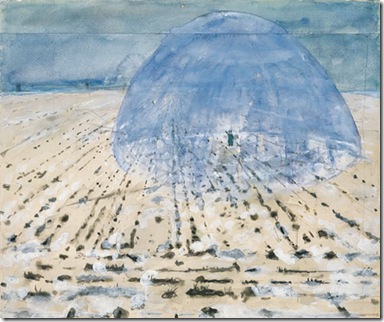
Everyone Stands Under His Own Dome of Heaven -- Both the title of this work and the image of the dome with a lone figure inside refer to Kiefer's view that there is no single system or belief, such as Marxism or Christianity, that is appropriate for all people. "Each man has his own dome, his own perceptions, his own theories," Kiefer has noted.

As I said before, the Christian church hardened in its knowledge and its symbolism at a certain point. The kabbalistic tradition is not one buy many, forming a sophisticated spiritual discipline. It is a paradox of logic and mystical belief. It’s part scholarship, part religion, part magic. For me, it is a spiritual journey anchored by images.

Sunday, March 23, 2008

Resurrection is the Heart of Buddhism

From Parallels Between Buddhism and Christianity, a talk given by Shinzen Young:

My teacher Sasaki Roshi used to quite regularly hold Zen retreats at a Trappist Monastery where Father Thomas Keating used to be the abbot. He would go in and put on the Trappist robes and he'd make up Christian kōans for the monks.

The first kōan he gave them was What is your experience of God when you make the sign of the cross?

He would also describe Buddhism in terms of Christianity. He would ask them questions like What was Jesus's experience of God when he was on the cross?

He would say, "Resurrection is the heart of Buddhism. Unless you understand about resurrection, you cannot understand what Buddhism is about. Dying is the easy part. The resurrection is the hard part. Any religion that doesn't teach resurrection is a false religion." He was talking about his own experience which is why he would say it with such conviction.

Do you understand what he meant when he said resurrection is the heart of Buddhism? Well, it goes back to the experience of no self and full self. Allowing the self to dissolve is half of the enlightenment experience. Allowing the self to reform without interference, that's resurrection, isn't it?

Thomas Merton wrote, "All the paradoxes about the contemplative way are reduced to this one: being without desire means being lead by a desire so great that it is incomprehensible. It's too huge to be completely felt. It's a blind desire, which seems like a desire for nothing. Only because nothing can content it. And because it is able to rest in no thing, then it rests, relatively speaking, in emptiness. But not in emptiness as such, emptiness for it's own sake, actually there's no such entity as pure emptiness. And the merely negative emptiness of the false contemplative is a thing, not a nothing."

[It's very true. In other words, the negative emptiness, empty in the sense of your bank account is empty, that's not the emptiness that the meditator is talking about. That's actually a thing.]

"True emptiness is that which transcends all things and yet is imminent in all. For what seems to be emptiness in this case is pure being. But it's not this or that. Whatever you say of it, it is other than what you say. The character of emptiness, at least for a Christian contemplative, is pure love, pure freedom. Love that is free of everything, not determined by any thing or held down by any special relationship. It's love for love's sake. It's a sharing through the Holy Spirit in the infinite charity of God. And so when Jesus told his disciples to love, he told them to love as universally as the Father who sends rain alike on the just and the unjust. This purity, freedom, and indeterminateness of love is the very essence of Christianity."