Showing posts with label practice. Show all posts

Thursday, May 26, 2011

Seeing Clearly What Is Happening

Mark Williams from “Mindfulness is Happiness,” WealthWise Magazine, May 16, 2011:

Mark Williams Mindfulness simply means being aware — seeing clearly what is happening in our minds and in the world, from moment to moment, bringing a sense of kindness to our experience rather than getting caught in judging it.

The methods used to cultivate mindfulness were first recorded over two thousand years ago. It has long been central to wisdom traditions in Asia, particularly the Buddhist tradition, but the art of cultivating inner silence has been a central part of all religious traditions across the ages.

Mindfulness meditation is a secular form of this tradition that anyone can learn. It trains us to pay deliberate attention to our experience, both external and internal. We learn to focus on what is happening from moment to moment with full intention and without judgment. Mindfulness is the awareness that emerges through such training, and the skill of developing and sustaining that awareness.

Modern mindfulness-based approaches in healthcare began in the USA. From the late 1970s, Jon Kabat-Zinn’s pioneering research into Mindfulness-Based Stress Reduction (MBSR1) found remarkable effects on chronic pain and stress. With colleagues John Teasdale and Zindel Segal, we have reasoned that mindfulness training might have powerful effects in preventing future recurrence of depression, even if taught when people were well.

To test this hypothesis, we have created the 8-week Mindfulness-Based Cognitive therapy program. Six research trials have evaluated the power of MBCT to prevent depression. The results are striking. In the most seriously ill patients – those with three or more previous episodes of depression, MBCT reduces the recurrence rate over 12 months by 40-50% compared with the usual care, and has proved to be as effective as maintenance antidepressants in preventing new episodes of depression.

…Mindfulness is “skills training” rather than traditional type of therapy, so anyone can try it without feeling that they have to go over old ground, or talk through their problems yet again.  Those already in therapy report finding treatment easier if they are more able to be mindful, and to see their thoughts and feelings with greater distance and perspective.

Oxford Unversity Professor Mark Williams, talks about stress and its impact for the Be Mindful campaign.

Friday, May 20, 2011

Acquiring Skills

“I want to see wave riding documented the way I see it in my head and the way I feel it in the sea. It’s a strange set of skills to acquire and it’s only achievable through time spent riding waves.”

~ Mickey Smith


[Thanks, Kit!]

Thursday, May 05, 2011

Noise-Canceling Life's Din With Meditation

Noise Canceling, Without Headphones
by Roni Caryn Rabin
The New York Times
May 2, 2011

Stephanie Nash's Posture-Pedia

Studies have found that meditation helps prevent the recurrence of depression, perhaps by producing changes in parts of the brain associated with learning and anxiety. A new study suggests that meditation may modulate brain waves called alpha rhythms, which help regulate the transmission of sensory input from the surrounding environment.

Harvard researchers randomly assigned 12 healthy adults to an eight-week course of training in meditation-based stress reduction or to a control group whose participants did not meditate.

At regular intervals, researchers used an imaging technique called magnetoencephalography to measure electrical currents in an area of the brain that processes signals from the left hand. During the tests, each participant was asked to direct his attention to his or her left hand or left foot.

After eight weeks, the brain scans showed that alpha rhythms changed more quickly and in a more pronounced way in participants who had been meditating.

“If you’re reading something in a noisy environment and you want to be in a bubble, you might use your alpha rhythms like a volume knob, to turn down the volume on neurons that represent sound from the outside world,” said Catherine E. Kerr, a neuroscientist at Harvard Medical School and a co-author of the report, published April 21 in the journal Brain Research Bulletin. “We all do this to some extent, but it turns out that meditators become much more skilled at it.”

See also: Hear Out Daily Workout

Saturday, April 02, 2011

Just Another Phenomenon of Consciousness

Excerpt from “Just One Breath: The Practice of Poetry and Meditation,” by Gary Snyder, Tricycle Magazine, Fall 1991:

snyder Traditions of deliberate attention to consciousness, and of making poems, are as old as humankind. Meditation looks inward, poetry holds forth. One is private, the other is out in the world. One enters the moment, the other shares it. But in practice it is never entirely clear which is doing which.

In any case, we do know that in spite of the contemporary public perception of meditation and poetry as special, exotic, and difficult, they are both as old and as common as grass. The one goes back to essential moments of stillness and deep inwardness, and the other to the fundamental impulse of expression and presentation.

People often confuse meditation with prayer, devotion, or vision. They are not the same. Meditation as a practice does not address itself to a deity or present itself as an opportunity for revelation. This is not to say that people who are meditating do not occasionally think they have received a revelation or experienced visions. They do. But to those for whom meditation is their central practice, a vision or a revelation is seen as just another phenomenon of consciousness and as such is not to be taken as exceptional.

The meditator would simply experience the ground of consciousness, and in doing so avoid excluding or excessively elevating any thought or feeling. To do this one must release all sense of the "I" as experiencer, even the "I" that might think it is privileged to communicate with the divine. It is in sensitive areas such as these that a teacher can be a great help.

Read the entire essay…

Saturday, March 05, 2011

At Home in Both

Excerpt from “Just One Breath: The Practice of Poetry and Meditation,” by Gary Snyder, Tricycle Magazine, Fall 1991:

In this world of onrushing events the act of meditation—even just a "one-breath" meditation—straightening the back, clearing the mind for a moment—is a refreshing island in the stream. Although the term meditation has mystical and religious connotations for many people, it is a simple and plain activity. Attention: deliberate stillness and silence. As anyone who has practiced sitting knows, the quieted mind has many paths, most of them tedious and ordinary. Then, right in the midst of meditation, totally unexpected images or feelings may sometimes erupt, and there is a way into a vivid transparency. But whatever comes up, sitting is always instructive. There is ample testimony that a practice of meditation pursued over months and years brings some degree of self-understanding, serenity, focus, and self-confidence to the person who stays with it. There is also a deep gratitude that one comes to feel for this world of beings, teachers, and teachings.

No one—guru or roshi or priest—can program for long what a person might think or feel in private reflection. We learn that we cannot in any literal sense control our mind. Meditation cannot serve an ideology. A meditation teacher can only help a student understand the phenomena that rise from his or her own inner world—after the fact—and give tips on directions to go. A meditation teacher can be a check or guide for the wayfarer to measure herself against, and like any experienced guide can give good warning of brushy paths and dead-end canyons from personal experience. The teacher provides questions, not answers. Within a traditional Buddhist framework of ethical values and psychological insight, the mind essentially reveals itself.

Meditation is not just a rest or retreat from the turmoil of the stream or the impurity of the world. It is a way of being the stream, so that one can be at home in both the white water and the eddies. Meditation may take one out of the world, but it also puts one totally into it. Poems are a bit like this too. The experience of a poem gives both distance and involvement: one is closer and farther at the same time.

Read the entire essay…

@WhiskeyRiver

Wednesday, February 16, 2011

Everything Changes All the Time

From Real Happiness: The Power of Meditation by Sharon Salzberg:

“Again and again I’ve seen novice meditators begin to transform their lives—even if they were initially resistant or skeptical. As I’ve learned through my own experience, meditation helps us to find greater tranquility, connect to our feelings, find a sense of wholeness, strengthen our relationships, and face our fears. That’s what happened to me.

Because of meditation, I’ve undergone profound and subtle shifts in the way I think and how I see myself in the world. I’ve learned that I don’t have to be limited to who I thought I was when I was a child or what I thought I was capable of yesterday, or even an hour ago. My meditation practice has freed me from the old, conditioned definition of myself as someone unworthy of love. Despite my initial fantasies when I began meditating as a college student, I haven’t entered a steady state of glorious bliss. Meditation has made me happy, loving, and peaceful—but not every single moment of the day. I still have good times and bad, joy and sorrow. Now I can accept setbacks more easily, with less sense of disappointment and personal failure, because meditation has taught me how to cope with the profound truth that everything changes all the time.”

Saturday, February 12, 2011

Engaged in the Normal Process of Living

Excerpt from Twelve Steps to a Compassionate Life by Karen Armstrong:

armstrong-12-steps The purpose of mindfulness…is to help us detach ourselves from the ego by observing the way our minds work. You might find it helpful to learn more about the neurological makeup of the brain and the way that meditation can enhance your sense of peace and interior well-being…but this is not essential. Practice is more important than theory, and you will find that it is possible to work on your mental processes just as you work out in the gym to enhance your physical fitness.

Mindfulness is a form of meditation that we perform as we go about our daily lives…Just as musicians have to learn how to manipulate their instruments and an equestrienne requires an intimate knowledge of the horse she is training, we have to learn to use our mental energies more kindly and productively. This is not a meditation that we should perform in solitude, apart from our ordinary routines. In mindfulness we mentally stand back and observe our behavior while we are engaged in the normal process of living in order to discover more about the way we interact with people, what makes us angry and unhappy, how to analyze our experiences, and how to pay attention to the present moment. Mindfulness is not meant to make us morbidly self-conscious, scrupulous, or guilty; we are not supposed to pounce aggressively on the negative feelings that course through our minds. Its purpose is simply to help us channel them more creatively.

With mindfulness, we use our new analytical brain to step back and become aware of the more instinctive, automatic mental processes of the old brain. So we live in the moment, observing the way we speak, walk, eat, and think. The Tibetan word for meditation is gom: “familiarization.” Mindfulness should give us greater familiarity with the Four Fs that are the cause of so much pain (feeding, fighting, fleeing, and—reproduction). We will become aware of how suddenly these impulses arise in response to stimuli that make us irrationally angry, hostile, greedy, rampantly acquisitive, lustful, or frightened, and how quickly they overturn the more peaceful, positive emotions. But instead of being overly distressed by this, we should recall that it is what nature intended and that the strong instinctual passions are simply working through us. Over time and with practice, we can learn how to become more aloof and refuse to identify with them: “This is not mine; this is not what I really am; this is not my self.” But it will not happen overnight; we have to be patient and understand that there is no quick fix.

Yet we should also take note of how unhappy these primitive emotions make us. When you are engrossed in thoughts of anger, hatred, envy, resentment, or disgust, notice the way your horizons shrink and your creativity diminishes…In the grip of these hostile preoccupations, we become focused on ourselves, can think of little else, and lose all wider perspective. We tend to assume that other people are the cause of our pain; with mindfulness, over time, we learn how often the real cause of our suffering is the anger that resides within us. When we are enraged, we tend to exaggerate a person’s defects—just as when we are seized by desire we accentuate somebody’s attractions and ignore her faults, even though at some level we may know that this is a delusion.

Similarly, we become aware that the acquisitive drive, which originally motivated our search for food, is never satisfied. As you progress, you will notice that once a desire is fulfilled, you almost immediately start to want something else. if the object of your desire turns out to be disappointing, you become frustrated and unsettled. You soon realize that nothing lasts long. An irritation, idea, or fantasy that seemed all-consuming a moment ago tends to pass quite quickly, and before long you are distracted by a startling noise or a sudden drop in temperature, which shatters your concentration. We humans rarely sit absolutely still but are constantly shifting our position, even when we sleep. We suddenly get it into our heads to wander into another room, make a cup of tea, or find somebody to talk to. One minute we are seething over a colleague’s inefficiency; the next we are daydreaming about our summer vacation. Gradually, as you become conscious of your changeability, you will find that you are beginning to sit a little more lightly to your opinions and desires. Your current preoccupation is not really “you,” because in a few moments you will almost certainly be obsessing about something else.

Saturday, January 29, 2011

Pinned to the Cushion

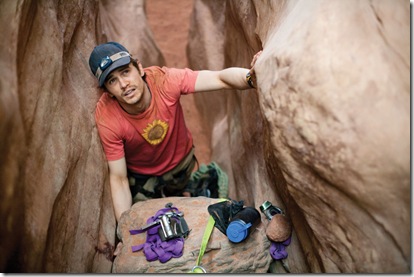
127Hours2

I was completely surprised to discover that Danny Boyle’s 127 Hours is much deeper than just a movie about someone who has to cut his arm off to survive. It’s also a brilliant account of being pinned to a de facto meditation cushion for an involuntary 5-day mindfulness intensive on the nature of thinking, feeling, the self, loving-kindness, and the liberation that can come from yielding to impersonal forces. The boulder deserves an Oscar nomination for a supporting role as both antagonist and teacher. I expected to feel uneasy, but instead I was completely absorbed in the clever depiction of an excruciating subjective experience of one person's suffering.

Aron Ralston said in one interview, "The entrapment created such an appreciation for the frolicking I had been doing until it happened and there was the euphoric feeling of being free and getting my life back again. Because of what happened, I understand what life is. I'm hopeful that people will see something inside of themselves, as well. I was in an extraordinary circumstance and it fundamentally came down to wanting to live and get back to my family. It is about survival, love and freedom — and those things are common in all of us."

The good news is that the profound yet practical insights Ralston carried out of Blue John Canyon can also be gradually cultivated through the consistent development of attentional skills over time. I enthusiastically recommend both the film and the effort required to experience high levels of concentration, sensory clarity, and equanimity without waiting for the conditions to become so extreme.

Monday, January 24, 2011

Even A Little Calm Goes a Long Way

“Mindfulness, then, is not about ecstatic states, as if the marks of success are oceanic experiences or yogic flying. It's mostly pretty humdrum. Moreover, it is not a fast track to blissful happiness. It can, in fact, be quite unsettling, as  works with painful experiences, to understand them better and thereby get to the root of problems.

Research into the benefits of mindfulness seems to support its claims. People prone to depression, say, are less likely to have depressive episodes if they practice meditation. Stress goes down. But it's more like going on a journey than taking a pill. Though meditation techniques can be learned quickly, it's no instant remedy and requires discipline. That said, many who attend lessons or go on retreats find immediate benefits—which is not so surprising, given that in a world of no stillness, even a little calm goes a long way.”

~ Mark Vernon, from “How to Meditate: An Introduction,” The Guardian, Jan. 22, 2011

How to Meditate by Andy Puddicombe, founder of Headspace, for The Guardian

Thanks to Jonathan Carroll.

Friday, January 07, 2011

Learning to Improvise

From “The Improvisational Brain,” by Amanda Rose Martinez, SeedMagazine, Dec. 14, 2010:

Aaron Berkowitz, a cognitive ethnomusicologist, who took on the task of demystifying improvisation as the focus of his dissertation work at Harvard, has a theory. He likens the process of learning to improvise to that of learning a second language. Initially, he says, it’s all about memorizing vocabulary words, useful phrases and verb conjugation tables. Your first day, you might learn to say: How are you? I’m fine. “These are like the baby steps beginning improvisers take. They learn the structure of the blues. They learn basic chords and get the form down,” said Berkowitz. But they’re still very limited in what they can do.

Credit: Flickr user maistoraA dedicated musician will immerse himself in the recordings of his chosen genre or composer, just as a language student might absorb foreign films or tapes of people speaking. Over time, both musician and student accumulate more phrases and ways to combine them. “But you still can’t really invent anything. [The language learner] can’t talk about politics or the environment,” Berkowitz said. “You’re still thinking: ‘Uh oh, here’s comes a verb. I have to put it in the past tense. I have to put it at the end of the sentence before I can say this whole phrase.”

But eventually, through constant practice, you get to the point where, scientists believe, these processes get pushed down into the subconscious. They don’t need to be consciously worked out anymore. They become a subroutine. Suddenly you realize you’re saying things you haven’t heard or memorized. You’re able to free-associate. Your brain begins exerting control at a higher level, directing bigger chunks of information that can be expressed as whole ideas.

The trajectory of acquiring a language, according to Berkowitz, where you begin with learned phrases, achieve fluency, and are eventually able to create poetry mirrors perfectly the process of learning to improvise. In the same way a language student learns words, phrases and grammatical structure so that later he can recombine them to best communicate his thoughts, a musician collects and commits to memory patterns of notes, chords and progressions, which he can later draw from to express his musical ideas.

Read the entire article…

Wednesday, November 17, 2010

For One Minute

…or just look at this pole and try to relax the impulse to define it or interpret it or decide whether or not it is beautiful. Try to notice what it feels like to see, as if you had no words for any of the forms or colors in front of you, as if the words on the paper were written in a language you never learned to read.

…or let your gaze spread gently across your entire field of vision, taking in the area immediately in front of you, the farthest distance you can observe without straining, the right and left edges of your peripheral vision, and everything in between. Take it all in at once—the whole three-dimensional volume of visual space. This is what the present looks like. This is what it feels like to see without spinning a story. This is what it feels like to see as a young child sees, simply fascinated with the seeing itself. Sixty seconds can feel like a long time. Try stringing together several intervals of four or five seconds instead. 

…or listen to what this moment sounds like without needing to know the source of the sounds or to evaluate any of them as pleasant or unpleasant. Steep in the wonder of vibrations striking tiny bones inside your ears and massaging that space where all of the internal chatter plays out, wave after wave of internal sound. There’s no need to tamp down the internal sounds that well up as you’re listening. Allow them to play out as they will, trying to be aware of the silence between the waves. Use the activity of internal sound to remind you to spread your listening out in all directions and become absorbed by it. 

Monday, October 18, 2010

Walking the Razor’s Edge

Excerpt from “This Very Moment,” by Charlotte Joko Beck, from Ordinary Magic: Everyday Life as Spiritual Path:

Phillipe Petite (Man on Wire) Always we have an illusion of being separate, which we have created. When we’re threatened or when life doesn’t please us, we start worrying, we start thinking about a possible solution. And without exception there is no person who doesn’t do this. We dislike being with life as it is because that can include suffering, and that is not acceptable to us. Whether it’s a serious illness or a minor criticism or being lonely or disappointed—that is not acceptable to us. We have no intention of putting up with that or just being that if we can possibly avoid it. We want to fix the problem, solve it, get rid of it. That is when we need to understand the practice of walking the razor’s edge. Spiritual practice is about understanding the razor’s edge and how to work with it.

The point at which we need to practice walking the razor’s edge is whenever we begin to be upset (angry, irritated, resentful, jealous). First, we need to know we’re upset. Many people don’t even know that upset is taking place. When we meditate and begin to know our minds and our reactions, we begin to be aware that yes, we are upset.

The Man Who Walked Between The Towers by Mordicai GersteinThat’s the first step, but it’s not the razor’s edge. We’re still separate, but now we know it. How do we bring our separated life together? To walk the razor’s edge is to do that; we have once again to be what we basically are, which is seeing, touching, hearing, smelling; we have to experience whatever our life is, right this second. If we’re upset we have to experience being upset. If we’re frightened, we have to experience being frightened. If we’re jealous we have to experience being jealous. And such experiencing is physical; it has nothing to do with the thoughts going on about the upset.

When we are experiencing nonverbally we are walking the razor’s edge—we are in the present moment. When we walk the edge the agonizing states of separateness are pulled together, and we experience perhaps not happiness but joy. Understanding the razor’s edge (and not just understanding it, but doing it) is what meditation practice is. The reason it’s difficult is that we don’t want to do it. We know we don’t want to do it. We want to escape from it.

If I feel that I’ve been hurt by you, I want to stay with my thoughts about the hurt. I want to increase my separation; it feels good to be consumed by those fiery, self-righteous thoughts. By thinking, I try to avoid feeling the pain. The more sophisticated my practice becomes, the more quickly I see this trap and return to experiencing the pain, the razor’s edge. And where I might once have stayed upset for two years, the upset shrinks to two months, two weeks, two minutes. Eventually I can experience an upset as it happens and stay right on the razor’s edge.

In fact the enlightened life is simply being able to walk that edge all the time. And while I don’t know anyone who can always do this, certainly after years of practice we can do it much of the time. It is joy to walk that edge.

Still, it is necessary to acknowledge that most of the time we want nothing to do with that edge; we want to stay separate. We want the sterile satisfaction of wallowing in “I am right.” That’s a poor satisfaction, of course, but still we will usually settle for a diminished life rather than experience life as it is when that seems painful and distasteful.

All troublesome relationships at home and work are born of the desire to stay separate. By this strategy we hope to be a separate person who really exists, who is important. When we walk the razor’s edge we’re not important; we’re no-self, embedded in life. This we fear—even though life as no-self is pure joy. Our fear drives us to stay over here in our lonely self-righteousness. The paradox: only in walking the razor’s edge, in experiencing the fear directly, can we know what it is to have no fear.

phillipe petite-2Now I realize we can’t see this all at once or do it all at once. Sometimes we jump onto the razor’s edge and then hop off, like water dropped on a sizzling frying pan. That may be all we can do at first, and that’s fine. But the more we practice, the more comfortable we become there. We find it’s the only place where we are at peace. So many people say, “I want to be at peace.” Yet there may be little understanding of how peace is to be found. Walking the razor’s edge is it. No one wants to hear that. We want somebody who will take our fear away or promise us happiness. No one wants to hear the truth, and we won’t hear it until we are ready to hear it.

Wednesday, October 13, 2010

The Combustion of Egoistic Delusions

Excerpt from “This Very Moment,” by Charlotte Joko Beck, from Ordinary Magic: Everyday Life as Spiritual Path:

Back in the 1920s, when I was maybe eight or ten years old, and living in New Jersey where the winters are cold, we had a furnace in our house that burned coal. It was a big event on the block when the coal truck rolled up and all this stuff poured down the coal chute into the coal bin. I learned that there are two kinds of coal: one was called anthracite or hard coal, and the other was lignite, soft coal. My father told me about the difference in the way those two kinds of coal burned. Anthracite burns cleanly, leaving little ash. Lignite leaves lots of ash. When we burned lignite, the cellar became covered with soot and some of it got upstairs into the living room.

What does this have to do with our practice? Practice is about breaking our exclusive identification with ourselves. This process has sometimes been called purifying the mind. To “purify the mind” doesn’t mean that you become holy or other than you are; it means to strip away that which keeps a person—or furnace—from functioning best.  The furnace functions best with hard coal. But unfortunately what we’re full of is soft coal. There’s a saying in the Bible: “He is like a refiner’s fire.” It’s a common analogy, found in other religions as well. To sit in meditation is to be in the middle of a refining fire. Eido Roshi said once, “This meditation hall is not a peaceful haven, but a furnace room for the combustion of our egoistic delusions.” A meditation hall is not a place for bliss and relaxation, but a furnace room for the combustion of our egoistic delusions. What tools do we need to use? Only one. We’ve all heard of it, yet we use it very seldom. It’s called attention.

Attention is the cutting, burning sword, and our practice is to use that sword as much as we can. None of us is very willing to use it; but when we do—even for a few minutes—some cutting and burning take place. All practice aims to increase our ability to be attentive, not just in meditation but in every moment of our life.

Saturday, October 09, 2010

The Intimacy You Get From Practicing

Flamenco guitarist and Zen practitioner Ottmar Liebert, from “Intimacy Through Practice,” Buddhist Geeks Podcast, September 13, 2010:

There’s a part of practice that I think is inherent in all different practices. The type of concentration, the familiarity, the intimacy that you get to whatever you’re practicing, whether it’s archery or Zen or music or how to make a perfect pancake. You won’t get there unless you get intimate with the subject. You only get there through practice. As you become more intimate, you know more about it, where you can say “This batter is too liquid or too solid or too warm too cold. It’ll act this way.” All that comes only through practice. It comes  up often in conversations with my friends about how people go about life these days, that they’re really not willing to practice anything.

The other day we got to talking about jeans. There’s only one of the old fashioned wooden looms in America. I think it’s actually in Raleigh, North Carolina. All the other ones were shipped to Japan, and that’s in the ‘50s. And that’s where you  get the superior denim because people are willing to make things by hand and become intimate with it. Whereas a lot of people in the United States or in Europe will just go, “I’d rather buy ten pairs at Walmart than buy one pair of really good jeans, even though the really good pair will probably outlast the ten pairs they buy at Walmart.” So, there’s a lack of that—you might say depth—that comes from not practicing, from not practicing a craft.

*     *     *     *     *

Raleigh Denim

Raleigh Denim: Handcrafted in North Carolina from David Huppert on Vimeo.

Wednesday, September 01, 2010

As Complete as Possible

Excerpt from "Happiness and Completion," by Ken McLeod:

For me, spiritual practice is now not so much about happiness as about completion, a way of experiencing life that is as complete as possible in each and every moment.

...when we see and accept what is actually happening, even if it is very difficult or painful, mind and body relax, and in that rest, there is an exquisite quality that comes through just experiencing what arises, completely, with no separation.

Some might call it joy, but it is not a giddy or excited joy. Rather it is a deep and quiet joy, a joy that, in some sense is always there, waiting for us, but usually touched only when some challenge, pain, or tragedy leaves us with no other option.

Others might call it truth, but this is a loaded and misleading word, carrying with it the notion of something that exists apart from experience itself. The notion of truth also sets up an opposition, with what is held to be false, and such duality necessarily leads to hierarchy, authority, and institutional thinking and its associated forms of mind killing.

... the desire for happiness itself is a form of suffering as it leads to a struggle with experience, e.g., in the context of relationships, the desire for continual happiness undermines emotional connection.

Thus, for me, the purpose of practice is how to be with whatever arises in this experience we call 'life', nothing more, and nothing less. Everything we do in practice is aimed at the development of the willingness, skills, and capacities needed to experience life this way.

Read the complete essay…

Friday, June 25, 2010

Stepping Stones

Stepping Stones Crossing the River Duddon to Seathwaite

"Some people spend their entire lives reading but never get beyond reading the words on the page, they don’t understand that the words are merely stepping stones placed across a fast-flowing river, and the reason they’re there is so that we can reach the farther shore, it’s the other side that matters.”

~  José Saramago

Saturday, February 06, 2010

The Two are One

“If we’re not careful, this is how we approach mindfulness: as an idea, one we rather like, to elevate our lives with special contemplative consideration, a method for making smarter choices and thereby assuring better outcomes. The problem is that the life before us is the only life we have. The search for meaning robs our life of meaning, sending us back into our discursive minds while right in front of us the laundry piles up…

…With only a change in perspective, the most ordinary things take on inexpressible beauty. When we don’t know, we don’t judge. And when we don’t judge, we see things in a different light. That is the light of our awareness, unfiltered by intellectual understanding, rumination, or evaluation. When we cultivate nondistracted awareness as a formal practice, we call it mindfulness meditation. When we cultivate it in our home life, we call it the laundry, the kitchen, or the yard—all the places and the ways to live mindfully by attending without distraction to whatever appears before us. But it’s hard for us to believe that attention is all there is to it, and so we complicate things with our judgment—debasing the ordinary as insignificant and idealizing the spiritual as unattainable—never seeing that the two are one.”

~ by Karen Maezen Miller, from “Do Dishes, Rake Leaves (And Don’t Forget the Endless Loads of Laundry),” Shambhala Sun, March 2010

Friday, January 29, 2010

Belonging, Blooming, and Beginning Again

If worries were stones that could be polished by rolling around repeatedly in our minds, one of the shiniest rocks in my tumbler would have to be wondering where I really belong. Growing up in Wichita, Kansas I was convinced I was being excluded from a much more Technicolor city. In New Mexico I quickly grew bored of the piercingly blue skies and yearned for thunderstorms. Ohio seemed to choose me instead of the other way around. I don't strongly identify with many of the aspects of my life and personality that make easy answers to casual questions about who I am or what I do.

Year-End Retreat 2009, Rancho Palos Verdes

All this becomes especially distressing when I'm convinced that everyone else not only knows for certain where they belong but have also managed to get there. It reminds me of the paradox that throws so many people off about meditation: the way it appears on the outside doesn’t give a very reliable indication of what it feels like on the inside.

I recently had the extravagantly good fortune to practice mindfulness intensively in an idyllic setting near the ocean, with Birds of Paradise thriving in early January, and a few peacocks adding spontaneous local color. Yet I found myself wondering if I really belonged there — even as a visitor.

Year-End Retreat 2009, Rancho Palos VerdesAs much sincere intention as I put into weeding out unrealistic assumptions about life, I've managed to hold onto the notion that some perfect fit exists for each of us. I don't want to blame this on Hollywood or religion or advertising — aren't they all just responding to the strong craving for narrative which seems to be hardwired into our nervous systems? It’s that same inherited impulse toward security and the sense that each of us is actually the main character in this one long reality show.

Practicing mindfulness over time can lead to a direct and deepening awareness that nothing is unchanging. Could this apply to my perpetual desire to belong? What if there really is no satisfying it in the same way we never seem to reach the point of having the right amount of money or time?

What if instead of finding out exactly where I belong, I put my energy into belonging where I find myself at any given moment? This means making ourselves at home scraping snow from the windshield, listening to the hold music, drinking coffee, sitting through another boring meeting, watching a great movie, waiting to see the doctor, washing our hands, and dropping off the recyclables. To really bloom where we find ourselves planted begins with settling in, soaking up whatever our roots can reach, and celebrating the sprouting as well as the whole climb toward blooming.

What would it feel like to at least attempt to notice and accept all the many points along the way — the pleasant episodes as well as the unpleasant ones? If we can practice embracing the hundreds of different places we find ourselves each day (physically, mentally, emotionally), then we're well on our way to belonging wherever we go.

Thursday, October 29, 2009

On Making a Raft

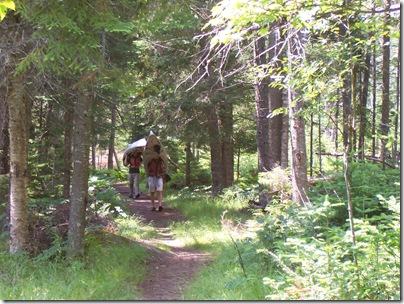
Matt & Daron Portaging in the Adirondaks (July 2009)

"How useful this raft has been to me! For it was in dependence on this raft that, making an effort with my hands and feet, I have crossed over to safety on the further shore. Why don't I, having hoisted it on my head or carrying on my back, go wherever I like?"

~ Buddha

Why would one make and use a raft to cross a river only to haul it uselessly around as a burden? This is often our unskillful practice, says Stephen Batchelor. We use spiritual practice to encounter life with freshness and openness, not clinging to any particular method, just as we do not carry around a raft after having crossed a river. Each moment is an opportunity to practice. If we truly embody the practice, we can act appropriately and spontaneously in every situation.

@c4chaos

Tuesday, July 21, 2009

A Little Out of Scale

Norman Fischer speaking with Vince Horn on Buddhist Geeks (Episode129 -- Buddhism May Need a Plan B):

BG ...twenty-five years ago nobody went to the gym. Now we've well established through research in our society that exercise is really important so there's a gym on every corner. Well, why isn't there a meditation hall on every corner? Haven’t we established the fact that some spiritual endeavor is just as important for inner health as exercise is for the body? So there ought to be meditation halls on every corner and people should know how important this is and feel like it makes sense to access it and pay for it so that there could be people to offer it.

I mean that there is tremendous spike in research on meditation. Just in last three or four years. It’s exponentially increased and all the research is always showing the same thing that meditation is actually a effective, that it really works, and that it has all kind of benefits. So people seem to believe in research and scientific data, but just talk to your friends who do this practice and that’s probably enough to convince you even without the scientific data.

...It's funny, you know? I'm gone do a retreat for the army for Norman Fischer      caregivers and chaplains. So the Army's going to spend fifty cents to pay me to do the retreat and then a million dollars to study the effects of the retreat over time. So...it’s very expensive to conduct research. Very expensive. A million dollar research grant is not an unusual grant. A million dollar gift to a dharma center or for a teacher training or something like that is very, very rare. So it’s a little out of scale.

[The conversation continues in Episode 130 -- Buddhism and the Evolution of Religion. Check out Norman Fischer’s article, “Why We Need a Plan B,” in the summer issue of Buddhadharma.]