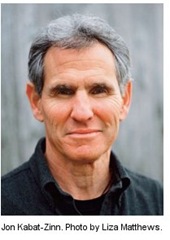
Showing posts with label Jon Kabat-Zinn. Show all posts

Thursday, May 26, 2011

Seeing Clearly What Is Happening

Mark Williams from “Mindfulness is Happiness,” WealthWise Magazine, May 16, 2011:

Mark Williams Mindfulness simply means being aware — seeing clearly what is happening in our minds and in the world, from moment to moment, bringing a sense of kindness to our experience rather than getting caught in judging it.

The methods used to cultivate mindfulness were first recorded over two thousand years ago. It has long been central to wisdom traditions in Asia, particularly the Buddhist tradition, but the art of cultivating inner silence has been a central part of all religious traditions across the ages.

Mindfulness meditation is a secular form of this tradition that anyone can learn. It trains us to pay deliberate attention to our experience, both external and internal. We learn to focus on what is happening from moment to moment with full intention and without judgment. Mindfulness is the awareness that emerges through such training, and the skill of developing and sustaining that awareness.

Modern mindfulness-based approaches in healthcare began in the USA. From the late 1970s, Jon Kabat-Zinn’s pioneering research into Mindfulness-Based Stress Reduction (MBSR1) found remarkable effects on chronic pain and stress. With colleagues John Teasdale and Zindel Segal, we have reasoned that mindfulness training might have powerful effects in preventing future recurrence of depression, even if taught when people were well.

To test this hypothesis, we have created the 8-week Mindfulness-Based Cognitive therapy program. Six research trials have evaluated the power of MBCT to prevent depression. The results are striking. In the most seriously ill patients – those with three or more previous episodes of depression, MBCT reduces the recurrence rate over 12 months by 40-50% compared with the usual care, and has proved to be as effective as maintenance antidepressants in preventing new episodes of depression.

…Mindfulness is “skills training” rather than traditional type of therapy, so anyone can try it without feeling that they have to go over old ground, or talk through their problems yet again.  Those already in therapy report finding treatment easier if they are more able to be mindful, and to see their thoughts and feelings with greater distance and perspective.

Oxford Unversity Professor Mark Williams, talks about stress and its impact for the Be Mindful campaign.

Wednesday, August 18, 2010

Training to Become Intimate with the Workings of One’s Own Mind

Excerpts from “Toward a Mindful Society,” an interview with Jon Kabat-Zinn by Barry Boyce, Shambhala Sun, March 2010 (Dr. Kabat-Zinn is giving a talk on behalf of the Susan G. Komen for the Cure Foundation on October 6, 2010 at UCLA):

Jon Kabat-Zinn I am not really interested in “spreading” mindfulness, so much as I am interested in igniting passion in people for what is deepest and best within all of us, but which is usually hidden and rarely accessible. Science is a particular way of understanding the world that allows some people to approach what they would otherwise shun, and so can be used as a skillful means for opening people’s minds. By bringing science together with meditation, we're beginning to find new ways, in language people can understand, to show the benefits of training oneself to become intimate with the workings of one’s own mind in a way that generates greater insight and clarity.

The science is also showing interesting and important health benefits of such mind–body training and practices, and is now beginning to elucidate the various pathways through which mindfulness may be exerting its effects on the brain (emotion regulation, working memory, cognitive control, attention, activation in specific somatic maps of the body, cortical thickening in specific regions) and the body (symptom reduction, greater physical well-being, immune function enhancement, epigenetic up and down regulation of activity in large numbers and classes of genes). It is also showing that meditation can bring a sense of meaning and purpose to life, based on understanding the nonseparation of self and other. Given the condition we find ourselves in these days on this planet, understanding our interconnectedness is not a spiritual luxury; it’s a societal imperative.

Three or four hundred years ago, not so long in the scheme of things, people practicing meditation did so under fairly isolated conditions, mostly in monasteries. Now meditation is being practiced and studied in laboratories, hospitals, and clinics, and is even finding its way into primary and secondary schools. The people teaching and researching it have in many cases been involved with mindfulness for ten, twenty, thirty, or more years by now.

orthogonal

The line segments AB and CD are orthogonal to each other.

They are not just jumping on some new mindfulness bandwagon. And their work has resulted in many professionals being drawn to mindfulness for the first time. That in itself is a wonderful phenomenon, as long as it is understood that mindfulness is not merely a nice “concept” but an orthogonal way of being that requires ongoing practice and cultivation.

…There's nothing wrong with thinking. So much that is beautiful comes out of thinking and out of our emotions. But if our thinking is not balanced with awareness, we can end up deluded, perpetually lost in thought, and out of our minds just when we need them the most.

Sunday, March 21, 2010

Opening to Sounds

“Everything supports wakefulness if you are willing to let yourself be awakened by tenderly yet consistently connecting though your senses. Everything. But it requires a brave heart, and a mind that sees the folly in clinging…to anything.


As an experiment, see if you can be here in the pure awareness of hearing, surrendering over and over, again and again, to a hearing that is always happening without your having to do anything or exert yourself at all…opening to sounds and the spaces between them, and to the silence lying inside, underneath, and in between all sound.”

~ Jon Kabat-Zinn, from Arriving at Your Own Door: 108 Lessons in Mindfulness

Thursday, April 30, 2009

Cultivating Awareness of Awareness

Jon Kabat-Zinn in conversation with Krista Tippett on Speaking of Faith (April 16, 2009):

How you pay attention in your life actually can change your life and your biology and your brain. So when you don't have any cause to question Opening to Our Liveswhat's going on…and things are going in a direction that you describe for yourself as desirable — in other words, your 401(k) is increasing in value every year and so forth — it just seems like, yes, all is right with the world. And you can pay your mortgage payments and maybe buy a bigger house and on and on and…we tell ourselves that this is the way it's supposed to be. And then there are these rude awakenings that happen sometimes. It doesn't have to be the collapse of the economy or the stock market. It can be as simple as, you know, something happening to one of your family members or yourself.

…But we live in a kind of somnambulant expectation that everything will go on the way it is. Do you know what I'm saying? And that is certifiably absurd. And so that, the stress if we loop it back to stress and the whole thing about mindfulness-based stress reduction, is that the stress really has to do with wanting things to stay the same when they are inevitably going to change. The law of impermanence basically rules the universe and so things are never constant; they're continually changing. And if you want to hold them a particular way, you can do it for short periods of time at tremendous cost, but ultimately things change.

And if you don't recognize that, then you're going to create a lot of suffering for yourself and other people.

…we call ourselves Homo sapien sapiens. That's the species name we've given ourselves. And that means from the Latin sapere, which means "to taste" or "to know." The species that knows and knows that it knows. So that means really awareness and meta-awareness. And it would be nice if that were actually true, but I think it's a little premature to call ourselves that. And now maybe we need to live ourselves into owning that name by cultivating awareness and awareness of awareness itself and let that be in some sense the guide as to what we're going to invest in, how we're going to make decisions about where we live, where we're going to send our kids to school, how we're going to be at the dinner table. Whether we're going to take our bodies and our children and our parents for granted or whether we're going to live life as if it really mattered moment by moment.

And that's not some kind of prescription for more stuff that you need to do in order to be happy. This is getting out of your own way long enough to realize that you already have the potential for tremendous well-being and happiness right here, right now. Nothing else has to change.

…And all the scientific evidence is suggesting that when you choose life in the way I'm talking about, your brain changes in both form and function, your immune system changes, your body changes. I mean, we start to really take care of what's most important and there are very, very tangible results at the level of the body, the mind, and the heart, and most importantly our relationships with the world and with our loved ones and with our own bodies.

*     *     *     *     *

Books by Jon Kabat-Zinn:

Wednesday, November 12, 2008

Cultivating Mindfulness

Beginning or Deepening a Personal Meditation Practice
by Jon Kabat-Zinn

  1. The real meditation is how you live your life.
  2. In order to live life fully, you have to be present for it.
  3. To be present, it helps to purposefully bring awareness to your moments – otherwise you may miss many of them.
  4. You do that by paying attention on purpose, in the present moment, and non-judgmentally to whatever is arising inwardly and outwardly.
  5. This requires a great deal of kindness toward yourself, which you deserve.
  6. It helps to keep in mind that good or bad, pleasant or unpleasant, the present moment is the only time any of us are alive. Therefore, it's the only time to learn, grow, see what is really going on, find some degree of balance, feel and express emotions such as love and appreciation, and do what we need to do to take care of ourselves – in other words, embody our intrinsic strength and beauty and wisdom – even in the face of pain and suffering.
  7. So a gentle love affair with the present moment is important.
  8. We do that through learning to rest in awareness of what is happening inwardly and outwardly moment by moment by moment – it is more a “being” than a “doing.”
  9. Formal and informal meditation practices are specific ways in which you can ground, deepen, and accelerate this process, so it is useful to carve out some time for formal practice on a regular daily basis – maybe waking up fifteen or twenty minutes earlier than you ordinarily would to catch some time for ourselves.
  10. We bring awareness to our moments only as best we can.
  11. We are not trying to create a special feeling or experience – simply to realize that this moment is already very special – because you are alive and awake in it.
  12. This is hard, but well worth it
  13. It takes a lot of practice.
  14. Lots of practice.
  15. But you have a lot of moments – and we can treat each one as a new beginning.
  16. So there are always new moments to open up to if we miss some.
  17. We do all this with a huge amount of self-compassion.
  18. And remember, you are not your thoughts or opinions, your likes or dislikes. They are more like weather patterns in your mind that you can be aware of – like clouds moving across the sky, – and so don’t have to be imprisoned by.
  19. Befriending yourself in this way is the adventure of a lifetime, and hugely empowering.
  20. Try it for a few weeks – it grows on you.

From Oprah.com

[Thanks John!]

Sunday, May 18, 2008

Befriending

"Mindfulness is moment-to-moment, non-judgmental awareness, cultivated by paying attention. Mindfulness arises naturally from living. It can be strengthened through practice. This practice is sometimes called meditation. But meditation is not what you think.

Meditation is really about paying attention, and the only way in which we can pay attention is through our senses, all of them, including the mind. Mindfulness is a way of befriending ourselves and our experience. Of course, our experience is vast, and includes our own body, our mind, our heart, and the entire world."

~ Jon Kabat-Zinn, Arriving at Your Own Door: 108 Lessons in Mindfulness (Excerpts from Coming to Our Senses)