Showing posts with label hearing. Show all posts

Wednesday, March 23, 2011

What’s Always Here

Excerpt from Natural Awareness: Guided Meditations and Teachings for Welcoming All Experience by Pema Chödrön:

There are various ways to say what we’re doing here. One of them is uncovering our natural wakefulness or open awareness. Not attaining it or achieving it, but relaxing enough to experience it—to tune into it. What’s always said is like tuning into what’s always here.

When you listen to sounds…

For just a moment, just listen.

Can you hear your heartbeat?

Or feel your heartbeat?

Can you hear your breath?

The idea is that your heart is hopefully always beating. You’re always breathing. But there’s no consciousness of it. In the same way, you’re not conscious of the sounds. We all know what it’s like to walk a city block or country street — or anywhere — and be so lost in thought that you don’t see anything that’s on that street — just enough to keep you from bumping into people or falling down. But you miss a lot.

So the practice is returning or tuning into this natural ability to be present and see and hear — to be conscious, really. You could call it a practice of being fully conscious as opposed to being unconscious. Which is a pretty typical state. Lost in thought. Wandering away.

The point I’m trying to make is it’s not about acquiring something, but uncovering or tuning into a natural wakefulness, a natural awareness, an open awareness that’s always been here.

Sunday, March 13, 2011

Seeing with Sound

Excerpts from “Blindness No Obstacle To Those With Sharp Ears,” All Things Considered, March 13, 2011:

Meet Daniel Kish. He's a man of many talents. He likes to hike, make music and write. He enjoys children and loves nature. He's an avid biker.

He's also completely blind.

How can Kish bike if he can't see? The method is called echolocation — Kish calls it "flash sonar." As he speeds along on his bike, he makes clicking sounds. As the clicks bounce back to him, he creates a mental image of the space around him. He's kind of like a human bat.

"It is literally a process of seeing with sound," he says.

"It is literally a process of seeing with sound." ~ Daniel Kish
Daniel Kish leads All Things Considered weekend host Guy Raz on a bike ride in Culver City, Los Angeles, Ca.

“I think that children are incredibly adaptable and intuitive. We know this. I work a lot with children, especially very young children. What I often tell parents when children lose their sight is — warn and support parents — to try and get themselves out of the way of the adaptation process, become more an asset to it than a liability. Because children will adapt if given support to do so and given space to do so.

…It’s the overall process of being willing to reach out into the environment and discover what is around them. If that discovery process is broken by introducing a situation that is not natural, such as keeping the blind child in a playpen or a crib or in the corner, or such as always guiding their hands around their environment or guiding their bodies around their environment — [you really just have to let them figure it out. Getting hurt] is part of it for any child…It is tough, but there’s still a kind of a priori difference. When a sighted child gets hurt we consider it to be unfortunate; when a blind child gets hurt we consider it to be tragic…We really need to divest ourselves of that double standard.

[At World Access for the Blind] our main focus is supporting individuals to access their environment better…It is about a philosophy that we call No Limits Philosophy which challenges us to challenge what we think we know. To challenge every boundary, every box, every limitation that we’ve either put up ourselves or allowed ourselves to be conditioned to accept.

… Conventional wisdom doesn’t favor blindness. Conventional wisdom basically favors the perpetuation of convention. Blindness is not conventional — it’s anything and everything but conventional. So we tend to challenge conventional wisdom to expand itself and accept that there are situations, circumstances which are not conventional yet which still warrant accommodation, consideration, acceptance, awareness.   

Friday, March 04, 2011

Nothing Cannot Be Thought

Bust of the great Greek philosopher, Plato. SOCRATES: He then who sees some one thing, sees something which is?

THEAETETUS: Clearly.

SOCRATES: And he who hears anything, hears some one thing, and hears that which is?

THEAETETUS: Yes.

SOCRATES: And he who touches anything, touches something which is one and therefore is?

THEAETETUS: That again is true.

SOCRATES: And does not he who thinks, think some one thing?

THEAETETUS: Certainly.

SOCRATES: And does not he who thinks some one thing, think something which is?

THEAETETUS: I agree.

SOCRATES: Then he who thinks of that which is not, thinks of nothing?

THEAETETUS: Clearly.

SOCRATES: And he who thinks of nothing, does not think at all?

THEAETETUS: Obviously.

SOCRATES: Then no one can think that which is not, either as a self-existent substance or as a predicate of something else?


~ Plato, from Theaetetus

Saturday, February 12, 2011

Learning How to See Again Using Sound

| Artists Wanted | In Focus : Pete Eckert from Artists Wanted on Vimeo.

Even though he can’t see, Pete Eckhert demonstrates that he is a visual person through photography. He was the Grand Prize recipient of Artists Wanted: Exposure 2008, an international photography competition, and was awarded $2,008 with a formal reception at Leo Kesting Gallery in New York City on Thursday August 7, 2008.

Check out Artists Wanted and visit the program on Facebook.

Tuesday, February 08, 2011

Impossible Notes

The Fire In The Song
by David Whyte, from Fire in the Earth

Fire in the EarthThe mouth opens
and fills the air
with its vibrant shape

until the air
and the mouth
become one shape.

And the first word,
your own word,
spoken from that fire

surprises, burns,
grieves you now
because

you made that pact
with a dark presence
in your life.

He said, "If you only
stop singing
I’ll make you safe."

And he repeated the line,
knowing you would hear
"I’ll make you safe"

as the comforting
sound of a door
closed on the fear at last,

but his darkness crept
under your tongue
and became the dim

cave where
you sheltered
and you grew

in that small place
too frightened to remember
the songs of the world,

its impossible notes,
and the sweet joy
that flew out the door

of your wild mouth
as you spoke.

Wednesday, November 17, 2010

For One Minute

…or just look at this pole and try to relax the impulse to define it or interpret it or decide whether or not it is beautiful. Try to notice what it feels like to see, as if you had no words for any of the forms or colors in front of you, as if the words on the paper were written in a language you never learned to read.

…or let your gaze spread gently across your entire field of vision, taking in the area immediately in front of you, the farthest distance you can observe without straining, the right and left edges of your peripheral vision, and everything in between. Take it all in at once—the whole three-dimensional volume of visual space. This is what the present looks like. This is what it feels like to see without spinning a story. This is what it feels like to see as a young child sees, simply fascinated with the seeing itself. Sixty seconds can feel like a long time. Try stringing together several intervals of four or five seconds instead. 

…or listen to what this moment sounds like without needing to know the source of the sounds or to evaluate any of them as pleasant or unpleasant. Steep in the wonder of vibrations striking tiny bones inside your ears and massaging that space where all of the internal chatter plays out, wave after wave of internal sound. There’s no need to tamp down the internal sounds that well up as you’re listening. Allow them to play out as they will, trying to be aware of the silence between the waves. Use the activity of internal sound to remind you to spread your listening out in all directions and become absorbed by it. 

Sunday, August 22, 2010

An Air Pocket of Total Silence

Excerpt from “The Year of Silence,” by Kevin Brockmeier. Anthologized in The Best American Short Stories 2008. Listen to this story read by Anthony Rapp from the Aug. 22, 2010 episode of Selected Shorts titled Let’s Not Talk.

1.
Shortly after two
in the afternoon, on Monday, the sixth of April, a few seconds of silence overtook the city. The rattle of the jackhammers, the boom of the transformers, and the whir of the ventilation fans all came to a halt. Suddenly there were no car alarms cutting through the air, no trains scraping over their rails, no steam pipes exhaling their fumes, no peddlers shouting into the streets. Even the wind seemed to hesitate.

We waited for the incident to pass, and when it did, we went about our business. None of us foresaw the repercussions.

2.
That the city’s
whole immense carousel of sound should stop at one and the same moment was unusual, of course, but not exactly inexplicable. We had witnessed the same phenomenon on a lesser scale at various cocktail parties and interoffice minglers over the years, when the pauses in the conversations overlapped to produce an air pocket of total silence, making us all feel as if we’d been caught eavesdropping on one another. True, no one could remember such a thing happening to the entire city before, but it was not so hard to believe that it would.

3.
A handful of people
were changed by the episode, their lives redirected in large ways or small ones. The editor of a gossip magazine, for instance, came out of the silence determined to substitute the next issue’s lead article about a movie star for one about a fashion model, while her assistant realized that the time had come for her to resign her job and apply for her teaching license. A lifelong vegetarian who was dining in the restaurant outside the art museum decided to order a porterhouse steak, cooked medium rare. A would-be suicide had just finished filling his water glass from the faucet in his bathroom when everything around him seemed to stop moving and the silence passed through him like a wave, bringing with it a sense of peace and clarity he had forgotten he was capable of feeling. He put the pill bottle back in his medicine cabinet.

Such people were the exceptions, though. Most of us went on with our lives as though nothing of any importance had happened until the next incident occurred, some four days later.

4.
This time the silence
lasted nearly six seconds. Ten million sounds broke off and recommenced like an old engine marking out a pause and catching spark again. Those of us who had forgotten the first episode now remembered it. Were the two occasions connected, we wondered, and if so, how? What was it, this force that could quell all the tumult and noise of the city—and not just the clicking of the subway turnstiles and the snap of the grocery-store awnings, but even the sound of the street traffic, that oceanic rumble that for more than a century had seemed as interminable to us as the motion of the sun across the sky? Where had it come from? And why didn’t it feel more unnatural?

These questions nettled at us. We could see them shining out of one another’s eyes. But a few days passed before we began to give voice to them. The silence was unusual, and we were not entirely sure how to talk about it—not because it was too grave and not because it was too trivial, but because it seemed grave one moment and trivial the next, and so no one was quite able to decide whether it mattered enormously or not at all.

Saturday, August 07, 2010

At the Heart of Change

The first few sentences of “Forgetting” by W.S. Merwin, from The Book of Fables:

First you must know that the whole of the physical world floats in each of the senses at the same time. Each of them reveals to us a different aspect of the kingdom of change. But none of them reveals the unnamable stillness that unites them. At the heart of change it lies unseeing, unhearing, unfeeling, unchanging, holding within itself the beginning and the end. It is ours. It is our only possession. Yet we cannot take it in to our hands, which change, nor see it with our eyes, which change, nor hear it or taste it or smell it. None of the senses can come to it. Except backwards.

Any more than they can come to each other.

Yet they point the way. And most authoritatively as they disappear.

Tuesday, June 22, 2010

See More, Hear More, Feel More

The first five seconds of this IMAX 3D countdown summarizes the mindfulness strategy I practice and share. Shinzen Young has been saying for years that the development of basic attentional skills through working with ordinary sensory experiences can lead to a life lived in higher definition. Of course IMAX can only enhance your awareness of the objective world by increasing the intensity, while Shinzen’s strategies also address your awareness of the subjective world—as well as the interplay between the two—while strengthening your ability to remain open to the full range of intensity and subtlety. It’s similar to the difference between watching marathon runners cross a finish line versus training to run one yourself.

“There are actually two reasons why people in general are out of touch with their subjective experiences: They have ‘low definition’ bodies and they are continuously fixated in thought, especially verbal thought. Of course, there’s nothing intrinsically wrong with thinking. Indeed complex thought is evolution’s wonderful gift to humankind, giving our species special powers that the others lack. Thought per se is not the problem. The problem is the driven and fixated way in which we think. Fortunately, both low definition in the body and compulsive fixation in the mind can be remedied through systematic practice of mindfulness.”

~ Shinzen Young, from Bringing the Monastery Home

Wednesday, May 19, 2010

To Be Able to Sing

An excerpt from a Radiolab conversation between Jad Abumrad and musician Juana Molina (May 4, 2009):

Juana: I usually feel that the sounds tell me what to do with them. Every sound has its own behavior. I’m just feeling like a driver of those sounds. Little by little, my ridiculously small universe becomes huge. Anything that has a note or a rhythm, you can make music with.

Jad: Are you inspired more by a thought, like I want to say something?

Juana: No. Never! There’s absolutely nothing that I really want to say.

Jad: Really?

Juana: Really.

Jad: Well, you have lyrics sometimes.

Juana: Most of the times.

Jad: So when the song pops into your head and you develop it, you’re not thinking of  a story per se.

Juana: No. Never.

Jad: But you put the story on afterwards, why?

Juana: In order to be able to sing.

Un Día

Un día voy a cantar las canciones sin letra y cada uno podrá imaginar si hablo de amor, de desilusión, banalidades o sobre platón.

One day I will sing the songs with no lyrics and everyone can imagine for themselves if it's about love, disappointment, banalities or about Plato.

Sunday, March 21, 2010

Nature Guards Its Secrets

Spring Equinox 2010

Look Again
by Sarah Lindsay, from Twigs and Knucklebones 

I know how little I know
from observation:
that the dog sleeping on the rug
with pure concentration
will be sleeping, each time I look up,
in a different direction,

that five wart-lidded mushrooms
can form on the lawn
in the time rain takes
to shift from falling to fallen,

that my eyes are too slow
to track shooting stars, too quick
to spy continental drift,
and Earth conceals its spin
by spinning me with it,

that a tree won’t let me
see its growth, only its height,
that hairs on my head go singly gray
only by night. 

Opening to Sounds

“Everything supports wakefulness if you are willing to let yourself be awakened by tenderly yet consistently connecting though your senses. Everything. But it requires a brave heart, and a mind that sees the folly in clinging…to anything.
As an experiment, see if you can be here in the pure awareness of hearing, surrendering over and over, again and again, to a hearing that is always happening without your having to do anything or exert yourself at all…opening to sounds and the spaces between them, and to the silence lying inside, underneath, and in between all sound.”

~ Jon Kabat-Zinn, from Arriving at Your Own Door: 108 Lessons in Mindfulness

Friday, March 12, 2010

Where You Are

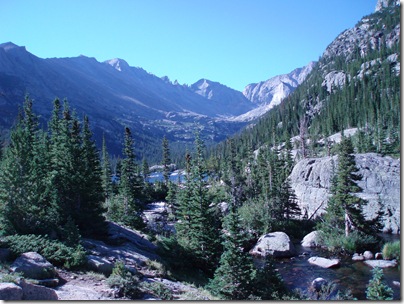
Rocky Mountain National Park (2007)

Lost
by David Wagoner, from Traveling Light 

Stand still. The trees ahead and bushes beside you
Are not lost. Wherever you are is called Here,
And you must treat it as a powerful stranger,
Must ask permission to know it and be known.
The forest breathes. Listen. It answers,
I have made this place around you.
If you leave it, you may come back again, saying Here.
No two trees are the same to Raven.
No two branches are the same to Wren.
If what a tree or a bush does is lost on you,
You are surely lost. Stand still. The forest knows
Where you are. You must let it find you.

Saturday, October 17, 2009

Sound Living, Sound Business

Julian Treasure
TED Talks (October 2009)


[Thanks Kit!]

Thursday, October 08, 2009

Expect Nothing Always

Philip Booth "Writing poems is not a career but a lifetime of looking into, and listening to, how words see." ~ Philip Booth

By Philip Booth:

How to See Deer

Forget roadside crossings.
Go nowhere with guns.
Go elsewhere your own way,

lonely and wanting.
Or stay and be early:
next to deep woods

inhabit old orchards.
All clearings promise.
Sunrise is good,

and fog before sun.
Expect nothing always;
find your luck slowly.

Wait out the windfall.
Take your good time
to learn to read ferns;

make like a turtle:
downhill toward slow water.
Instructed by heron,

drink the pure silence.
Be compassed by wind.
If you quiver like aspen

trust your quick nature:
let your ear teach you
which way to listen.

You've come to assume
protective color; now
colors reform to

new shapes in your eye.
You've learned by now
to wait without waiting;

as if it were dusk
look into light falling:
in deep relief

things even out.
Be careless of nothing.
See what you see.

First Lesson

Lie back daughter, let your head
be tipped back in the cup of my hand.
Gently, and I will hold you. Spread
your arms wide, lie out on the stream
and look high at the gulls. A dead-
man's float is face down. You will dive
and swim soon enough where this tidewater
ebbs to the sea. Daughter, believe
me, when you tire on the long thrash
to your island, lie up, and survive.
As you float now, where I held you
and let go, remember when fear
cramps your heart what I told you:
lie gently and wide to the light-year
stars, lie back, and the sea will hold you.

Wednesday, September 23, 2009

Conditions that Foster Creativity

Anna Deavere Smith, from her Chataqua Institution lecture “Looking for Grace,” FORA.tv, September 13, 2009:

I started to think about the conditions that foster creativity. I would say that any modest amount of creativity that I’ve experienced—at least in my adult life—required the following: a restricted environment, uncertainty, independence and responsibility, a lack of safety, the need for change, richness of inner life, need, physical beauty, contradictions, and doubt.

Now, if we were to create a school or community where we wanted to foster creativity, we would probably not seed the growth of those attributes. I think that list would look something like this: an environment where possibility seemed endless, steadiness, a firm foundation, strong mentorship, safety, richness of inner life, provisions, clarity, confidence, and physical beauty.


"My tape recorder and my ear create the necessary distance that allows me to get close to another person."

Tuesday, September 22, 2009

No Thing Here

In the seen, there is only the seen,
in the heard, there is only the heard,
in the sensed, there is only the sensed,
in the cognized, there is only the cognized.
Thus you should see that
indeed there is no thing here;

…as you see that there is no thing there,
you will see that
you are therefore located neither in the world of this,
nor in the world of that,
nor in any place
betwixt the two.
This alone is the end of suffering.

~ Buddha, from the Udana

At breakfast on Saturday, the sun slowly crept up the window until it was shining almost directly into my eyes. It occurred to me that while it feels like the sun was moving, it was really the me, the table, the room, the building, and the earth that were all rotating imperceptibly.

Aristarchus's 3rd century BC calculations on the relative sizes of the Earth, Sun and Moon, from a 10th century AD Greek copy. It’s been nearly four hundred years since Galileo began defending heliocentrism, and yet it still does seem to us that we are at the center of the universe. The image of a sphere of water and dirt and plants and animals careening through space remains unsettling. We still go to the beach to watch the sun rise and set. It is challenging to imagine that people living in other time zones are currently sleeping while we are going about our business awake.

If the sun isn’t menacing me or entertaining me, and the ground beneath my feet isn’t stationary, where am I supposed to find a safe place to make my home? Our nervous systems crave certainty and solidity and, in their absence, have created a complex process for representing stability.

It is very useful to accept these illusions, but at some point Prague Orlojwe can’t help seeing through them. We navigate the uncertainty by trying to determine what the absence of true solidity means. Some interpret it as nihilism, others find that there being no thing simply means that every thing is in constant dynamic flux.

Mindfulness practice, seems to be one way that the need for things to be fixed gets eroded gradually. This allows us to live more comfortably inside the illusion as well as being able to experience the wonder of participating in the ongoing flow of the universe.

Monday, September 21, 2009

The Theater of the Mind

Charles Bonnet said he wondered how ‘the theater of the mind’ could be generated by the machinery of the brain. Now, two hundred and fifty years later, I think we’re beginning to glimpse how this is done.”

~ Oliver Sacks, from “What Hallucination Reveals about Our Minds,” TED Talks (February 2009)

Thursday, September 10, 2009

The Substance of Things Not Seen

“Consider for a moment that sound does have form and we’ve seen that it can affect matter and cause form within matter. Then take a leap and think about the universe forming and think about the immense sound of the universe forming. Perhaps cymatics had an influence on the formation of the universe itself.”

~ Evan Grant, from “Making Sound Visible Through Cymatics,” TED Talks, July 2009 

Wednesday, September 02, 2009

Music is More Magical with Understanding

Cottton Top TamarindFrom “Music Written For Monkeys Strikes A Chord,” by Richard Harris, Morning Edition (9.2.09):

David Teie has been developing a theory to explain why music plays on human emotions. His theory is that music relates to the most primitive sounds we make and respond to, like laughter, heartbeats, or a mother's cooing.

Fearful monkey music:

Happy monkey music:

He says, "the paradox is that I distinctly remember thinking once that when they figure out why Puccini makes me cry, I hope I die the day before the news gets out. But the great news about this exploration into music is it's actually more magical and wonderful once you realize how it works."

David Teie Plays the Schuman Cello Concerto in A minor (Mvt 1) with the Eclipse Chamber Orchestra, April 2007

See also: Music for Cats