Showing posts with label aging. Show all posts

Monday, May 02, 2011

Benefits Beyond Relaxation

Excerpts from “How Meditation Might Ward Off the Effects of Ageing,” by Jo Marchant, The Guardian,  April 24, 2011:

The assumption that meditation simply induces a state of relaxation is "dead wrong", says Charles Raison. Brain-imaging studies suggest that it triggers active processes within the brain, and can cause physical changes to the structure of regions involved in learning, memory, emotion regulation and cognitive processing.

The question of how the immaterial mind affects the material body remains a thorny philosophical problem, but on a practical level, "our understanding of the brain-body dialogue has made jaw-dropping advances in the last decade or two," says Raison. One of the most dramatic links between the mind and health is the physiological pathways that have evolved to respond to stress, and these can explain much about how meditation works.

When the brain detects a threat in our environment, it sends signals to spur the body into action. One example is the "fight or flight" response of the nervous system. When you sense danger, your heart beats faster, you breathe more rapidly, and your pupils dilate. Digestion slows, and fat and glucose are released into the bloodstream to fuel your next move. Another stress response pathway triggers a branch of the immune system known as the inflammatory response.

These responses might help us to run from a mammoth or fight off infection, but they also damage body tissues. In the past, the trade-off for short bursts of stress would have been worthwhile. But in the modern world, these ancient pathways are continually triggered by long-term threats for which they aren't any use, such as debt, work pressures or low social status. "Psychological stress activates these pathways in exactly the same way that infection does," says Raison…

Meditation seems to be effective in changing the way that we respond to external events. After short courses of mindfulness meditation, people produce less of the stress hormone cortisol, and mount a smaller inflammatory response to stress. One study linked meditators' lower stress to changes in the amygdala —a  brain area involved in fear and the response to threat.

Read the entire article here…

See also: Shamatha Project

Wednesday, March 23, 2011

Temporary Custodian of Beautiful Things

“I’ve been lucky all my life. Everything was handed to me. Looks, fame, wealth, honors, love. I rarely had to fight for anything. But I’ve paid for that luck with disasters. . .I’m like a living example of what people can go through and survive. I’m not like anyone. I’m me.”

~ Elizabeth Taylor, quoted in “A Lustrous Pinnacle of Hollywood Glamour,” New York Times, Mar. 23, 2011

And this from a recent interview for Harper’s Bazaar, “I never planned to acquire a lot of jewels or a lot of husbands. For me, life happened, just as it does for anyone else. I have been supremely lucky in my life in that I have known great love, and of course I am the temporary custodian of some incredible and beautiful things. But I have never felt more alive than when I watched my children delight in something, never more alive than when I have watched a great artist perform, and never richer than when I have scored a big check to fight AIDS. Follow your passion, follow your heart, and the things you need will come.”

Tuesday, March 01, 2011

If You Take the Time

"In the course of the play, what I learn — and it's why I view it as a Zen play — is that if you take the time, which often old age and disease forces you to do, you slow down and take the time, you begin to see things differently. Things that might on the surface look mediocre, but that in fact, when you pierce them and delve down into them, are beautiful."

~ Jane Fonda, discussing 33 Variations with Susan Stamberg, Morning Edition, Mar. 1, 2011

Tuesday, November 30, 2010

Museum of Unfinished Gestures

Blank
by George Bilgere, from American Life in Poetry

When I came to my mother’s house
the day after she had died
it was already a museum of her
unfinished gestures. The mysteries
from the public library, due
in two weeks. The half-eaten square
of lasagna in the fridge.

The half-burned wreckage
of her last cigarette,
and one red swallow
of wine in a lipsticked
glass beside her chair.

Finally, a blue Bic
on a couple of downs
and acrosses left blank
in the Sunday crossword,
which actually had the audacity
to look a little smug
at having, for once, won.

Tuesday, November 23, 2010

Split from Our Bodies

Tara Brach, from Presence and Aliveness (Part 1), January 20, 2010 (download audio):

Our children do, more than ever, grow up in a virtual reality: video games and TV and computers and texting. Leaving the body’s very reinforced by the culture.

In spiritual-religious communities there’s a mistrust of the body. Especially where there’s a real imprint of the kind of shadow-masculine of controlling the body and not getting seduced by pleasure. You see this in the monastic communities.

Ulysses and the Sirens, John William Waterhouse (1891)

And of course we know, in this culture, there’s a mistrust of the body with pain, that pain is wrong, it’s bad, it’s to be controlled. And again, it’s totally wise and compassionate to use medication when appropriate, and we so overdo it. We’re so afraid of pain. We think that aging and death are kind of an embarrassment, an insult in some way. We anesthetize births and way over-interfere with dying.

So it’s a split. We get split from our bodies in this culture and it gets very much amplified with emotional wounding. If you really consider that the pain of our emotion lives in our bodies, when that emotional feels like too much, especially when we’re traumatized early, we have to leave. We have no other way to handle it. Emotional trauma makes us leave our bodies. The more emotional wounding there’s been, the more we’ve left our bodies. It’s pretty directly correlated.

So we push away the immediate experience of the pain in our body because we’re designed to try to anesthetize that much pain. The point, again, is not that we should avoid what comforts. It’s not even that we should stick with something that’s overwhelming.

The truth is our lives get very organized around avoiding unease and unpleasantness. It becomes important to recognize our flinch responses, our intolerance to physical discomfort or to difficult emotional weather. Because the habit is so quickly—without even be conscious of it—to leave our body and go into what I sometimes think of as the mental control tower, where we try to work things and maneuver things to feel better. We don’t stay. One of the best phrases I know, in terms of describing meditation, is learning to stay. Not in a way that’s uncompassionate. Not when it’s too much. But gradually getting the knack of noticing we’ve left, noticing we’re off in thoughts, and reconnecting with this aliveness. 

Saturday, September 25, 2010

What You Love

Guilty of Dust
by Frank Bidart, from In the Western Night

up or down from the infinite C E N T E R
B R I M M I N G at the winking rim of time

the voice in my head said

LOVE IS THE DISTANCE
BETWEEN YOU AND WHAT YOU LOVE

WHAT YOU LOVE IS YOUR FATE
                •
then I saw the parade of my loves

those PERFORMERS comics actors singers

forgetful of my very self so often I
desired to die to myself to live in them

then my PARENTS my FRIENDS the drained
SPECTRES once filled with my baffled infatuations

love and guilt and fury and
sweetness for whom

nail spirit yearning to the earth
                •
then the voice in my head said

WHETHER YOU LOVE WHAT YOU LOVE

OR LIVE IN DIVIDED CEASELESS
REVOLT AGAINST IT

WHAT YOU LOVE IS YOUR FATE

How My Son Ruined My Life

Selma Baraz reveals how her son, James Baraz’s Awakening Joy course has ruined her life.

Wednesday, September 22, 2010

It Turns to Reveal Its Other Face

Snippets of conversation from “A Wild Love for the World,” Being, September 16, 2010:

Krista Tippett: You really work with people to hold on to grief, to take their grief seriously, right?

Joanna Macy: Or not to hold on to it so much as to not be afraid of it because that grief, if you are afraid of it and pave it over, clamp down, you shut down. And the kind of apathy and closed-down denial, our difficulty in looking at what we're doing to our world stems not from callous indifference or ignorance so much as it stems from fear of pain. That was a big learning for me as I was organizing around nuclear power and around at the time of Three Mile Island catastrophe and around Chernobyl.

Then as I saw it, it relates to everything. It relates to what's in our food and it relates to the clear-cuts of our forests. It relates to the contamination of our rivers and oceans. So that became actually perhaps the most pivotal point in, I don't know, the landscape of my life, that dance with despair, to see how we are called to not run from the discomfort and not run from the grief or the feelings of outrage or even fear and that, if we can be fearless, to be with our pain, it turns. It doesn't stay static. It only doesn't change if we refuse to look at it. But when we look at it, when we take it in our hands, when we can just be with it and keep breathing, then it turns. It turns to reveal its other face, and the other face of our pain for the world is our love for the world, our absolutely inseparable connectedness with all life.

Krista Tippett: I just want to kind of underline the connection that you repeatedly make that I think might be counterintuitive. You know, you talk about spirituality and you are also always equally talking about, you know, these are some phrases from your writing that echo things you said. Your wild love for the world or even an erotic connection with the world, that those two things go together for you.

Joanna Macy: Yeah. That's right. World is lover, world is self and that it's OK for our hearts to be broken over the world. What else is a heart for? There's a great intelligence there. We've been treating the earth as if it were a supply house and a sewer. We've been grabbing, extracting resources from it for our cars and our hair dryers and our bombs and we've been pouring the waste into it until it's overflowing, but our earth is not a supply house and a sewer. It is our larger body. We breathe it. We taste it. We are it and it is time now that we venerate that incredible flowering of life that takes every aspect of our physicality.

So when I — I'm looking at my hand right now as we talk. It's got a lot of wrinkles because I'm 81 years old, but it's linked to hands like this back through the ages. This hand is directly linked to hands that learned to reach and grasp and climb and push up on dry land and weave reeds into baskets, and it has a fantastic history. Every particle and every atom in this hand goes back to the beginning of space-time. We're part of that story.

Read or listen to the whole conversation here…

See also: Hands

Sunday, March 21, 2010

Nature Guards Its Secrets

Spring Equinox 2010

Look Again
by Sarah Lindsay, from Twigs and Knucklebones 

I know how little I know
from observation:
that the dog sleeping on the rug
with pure concentration
will be sleeping, each time I look up,
in a different direction,

that five wart-lidded mushrooms
can form on the lawn
in the time rain takes
to shift from falling to fallen,

that my eyes are too slow
to track shooting stars, too quick
to spy continental drift,
and Earth conceals its spin
by spinning me with it,

that a tree won’t let me
see its growth, only its height,
that hairs on my head go singly gray
only by night. 

Monday, November 30, 2009

It’s Less the Device than the Devices

From “Over 60, and Proud to Join the Digerati,” by James R. Gaines, New York Times, November 28, 2009:

Yes, the world of print publishing is going through a fundamental disruption brought about by the Internet. People are being laid off left and right, newspapers and magazines are folding, the book business is floundering.

In the digital world, though, social networks are now bigger than most national populations, more people are consuming more news and information than ever before, and an archive of all the world’s knowledge is being built and streamed to your favorite device. This new world brings with it as much promise as pain. It’s like youth that way.

Media will change as radically as technology allows, and right now the Internet is moving over the media landscape like a tsunami. But the job I learned to love when young was to tell stories, and the story has lost nothing in this transition. It is as elemental and as riveting as ever.

Everybody’s worried about the device. Could Microsoft’s Courier be the answer, or the iTablet? Good question, but not the most important one. It’s less the device than the devices — the crafts and the art of storytelling — that need updating most urgently for the digital world.

The young people I work with now will be the settlers of that frontier, and I can’t think of anything I would rather do than help them get there.

pencil-gaines

Sunday, November 29, 2009

The House of Small Cubes

La Maison En Petites Cubes from Anton Cherednichenko on Vimeo.

Life Moved More Slowly

From Buddhist Geeks Podcast Episode 148: “Work, Sex, Money, Dharma,” a conversation with Martin Aylward:

There's a quote by Lao Tzu, who was an exact contemporary of the Buddha. So living two and a half thousand years ago in rural China.  And when he was an old Lao Tzuman, he wrote: "When I was younger, life moved more slowly. People had time for each other. Nowadays, everything moves so quickly. Everything's so complicated, people don't have time for each other." And you know, that's two and a half thousand years ago in China.

So one has to ask well, has life been constantly getting more and more crazy and complicated, and people having less and less time for each other over those two and a half thousand years? Or is it that there's that tendency of mind as we get older, to look back and idealize something from our own memory as being simpler, and then kind of apply that to the outside world. And so that can happen in any generation, and it can happen around anything.

It can certainly happen around the Internet, taking us away from ourselves rather than just being the latest tool.

Sunday, November 15, 2009

Neither Young Nor Old

November, Trees  by John HuberSabbaths 2005
VII.

I know I am getting old and I say so,
but I don’t think of myself as an old man.
I think of myself as a young man
with unforeseen debilities. Time is neither
young nor old, but simply new, always
counting, the only apocalypse. And the clouds
—no mere measure or geometry, no cubism,
can account for clouds or, satisfactorily, for bodies.
There is no science for this, or art either.
Even the old body is new—who has known it
before?—and no sooner new than gone, to be
replaced by a body yet older and again new.
The clouds are rarely absent from our sky
over this humid valley, and there is a sycamore
that I watch as, growing on the riverbank,
it forecloses the horizon, like the years
of an old man. And you, who are as old
almost as I am, I love as I loved you
young, except that, old, I am astonished
at such a possibility, and am duly grateful.

~ From Leavings by Wendell Berry

Sunday, October 18, 2009

Hands

Dłonie (Hands)
by Maciej Jurewicz

A short documentary about silence.


@jscarroll

Thursday, September 24, 2009

When I Was a Child I Understood

What I Understood
by Katha Pollitt, from The Mind-Body Problem

When I was a child I understood everything
about, for example, futility. Standing for hours
on the hot asphalt outfield, trudging for balls
I'd ask myself, how many times will I have to perform
this pointless task, and all the others? I knew
about snobbery, too, and cruelty—for children
are snobbish and cruel—and loneliness: in restaurants
the dignity and shame of solitary diners
disabled me, and when my grandmother
screamed at me, "Someday you'll know what it's like!"
I knew she was right, the way I knew
about the single rooms my teachers went home to,
the pictures on the dresser, the hoard of chocolates,
and that there was no God, and that I would die.
All this I understood, no one needed to tell me.
the only thing I didn't understand
was how in a world whose predominant characteristics
are futility, cruelty, loneliness, disappointment
people are saved every day
by a sparrow, a foghorn, a grassblade, a tablecloth.
This year I'll be
thirty-nine, and I still don't understand it.

[More poems by Katha Pollitt.]

Sunday, August 30, 2009

Birdman

“Forrest Bird’s invention, the respirator, has saved millions of lives and, at 86, he’s still living his life to the fullest, flying his airplanes and working 12-hour days.”

Tuesday, August 18, 2009

Until Then

First Grade
appleby Ron Koertge

Until then, every forest
had wolves in it, we thought
it would be fun to wear snowshoes
all the time, and we could talk to water.

So why is this woman with the gray
breath calling out names and pointing
to the little desks we will occupy
for the rest of our lives?


From American Life in Poetry: Column 230

Monday, July 20, 2009

How Long Do You Think You’re Going to Live?

From The Week (July 24, 2009):

British Vogue July 2009 Julianne Moore doesn’t mind calling herself “middle-aged,” says Gaby Wood in British Vogue. “When people say, ‘I’m not middle-aged,’ you want to say, ‘Well, exactly how long do you think you’re going to live?’” the 48-year-old actress says. “It becomes so tedious after a while, this idea that everybody’s so focused on being young. Whenever you ask anybody, ‘Would you want to be 20 again?’ invariably they go, ‘No.’ You don’t want to repeat it—you want to be what you are.” In Moore’s case, youth was not only a time of personal confusion; it was a time when she couldn’t find work. “When I was auditioning for movies in the ’80s, I never got anything. They made a lot of movies about young people doing things, like St. Elmo’s Fire. I got my first movie role when I was 29, which was considered really old. I wasn’t supposed to tell anyone my age. It was horrible—so stupid and awkward—and I found it really oppressive. I was, like, I can’t do this anymore! What is the problem with telling people I’m 30, 31, 32?” She got her breakthrough in indie films, and her career took off after that. Moore’s now fully content with both her professional life and her personal one—she’s married, with two children—and the recent sudden death of friend Natasha Richardson helped put things in perspective. “I’m lucky to be 48, and not be … not here. I’m never going to be 48 again—48’s over after this year.”

Tuesday, June 02, 2009

Get Some Plaster

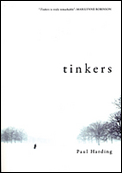
Excerpt from Tinkers by Paul Harding:

Tinkers George Washington Crosby began to hallucinate eight days before he died. From the rented hospital bed, placed in the middle of his own living room, he saw insects running in and out of imaginary cracks in the ceiling plaster. The panes in the windows, once snugly pointed and glazed, stood loose in their sashes. The next stiff breeze would topple them all and they would flop onto the heads of his family, who sat on the couch and the love seat and the kitchen chairs his wife had brought in to accommodate everyone. The torrent of panes would drive everyone from the room, his grandchildren in from Kansas and Atlanta and Seattle, his sister in from Florida, and he would be marooned on his bed in a moat of shattered glass. Pollen and sparrows, rain and the intrepid squirrels he had spent half his life keeping out of the bird feeders would breach the house.

He had built the house himself—poured the foundation, raised the frame, joined the pipes, run the wires, plastered the walls, and painted the rooms. Lightning struck once when he was in the open foundation, soldering the last joint of the hot-water tank. It threw him to the opposite wall. He got up and finished the joint. Cracks in the plaster did not stay cracks; clogged pipes got routed; peeling clapboard got scraped and slathered with a new coat of paint.

Get some plaster, he said, propped up in the bed, which looked odd and institutional among the Persian rugs and Colonial furniture and dozens of antique clocks. Get some plaster. Jesus, some plaster and some wires and a couple of hooks. You’d be all set for about five bucks.

Yes, Gramp, they said.

Yes, Dad. A breeze blew through the open window behind him and cleared exhausted heads. Bocce balls clicked out on the lawn.

Tuesday, April 28, 2009

Foreseeing

by Sharon Bryan, from Flying Blind

Flying Blind Middle age refers more
to landscape than to time:
it's as if you'd reached

the top of a hill
and could see all the way
to the end of your life,

so you know without a doubt
that it has an end—
not that it will have,

but that it does have,
if only in outline—
so for the first time

you can see your life whole,
beginning and end not far
from where you stand,

the horizon in the distance—
the view makes you weep,
but it also has the beauty

of symmetry, like the earth
seen from space: you can't help
but admire it from afar,

especially now, while it's simple
to re-enter whenever you choose,
lying down in your life,

waking up to it
just as you always have—
except that the details resonate

by virtue of being contained,
as your own words
coming back to you

define the landscape,
remind you that it won't go on
like this forever.