Excerpts from Antony Gormley (Contemporary Artists) by John Hutchinson, E.H. Gombrich, and Lela B. Njatin:
To Meister Eckhart, art was religion and religion art. Artistic form, in his view, was a revelation of essence, a kind of revelation that is both living and active. “Work,” he wrote, “comes from the outward and from the inner man, but the innermost man takes no part in it. In making a thing the very innermost self of a man comes into outwardness.”
…

Much of Antony Gormley’s art is based on his understanding of Western and Eastern spiritual traditions, and his work resonates when it is placed in this context. Like Eckhart — or, indeed like Joseph Beuys — Gormley believes that the artist is not a special kind of man, but that every man is a special kind of artist…He works with “types,” with universals, and yet he roots his work in subjective experience…But what concerns Gormley more than anything else, is the paradoxical manner in which man, while containing infinite space, is also contained by it…His sculpture deals with what he sees as the “deep space” of the interior body, yet he is also concerned with “touch as gravity” and “gravity as the attraction that binds us to the earth.” Its key strength, perhaps, lies in the artist’s determination to accept nothing until is has been lived and internalized. Gormley’s work is structured and methodical, preconceived to a certain point, and then realized in the process of making.
…
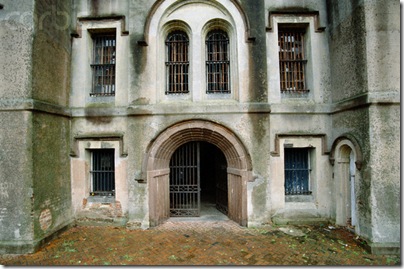
To Gormley, the body has a relation to the external space within which it exists as well as to the inner space it contains. And in a [1991] installation made for “Places with a Past,” an exhibition of site-specific art at Charleston, South Carolina, Gormley combined a series of works — Host, Field, Three Bodies, Learning to Think, Fruit and Cord — in order to explore that relationship. The Old City Jail, which contained and became part of the installation, could be described as having the shape of a body: the original rectangular structure is rather like a torso; its later octagonal addition, like a head. And in order to emphasize its parallels with his body cases, which are sometimes connected to the outside world through orifices, Gormley removed the boards and glazing that had sealed up the prison’s doors and windows. This allowed light and sound to enter the prison, to enliven what had hitherto been dark and dormant, and to engage time as an active element in the installation. In the artist’s words, “the building became a catalyst for reflection on liberty and incarceration.”
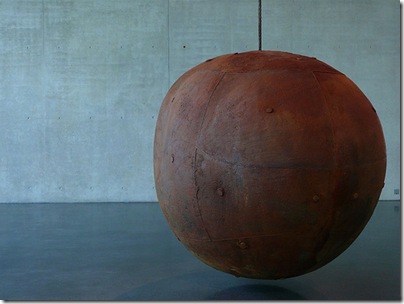
One the second floor, Field, a set of terracotta figurines, faced a similar vast space that contained only Three Bodies—large metal spheres, made of steel and air, which the aritst has described as “like celestial bodies fallen from the sky.”

Above Field was Learning to Think, five headless lead body cases that were suspended from the ceiling, in a contradictory evocation of both lynching and ascension. The corresponding space held Host, a room containing mud and sea water — “The surface of the earth described in Genesis…the unformed, the place of possibility, a place waiting for the seed,” according to Gormley.

In the octagonal extension, two related organic forms, Fruit, were hung on either side of a wall. Only one was visible at a time in order “to reconcile opposites not in terms of differentiation but by mirroring,” Hidden from view, and at the center of each sculpture, was a space once occupied by the artist’s own body, linked to the other side, though mouth and genitals, by steel pipes. The final piece was Cord, made of many tubes inside one another — a kind of umbilical lifeline between the “seen” and “unseen.”
In this installation, one of great richness and complexity, Gormley brought into play the full panoply of his ambition. Working with lead and clay, as well as with the four elements, Gormley alluded to physical and spiritual containment, body and mind, outer and inner worlds, feeling and thinking, birth and death, growth and decay. And if the contradictions inherent in  Learning to See give strength to the artist’s conception of inner vision, the dualities evoked by the installation at Charleston are subservient to a sense of passage towards expansiveness. The emotional depth of the work can be ascribed to its refusal to exclude either the particular or the universal: it encompasses both historical specificity and a sense of shared human experience. In formal terms, this is achieved by the undermining of the Modernist notion of the self-referential object. While each of the elements of the installation can be separately contemplated, they are most meaningful when perceived as parts of a larger whole. In that sense, they are like parts of a body.





 The truth is our lives get very organized around avoiding unease and unpleasantness. It becomes important to


 “I see nothing irrational about seeking the states of mind that lie at the core of many religions. Compassion, awe, devotion and feelings of oneness are surely among the most valuable experiences a person can have…Ecstasy, rapture, bliss, concentration, a sense of the sacred—I’m comfortable with all of that…I think all of that is indispensable and I think it’s frankly lost on much of the atheist community.”
 "That it doesn't strike us at all when we look around us, move about in space, feel our own bodies, shows how natural these things are to us. We do not notice that we see space perspectively or that our visual field is in some sense blurred towards the edges. It doesn't strike us and never can strike us because it is the way we perceive. We never give it a thought and it's impossible we should, since there is nothing that contrasts with the form of our world. What I wanted to say is it's strange that those who ascribe reality only to things and not to our ideas move about so unquestioningly in the world as idea and never long to escape from it."
 "If I feel really bad about myself, if I don't like myself, how many people are there in here? Which one is it that doesn't like the other one? Isn't there a sense of superiority? When I say, I'm such a schmuck, isn't the person who's thinking that a little bit better than the schmuck that he just judged? So how many people are there in there? It looks like at least two. When I think, Oh, I'm such a jerk, selfish person, hot-tempered person—whatever derogative comment we make about ourselves—it seems to me that it is a classic instance of it-ifying oneself. Just turning oneself into an unpleasant object from a superior vantage point and then looking down on oneself as that's the one I don't like.
  But it happens not only for self-loathing, low self-esteem, lack of self-worth and so forth, but on some occasions some people feel pretty good about themselves: self-infatuation. Looking into the mirror and saying, Looking good! I am really something. And now there's one more it and this is a pleasant it. We're applauding the it as if we're watching a show. So we can it-ify, objectify, in an agreeable fashion, in which case we become objects of attachment for ourselves. We can be also objects of aversion for ourselves. And on other occasions, we can simply say, Man, you're a boring person. I don't really care much about you one way or another. So one more it-ifying.”
 The
The 





