Showing posts with label sculpture. Show all posts

Friday, October 29, 2010

Containing and Contained by Infinite Space

Excerpts from Antony Gormley (Contemporary Artists) by John Hutchinson, E.H. Gombrich, and Lela B. Njatin:

To Meister Eckhart, art was religion and religion art. Artistic form, in his view, was a revelation of essence, a kind of revelation that is both living and active. “Work,” he wrote, “comes from the outward and from the inner man, but the innermost man takes no part in it. In making a thing the very innermost self of a man comes into outwardness.”

Much of Antony Gormley’s art is based on his understanding of Western and Eastern spiritual traditions, and his work resonates when it is placed in this context. Like Eckhart — or, indeed like Joseph Beuys — Gormley believes that the artist is not a special kind of man, but that every man is a special kind of artist…He works with “types,” with universals, and yet he roots his work in subjective experience…But what concerns Gormley more than anything else, is the paradoxical manner in which man, while containing infinite space, is also contained by it…His sculpture deals with what he sees as the “deep space” of the interior body, yet he is also concerned with “touch as gravity” and “gravity as the attraction that binds us to the earth.” Its key strength, perhaps, lies in the artist’s determination to accept nothing until is has been lived and internalized. Gormley’s work is structured and methodical, preconceived to a certain point, and then realized in the process of making.

To Gormley, the body has a relation to the external space within which it exists as well as to the inner space it contains. And in a [1991] installation made for “Places with a Past,” an exhibition of site-specific art at Charleston, South Carolina, Gormley combined a series of works — Host, Field, Three Bodies, Learning to Think, Fruit and Cord — in order to explore that relationship. The Old City Jail, which contained and became part of the installation, could be described as having the shape of a body: the original rectangular structure is rather like a torso; its later octagonal addition, like a head. And in order to emphasize its parallels with his body cases, which are sometimes connected to the outside world through orifices, Gormley removed the boards and glazing that had sealed up the prison’s doors and windows. This allowed light and sound to enter the prison, to enliven what had hitherto been dark and dormant, and to engage time as an active element in the installation. In the artist’s words, “the building became a catalyst for reflection on liberty and incarceration.”

Old Jail, Charleston, exterior

One the second floor, Field, a set of terracotta figurines, faced a similar vast space that contained only Three Bodies—large metal spheres, made of steel and air, which the aritst has described as “like celestial bodies fallen from the sky.”

American Field, Antony Gormley (1991)

Above Field was Learning to Think, five headless lead body cases that were suspended from the ceiling, in a contradictory evocation of both lynching and ascension. The corresponding space held Host, a room containing mud and sea water — “The surface of the earth described in Genesis…the unformed, the place of possibility, a place waiting for the seed,” according to Gormley

Learning to Think, Antony Gormley (1991)

In the octagonal extension, two related organic forms, Fruit, were hung on either side of a wall. Only one was visible at a time in order “to reconcile opposites not in terms of differentiation but by mirroring,” Hidden from view, and at the center of each sculpture, was a space once occupied by the artist’s own body, linked to the other side, though mouth and genitals, by steel pipes. The final piece was Cord, made of many tubes inside one another — a kind of umbilical lifeline between the “seen” and “unseen.”

Body & Fruit, 1991/93

In this installation, one of great richness and complexity, Gormley brought into play the full panoply of his ambition. Working with lead and clay, as well as with the four elements, Gormley alluded to physical and spiritual containment, body and mind, outer and inner worlds, feeling and thinking, birth and death, growth and decay. And if the contradictions inherent in Learning to See (1991) Learning to See give strength to the artist’s conception of inner vision, the dualities evoked by the installation at Charleston are subservient to a sense of passage towards expansiveness. The emotional depth of the work can be ascribed to its refusal to exclude either the particular or the universal: it encompasses both historical specificity and a sense of shared human experience. In formal terms, this is achieved by the undermining of the Modernist notion of the self-referential object. While each of the elements of the installation can be separately contemplated, they are most meaningful when perceived as parts of a larger whole. In that sense, they are like parts of a body.

Tuesday, September 07, 2010

Making Waves

“Making architecture is like writing a novel; making a work of art is like a poem.”

~ Maya Lin, from “Maya Lin’s ‘Wave Field’,” video produced by Erik Olsen & Carol Kino, New York Times, November 2008 

Groundswell,” 1993. Forty-three tons of recycled, shattered automobile safety glass. Wexner Center for the Arts, Ohio State University, Columbus

"The Wave Field," 1995. Shaped earth; 100 x 100 feet. University of Michigan, Ann Arbor, Michigan

Blue Lake Pass,” 2006, Duraflake particleboard, 20 blocks, 36 x 36 in. each (68 x 210 x 269 in. overall)

Storm King Wavefield,” 2008. Earth and grass; 240,000 square feet (11-acre site)

maya-lin-waves-what-is-missing

Video still from Maya Lin’s tribute to vanishing species titled What is Missing?

Saturday, September 04, 2010

Digitally Archiving David

Scanning David

From The Digital Michelangelo Project:

“Recent improvements in laser rangefinder technology, together with algorithms developed at Stanford for combining multiple range and color images, allow us to reliably and accurately digitize the external shape and surface characteristics of many physical objects. Examples include machine parts, cultural artifacts, and design models for the manufacturing, moviemaking, and video game industries.

As an application of this technology, a team of 30 faculty, staff, and students from Stanford University and the University of Washington spent the 1998-99 academic year in Italy scanning the sculptures and architecture of Michelangelo. As a side project, we also scanned 1,163 fragments of the Forma Urbis Romae, a giant marble map of ancient Rome…Our goal is to produce a set of 3D computer models - one for each statue, architectural setting, and map fragment we scanned - and to make these models available to scholars worldwide.”

Scanning David “The motivations behind this project are to advance the technology of 3D scanning, to place this technology in the service of the humanities, and to create a long-term digital archive of some important cultural artifacts.”

“On the left is a photograph of Michelangelo's David. On the right is a computer rendering made from a geometric model. Constructed in December, 1999 at a resolution of 1.0 mm, the model is watertight and contains 4 million polygons. For a brief overview of the steps required to build this model, click here.”

Laser scan of the David

Tuesday, August 31, 2010

Small Wonders

Party Bed

workworkworkworkwork
by Charles LeDray
Institute of Contemporary Art
Through October 17, 2010

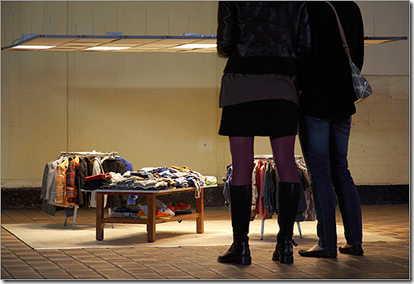
workworkworkworkwork consists of hundreds of objects, including shirts, pottery, paintings, necklaces and magazines that recreate displays of objects for sale that homeless people frequently put on New York sidewalks. (Bing, 2003) The piece is not classified by object, however it is more of a confusion of pieces, each “grouping is ordered in its own special way, as if different senses of order were involved, individual orders—different levels of marketing and presentability.” (Saltz, 1992)

~ Wikipedia

MENS SUITS, Charles LeDray, 2006MENS SUITS 

Excerpt from “Life’s Wear and Tear,” by Sebastian Smee, the Boston Globe, July 16, 2010:

Charles LeDray treats clothes as surrogates for human identity, particularly male identity, and for the many types of work that go into constructing it. As such—and unlike the fashion industry, which is founded on an unblinking faith in the potential of clothes to communicate power, beauty, and self-worth—his work is intensely alive to the pathos clothes can communicate, and to the many senses in which they just don’t . . . quite. . . fit.

LeDray, who was born in Seattle in 1960 and lives and works in New York, gives this “not quite fitting’’ a literal twist. The majority of the clothes he makes and transforms into sculptures are small. Too small to wear, but not so small that they seem precious or cute.

And yes, LeDray makes them. All of them. By hand. Himself.

Today, when the actual making of art objects is frequently displaced from the hands of the nominal creator to various anonymous assistants, there’s an atavistic appeal in LeDray’s displays of virtuosic skill and dedication. But it’s not just a sentimental appeal.

The time LeDray dedicates to the making of his pieces — in some cases as long as three or four years — is as much a conceptual tool as the medium itself. Painstakingly cut, carved, stitched, sewn, and thrown, his sculptures crystallize, through ironic devotion, a sense of pathos. They sharpen our awareness of the expendability of things…

Thinking of the artist working away, with scissors, pins, needle, and thread, I thought of W.S. Merwin’s great poem, “Separation’’:

Your absence has gone through me
Like thread through a needle.
Everything I do is stitched with its color.

Overcoat, 2004

Monday, April 20, 2009

Emerge

William Lamson is “a Brooklyn based artist, interested in photography, sculpture and performance. Using inexpensive materials and simple structures, he creates visuals that are mesmerizing and, in one word, playful.” An exhibition of his work will run from May 22 through June 21 at Pierogi Brooklyn.


From NPR’s Daily Picture Show blog.

[Thanks Scott!]