“I take comfort in histories and knowing that something came before me and something will come after me and that I’m just part of it. Sometimes students will say, ‘Well, it’s all been done.’ But I think, who cares? What does that have to do with anything? I wouldn’t be painting if I cared about that. Okay it’s all been done, so what? You have to figure out how to do it for you.”
“Stretching along High Street, south of the Ohio State University campus, the Short North is Columbus’s designated arts district and home to a hugely popular arts event called Gallery Hop. On the first Saturday of each month, street performers, musicians and artists hit the sidewalks, shops set up temporary exhibits, and art galleries remain open late. Drawing crowds since it started in 1984, Gallery Hop helped transform the formerly neglected, crime-ridden urban district into the vibrant, independent arts enclave that it is today.”
From “Hello, Columbus,” by Ingrid K. Williams, New York Times (March 14, 2010)
ART AT STAKE I'll See Your Lorrain and Raise You a Turner (Studio 360)
“The directors of the New Orleans and the Indianapolis art museums have a lot more riding on this weekend's Super Bowl than a couple of bucks in the office pool. After arts blogger [Tyler Green] posed a challenge, they've each put up a treasured painting from their collections. The director of the losing city's museum will have to lend his masterpiece to the winner.”
HARD TARGETS Sports and Masculinity Explored in Art
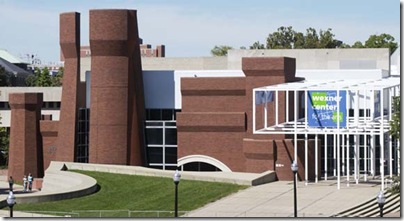
“The multimedia exhibition Hard Targets, on view January 30–April 11, 2010 at the Wexner Center, surveys provocative artworks produced over the last 25 years that take masculinity and sports as their central themes. Ranging broadly in interest and focus from biology to commodity and locker room to stadium, Hard Targets endeavors to complicate and revise the time-honored archetype of the male athlete as an aggressive, heterosexual, hyper-competitive, emotionally remote subject. Instead, the artists in the show offer opposing views of masculinity and sport, and of the entire theater of athletic play, including the rituals and accoutrements that surround this intimate, and often still male-dominated, world. The more than 70 works—in a wide variety of media, including video, photography, mixed-media sculpture, painting, and installation—range from funny and irreverent to self-effacing and incisive.”
“The 21 artists in the show are Doug Aitken, Matthew Barney, Mark Bradford, Harun Farocki, Andreas Gursky, Douglas Gordon, David Hammons, Brian Jungen, Byron Kim, Jeff Koons, Cary Leibowitz, Glenn Ligon, Kori Newkirk, Catherine Opie (including a new suite of photographs of high school football players produced in Columbus), Philippe Parreno, Paul Pfeiffer (whose 11 exhibited pieces offer a mini-survey of this artist’s work), Collier Schorr, Sam Taylor-Wood, Hank Willis Thomas, and Jonas Wood. In addition, a video work by Joe Sola video will be presented in The Box video space during the first month of the show.”
“Each artist examines the way masculinity is characterized and ‘performed’ in a sporting context, and each suggests that the ways we view and consume sports stars and athletic events are structured by more complex systems of desire and identification than most spectators realize. The works in the exhibition open up alternative, and possibly more democratic, interpretations and inflections of sports and sports fandom than the authorized, often frankly commercial, images that most frequently and forcefully convey the cultural identity of male athletes and athleticism.”
"The primary focus of this path of choosing wisely...is learning to stay present. Pausing very briefly, frequently throughout the day, is an almost effortless way to do this. For just a few seconds we can be right here. Meditation is another way to train in learning to stay or...learning to come back, to return to the present over and over again."
"In Zen Buddhist painting, ensō symbolizes a moment when the mind is free to simply let the body-spirit create. The brushed ink of the circle is usually done on silk or rice paper in one movement and there is no possibility of modification: it shows the expressive movement of the spirit at that time."