Showing posts with label maturity. Show all posts

Sunday, May 01, 2011

Before & After: My Imperfection is My Nature

Photograph by Amy Arbus for The New York Times

From “Last-Minute Doubts, New York City,” interviews by Joanna Miller, The New York Times, May 1, 2011:

ANNA MEDVEDEVA, 24: The photo was taken the night before my breast-augmentation, chin- and neck-liposuction surgeries, and I was very confused and was thinking, What are you doing with yourself, girl? I spent all that day at home preparing for surgery. I was alone with my fear that night, and I was thinking that I wanted to change my decision. So I tried on the bandage that I would have to wear on my face after the surgery. I felt scared and called my best friend, who really helped me so much. My friend and I talked as Amy took pictures of me. In some, I was nude, and when the light went through the window from the street and I saw myself, I thought, I’m already perfect. My imperfection is my nature. Now, after everything is done, I love it so much. I look to the mirror, and I’m like: “Wow, you’re so sexy. I want you, girl.”

AMY ARBUS: A week before this photo session, Anna told me she was having plastic surgery, and I asked to do before-and-after pictures. Toward the end of this shoot, she started getting nervous about the surgery, and I said, “You can still change your mind.” She was on the phone a lot with her girlfriend, and when we were done, she was looking to see if she had heard back, and that’s when I took that picture. It was the last one I took.

Wednesday, April 13, 2011

You Will See

Evelyn Corley Buzbee

“Go into your own familiar yard. It may be a beautiful garden. It may be only a weedy lawn with a few half-dead shrubs. No matter — if you throw back your shoulders and look up into the sky, you will see what else is yours.”

~ Evelyn Corley Buzbee, lifelong gardener

See also: Cabin Tiger Studio

[Thanks, Pat!]

Saturday, February 26, 2011

The Bright Home in Which I Live

Winter 2010

The House of Belonging
by David Whyte, from The House of Belonging

I awoke
this morning
in the gold light
turning this way
and that

thinking for
a moment
it was one
day
like any other.

But
the veil had gone
from my
darkened heart
and
I thought

it must have been the quiet
candlelight
that filled my room,

it must have been
the first
easy rhythm
with which I breathed
myself to sleep,

it must have been
the prayer I said
speaking to the otherness
of the night.

And
I thought
this is the good day
you could
meet your love,

this is the black day
someone close
to you could die.

This is the day
you realize
how easily the thread
is broken
between this world
and the next

and I found myself
sitting up
in the quiet pathway
of light,

the tawny
close grained cedar
burning round
me like fire
and all the angels of the housely
heaven ascending
through the first
roof of light
the sun has made.

This is the bright home
in which I live,
this is where
I ask
my friends
to come,
this is where I want
to love all the things
it has taken me so long
to learn to love.

This is the temple
of my adult aloneness
and I belong
to that aloneness
as I belong to my life.

There is no house
like the house of belonging.

Sunday, May 16, 2010

The Way You Are

“You know how unhappy you would be if you thought that the way you are is not okay? I started out my life like that. I don’t want to end up my life like that.”

~ Bill Withers, from Still Bill

Tuesday, March 30, 2010

Preparing for Things that Matter Most

“Most people vastly overestimate the extent to which more money would improve our lives. Most schools and colleges spend too much time preparing students for careers and not enough preparing them to make social decisions. Most governments release a ton of data on economic trends but not enough on trust and other social conditions. In short, modern societies have developed vast institutions oriented around the things that are easy to count, not around the things that matter most. They have an affinity for material concerns and a primordial fear of moral and social ones…Governments keep initiating policies they think will produce prosperity, only to get sacked, time and again, from their spiritual blind side.”

~ David Brooks, from “The Sandra Bullock Trade,” New York Times (March 29, 2010)

Friday, March 26, 2010

We’ve Seen it All Before

Excerpt from the introduction of Taking Our Places: The Buddhist Path to Truly Growing Up by Norman Fischer:

Taking Our Places Another characteristic of maturity — one that any of us would mention — is experience. A grown-up is someone who is experienced and, through having lived long enough to have seen many things, has a point of view and a measure of savvy about how life works. There is certainly no substitute for the experience that accumulates as the years go by, but it is also possible to be alive for a long time and not really experience our living, not really see our life. The human capacity for self-deception and blindness runs deep. We may be alive, but we have not necessarily lived. If we accumulate experiences without really engaging with them, then our experience tends to make us stodgy and boring. As we catalog and define our experiences, possessing them without ever really being possessed by them, we begin to expect that new situations will just be repetitions of old ones. Soon we feel as if we’ve seen it all before. We know what to expect. Our point of view gradually becomes a set of blinders rather than a searching flashlight.

But if we pay close and open attention to our experiences, life’s larger patterns begin to come into view. We see that all things are transitory and unique. Nothing repeats. We understand that, though always instructive, the past can never tell us what the future will be. Within the larger pattern that experience reveals, there are endless variations. Insofar as we see this, our experience increases our wonder at and appreciation of all that happens. With little life experience, we might be naively excited by the novelty of a person we meet or an event that occurs. But when we truly appreciate our experience, we respond to that newness with a deeper understanding of its meaning and wonder as we relate it to what we have seen before. Far from dampening our sense of wonder, real experience refreshes and mellows it.

Wednesday, March 17, 2010

Become What You Are

Excerpt from the introduction of Taking Our Places: The Buddhist Path to Truly Growing Up by Norman Fischer:

Time is strange. We live within it, depend on it, take it for granted, yet it relentlessly passes, and our lives slip through our fingers moment by moment. Where does time come from, and where does it go? How is it that every moment we are different, we grow, we develop, we are born, we die? What are we supposed to be doing with this life?

After many years of grappling with these questions during the course of my long spiritual journey, I have come to have a feeling for their answers. We don’t really know what appears, what time is, where it goes. But we are here to try to understand. And we all have our own way of understanding, and of expressing that understanding through the living of our lives.

Each of us has a place in this world. Taking that place, I have come to feel, is our real job as human beings. We are not generic people, we are individuals, and when we appreciate that fact completely and allow ourselves to embrace it and grow into it fully, we see that taking our unique place in this world is the one thing that gives us a sense of ultimate fulfillment.

Bantu tribesmen, it is said, sneak into the rooms of their children as they sleep and whisper in their ears, “Become what you are.”

To take our place is to mature, to grow into what we are. Mostly we take maturity for granted, as if it were something that comes quite naturally and completely as our bodies grow and our minds and hearts fill up with life experience. In fact, however, few of us are truly mature individuals; few of us really occupy our places. We are merely living out a dream of maturity, a set of received notions and images that passes for adulthood. What does it really mean to grow up? How do we do the work that will nurture a truly mature heart from which can flow healing words and deeds? Each of our lives depends on our undertaking the exploration that these questions urge us toward. And the mystery is that the whole world depends on each of us to take this human journey.

Monday, November 02, 2009

The Full Flowering of Humanity

Coming Home “Enlightenment is the awakening to our primal harmony or, in another mystical language, to our rootedness in the Divine. From Enlightenment radiate the insight, compassion, and power needed to resolve individual and collective human problems as they continue to rise endlessly. Enlightenment is not a magical transcendence of the human condition but the full flowering of humanity, disclosing unity and equilibrium at the heart of the love and suffering we call life.
All existence is revealed to the Enlightened human being as a seamless whole, as Divine Life. Some taste of this Enlightenment which consciously touches the Ultimate is possible for each of us. It need not be deferred to any future existence in heaven or on earth.

Enlightenment is the secret essence of our consciousness, and the gradual revelation of this essence is the process of spiritual growth in which everyone is involved.”

~ Lex Hixon, from Coming Home: The Experience of Enlightenment in Sacred Traditions

Tuesday, October 20, 2009

Animals Never Lie

Excerpt from White Apples by Jonathan Carroll:

White Apples “Here's something you must know and don't forget it—animals never lie. They don't lie, they don't put on disguises, and they are always true to what they are. That's why you can trust them."

“Excuse me, but I do not trust lions. Or bears or snakes—"

"That’s because you want them to be the creatures you imagined as a child. Lions should be the strong but sweet beasts in a Disney cartoon. But they aren't, so when they start acting like lions you're angry at them for not being the fantasy animals you imagined. Real bears don't wear top hats and ride unicycles. Nor do they sleep in bed next to Goldilocks. Human beings force them to do those stupid things in circuses and films or children's books. Sure, some might be more docile or more ferocious than others, but in the end they will always, always be bears. You know you should never should turn your back on a bear. You should never even get near them; it's that simple. They're not being dishonest—you are in your perception of them."

Monday, October 12, 2009

Extemporizing

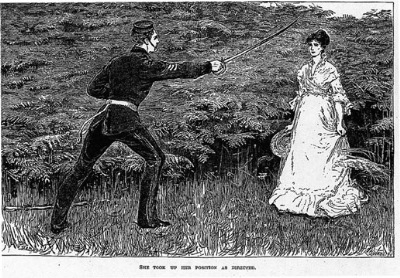
"She took up her position as directed." Troy courts Bathsheba; Cornhill illustration by Helen Paterson Allingham.

"It is safer to accept any chance that offers itself, and extemporize a procedure to fit it, than to get a good plan matured, and wait for a chance of using it."

~ Thomas Hardy, from Far from the Madding Crowd

[Thanks Linda!]

Thursday, September 24, 2009

When I Was a Child I Understood

What I Understood
by Katha Pollitt, from The Mind-Body Problem

When I was a child I understood everything
about, for example, futility. Standing for hours
on the hot asphalt outfield, trudging for balls
I'd ask myself, how many times will I have to perform
this pointless task, and all the others? I knew
about snobbery, too, and cruelty—for children
are snobbish and cruel—and loneliness: in restaurants
the dignity and shame of solitary diners
disabled me, and when my grandmother
screamed at me, "Someday you'll know what it's like!"
I knew she was right, the way I knew
about the single rooms my teachers went home to,
the pictures on the dresser, the hoard of chocolates,
and that there was no God, and that I would die.
All this I understood, no one needed to tell me.
the only thing I didn't understand
was how in a world whose predominant characteristics
are futility, cruelty, loneliness, disappointment
people are saved every day
by a sparrow, a foghorn, a grassblade, a tablecloth.
This year I'll be
thirty-nine, and I still don't understand it.

[More poems by Katha Pollitt.]

Wednesday, September 23, 2009

Yeah, You

For our beautiful flower on her first day of college…


'Cause you're beautiful like a flower
More valuable than a diamond
You are powerful like a fire
You can heal the world with your mind

There is nothing in the world that you cannot do
When you believe in you, who are beautiful
Yeah, you, who are brilliant
Yeah, you, who are powerful
Yeah, you, who are resilient

~ India.Arie

Sunday, July 26, 2009

Sailing Home

From Authors@Google (October 10, 2008):

Sailing Home: Using the Wisdom of Homer's Odyssey to Navigate Life's Perils “In Sailing Home, renowned Zen teacher Norman Fischer deftly incorporates Buddhist, Judaic, Christian, and popular thought, as well as his own unique and sympathetic understanding of life, in his reinterpretation of Odysseus's familiar wanderings as lessons that everyone can use. We see how to resist the seduction of the Sirens' song to stop sailing and give up; how to bide our time in a situation and wait for the right opportunity; and how to reassess our story and rediscover our purpose and identity if, like the Lotus-Eaters, we have forgotten the past. With meditations that yield personal revelations, illuminating anecdotes from Fischer's and his students' lives, and stories from many wisdom traditions, Sailing Home shows the way to greater purpose in your own life.”

 
“So this is the mystery and the pain of our lives: every one of us is exactly where we need to be, but we don’t know it. We’re looking for somewhere else to be. The spiritual odyssey, life’s deepest and most significant undertaking, involves a great effort and inevitably it leads us on through many disasters and troubles in the checkered course of our living and growing. And where to we end up? Back where we started from. Back to ourselves. Only now maybe with more wisdom.” ~ Norman Fischer 

Friday, July 24, 2009

Maybe It’s Not Too Late to Grow Up

From Forever Young, and essay written and read by Kurt Anderson of Studio 360 (July 17, 2009):

"Waiting to get what you want is a definition of maturity. Demanding satisfaction right this instant is the definition of a seven year old. But instant satisfaction has been driving our economy and our culture for a while.

Send a message now! Get an answer now! Pick your airline seat now! Buy anything you want right now!

The web, cell phones, FedEx: they all indulge the impulsive child in every one of us.

Save? Why? For what?

Wait till I can afford it? No…Fooey!

Fuel efficient? Lame.

I don't mean to be a crank and I don't mean to condemn fun. I'm committed to rubber soles for life and I cherish The Simpsons. I'm even a convert to Twitter -- the official medium of back-of-the-class wisecracks.

Yes, the economic collapse had everything to do with credit policy and financial regulation. But I really, truly think that this forty-year-long celebration of our inner child helped lead us to the spree that we've just come off.

But with this crisis and now the rebuilding and reshaping of America we're required to do, we Boomers have maybe our last, best shot to suck it up and get serious and help straighten out the messes that we helped make. Maybe it's not too late to grow up a little.”

Tuesday, April 28, 2009

Foreseeing

by Sharon Bryan, from Flying Blind

Flying Blind Middle age refers more
to landscape than to time:
it's as if you'd reached

the top of a hill
and could see all the way
to the end of your life,

so you know without a doubt
that it has an end—
not that it will have,

but that it does have,
if only in outline—
so for the first time

you can see your life whole,
beginning and end not far
from where you stand,

the horizon in the distance—
the view makes you weep,
but it also has the beauty

of symmetry, like the earth
seen from space: you can't help
but admire it from afar,

especially now, while it's simple
to re-enter whenever you choose,
lying down in your life,

waking up to it
just as you always have—
except that the details resonate

by virtue of being contained,
as your own words
coming back to you

define the landscape,
remind you that it won't go on
like this forever.

Friday, February 06, 2009

Portal into the Miraculous

I remember feeling this same expectation strongly as a child. It is from Toward 2012: Perspectives on the Next Age by Daniel Pinchbeck:

Toward 2012 “All through my childhood, I felt certain that something extraordinary — absolutely amazing and out of the ordinary — was going to happen to me. The world seemed bursting with a secret that nobody would divulge, and someday this tremendous mystery would be revealed. Simply because they were older, I assumed that all adults had passed through this portal into the miraculous essence of existence, although they never spoke about it. As I approached adolescence, I began to suspect that my deepest hopes were going to be unfulfilled. By the time I went to college, I had realized, to my horror, that ‘maturity’ meant accepting constraints and being bound to a limited career path, rather than blossoming into a deeper dimension of possibility and wonder. This was a painful shock.”

[More… ]