Showing posts with label evolution. Show all posts

Sunday, May 15, 2011

Reasoning Is Suffused With Emotion

Excerpt from “The Science of Why We Don’t Believe Science,” by Chris Mooney, Mother Jones, April 18, 2011:

The theory of motivated reasoning builds on a key insight of modern neuroscience. Reasoning is actually suffused with emotion (or what researchers often call "affect"). Not only are the two inseparable, but our positive or negative feelings about people, things, and ideas arise much more rapidly than our conscious thoughts, in a matter of milliseconds—fast enough to detect with an EEG device, but long before we're aware of it. That shouldn't be surprising: Evolution required us to react very quickly to stimuli in our environment. It's a "basic human survival skill," explains political scientist Arthur Lupia of the University of Michigan. We push threatening information away; we pull friendly information close. We apply fight-or-flight reflexes not only to predators, but to data itself.

Illustration by Jonathon Rosen

We're not driven only by emotions, of course—we also reason, deliberate. But reasoning comes later, works slower—and even then, it doesn't take place in an emotional vacuum. Rather, our quick-fire emotions can set us on a course of thinking that's highly biased, especially on topics we care a great deal about.

Consider a person who has heard about a scientific discovery that deeply challenges her belief in divine creation—a new hominid, say, that confirms our evolutionary origins. What happens next, explains political scientist Charles Taber of Stony Brook University, is a subconscious negative response to the new information—and that response, in turn, guides the type of memories and associations formed in the conscious mind. "They retrieve thoughts that are consistent with their previous beliefs," says Taber, "and that will lead them to build an argument and challenge what they're hearing."

In other words, when we think we're reasoning, we may instead be rationalizing. Or to use an analogy offered by University of Virginia psychologist Jonathan Haidt: We may think we're being scientists, but we're actually being lawyers. Our "reasoning" is a means to a predetermined end—winning our "case"—and is shot through with biases. They include "confirmation bias," in which we give greater heed to evidence and arguments that bolster our beliefs, and "disconfirmation bias," in which we expend disproportionate energy trying to debunk or refute views and arguments that we find uncongenial.

That's a lot of jargon, but we all understand these mechanisms when it comes to interpersonal relationships. If I don't want to believe that my spouse is being unfaithful, or that my child is a bully, I can go to great lengths to explain away behavior that seems obvious to everybody else—everybody who isn't too emotionally invested to accept it, anyway. That's not to suggest that we aren't also motivated to perceive the world accurately—we are. Or that we never change our minds—we do. It's just that we have other important goals besides accuracy—including identity affirmation and protecting one's sense of self—and often those make us highly resistant to changing our beliefs when the facts say we should.

Read entire article here…

Friday, February 11, 2011

You are Not the Stuff of Which You are Made

From “Richard Dawkins on Our ‘Queer’ Universe,” TED Talks, Sep. 2006:

"Steve Grand, in his book, Creation: Life and How to Make It, is positively scathing about our preoccupation with matter itself. We have this tendency to think that only solid, material things are really things at all. Waves of electromagnetic fluctuation in a vacuum seem unreal. Victorians thought the waves had to be waves in some material medium -- the ether. But we find real matter comforting only because we've evolved to survive in Middle World, where matter is a useful fiction. A whirlpool, for Steve Grand, is a thing with just as much reality as a rock.

In a desert plain in Tanzania, in the shadow of the volcano Ol Donyo Lengai, there's a dune made of volcanic ash. The  beautiful thing is that it Mesquite Sand Dunes, Death Valleymoves bodily. It's what's technically known as a barchan, and the entire dune walks across the desert in a westerly direction at a speed of about 17 meters per year. It retains its crescent shape and moves in the direction of the horns. What happens is that the wind blows the sand up the shallow slope on the other side, and then, as each sand grain hits the top of the ridge, it cascades down on the inside of the crescent, and so the whole horn-shaped dune moves.

Steve Grand points out that you and I are, ourselves, more like a wave than a permanent thing. He invites us, the reader, to "think of an experience from your childhood -- something you remember clearly, something you can see, feel, maybe even smell, as if you were really there. After all, you really were there at the time, weren't you? How else would you remember it? But here is the bombshell: You weren't there. Not a single atom that is in your body today was there when that event took place. Matter flows from place to place and momentarily comes together to be you. Whatever you are, therefore, you are not the stuff of which you are made. If that doesn't make the hair stand up on the back of your neck, read it again until it does, because it is important."

[Thanks, Pete!]

Thursday, January 20, 2011

A Creature in the River of Knowledge

Monologue from a fictional neuroscientist speaking at an imagined Aspen Ideas Festival/TED Talk event, from “Social Animal,” by David Brooks, New Yorker, Jan. 17. 2011:

“I guess I used to think of myself as a lone agent, who made certain choices and established certain alliances with colleagues and friends…Now, though, I see things differently. I believe we inherit a great river of knowledge, a flow of patterns coming from many sources. The information that comes from deep in the evolutionary past we call genetics. The information passed along from hundreds of years ago we call culture. The information passed along from decades ago we call family, and the information offered months ago we call education. But it is all information that flows through us. The brain is adapted to the river of knowledge and exists only as a creature in that river. Our thoughts are profoundly molded by this long historic flow, and none of us exists, self-made, in isolation from it.

Columbia River plume “And though history has made us self-conscious in order to enhance our survival prospects, we still have deep impulses to erase the skull lines in our head and become immersed directly in the river. I’ve come to think that flourishing consists of putting yourself in situations in which you lose self-consciousness and become fused with other people, experiences, or tasks. It happens sometimes when you are lost in a hard challenge, or when an artist or a craftsman becomes one with the brush or the tool. It happens sometimes while you’re playing sports, or listening to music or lost in a story, or to some people when they feel enveloped by God’s love. And it happens most when we connect with other people. I’ve come to think that happiness isn’t really produced by conscious accomplishments. Happiness is a measure of how thickly the unconscious parts of our minds are intertwined with other people and with activities. Happiness is determined by how much information and affection flows through us covertly every day and year.”

Read the entire piece here…

Sunday, January 09, 2011

Room for Both the Wind and the Lion

From “Mass Animal Deaths: An Environmental Whodunit,” by James Gorman, New York Times, Jan. 9, 2011:

Michael Shermer, the founding publisher of Skeptic magazine and a Scientific American columnist …uses a common scenario to explain why we believe in things that may not be there — hominids on the savannah hearing a rustling in the tall grass.  The one who thinks, “It’s a lion!” and escapes quickly survives to propagate her genes, thus fostering a kind of protective alarmism in her descendants. Another might think, “There’s always some kind of rustling in the tall grass, it’s probably the wind,” and keep on grooming. If he guesses wrong, the downside is being eaten by the lion. Thus, no offspring and no propagation of the “don’t worry, be happy” genes.

Of course, people have both modes of thought, perhaps because rustling is usually caused by the wind, and the hominid who is too alarmist is always running away from nothing and probably too exhausted and too anxiety-ridden to mate. So there’s room for both the wind and the lion in human minds.

Read the rest of this essay…

Monday, November 22, 2010

A Brand New Choice

Kevin Kelly, Senior Maverick at Wired magazine and author, most recently, of What Technology Wants, in conversation with Vincent Horn, Buddhist Geeks: Episode 196, November 22, 2010:

what-technology I’m not big on utopias, and I think one thing that any candid appraisal of technology would have to acknowledge is that every new technology is creating nearly as many problems as it is solving. And most of the problems in our lives today are technogenic, they’ve been generated by previous technologies. It suggests very clearly that most of the problems in the future will be technogenic, created by technologies that we’ve made today. For that reason alone, it’s not utopia, and where we’re headed is not a place where there are no problems or technology solves, mends everything so that we kind of live in this state of bliss. Or, it’s not even to suggest that there’s some endpoint in evolution, or some Omega Point where we’re all headed and everything is fixed and works perfectly, or it’s, in some ways, culminated in perfection. First of all, there is no endpoint in evolution–in fact the point of it is that there is no endpoint, that it’s an open-ended process of continual flux and change and more importantly that the nature of the change itself is changing. So in that way there’s no utopia, but also part of that internal flux is the fact that problems are constantly being invented as well as solutions.

Kevin KellyHowever, saying that I do think there’s a moral dimension to technology and that comes in the fact that while it’s true that newly affected technology will create as many, rarely as many problems as solutions, it’s not neutral. I wouldn’t say that life is neutral although obviously life cannot go on without death. Death is sort of part of those two cycles. But even though for every animal that’s born there’s an animal that dies, we don’t think of life as neutral. No, we say life is good. Overall, the net effect of life is good.

More life is better, even though everything born dies, and so you say “Why isn’t that neutral?” That’s because the same thing happens in technology, when something is invented–let’s say you have a hammer. You could use that hammer to kill someone or you could use it to build something, and there is a sense that that’s just neutral. They’re just tools. You can use them for harm or good.

But in fact, the invention of that hammer actually introduces a brand new choice that we’ve never had before, and that choice, I think, tips the balance. That new choice that did not exist before, tips the balance slightly in favor of the good because there is a new choice for good or harm that had never existed before. That new choice itself is good. Even if we choose the harm in it, we have a choice we did not have before.

So, I think, it turns out that you don’t need very much more good over time to get progress. That if you use technology to create 1% more than you destroy a year, that 1% compounded over time is what we call progress.

See also: What Does Technology Want? (Radiolab, Nov. 16, 2010)

Tuesday, November 16, 2010

We Find Beauty in Something Done Well

“The next time you pass by a jewelry shop window displaying a beautifully cut, teardrop-shaped stone, don’t be so sure it’s just your culture telling you that that sparkling jewel is beautiful. Your distant ancestors loved that shape and found beauty in the skill needed to make it—even before they could put their love into words.”

~ Denis Dutton, author of The Art Instinct: Beauty, Pleasure, and Human Evolution

Saturday, September 11, 2010

To Empathize is to Civilize

“In this talk from RSA Animate, bestselling author Jeremy Rifkin investigates the evolution of empathy and the profound ways it has shaped human development and society.”

~ TED Talks | Best of the Web

Wednesday, July 28, 2010

Condemned to Freedom

Excerpt from “The Limits of the Coded World,” by William Eggington, New York Times (July 25, 2010):

In Immanuel Kant’s view, the main mistake philosophers before him had made when considering how humans could have accurate knowledge of the world was to forget the necessary difference between our knowledge and the actual subject of that knowledge. At first glance, this may not seem like a very easy thing to forget; for example, what our eyes tell us about a rainbow and what that rainbow actually is are quite different things. Kant argued that our failure to grasp this difference was further reaching and had greater consequences than anyone could have thought.

rainbow Taking again the example of the rainbow, Kant would argue that while most people would grant the difference between the range of colors our eyes perceive and the refraction of light that causes this optical phenomenon, they would still maintain that more careful observation could indeed bring one to know the rainbow as it is in itself, apart from its sensible manifestation. This commonplace understanding, he argued, was at the root of our tendency to fall profoundly into error, not only about the nature of the world, but about what we were justified in believing about ourselves, God, and our duty to others.

The problem was that while our senses can only ever bring us verifiable knowledge about how the world appears in time and space, our reason always strives to know more than appearances can show it. This tendency of reason to always know more is and was a good thing. It is why human kind is always curious, always progressing to greater and greater knowledge and accomplishments. But if not tempered by a respect for its limits and an understanding of its innate tendencies to overreach, reason can lead us into error and fanaticism…

As much as we owe the nature of our current existence to the evolutionary forces Darwin first discovered, or to the cultures we grow up in, or to the chemical states affecting our brain processes at any given moment, none of this impacts on our freedom. I am free because neither science nor religion can ever tell me, with certainty, what my future will be and what I should do about it. The dictum from Sartre…gets it exactly right: I am condemned to freedom. I am not free because I can make choices, but because I must make them, all the time, even when I think I have no choice to make.

Read the entire Opinionator post…

Thursday, May 27, 2010

Playing the Role of the Illusionist

Excerpt from Seeing Red by Nicholas Humphrey:

seeing-red

I dare say belief in mind-body duality may not be “accidental” in the least.

In the wider world, there are two sorts of “illusion”—accidental and contrived. There are cases where we get things wrong as the result of bad luck, and cases where we are the victims of deliberate trickery. When, for example, we see a stick in water as being bent, or when we think we are moving as the train beside us pulls away, it is a matter of bad luck. We are applying rules of inference in situations where our information is inaccurate or incomplete. But no one is trying to delude us.

When, however, we see a stage magician bending a metal spoon without touching it, or when we feel the table at a spiritualist seance lifting off the ground, it is a matter of intentional trickery. We may, again, be applying rules of inference in situations where our information is inaccurate or incomplete. But this time there is an illusionist who wants us to get it wrong.

Now, with belief in mind-body duality, which kind of illusion is it? The general view among materialist philosophers has always been that it is an illusion of the first kind, an honest—if regrettable—error. But how about if it is an illusion of the second kind, a deliberate trick!

Could it be? Only of course if there were to be an active agency behind it, playing the role of the illusionist. But who or what could possibly be doing this? And what interest could they have in encouraging individual humans to believe in a non-physical world?

The immediate, but unhelpful answer, might be that, since it is a case of self-delusion, the illusionist must lie within the subject’s own brain. The more interesting answer might be that, insofar as the brain is designed by genes, the illusionist is the subject’s own genes. But in that case, the ultimate answer must surely be that the illusionist is Nature herself, working through natural selection.

Monday, March 01, 2010

An Adaptive Response to Affliction

Excerpt from “Depression’s Upside,” by Jonah Lehrer, New York Times Sunday Magazine (February 25, 2010):

The mystery of depression is not that it exists — the mind, like the flesh, is prone to malfunction. Instead, the paradox of depression has long been its prevalence. While most mental illnesses are extremely rare — schizophrenia, for example, is seen in less than 1 percent of the population — depression is everywhere, as inescapable as the common cold. Every year, approximately 7 percent of us will be afflicted to some degree by the awful mental state that William Styron described as a “gray drizzle of horror . . . a storm of murk.” Obsessed with our pain, we will retreat from everything. We will stop eating, unless we start eating too much. Sex will lose its appeal; sleep will become a frustrating pursuit. We will always be tired, even though we will do less and less. We will think a lot about death.

The persistence of this affliction — and the fact that it seemed to be heritable — posed a serious challenge to Darwin’s new evolutionary theory. If depression was a disorder, then evolution had made a tragic mistake, allowing an illness that impedes reproduction — it leads people to stop having sex and consider suicide — to spread throughout the population. For some unknown reason, the modern human mind is tilted toward sadness and, as we’ve now come to think, needs drugs to rescue itself.

The alternative, of course, is that depression has a secret purpose and our medical interventions are making a bad situation even worse. Like a fever that helps the immune system fight off infection — increased body temperature sends white blood cells into overdrive — depression might be an unpleasant yet adaptive response to affliction. Maybe Darwin was right. We suffer — we suffer terribly — but we don’t suffer in vain.

Wednesday, February 24, 2010

How Things Are and Which Things Matter

Excerpt from Everybody’s Story: Wising Up to the Epic of Evolution by Loyal Rue:

The most fundamental sources of self-understanding are found at the level of story. To put the thesis even more directly: if we are to respond effectively to the global problematique then we must attend to our stories, for in the story of a culture we find its most profound expression of wisdom.
Perhaps this thesis exaggerates the case. Is it possible that stories can make a decisive difference in the viability of our species? Is story that fundamental to human existence? It is difficult to believe otherwise once we stop to consider the many ways in which our lives are shaped by stories.

We legitimate institutions and values in their name, we wage wars in their defense, we judge ourselves and others by their standards, we take pains that our children will learn them well, we draw inspiration from their examples, we construct our hopes and fears under their influence, and so on. It would not be extreme to say that we negotiate our way through life by the guidance of our stories.

We humans are the only species to tell stories, and so far as anyone knows every recognizable human community has fostered storytelling traditions. Thus we appear to be in the presence of a trait that is both universally and exclusively human, suggesting that what humans are has something to do with their stories.

If these ideas hold up – that is, if storytelling is an essential human activity bestowing substance and form on the lives we have – then it follow that changes at this level of human thought will be among the most profound and far-reaching we can imagine. Thus we have good reason to believe that appropriate changes at the level of story might hold the power of reorientation needed for enhancing human solidarity and cooperation…

…I want to suggest that the profound sense of story bears a deep relation to the basic functions of the central nervous system. I am saying that if we can picture what the brain does for an individual organism then we shall have a way to think about what story does for a cultural tradition.

All brains (human or otherwise) do essentially the same thing, that is, they take some measure of how things are in the external environment and then use this information to devise behaviors that will be more or less conducive to the interests of the organism. Brains that have become specialized for symbolic interaction do not suddenly depart from this basic function, they just continue it in a new domain, the domain of culture.

Indeed, human culture just is the result of assessing and addressing the environment with the aid of symbols. In every particular human culture, therefore, we may expect to find (and do find) two basic types of ideas: ideas about how things are in the world, and ideas about which things matter for human existence.

This principle may be extended by the assertion that a culture exists as a coherent entity to the extent that its members share common ideas about how things are and which things matter. A further implication is that the important difference between cultures may be measured in terms of incompatible ideas about reality and value.

Wednesday, November 25, 2009

There is Grandeur, If You Look

More Funny Ideas About Grandeur
by Ruth Padel, from Darwin: A Life in Poems

'To Emma, in case of my sudden death.
      I have just finished this sketch
of my species theory. If true, as I believe,
      it will be a considerable step
in science. My most solemn last request
      is that you devote 400 pounds
to its publication.'

'There is grandeur, if you look
      at every organic being
as the lineal successor of some other form,
      now buried under thousands of feet of rock.
Or else as a co-descendant, with that buried form,
      from some other inhabitant of this world
more ancient still, now lost.

Out of famine, death and struggle for existence,
      comes the most exalted end
we're capable of conceiving: creation
      of the higher animals!
Our first impulse is to disbelieve — 
      how could any secondary law
produce organic beings, infinitely numerous,

characterized by most exquisite
      workmanship and adaptation?
Easier to say, a Creator designed each.
      But there is a simple grandeur in this view —
that life, with its power to grow, to reach, feel,
      reproduce, diverge, was breathed
into matter in a few forms first

and maybe only one. To say that while this planet
      has gone cycling on
according to fixed laws of gravity,
      from so simple an origin, through selection
of infinitesimal varieties, endless forms
      most beautiful and wonderful
have been, and are being, evolved.'


Charlie Darwin

by Low Anthem, from Oh My God, Charlie Darwin

Set the sails I feel the winds a'stirring
Toward the bright horizon set the way
Cast your wreckless dreams upon our Mayflower
Haven from the world and her decay

And who could heed the words of Charlie Darwin
Fighting for a system built to fail
Spooning water from their broken vessels
As far as I can see there is no land

Oh my god, the water's all around us
Oh my god, it's all around

And who could heed the words of Charlie Darwin
The lords of war just profit from decay
And trade their children's promise for the jingle
The way we trade our hard earned time for pay

Oh my god, the water's cold and shapeless
Oh my god, it's all around
Oh my god, life is cold and formless
Oh my god, it's all around

Explore Studio 360’s November 20, 2009 episode on Evolution.

Tuesday, November 03, 2009

The Survival of the More Versatile

Dr. Rick Potts, from “The Adaptable Human,” NOVA, October 26, 2009:

Dr. Rick Potts holds one of 500 handaxes made by Homo erectusthat he and his team uncovered at his research site at Olorgesailie, Kenya. Photo credit: © Jason F. NicholsClimate change had always been on people's minds when it came to human evolution. The idea that was around for a long time is that the establishment of a savanna environment, the grassy environment with a few trees, was critical to human evolution early on, and that and the Ice Age later on presented the challenging environment in which humans evolved.

But when I began the work here at Olorgesailie, we kept seeing layer after layer of environmental change, from soils to volcanic ashes to a lake to a drought when the lake completely evaporated. We saw this through 700,000 years, and I began to think, well, maybe it's not the particular environment of a savanna that was important, but the tendency of the environment to change, to vary in very dramatic ways. And we saw that the large grazing animals of the savanna—elephants, baboons, pigs, zebras, all of whom ate grass—disappeared in the time period when worldwide climate began to vary the most.

So it dawned on me: Rick, you're an anthropologist. Maybe this has something to do with human evolution, and it's not the survival of the fittest in any one environment but the survival of the more versatile, the more general and flexible creatures that would really persist over time. This gave me a new insight into human evolution. The origin of stone tools, the expansion of the brain, and the complexity of social life that we see with the emergence of our own species may actually be a response not to just the dry savanna or the cold Ice Age but to the wide and dramatic variability of climate over time.

Friday, October 16, 2009

What We Remember

“We’re constantly being swayed in what we do by just a little teeny change, something that comes, for examples, from our past experience with a certain kind of situation. But what we remember from the previous situation is not just the facts and not just the outcome that may be good or bad. We also remember whether or not what we felt was good or bad. This is something that people need to understand. When you are making decisions, any day of your life, the [choices] you make are going to produce a good or bad outcome – or something in between. You don’t only remember what the factual result is, but also what the emotional result is. And that tandem of fact and associated emotion is critical. And of course most of what we construct as wisdom, over time, is actually a result of cultivating that knowledge about how our emotions behaved – what we learned from them.”

~ Antonio Damasio, in conversation with David Brooks on the topic of emotions from the perspective of neuroscience and evolution during the Aspen Institute on July 4, 2009.

Wednesday, September 02, 2009

Music is More Magical with Understanding

Cottton Top TamarindFrom “Music Written For Monkeys Strikes A Chord,” by Richard Harris, Morning Edition (9.2.09):

David Teie has been developing a theory to explain why music plays on human emotions. His theory is that music relates to the most primitive sounds we make and respond to, like laughter, heartbeats, or a mother's cooing.

Fearful monkey music:

Happy monkey music:

He says, "the paradox is that I distinctly remember thinking once that when they figure out why Puccini makes me cry, I hope I die the day before the news gets out. But the great news about this exploration into music is it's actually more magical and wonderful once you realize how it works."

David Teie Plays the Schuman Cello Concerto in A minor (Mvt 1) with the Eclipse Chamber Orchestra, April 2007

See also: Music for Cats

Thursday, February 26, 2009

Emotions Come First

From Animals Make Us Human: Creating the Best Life for Animals by Temple Grandin:

Animals Make Us Human I believe that the best way to create good living conditions for any animal, whether it’s a captive animal living in a zoo, a farm animal, or a pet, is to base animal welfare programs on the core emotion systems in the brain. My theory is that the environment animals live in should activate their positive emotions as much as possible, and not activate their negative emotions any more than necessary. If we get the animal’s emotions right, we will have fewer problem behaviors.

That might sound like a radical statement, but some of the research in neuroscience has been showing that emotions drive behavior, and my own thirty-five years of experience working with animals have shown me that this is true. Emotions come first. You have to go back to the brain to understand animal welfare.

Of course, usually — though not always — the more freedom you give an animal to act naturally, the better, because normal behaviors evolved to satisfy the core emotions. When a hen hides to lay her eggs, the hiding behavior turns off fear. But if you can’t give an animal the freedom to act naturally, then you should think about how to satisfy the emotion that motivates the behavior by giving the animal other things to do. Focus on the emotion, not the behavior.

So far, research in animal behavior agrees with the neuroscience research on emotions. A really good study on whether animals have purely behavioral needs was done with gerbils. Gerbils love to dig and tunnel, and a lot of them develop a corner-digging stereotypy when they’re around thirty days old. A stereotypy is an abnormal repetitive behavior (ARB for short), such as a lion or tiger pacing back and forth in its cage for hours on end. Pets and farm animals can develop stereotypies, too. Stereotypies are defined as abnormal behaviors that are repetitive, invariant (lions always pace the exact same path in their cages), and seemingly pointless.

An adult gerbil spends up to 30 percent of its "active time" doing stereotypic digging in the corner of its cage. That would never happen in nature, and many researchers have hypothesized that the reason captive gerbils develop stereotypic digging is that they have a biological need to dig that they can’t express inside a cage.


On the other hand, in nature gerbils don’t dig just to be digging. They dig to create underground tunnels and nests. Once they’ve hollowed out their underground home, they stop digging. Maybe what the gerbil needs is the result of the digging, not the behavior itself. A Swiss psychologist named Christoph Wiedenmayer set up an experiment to find out. He put one set of baby gerbils in a cage with dry sand they could dig in, and another set in a cage with a predug burrow system but nothing soft to dig in. The gerbils in the sand-filled box developed digging stereotypies right away, whereas none of the gerbils in the cage with the burrows did.

That shows that the motivation for a gerbil’s digging stereotypy is a need to hide inside a sheltered space, not a need to dig. The gerbil needs the emotion of feeling safe, not the action of digging. Animals don’t have purely behavioral needs, and if an animal expresses a normal behavior in an abnormal environment, its welfare may be poor. A gerbil that spends 30 percent of its time digging without being able to make a tunnel does not have good welfare.

All animals and people have the same core emotion systems in the brain. Most pet owners probably already believe this, but I find that a lot of executives, plant managers, and even some veterinarians and researchers still don’t believe that animals have emotions. The first thing I tell them is that the same psychiatric medications, such as Prozac, that work for humans also work for animals. Unless you are an expert, when you dissect a pig’s brain it’s difficult to tell the difference between the lower-down parts of the animal’s brain and the lower-down parts of a human brain. Human beings have a much bigger neocortex, but the core emotions aren’t located in the neocortex. They’re in the lower-down part of the brain.

When people are suffering mentally, they want to feel better — they want to stop having bad emotions and start having good emotions. That’s the right goal with animals, too.

Thursday, December 11, 2008

Transcending

by Marvin Levine, from Look Down From Clouds

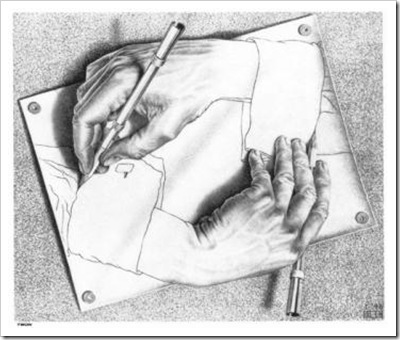
Escher got it right.
Men step down and yet rise up,
the hand is drawn by the had it draws,
and a woman is poised on her very own shoulders.

Without you and me this universe is simple,
run with the regularity of a prison.
Galaxies spin along stipulated arcs,
stars collapse at the specified hour,
crows u-turn south and monkeys rut on schedule.

But we, whom the Cosmos shaped for a billion years
to fit this place, we know it failed.
For we can reshape,
reach an arm through the bars
and, Escher-like, pull ourselves out.

And while whales feeding on mackerel
are confined forever in the sea,
we climb the waves,
look down from clouds.

Tuesday, April 10, 2007

Between Stability and Chaos

Sherwin Nuland on Speaking of Faith (Jan. 18, 2007):


"Wonder is something I share with people of deep faith. They wonder at the universe that God has created and I wonder at the universe that nature has created. But this is a sense of awe that motivates the faithful, motivates me. It provides an energy for seeking. Just as the faithful will always say, 'We are seeking,' I am seeking.

"We're seeking different things. I'm seeking an understanding of this integrity of everything, this unity of everything, of the equilibrium of not just the homeostasis as the physiologists say—the staying the sameness—but of the closeness that we are constantly coming to chaos."
...

[Listen] "Responding to sensory input from the body and its surroundings, delivered over incoming fibers and via chemical messengers, the human brain has, I believe, engaged itself in the instinctual battle between stability and chaos, echoing up from its deepest cellular self. That battle is expressed in the psychological conflict between Eros and Thanatos—the forces of love (and therefore life) against the forces of death instinct. Because the two are irreconcilable, the central nervous system of man has had, since the time it originally came into existence with the birth of the first Homo sapiens, to conjure with itself—to try various combinations of circuitry and chemistry, and to turn to its excess reserve capacity in exploratory ways—until it became what it is today, a vast machine works of intellect, spirituality, and even neurosis.

"It might be pointed out, and properly so, that all of the foregoing presupposes a state of constant improvement, and therefore presents Pollyanna's view of the mind and its potentialities. But my definition of the human spirit is not restricted to the sublime qualities developed within our species. It includes, as well, those other characteristics of which we are far less proud, the baser qualities in all that is subsumed under the rubric of humanness. If there is an antonym for everything we customarily associate with spiritual, it must surely be mean-spirited. The same adaptive use of circuitry and molecular interactions that allows humankind to perform the mental gymnastics leading to our finest accomplishments is also in thrall to our baser instincts. Like all adaptations, some are maladaptive. The maladaptations, the conflict between order and chaos, as well as the imperatives of living in societies in which individualistic drives must be restrained in the interest of community—these are the stuff of antisocial behavior and neurosis. This, too, is part of humanity.

"The very instability of the multitudinous mechanisms that maintain our homeostasis is reflected in the instability and ambivalence with which we view our fellows and the universe, but especially ourselves. Echoing his inner physiology, man is engaged in a constant struggle to maintain the equilibrium that permits daily living. The conflict between constancy and consistency on the one hand and chaos and destruction on the other is mirrored in the mind's equally persistent struggle between the goodness that is in us and the dark drives of anarchic catastrophe. That luminous quality of reason that we value so highly is precariously perched on the unsettled knife edge between good and evil. The human mind being some 200 million years younger than the mammalian body to which it can trace its origin, the quality we might call mental homeostasis is not yet as effective as its physical counterpart. We function not only physically but mentally too, in a crucible of conflicting forces; we continue in stable emotional life only because a degree of balance is achieved by the internalized morality that is sustained by our individual and societal equivalents of enzymes and other regulatory mechanisms. Sometimes we lose the uneasy equilibrium we have attained with so much effort. The result is mental illness, injustice, and the maleficence to which we give daily witness.

"My rabbinic teachers first made me aware of the Talmudic teaching that man lives in eternal conflict between the yetzer hatov and the yetzer hara, his good and evil inclination. Civilization began and persists because the maintenance of what might be called social homeostasis, and therefore a civilized society, demands that the forces of equilibrium—the forces of the good—win out. But the history of the twentieth century and the events of which we read in our daily newspapers tell us that this is an ideal too often unattained. Society's struggle, like ours, never ends."