Showing posts with label connection. Show all posts

Saturday, April 23, 2011

Finding New Ways to Speak

"It is human nature to look at someone like me and assume I have lost some of my marbles. People talk loudly and slowly to me. Sometimes they assume I am deaf. There are people who don't want to make eye contact. It is human nature to look away from illness. We don't enjoy a reminder of our own fragile mortality.

That's why writing on the Internet has become a life-saver for me. My ability to think and write have not been affected. And on the Web, my real voice finds expression. I have also met many other disabled people who communicate this way. One of my Twitter friends can type only with his toes. One of the funniest blogs on the Web is written by a friend of mine named Smartass Cripple. Google him and he will make you laugh.

All of these people are saying, in one way or another, that what you see is not all you get."

~ Robert Ebert, from “Remaking My Voice,” TED Talks, April 2011

Silence No One Hears

Poem with No Speaker
by Franz Wright, from Earlier Poems

Are you looking
for me? Ask that crow

rowing
across the green wheat.

See those minute air bubbles
rising to the surface

at the still creek's edge—
talk to the crawdad.

Inquire
of the skinny mosquito

on your wall
stinging its shadow,

this lock
of moon

lifting
the hair on your neck.

When the hearts in the cocoon
start to beat,

and the spider begins
its hidden task,

and the seed sends its initial
pale hairlike root to drink,

you'll have to get down on all fours

to learn my new address:
you'll have to place your skull

besides this silence
no one hears.

Monday, April 11, 2011

Virtual Choir

“In a moving and madly viral video last year, composer Eric Whitacre led a virtual choir of singers from around the world. He talks through the creative challenges of making music powered by YouTube, and unveils the first two minutes of his new work, ‘Sleep,’ with a video choir of 2,052.”

Looking for Meaning in Objects

Excerpt from “Alive Enough?on Being, April 7, 2011:

Krista Tippett (host): I'm utterly intrigued just by the way you describe your passion, your interest and concern, that you study this objective side of our encounters with technologies, that I'm concerned with— the human meaning of the objects of our lives. And just as we start, I wanted to ask you a kind of question I ask everyone, which is, was there a spiritual background to your childhood?

Sherry Turkle (author of Alone Together): Well, I think in my case the question didn't come from a spiritual quest. It came from a deeply personal psychological quest. My father — my biological father disappeared from my life when I was around two. My mother, my grandparents, my mother's sister, my aunt, didn't want me to know anything about him. And so, of course, I only wanted to know things about him and would search…

There were these places. There was a closet that had old books and trinkets and there was a junk drawer. There were just these places where the memories were kept. I would scour them for traces of him and finally I found one. I found a photograph of him in which someone in anger had rubbed out his face, but I found all kinds of information from that photograph, you know, that he wore tweed pants, where he was standing, what his lace-up shoes looked like, and I just think that some place in that quest of a child, the notion of looking for objects to fill in human meaning became very close to my heart in a very personal way.

As I became a sociologist, [I discovered] there's a fancy word for studying this; it's called bricolage. It's the science of studying meanings and the interplay of objects, and I realized that that's kind of what I'd been doing all the time. A little bit like Molière's, Monsieur Jourdain who'd been speaking prose all his life without knowing it, I'd been a bricoleur all my life without knowing it.

*     *     *     *     *

To make our life livable, we have to have spaces where we are fully present to each other or to ourselves, where we're not competing with the roar of the Internet and, quite frankly, where the people around us are not competing with the latest news off the Facebook status update. They may not have anything new. They may just be there being in a way that needs attention. I mean, people like to put things on Facebook--and certainly Twitter--that are happy. I've interviewed people who say things to me as simple as, you know, I don't even like to put that my dog died...because it doesn't seem the place. It doesn't seem the place for a lot of people to share negative things.

Anyway, I guess I'm saying that sacred space [are] the places in your daily life where you want to keep them for yourself and the people who you need to give your full attention to. I have very simple rules — so far as I have rules — for how to know you're close to one or in one or should be having one: it's dinner, it's sharing meals with your family, it's that moment at school pickup when your kid looks up and is trying to meet your eye. You know, you're looking down at your smartphone and your child is trying to meet your eye.

swing I have enough data from children who're going through this experience to know that it's a terrible moment for them. It's on the playground. Very bad when your child's on the jungle gym and is desperately trying to have you look at them, for them to be taking hands off the jungle gym to try to get your attention — accident time. I mean, be in the park. Be in the park with them. Spend less time there, but make it a space. Make it a moment. These are important moments.

*     *     *     *     *

See also: “Brainpower,” To the Best of Our Knowledge, 4/10/11

Saturday, April 02, 2011

Lost & Found


See also: Todd Bieber Finds Owner Of Missing Film From NYC Blizzard


[Thanks, Scott!]

Saturday, January 29, 2011

The Love of Strangers

“A poet writes always of his personal life, in his finest work out of its tragedies, whatever it be, remorse, lost love or mere loneliness; he never speaks directly as to someone at the breakfast table.”

~ William Butler Yeats, from A General Introduction for My Work

Billy Collins, from “Dear Reader,” a reading and lecture delivered at the Key West Literary Seminar:

A friend of mine was walking along Madison Avenue, let’s say, with the New Yorker writer Roger Angell, one of the great sports writers of America…Someone recognized Angell  and stopped him and began to flatter him about his writing and tell him what a great writer he was. Then my friend and Angell continued to talk…Angell said to my friend, “That’s what it’s all about.”

“What do you mean?”

“That’s what writing is all about.”

“What?”

“The love of strangers.”

Which is a sort of neuroses. Most people are satisfied with the love of people around them, although that love tends to be insufficient at most times. Whereas writers tend to court the love of total strangers and I am probably more guilty than anybody. I tend to begin each of my books with a prefatory poem that’s actually addressed to the reader. It’s my way of acknowledging the presence of the reader.

As I’m reading contemporary poetry, they tend to fall into two categories which are sort of indefinable. In one category, I feel that the poet is aware of my presence and in the other I feel that an act of typewriting or someone is committing an act of literature oblivious to my participation in it.

You might call these two kinds dogs and cats. Dogs are really interested in people, as you know, whereas cats are much more self-referential…I think of the poem as a social encounter.

Jorge Luis Borges writes:

braeburnpage The taste of the apple  lies in the contact of the fruit with the palate, not in the fruit itself; in a similar way (I would say) poetry lies in the meeting of the poem and the reader, not in the lines of symbols printed on the pages of a book. What is essential is the aesthetic act, the thrill, the almost physical emotion with each reading.


Dear Reader
by Billy Collins, from Picnic, Lightning

Every morning I sit across from you
at the same small table,
the sun all over the breakfast things—
curve of a blue-and-white pitcher,
a dish of berries—
me in a sweatshirt or robe,
you invisible.

Most days, we are suspended
over a deep pool of silence.
I stare straight through you
or look out the window at the garden,
the powerful sky,
a cloud passing behind a tree.

There is no need to pass the toast,
the pot of jam,
or pour you a cup of tea,
and I can hide behind the paper,
rotate in its drum of calamitous news.

But some days I may notice
a little door swinging open
in the morning air,
and maybe the tea leaves
of some dream will be stuck
to the china slope of the hour—

then I will lean forward,
elbows on the table,
with something to tell you,
and you will look up, as always,
your spoon dripping milk, ready to listen.

james-dean-breakfast-2

Thursday, January 20, 2011

A Creature in the River of Knowledge

Monologue from a fictional neuroscientist speaking at an imagined Aspen Ideas Festival/TED Talk event, from “Social Animal,” by David Brooks, New Yorker, Jan. 17. 2011:

“I guess I used to think of myself as a lone agent, who made certain choices and established certain alliances with colleagues and friends…Now, though, I see things differently. I believe we inherit a great river of knowledge, a flow of patterns coming from many sources. The information that comes from deep in the evolutionary past we call genetics. The information passed along from hundreds of years ago we call culture. The information passed along from decades ago we call family, and the information offered months ago we call education. But it is all information that flows through us. The brain is adapted to the river of knowledge and exists only as a creature in that river. Our thoughts are profoundly molded by this long historic flow, and none of us exists, self-made, in isolation from it.

Columbia River plume “And though history has made us self-conscious in order to enhance our survival prospects, we still have deep impulses to erase the skull lines in our head and become immersed directly in the river. I’ve come to think that flourishing consists of putting yourself in situations in which you lose self-consciousness and become fused with other people, experiences, or tasks. It happens sometimes when you are lost in a hard challenge, or when an artist or a craftsman becomes one with the brush or the tool. It happens sometimes while you’re playing sports, or listening to music or lost in a story, or to some people when they feel enveloped by God’s love. And it happens most when we connect with other people. I’ve come to think that happiness isn’t really produced by conscious accomplishments. Happiness is a measure of how thickly the unconscious parts of our minds are intertwined with other people and with activities. Happiness is determined by how much information and affection flows through us covertly every day and year.”

Read the entire piece here…

Monday, December 27, 2010

Excruciating Vulnerability

“When you ask people about love, they tell you about heartbreak. When you ask people about belonging, they’ll tell you their most excruciating experiences of being excluded. And when you ask people about connection, the stories they told me were about disconnection.”

~ Brené Brown, from “The Power of VulnerabilityTED Talks, June 2010


@c4chaos

Tuesday, December 14, 2010

Bottle

Bottle from Kirsten Lepore on Vimeo.

Tuesday, October 19, 2010

Obliterating Boundaries

Home. October 19, 2010“More than ever, I have come to appreciate how deeply and passionately most of us live within ourselves. Our attachments are ferocious. Our loves overwhelm us, define us, obliterate the boundaries between ourselves and others.”

~ Paul Auster, from I Thought My Father was God: And Other True Stories from NPR’s National Story Project

[Thanks, Mary!]

Saturday, September 25, 2010

No Real Distance

Gap
by Gary Jackson

Every year, my mother reminds me
to place flowers on my sister’s grave.

    On a Thursday, I buy red
    and yellow carnations
    and baby’s breath.  I drive alone.
    The oak that grows nearby
    has branches low enough to bear
    the graves’ shadows.

    I do this
for all of us. My sister buried in Topeka.
My mother who left for Dallas. The boy
I used to be who still clings     to the years between.

I swore long ago I would never come back.
My mother does not swear,
but bears the same memories that lie beneath

Kansan green, waiting to break open
like rain on concrete.  So I become
her emissary. I shoulder her burden.

I drudge down familiar streets, careful
to avoid high school crushes,
teachers, bullies, cousins who never made it out
of the state they were born in.

    By the time I’ve pulled onto 21st,
    the black iron gates behind,
    I think of how there is no real distance

    between anything, how Kansas
is always a breath
away. It’s not the grave,
but the memory that pulls.

Thursday, September 02, 2010

Thinking of Being Somewhere Else

Kansai International Airport Terminal

Airport
by W.S. Merwin, from The Rain in the Trees

None of the computers can say
how long it took to evolve a facility
devoted to absence in life

you walk out of the chute
and a person smiles at your ticket
and points you to your seat

is this the only way home
nobody asks
because nobody knows

the building is not inhabited it is not
home except to roaches
it is not loved it is serviced

it is not a place
but a container with signs
directing a process

there is neither youth in the air
nor earth under foot
there is a machine to announce

yet the corridors beat with anguish longing relief
news trash insurance dispensers
and many are glad to be here

thinking of being somewhere else
hurrying at great expense
across glass after glass

we travel far and fast
and as we pass through we forget
where we have been

Sunday, August 15, 2010

The New Way

The Quiet World
by Jeffrey McDaniel, from The Forgiveness Parade

In an effort to get people to look
into each other’s eyes more,
and also to appease the mutes,
the government has decided
to allot each person exactly one hundred  
and sixty-seven words, per day.

When the phone rings, I put it to my ear  
without saying hello. In the restaurant  
I point at chicken noodle soup.
I am adjusting well to the new way.

Late at night, I call my long distance lover,  
proudly say I only used fifty-nine today.  
rotary phone off hookI saved the rest for you.

When she doesn’t respond,
I know she’s used up all her words,  
so I slowly whisper I love you
thirty-two and a third times.
After that, we just sit on the line  
and listen to each other breathe.

Monday, August 02, 2010

An Endless Stream

"Sometimes technology outpaces humanity's ability to process it. I think that's where we are right now. My mind has been sliced and diced in so many ways. There's so many packets of information coming at me... It's just shocking: how is literature supposed to survive when our brain has been pummeled with information all day long at work — if we're white collar workers. When we go home, are we really going to open a thick text with 350 pages and try to waddle through it?…Here's the thing with this new technology. I think it's incredibly effective. I just don't think it's made anyone much happier. If anything, we are now always connected but we don't know what we're connected to. It's just an endless stream of information."

~ Gary Shteyngart, author of Super Sad True Love Story, talking to Terry Gross on Fresh Air (August 2, 2010).

Wednesday, May 05, 2010

Greater than Just Romantic Love

“Part of what this poem meant for me was the idea that somehow I would be in love and that someone would love me back was a profound revelation…I think the very first library book I ever checked out was a collection of poems by E.E. Cummings which included this poem…But being in your body, giving love through your body, getting love back through your body, is something that I think is greater than just romantic love relationships.”

~ Quang Bao

i like my body when it is with your
by E.E. Cummings

i like my body when it is with your
body. It is so quite new a thing.
Muscles better and nerves more.
i like your body. i like what it does,
i like its hows. i like to feel the spine
of your body and its bones, and the trembling
-firm-smooth ness and which i will
again and again and again
kiss, i like kissing this and that of you,
i like, slowly stroking the, shocking fuzz
of your electric fur, and what-is-it comes
over parting flesh....And eyes big love-crumbs,

and possibly i like the thrill
of under me you so quite new from

Sunday, May 02, 2010

Finding Words

Mai's Quiet Zone, 2004

Dr. Alan Dienstag from “Alzhiemer’s, Memory, and Meaning,” in conversation with Krista Tippett on Speaking of Faith, March 26, 2009:

I was working with a woman who actually first brought her sister to see me. Her name was Ann, and she wanted, her sister to join one of the writing groups [for people in the early stages of Alzheimer’s], but her sister wasn't right for it. About two years later, she came back, and she [herself] had been diagnosed with Alzheimer's. And so I started to work with her, and she joined one of my support groups.

She was in the group for a long time, and then it just became impossible for her to participate. The conversation was moving too fast. She just didn't have the language. She couldn't string together more than a sentence or two, and it just wasn't working. And so she had to leave the group.

Her husband, who was just extraordinarily devoted to her, really wanted her to maintain her connection with me. It was very helpful that I had known her before. And she would bring photo albums in. She would do a little tchotchke tour of my office. You know, when it wasn't really possible to talk about things, she would kind of walk around and we would look at objects. She was very taken by the birds outside the window. I mean, that was the kind of time that we spent together.

And then even that became difficult. She was one of those people who started to kind of retreat into almost a mask-like blankness. It was harder and harder to access her. And so we were reaching the end of that time, and I was talking to her husband, telling him that I just didn't think that it was a really fruitful way for her to spend her time and so on.

So it was around that time, and I was going on vacation, and she loved the beach and I loved the beach and this was something that we used to connect about.

As I was leaving I said, "Ann, I'm going to the beach. I'm going to be away for a while." And she smiled and her face kind of lit up.

I said, "What do you love about the beach?"

She kind of drifted away, as she did, and she got very quiet. And again I waited and I thought, well, you know, she can't really answer that question.

And she turned to me and she said, "There's some kind of music that lives there."

Time Makes a Family

“It’s about how much time you’ve spent together. That’s what makes a family, not biology, not sexual or political persuasion. It’s just that: time.”

~ Julianne Moore, from “Erotic Sparks Fly, and Lines Are Crossed,” by Dennis Lim, New York Times, April 30, 2010

Monday, April 05, 2010

Seeing Each Other

Abramovic, left, with Karen Dorothee Peters. Photo by Joshua Bright for The New York Times. The Artist is Present

“Time was passing, but I couldn’t tell…The overwhelming feeling I had was that you think you can understand a person just by looking at them, but when you look at them over a long period of time, you understand how impossible that is. I felt connected, but I don’t know how far the connection goes…We insulate ourselves in New York City. Everyone goes around with headphones. It’s one of the fantastic things about New York: you can be near all these people, and still be in your own head.”

~ Dan Visel, on sitting across a table from artist Marina Abramovic, from “Confronting a Stranger, for Art,” by Jim Dwyer, New York Times, April 2, 2010

[Thanks Matt!]

Thursday, March 18, 2010

Less Small Talk

Excerpt from “Talk Deeply, Be Happy?” by Roni Caryn Rabin, New York Times (March 17, 2010):

…people who spend more of their day having deep discussions and less time engaging in small talk seem to be happier, said Matthias Mehl, a psychologist at the University of Arizona who published a study on the subject.

“We found this so interesting, because it could have gone the other way — it could have been, ‘Don’t worry, be happy’ — as long as you surf on the shallow level of life you’re happy, and if you go into the existential depths you’ll be unhappy,” Dr. Mehl said.

But, he proposed, substantive conversation seemed to hold the key to happiness for two main reasons: both because human beings are driven to find and create meaning in their lives, and because we are social animals who want and need to connect with other people.

More…

Sunday, February 14, 2010

The Highest Form of Intimacy

Excerpts from “A Monotheistic Model of Love,” by Gilla Nissan, Parabola (Spring 2010):

parabola-35-1 In B’re-sheet, Genesis, during the process of the creation of the world, it is said that God separated the water into two: sha-ma-yim, the water of above, and ma-yim, the water below. The Zohar: The Book of Splendor, a collection of works ascribed to Simon Bar Yochai of the second century CE, goes on to say that the lower waters missed and longed for the higher waters and so cried out to unite back with them. The Hebrew words reflect this deep relationship: mayim, meaning water, and shamayim, meaning sky.

God tried several times to create the world. He used equal measures of compassion, che-sed, and judgment, din. More than once the world collapsed until He incorporated an extra measure of ra-cha-mim, another word for compassion. Without love the world cannot exist, yet we humans were given freedom to love or not to love. God so wants to be known and be loved out of free will; forced love is no love at all.

*     *     *

The Hebrew language has gender; we refer to God in the  masculine; although, in His true nature He is William Gesenius's Hebrew punctuation (i.e., Yahweh)without gender. In the Tetragrammaton, Yud Hey Vav Heh, the unutterable name of God, the letters vav and heh represent the male and female forces of providence. The male force is that which acts upon the world, while the female force is that which allows the world to be receptive to God’s power. We refer to God as Him because we want Him to act upon the world through the male force of providence. The Hebrew word for Divine Presence, on the other hand, is She-chi-nah, a feminine noun.

*     *     *

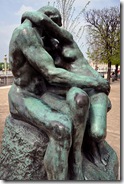
Rodin's Le Baiser (The Kiss) in the Tuileries Garden in Paris According to the Zohar, love begins with a physical attraction, then communication and speech. A kiss is the merging of one breath with another. As closeness occurs, the lovers stop speaking and are merely aware of each other’s breath. Finally, they come even closer, to the point of physical contact, and their communication becomes a kiss. Here they are aware of each other’s life force. Kissing, explains the modern mystic Rabbi Aryeh Kaplan, is a natural consequence of increased intimacy in speech. Two mouths come closer and closer, and progress from speech to breath to the kiss. The kiss, then, is the highest form of intimacy.

The Zohar describes four levels in the intimacy of love: physical attraction, speech, breath, and the kiss. These same four levels exist in the relationship of a person with the Divine. These levels are to this day reflected in the structure of the daily services in the synagogue and private prayer, moving the worshipper from one level of intimacy to another. The impact is deeply profound when one’s ka-va-nah, intention, is aligned with the words.