Showing posts with label satire. Show all posts

Wednesday, May 11, 2011

So Much More Than Nothing

Excerpt from This is a Book by Demetri Martin (New Yorker, Feb. 28, 2011):

Who am I? That is a simple question, yet it is one without a simple answer. I am many things—and I am one thing. But I am not a thing that is just lying around somewhere, like a pen, or a toaster, or a housewife. That is for sure. I am much more than that. I am a living, breathing thing, a thing that can draw with a pen and toast with a toaster and chat with a housewife, who is sitting on a couch eating toast. And still, I am much more.

I am a man.

And I am a former baby and a future skeleton, and I am a distant future pile of dust. I am also a Gemini, who is on the cusp.

I am trustworthy and loyal, but at the same time I am no Boy Scout. No, I am certainly not. I am quite the opposite, in fact. And by opposite I do not mean Girl Scout. No. I mean Man Scout. And by that I do not mean Scout Leader. In fact, I am not affiliated with the Scouts at all. Let’s just forget about the Scouts and Scouting altogether, O.K.?

I am concepts and thoughts and feelings and outfits. And I am each of these all at once, unless I am in the shower. Then I am not outfits, because that would be uncomfortable.

To some I am known as Chief. And these are usually people who work in Radio Shack or try to sell me shoes. To others I am known as Buddy. These are people who dwell in bars and wonder if I’ve got a problem or what it is that I am “looking at.” And to still others, who are in that same bar, standing just off to the side, I am “Get Him!”

I am everything and I am nothing. I am just kidding; I am not everything and nothing. That would be ridiculous. I am just everything.

I am what I eat. And I am this especially when I bite my nails.

I have been called Hey, You! and Get Out of the Way! and Look Out! And then, some time later, Plaintiff.

Read more…

Tuesday, March 08, 2011

Help for the Chirpy

Tuesday, October 05, 2010

Through a Prism of Comedy

Jon Stewart, in conversation with Terry Gross, from “Jon Stewart: The Most Trusted Name In Fake News,” Fresh Air from WHYY, October 4, 2010:

Jon StewartThere was a congressional bill where they were going to get money for first responders for 9/11 for chronic health issues. And I mean, its a no-brainer. The people that went into the Towers—or were down there searching—to have their health bills taken care of and legislative maneuvering—the Democrats wouldn’t bring an up or down vote because if they did that the Republicans would be allowed to insert amendments. And one of the amendments that they could insert was that you could give any of the money to illegal aliens.

And so the Democrats were afraid that they would have a commercial that would be made that would say, you voted to give money to—so rather than standing up and being moral for the people that risked everything for us down there, they decided to try a legislative maneuver that made it so that two-thirds had to pass the bill, so that no amendments could be put in it. Well, the Republicans obviously, you know, shot it down—their own moral failing.

So we did a segment on the show called "I Give Up.”

And the ability to articulate our sense of just absolute sadness, but through a prism of comedy—like, we came in that morning just really despairing as we watched this go down. And we walked out that night feeling like we had yelled and felt, you know, we had put it through the prism and the synthesis and the digestive process that we put it through and we made ourselves feel better.

And we didn’t make ourselves feel better by ignoring it, by dismissing it, by not dealing with it. We made ourselves feel better by expressing our utter rage at the ineptness and lack of courage from our legislators and we walked out of there that night feeling like, you know, what, (bleep) good day's work. That was it.

Listen to the whole conversation here…

Tuesday, August 03, 2010

Ultimate Machine


Inspired by Marvin Minsky and Claude Shannon's Ultimate Machine. Click here to get instructions for making your own

Monday, August 02, 2010

An Endless Stream

"Sometimes technology outpaces humanity's ability to process it. I think that's where we are right now. My mind has been sliced and diced in so many ways. There's so many packets of information coming at me... It's just shocking: how is literature supposed to survive when our brain has been pummeled with information all day long at work — if we're white collar workers. When we go home, are we really going to open a thick text with 350 pages and try to waddle through it?…Here's the thing with this new technology. I think it's incredibly effective. I just don't think it's made anyone much happier. If anything, we are now always connected but we don't know what we're connected to. It's just an endless stream of information."

~ Gary Shteyngart, author of Super Sad True Love Story, talking to Terry Gross on Fresh Air (August 2, 2010).

Monday, June 21, 2010

Leaving Unreconciled

“I don’t believe you should leave a film feeling reconciled. Hollywood and business interests want that. You leave feeling good, reconciled. I’d like to see films that didn’t try to reconcile audiences. There is no such thing and it would soften the impact of the film. I want it to be harsh. You’re supposed to reflect on the issues.”

~ Roy Andersson, from the commentary of his film Songs from the Second Floor


Thursday, March 11, 2010

In the Absence of that Conversation

Jonathan Lethem, discussing his most recent novel, Chronic City, with Michael Silverblatt on KCRW’s Bookworm (January 28, 2010):

“I was very interested in thinking about the condition of an actor, someone who’s learned to operate within scripts that are handed to them — whether the scripts are worth anything or not. It seemed to me that, in a way, stood for the problem of a lot of us as we get through our days. The scripts right now aren’t very good, but we don’t know how to step outside them very readily or at all.”

*     *     *

Chronic City“A writer, a social satirist, looking for ways to exemplify the hypocrisies of contemporary economic disparities — the unacknowledged class system — it’s almost impossible not to find easy targets. It’s so near at hand that you only have to turn your hand and it falls into your grasp. And so I couldn’t be terribly interested with looking for those kinds of symbols. Instead I wanted to talk about what happens when you and I and everyone we know lives with them right in front of our face — two inches from our face — and yet they’re not spoken of. It’s the denial. It’s the fact that symbols of this kind of reality proliferate wildly in books and in life.

Every day you open the newspaper and you find another allegory that would’ve made Karl Marx’s jaw drop — or Roland Barthes’s jaw drop. And yet we all go on reading that newspaper. We all go on moving through our days and this is the subject of the book: what we do instead, what we think about, and how we behave in the absence of that conversation. When everything is as exaggerated and hysterically out of whack and yet somehow the machine tumbles forward day-to-day. We wake up and take our positions inside it. Well, that’s an interesting subject and an elusive one. The social satire is not elusive at all.

All you have to do is take it to the ultimate degree and then you’ve got John Carpenter’s They Live or Idiocracy. Then you’ve said it as stridently as you possibly can. You’ve made the cartoon of reality into a cartoon and then it can be shrugged off again. I was trying not to shrug it off. I was trying to inhabit it with these characters. It’s the fact that we all live in a situation that is patently absurd in many ways and yet we we have no opportunity to take it lightly. We’re living real lives. It’s tragic…I don’t mean to fall into the trap of saying there can be a non-ideological space, but you do the best you can. You meet what’s before you. You try to solve the cartoon conundrums that come your way with as much real sincerity as you can bring to them. ”  

Sunday, August 30, 2009

Pro-Knife

"I am not anti-gun. I'm pro-knife. Consider the merits of the knife. In the first place, you have to catch up with someone in order to stab him. A general substitution of knives for guns would promote physical fitness. We'd turn into a whole nation of great runners. Plus, knives don't ricochet. And people are seldom killed while cleaning their knives."

~ Molly Ivins

Friday, January 23, 2009

Farewell


Great Moments in Presidential Speeches

Sunday, January 04, 2009

A Modest Proposal for the Publishing Industry

From “The Plot Curdles,” by Julian Gough (New York Times, 1.4.09):

As we all know, lax writing practices earlier this decade led to irresponsible writing and irresponsible reading. This simply put too many families into books they could not finish. We are seeing the impact on readers and neighborhoods, with five million Americans now behind on their reading. Some are just walking away from novels they should never have been reading in the first place. What began as a subprime reading problem has spread to other, less-risky readers and contributed to excess inventories.

These troubled novels are now parked, or frozen, on the shelves of libraries, bookstores and other reading institutions, preventing these institutions from financing readable novels. The normal buying and selling of nearly all types of literature has become challenged.

The role of the ratings agencies cannot be overlooked in creating this crisis. The Pulitzer, Booker and National Book Foundation committees continued to award top ratings to these novels, even as unread copies piled up all over America.

These unreadable novels are clogging up our literary system, and undermining the strength of our otherwise sound literary institutions. As a result, Americans’ personal libraries are threatened, and the ability of readers to borrow, and of libraries to lend, has been disrupted.

[Read responsibly on…]

Wednesday, January 09, 2008

Drunk History Vol. I

Featuring Michael Cera

Wednesday, November 08, 2006

That's What We're Trying To Do Over Here

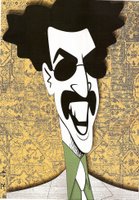
Were you wondering how Sacha Baron Cohen get all of those people to embarrass themselves in his movie? Like rodeo director, Bobby Rowe, who recommends that Borat shave his mustache so that he wouldn't look quite so Muslim and make people nervous about whether he's got explosives strapped to his body. Rowe also responds to Borat's claim that back in his country they put gays in prison and hang them saying, "That's what we're trying to do over here."

After Borat praises Bush's "war of terror" and works the crowd up with images of the president of the United States drinking "the blood of every single man, woman, and child in Iraq," he butchers the national anthem so badly that they finally turn on him.

Rowe told
Newsweek, "I go out there, and I say, 'Get the hell outta this dadgum building! Half the sumbucks in here are probably packin' heat, and they'll put you in front of the firin' squad.' Boy, they got in their trucks and hauled boogie."

With a budget of $18 million, Borat made $26.5 million in its opening weekend earning the
highest wide release opening gross for a film showing on under 1,100 screens.

Metacritic reviews of Borat

Monday, October 23, 2006

Fighting Bull


Harry Frankfurt, the Professor of Philosophy Emeritus at Princeton University, published a book last year in which he sets out a philosophical theory of bullshit. On Bullshit, which became a surprise best seller, was actually a paper he wrote back in 1986.

Publisher, Princeton University Press, commented: "Bullshitters seek to convey a certain impression of themselves without being concerned about whether anything at all is true. They quietly change the rules governing their end of the conversation so that claims about truth and falsity are irrelevant. Frankfurt concludes that although bullshit can take many innocent forms, excessive indulgence in it can eventually undermine the practitioner's capacity to tell the truth in a way that lying does not. Liars at least acknowledge that it matters what is true. By virtue of this, Frankfurt writes, bullshit is a greater enemy of the truth than lies are."

Deborah Solomon's questions this week in the New York Times magazine were for Mr. Frankfurt regarding his new book, an examination of the importance of truth, On Truth.

What do you think the pursuit of truth requires?

Recognizing truth requires selflessness. You have to leave yourself out of it so you can find out the way things are in themselves, not the way they look to you or how you feel about them or how you would like them to be.

The rest of her questions and his responses (free registration): http://tinyurl.com/ykox6d

60 Minutes clip