
Aesthetically Pleasing Balance
See also: Desperately Seeking Symmetry



Cutting Loose
by William Stafford
Sometimes from sorrow, for no reason,
you sing. For no reason, you accept
the way of being lost, cutting loose from all else and electing a world where you go
where you want to.
Arbitrary, sound comes, a reminder
that a steady center is holding
all else. If you listen, that sound will tell where it is, and you can slide your way past trouble.
Certain twisted monsters
always bar the path—but that’s when you get going best, glad to be lost, learning how real it is
here on the earth, again and again.
* * * * *

Lost & Found (1/25/11) -- “In this episode, Radiolab steers its way through a series of stories about getting lost, and asks how our brains, and our hearts, help us find our way back home.”
Part of a discussion between Michael Barrier, author of Hollywood Cartoons: American Animation in Its Golden Age, and Radiolab producer Pat Walters from “The Universe Knows My Name,” from Radiolab, Jan. 11, 2011:
Michael Barrier: [Wile E. Coyote] is an extraordinarily human animal.
Pat Walters: And not just like in the facial expressions that he made and ways that he’d look at the camera a lot, but actually, it kind of was about the predicaments he found himself in. Take for example this one really famous cartoon (at 4:20 in the clip below). Like always, Coyote has got a plan. He has made a painting of the road. He’s put this painting right at the edge of the cliff.
MB: The idea being that the Road Runner would run through the painting, gravity would take hold of him, and he would plunge into the chasm…Instead, the Road Runner runs into the painting as if the road were actually continuing. But when the coyote tries to follow the Road Runner into the painting, he runs through the painting and falls…Gravity isn’t this uniformly indifferent force. It’s a malignant force that comes in and out of play according to how inconvenient it can be for the coyote…He’s chasing the Road Runner, but the universe is his opponent.
PW: And that’s kind of what makes the coyote seems so human. He’s in that situation that all of us feel like we’re in sometimes. Like the very laws of physics are against us.
MB: It’s almost a primitive way of thinking, but I think all of us lapse into this, you know, How can this happen? You can’t be human and not feel that way.
* * * * *
Cartoon Physics, part 1
by Nick Flynn, from Some Ether
Children under, say, ten, shouldn't know
that the universe is ever-expanding,
inexorably pushing into the vacuum, galaxies
swallowed by galaxies, whole
solar systems collapsing, all of it
acted out in silence. At ten we are still learning
the rules of cartoon animation,
that if a man draws a door on a rock
only he can pass through it.
Anyone else who tries
will crash into the rock. Ten-year-olds
should stick with burning houses, car wrecks,
ships going down -- earthbound, tangible
disasters, arenas
where they can be heroes. You can run
back into a burning house, sinking ships
have lifeboats, the trucks will come
with their ladders, if you jump
you will be saved. A child
places her hand on the roof of a schoolbus,
& drives across a city of sand. She knows
the exact spot it will skid, at which point
the bridge will give, who will swim to safety
& who will be pulled under by sharks. She will learn
that if a man runs off the edge of a cliff
he will not fall
until he notices his mistake.
“The song written by an Englishman about an American city whose promise of togetherness really yields loneliness sung by a white Parisian woman everyone thought was black.”
~ From “Pop Music: Songs that Cross Borders,” Radiolab, April 21, 2008
When you're alone and life is making you lonely
You can always go - downtown
When you've got worries, all the noise and the hurry
Seems to help, I know - downtown
Just listen to the music of the traffic in the city
Linger on the sidewalk where the neon signs are pretty
How can you lose?
The lights are much brighter there
You can forget all your troubles, forget all your cares
So go downtown, things'll be great when you're
Downtown - no finer place, for sure
Downtown - everything's waiting for you
Don't hang around and let your problems surround you
There are movie shows - downtown
Maybe you know some little places to go to
Where they never close - downtown
Just listen to the rhythm of a gentle bossa nova
You'll be dancing with him too before the night is over
Happy again
The lights are much brighter there
You can forget all your troubles, forget all your cares
So go downtown, where all the lights are bright
Downtown - waiting for you tonight
Downtown - you're gonna be all right now
[Instrumental break]
And you may find somebody kind to help and understand you
Someone who is just like you and needs a gentle hand to
Guide them along
So maybe I'll see you there
We can forget all our troubles, forget all our cares
So go downtown, things'll be great when you're
Downtown - don't wait a minute for
Downtown - everything's waiting for you
Downtown, downtown, downtown, downtown ...
* * * * *
Listen to the whole fascinating Radiolab episode:
From Radiolab: “Words have the power to shape the way we think and feel. In this stunning video, filmmakers Will Hoffman and Daniel Mercadante bandy visual wordplay into a moving exploration of language set to an original score by Keith Kenniff.”
Listen to the Radiolab Words episode (Aug. 9, 2010).
Excerpt from “Time,” Radiolab (February 25, 2005).
Robert Krulwich: And to you, I guess, the joy of time—the deepest most ecstatic version of it—is when you lose it completely.
Jay Griffiths: I think that’s absolutely right. And I think that’s something in prayer, in meditation, in art—and in love, actually— is that people lose that very fretful, ticking-off-sense of clock time. And what you fall into is something transcendent. All that you have to have done is loved 
Robert: Time standing still at a moment like that is like a really swollen now.
Jay: Yes! Exactly. Exactly. And that in a sense that’s when the moment meets the eternal. That is all that matters is just this moment that you’re holding in your hand.

~ Paul Broks, author of Into the Silent Land: Travels in Neuropsychology, from “Who am I?” Radiolab (January 15, 2006)

“In mathematics, the parabola is a conic section, the intersection of a right circular conical surface and a plane to a generating straight line of that surface. Given a point (the focus) and a corresponding line (the directrix) on the plane, the locus of points in that plane that are equidistant from them is a parabola. The parabola has many important applications, from automobile headlight reflectors to the design of ballistic missiles.”
An excerpt from a Radiolab conversation between Jad Abumrad and musician Juana Molina (May 4, 2009):
Juana: I usually feel that the sounds tell me what to do with them. Every sound has its own behavior. I’m just feeling like a driver of those sounds. Little by little, my ridiculously small universe becomes huge. Anything that has a note or a rhythm, you can make music with.
Jad: Are you inspired more by a thought, like I want to say something?
Juana: No. Never! There’s absolutely nothing that I really want to say.
Jad: Really?
Juana: Really.
Jad: Well, you have lyrics sometimes.
Juana: Most of the times.
Jad: So when the song pops into your head and you develop it, you’re not thinking of a story per se.
Juana: No. Never.
Jad: But you put the story on afterwards, why?
Juana: In order to be able to sing.

Un Día
Un día voy a cantar las canciones sin letra y cada uno podrá imaginar si hablo de amor, de desilusión, banalidades o sobre platón.
One day I will sing the songs with no lyrics and everyone can imagine for themselves if it's about love, disappointment, banalities or about Plato.

Excerpts from "Sleep," Radiolab, May 25, 2007:

Robert Stickgold: So if it puts a sticky on everything that’s hard during the day, then all the brain has to do when it’s creating a dream is go and grab stickies.
Jad Abumrad: Stickgold thinks he’s seeing the outline if the dream-making process here. It starts really simply at the very beginning of sleep, right after you fall asleep, with the replay. This, he suspects, is just the brain emptying out its stickies.
Robert Krulwich: Are you at all puzzled by the super-duper, Technicolor, extraordinarily cinematic qualities of some of these [dreams]? Because if it were just an everyday brain function to sort of make sense of the world and allow you to make new connections, you wouldn’t really need quit the movie quality.
Robert Stickgold: When we talk about dreams, what seems to come into dreams are memories, concepts, relationships, associations that have a strong emotional flavor and — I’m guessing from the data — need a full-blown orchestration to be properly processed.
“Sleep is the annihilation of consciousness, so it’s a terrible time in which everything disappears — the universe and yourself with it. I think if people didn’t sleep and didn’t have the unconsciousness of sleep, they possibly wouldn’t even realize that consciousness is an enormous gift.”
Listen to this short, remarkable story about a clever strategy which a nursing home in Düsseldorf, Germany came up with to address the problem of disoriented residents wandering away.
“It’s like another thought comes up and you forget what you wanted. It’s like fishes coming up to the surface of the water and then going down again. Thoughts come up and they disappear and you don’t know that they have ever been there. You forget.”
~ Richard Neureither (translated by Regine Hauch) for “The Bus Stop,” by Lulu Miller, Radiolab, March 23, 2010
Pressure
by Company of Thieves
I'm angry all the time
No one's fault but mine
Tell me how you fashion kind
When you're out of style
And I try hard to answer
All the questions that you've posed
Tell me now how should I care
When I feel so alone
And so unloved
The pressure is rising
I mean it, it's binding
I've been compromising for you
When you come home really late at night
Ripe to pick a fight
I know just the kind you'd like
So come on and bite
And I try hard to answer
All the punches that you throw
Tell me now how should I fair
When I feel so unloved and so alone
The pressure is rising
I mean it, it's binding
I've been compromising for you
The pressure is rising
I've been compromising for you
I'm waiting at the bus stop in the morning
And it's pouring
Oh, I am waiting at the bust stop for you
Staring at walls with closed doors
The key that won't work
Sure helps the time pass by
Saying I'm wrong when I'm wrong
Knowing it's the right thing
Sure helps the thoughts in my mind
The pressure is rising
I mean it, it's binding
I've been compromising for you
You, you
I am waiting at the bus stop
In the morning
And it's boring
Pressure
by Company of Thieves
I'm angry all the time
No one's fault but mine
Tell me how you fashion kind
When you're out of style
And I try hard to answer
All the questions that you've posed
Tell me now how should I care
When I feel so alone
And so unloved
The pressure is rising
I mean it, it's binding
I've been compromising for you
When you come home really late at night
Ripe to pick a fight
I know just the kind you'd like
So come on and bite
And I try hard to answer
All the punches that you throw
Tell me now how should I fair
When I feel so unloved and so alone
The pressure is rising
I mean it, it's binding
I've been compromising for you
The pressure is rising
I've been compromising for you
I'm waiting at the bus stop in the morning
And it's pouring
Oh, I am waiting at the bust stop for you
Staring at walls with closed doors
The key that won't work
Sure helps the time pass by
Saying I'm wrong when I'm wrong
Knowing it's the right thing
Sure helps the thoughts in my mind
The pressure is rising
I mean it, it's binding
I've been compromising for you
You, you
I am waiting at the bus stop
In the morning
And it's boring
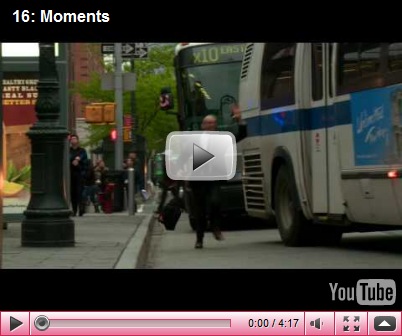
Radiolab presents 16: Moments by Will Hoffman. This film is a celebration of life that was inspired by David Eagleman's book, Sum.

Daron Larson
Freelance Contemplative



