
Wherever They Are
“Wildflowers don't move to find the sun's rays. God makes them fecund wherever they are.”
~ Frère Christian de Chergé, from Of Gods and Men



“Wildflowers don't move to find the sun's rays. God makes them fecund wherever they are.”
~ Frère Christian de Chergé, from Of Gods and Men

Pleasure depends very much on circumstances, on what triggers it. Then it's a sensation in a way. So, sensation changes from pleasurable to neutral and to unpleasurable...you can experience pleasure at the cost of other's suffering. So it's very vulnerable to the change of other circumstances. It doesn't help you to face the other circumstances better.
[But we can] think of happiness as a way of being that gives you the resources to deal with the ups and downs of life, that pervades all the emotional states, including sadness.”
~ Matthieu Ricard, from “The ‘Happiest’ Man in the World,” Speaking of Faith, November 12, 2009
“I long for the narrative arc and true storytelling,” Mr. [Alec] Soth said. When he’s on the road he tries to let each picture lead him to the next; taped to his steering wheel is a list of things to watch for while he’s driving. A list composed for his current project included beards, birdwatchers, mushroom hunters, men’s retreats, after the rain, figures from behind, suitcases, tall people (especially skinny), targets, tents, treehouses and tree lines. Thus the photo of the tall bearded monk standing amid a forest of soaring barren tree trunks and the image of a giantlike man with a suitcase walking away on an overgrown path.
~ From “Trolling for Strangers to Befriend,” by Hilarie M. Sheets, New York Times (August 2, 2009)

High Museum of Art Atlanta
August 8, 2009, through January 3, 2010
From “A Year in a Cage: A Life Shrunk to Expand Art,” by Roberta Smith, New York Times (Feb. 18, 2009):
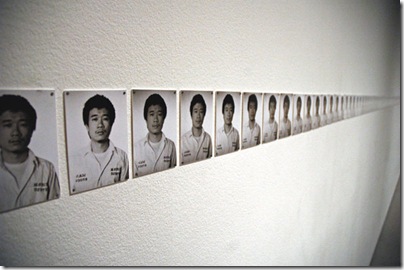
For “Cage Piece” Tehching Hsieh (pronounced dur-ching shay) built a cage from pine dowels and two-by-fours in a corner of his TriBeCa studio, furnishing it with a bed, a blanket, a sink (no toilet) and a pail, as well as some personal hygiene items. He entered the cell on Sept. 30, 1978. Robert Projansky, his lawyer, locked the door and affixed it and each dowel with paper seals that he signed. Every day a friend delivered food and dealt with the artist’s refuse. And each day the friend took a photograph of Mr. Hsieh, who had shaved his head at the beginning.

Daron Larson
Freelance Contemplative



