Showing posts with label T.S. Eliot. Show all posts

Saturday, October 02, 2010

Our Memory of the Moments

We die to each other daily.
What we know of other people
Is only our memory of the moments
During which we knew them. And they have changed since then.
To pretend that they and we are the same
Is a useful and convenient social convention
Which must sometimes broken. We must also remember
That at every meeting we are meeting a stranger.

~ T. S. Eliot, The Cocktail Party (1949)

Sunday, July 11, 2010

Reconciled Among the Stars

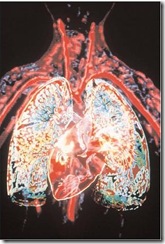
This scan of the cardiovascular system shows the heart and lungs, with major blood vessels radiating from them. Photograph by Howard Sochurek. Corbis. The trilling wire in the blood
Sings below inveterate scars
Appeasing long forgotten wars.
The dance along the artery
The circulation of the lymph
Are figured in the drift of stars
Ascend to summer in the tree
We move above the moving tree
In light upon the figured leaf
And hear upon the sodden floor
Below, the boarhound and the boar
Pursue their pattern as before
But reconciled among the stars.

At the still point of the turning world. Neither flesh nor fleshless;
Neither from nor towards; at the still point, there the dance is,
But neither arrest nor movement. And do not call it fixity,
Where past and future are gathered. Neither movement from nor towards,
Neither ascent nor decline. Except for the point, the still point,
There would be no dance, and there is only the dance.

~ T.S. Eliot, from "Burnt Norton," the first poem of his Four Quartets

The aftermath of the death of a massive star (X-ray: NASA/CXC/Penn State/S.Park et al.; Optical: Pal.Obs. DSS)

View in Google Sky

Friday, May 07, 2010

Every Moment

Coming Ashore, Evening, oil on canvas, Warren Sheppard

'Fare forward, you who think that you are voyaging;
You are not those who saw the harbour
Receding, or those who will disembark.
Here between the hither and the farther shore
While time is withdrawn, consider the future
And the past with an equal mind.
At the moment which is not of action or inaction
You can receive this: "on whatever sphere of being
The mind of a man may be intent
At the time of death"—that is the one action
(And the time of death is every moment)
Which shall fructify in the lives of others:
And do not think of the fruit of action.
Fare forward.
                      O voyagers, O seamen,
You who came to port, and you whose bodies
Will suffer the trial and judgment of the sea,
Or whatever event, this is your real destination.'
So Krishna, as when he admonished Arjuna
On the field of battle.
                                  Not fare well,
But fare forward, voyagers.

~ T.S. Eliot, from "The Dry Salvages," the third poem of his Four Quartets

Commentary by Phillip Moffitt from Dancing with Life:

Eliot is saying that there is only this moment in your life, and each moment is a death and a rebirth. You only exist as a string of moments and you are new and different in each moment. It is only when you are present in a moment that you are capable of affecting your life or another's. You fail to notice this truth because life is constantly changing and because of the power of memory and association.

When Eliot cautions not to think of the fruit of your actions, he is echoing the Buddha's teaching of nonattachment. To be nonattached is "to care" and "to not care" simultaneously, which can only be realized as an insight, not as a concept. Through meditation and practice of the Twelve Insights [of the four noble truths which is the theme of his book] in daily life, you slowly come to understand this paradoxical wisdom, which is the way to dance with life.

Saturday, January 16, 2010

Neither Daylight Nor Darkness

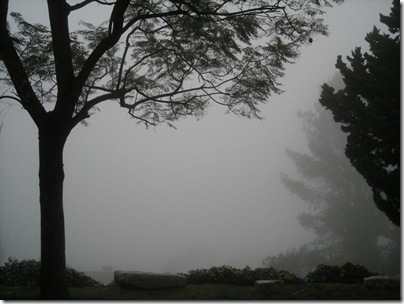
Year-End Retreat 2009, Rancho Palos Verdes

Here is a place of disaffection
Time before and time after
In a dim light: neither daylight
Investing form with lucid stillness
Turning shadow into transient beauty
With slow rotation suggesting permanence
Nor darkness to purify the soul
Emptying the sensual with deprivation
Cleansing affection from the temporal.
Neither plenitude nor vacancy. Only a flicker
Over the strained time-ridden faces
Distracted from distraction by distraction
Filled with fancies and empty of meaning
Tumid apathy with no concentration
Men and bits of paper, whirled by the cold wind
That blows before and after time,
Wind in and out of unwholesome lungs
Time before and time after.
Eructation of unhealthy souls
Into the faded air, the torpid
Driven on the wind that sweeps the gloomy hills of London,
Hampstead and Clerkenwell, Campden and Putney,
Highgate, Primrose and Ludgate. Not here
Not here the darkness, in this twittering world.

~ T.S. Eliot, from "Burnt Norton," the first poem of his Four Quartets

Tuesday, December 01, 2009

A Perpetual Possibility

The first lines from T.S. Eliot’s The Four Quartets:

eliotTime present and time past
Are both perhaps present in time future
And time future contained in time past.
If all time is eternally present
All time is unredeemable.
What might have been is an abstraction
Remaining a perpetual possibility
Only in a world of speculation.
What might have been and what has been
Point to one end, which is always present.
Footfalls echo in the memory
Down the passage which we did not take
Towards the door we never opened
Into the rose-garden. My words echo
Thus, in your mind.

Friday, April 10, 2009

T.S. Eliot on Poetry

T.S. Eliot

“It may make us from time to time a little more aware of the deeper, unnamed feelings which form the substratum of our being, to which we rarely penetrate; for our lives are mostly a constant evasion of ourselves.”

~ Quoted in Matrix of Modernism by Sanford Schwartz

* * *

“If you want to write poetry, keep away from pencils and paper and typewriters until you have overcome the temptation…Whatever you think, be sure that’s what you think; whatever you want, be sure that’s what you want; whatever you feel, be sure that’s what you feel.”

~ From an address at Milton Academy, June 17, 1933


From East Coker
(No. 2 of Four Quartets)

From Wikipedia: East Coker is a village in Somerset, England from which T.S. Eliot's ancestors emigrated to Boston in 1660. Eliot visited the village in 1936-7 and his ashes are buried in the churchyard. Inside the church a plaque memorializing him was placed in 1965. It contains the words of his chosen epitaph, the opening and closing lines from East Coker: “in my beginning is my end"/"in my end is my beginning”. East Coker represents earth.

Sunday, March 15, 2009

Only Live, Only Suspire

The dove descending breaks the air
With flame of incandescent terror
Of which the tongues declare
The one discharge from sin and error.
The only hope, or else despair
Lies in the choice of pyre of pyre—
To be redeemed from fire by fire.

Who then devised the torment? Love.
Love is the unfamiliar Name
Behind the hands that wove
The intolerable shirt of flame
Which human power cannot remove.
We only live, only suspire
Consumed by either fire or fire.

~ T.S. Eliot, from "Little Gidding," the fourth poem of his Four Quartets.

[Thank you Shinzen!]

Tuesday, August 05, 2008

The Way of Ignorance

I said to my soul, be still, and wait without hope
For hope would be hope for the wrong thing; wait without love,
For love would be love of the wrong thing; there is yet faith
But the faith and the love and the hope are all in the waiting.
Wait without thought, for you are not ready for thought:
So the darkness shall be the light, and the stillness the dancing.
Whisper of running streams, and winter lightning.
The wild thyme unseen and the wild strawberry,
The laughter in the garden, echoed ecstasy
Not lost, but requiring, pointing to the agony
Of death and birth.

You say I am repeating
Something I have said before. I shall say it again.
Shall I say it again? In order to arrive there,
To arrive where you are, to get from where you are not,
You must go by a way wherein there is no ecstasy.
In order to arrive at what you do not know
You must go by a way which is the way of ignorance.
In order to possess what you do not possess
You must go by the way of dispossession.
In order to arrive at what you are not
You must go through the way in which you are not.
And what you do not know is the only thing you know
And what you own is what you do not own
And where you are is where you are not.

~ T.S. Eliot, from "East Coker," the second poem of his Four Quartets

Sunday, March 16, 2008

Ghost against Ghost

"The fact is simple enough. Through a lifetime, by ingesting food and water, we build cells, we grow, we become larger and more substantial. That which was not, is. The process is undetectable. It can be viewed only at intervals along the way. We know it is happening, but we don't know quite how or why.
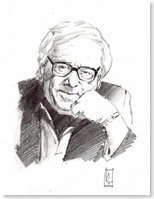
bradbury "Similarly, in a lifetime, we stuff ourselves with sounds, sights, smells, tastes and textures of people, animals, landscapes, events, large and small. We stuff ourselves with these impressions and experiences and our reactions to them. Into our subconscious goes not only factual data but reactive data, our movement toward or away from the sensed events.

"These are the stuffs, the foods, on which the Muse grows. This is the storehouse, the file, to which we must return every waking hour to check reality against memory, and in sleep to check memory against memory, which means ghost against ghost, in order to exorcise them, if necessary.

"What is the subconscious to every other man, in its creative aspect becomes, for writers, the Muse. They are two names for one thing. But no matter what we call it, here is the core of the individual we pretend to extol, to whom we build shrines and hold lip services in our democratic society. For it is in the totality of experience reckoned with, filed and forgotten, that each man is truly different from all others in the world."

...

"Read poetry every day of your life. Poetry is good because it flexes muscles you don't use often enough. Poetry expands the senses and keeps them in prime condition. It keeps you aware of your nose, your eye, your ear, your tongue, your hand. And, above all, poetry is compacted metaphor or simile. Such metaphors, like Japanese paper flowers, may expand outward into gigantic shapes. Ideas lie everywhere through the poetry books, yet how rarely have I heard short-story teachers recommending them for browsing...

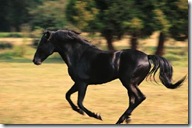
"What poetry? Any poetry that makes your hair stand up along your arms. Don't force yourself too hard. Take it easy. Over the years you may catch up to, horsemove even with, and pass T.S. Eliot on your way to other pastures. You say you don't understand Dylan Thomas? Yes, but your ganglion does, and your secret wits, and all your unborn children. Read him, as you read a horse with your eyes, set free and charging over and endless green meadow on a windy day."
-- Ray Bradbury, "How to Keep and Feed the Muse," The Writer Magazine (April 2008), reprinted from 1961.