Sunday, July 26, 2009

The Humor and Poetry and Drama

“I’m not scared that I don’t have a finished script, because I can very quickly find the humor and poetry and drama in situations. It’s there all the time in life.”

~ Roy Andersson, from “Calling It as He Sees It, in Great Detail,” by Dave Kehr, New York Times Sunday Magazine (July 26, 2009)

Saturday, July 25, 2009

Everything is Alive

Keeping Quiet
by Pablo Neruda, from Full Woman, Fleshly Apple, Hot Moon, translated by Stephen Mitchell

Now we will all count to twelve
and we will all keep still.

This one time upon the earth,
let’s not speak any language,
let’s stop for one second,
and not move our arms so much.

It would be a delicious moment,
without hurry, without locomotives,
all of us would be together
in a sudden uneasiness.

The fisherman in the cold sea
would do no harm to the whales
and the peasant gathering salt
would look at his torn hands.

Those who prepare green wars,
wars of gas, wars of fire,
victories without survivors,
would put on clean clothing
and would walk alongside their brothers
in the shade, without doing a thing.

What I want shouldn’t be confused
with final inactivity:
life alone is what matters,
I want nothing to do with death.

If we weren’t unanimous
about keeping our lives so much in motion,
if we could perhaps do nothing for once,
perhaps a great silence would interrupt this sadness,
this never understanding ourselves
and threatening ourselves with death,
perhaps the earth is teaching us
when everything seems to be dead
and everything is alive.

Now I will count to twelve
and you keep quiet and I’ll go.

As If It Were the Only One

Elias Canetti "There is no such thing as an ugly language. Today I hear every language as if it were the only one, and when I hear of one that is dying, it overwhelms me as though it were the death of the earth."

~ Elias Canetti

Friday, July 24, 2009

Maybe It’s Not Too Late to Grow Up

From Forever Young, and essay written and read by Kurt Anderson of Studio 360 (July 17, 2009):

"Waiting to get what you want is a definition of maturity. Demanding satisfaction right this instant is the definition of a seven year old. But instant satisfaction has been driving our economy and our culture for a while.

Send a message now! Get an answer now! Pick your airline seat now! Buy anything you want right now!

The web, cell phones, FedEx: they all indulge the impulsive child in every one of us.

Save? Why? For what?

Wait till I can afford it? No…Fooey!

Fuel efficient? Lame.

I don't mean to be a crank and I don't mean to condemn fun. I'm committed to rubber soles for life and I cherish The Simpsons. I'm even a convert to Twitter -- the official medium of back-of-the-class wisecracks.

Yes, the economic collapse had everything to do with credit policy and financial regulation. But I really, truly think that this forty-year-long celebration of our inner child helped lead us to the spree that we've just come off.

But with this crisis and now the rebuilding and reshaping of America we're required to do, we Boomers have maybe our last, best shot to suck it up and get serious and help straighten out the messes that we helped make. Maybe it's not too late to grow up a little.”

Equanimity Does Not Mean Fairness

justice “To practice equanimity is to understand that everything everybody ever does — I repeat, everything everybody ever does — is because at that moment, he or she feels that their action will improve their world. In other words he or she is just trying to be happy. The actions may be, and often are, tragically, catastrophically self-defeating, but that is the motivation at the moment of action. Equanimity, then, is a profound acceptance of each person's humanity. Fairness may be the result of equanimity, but it's not the practice of equanimity.”

~ Ken McLeod, from Rules for the Road

Try to Love the Questions

“Be patient towards all that is unsolved in your heart and try to love the questions themselves like locked rooms and like books that are written in a very foreign tongue. Do not now seek the answers, which cannot be given you because you would not be able to live them. And the point is, to live everything. Live the questions now. Perhaps you will then gradually, without noticing it, live along some distant day into the answer.”

~ Rainer Maria Rilke

Thursday, July 23, 2009

Benign Contagion

[Thanks Kimberly!]

Tuesday, July 21, 2009

A Little Out of Scale

Norman Fischer speaking with Vince Horn on Buddhist Geeks (Episode129 -- Buddhism May Need a Plan B):

BG ...twenty-five years ago nobody went to the gym. Now we've well established through research in our society that exercise is really important so there's a gym on every corner. Well, why isn't there a meditation hall on every corner? Haven’t we established the fact that some spiritual endeavor is just as important for inner health as exercise is for the body? So there ought to be meditation halls on every corner and people should know how important this is and feel like it makes sense to access it and pay for it so that there could be people to offer it.

I mean that there is tremendous spike in research on meditation. Just in last three or four years. It’s exponentially increased and all the research is always showing the same thing that meditation is actually a effective, that it really works, and that it has all kind of benefits. So people seem to believe in research and scientific data, but just talk to your friends who do this practice and that’s probably enough to convince you even without the scientific data.

...It's funny, you know? I'm gone do a retreat for the army for Norman Fischer      caregivers and chaplains. So the Army's going to spend fifty cents to pay me to do the retreat and then a million dollars to study the effects of the retreat over time. So...it’s very expensive to conduct research. Very expensive. A million dollar research grant is not an unusual grant. A million dollar gift to a dharma center or for a teacher training or something like that is very, very rare. So it’s a little out of scale.

[The conversation continues in Episode 130 -- Buddhism and the Evolution of Religion. Check out Norman Fischer’s article, “Why We Need a Plan B,” in the summer issue of Buddhadharma.]

Wishing Well

“The better part of happiness is to wish to be what you are.”

~ Desiderius Erasmus

Ce Soir


Ce Soir is Montreal-based band Monogrenade's first music video. Directed by Christophe Collette, the video is entirely made in stop-motion.

See also Vidéomusique

[Thanks again JC!]

Ideas Come as Little Phrases or Images

From The Story from the Static: On Writing and Painting by Audrey Niffenegger:

I have spent most of my life feeling like a woman trying to listen to the radio in a thunderstorm. I am trying to get an idea, something I can turn into a picture, or a novel, and occasionally such a thing does whiz into my brain and it's my job to pick it out from all the static of daily life and find out if it means anything.

Before I can think very hard about this idea I have to figure out if it's a word The Letter, 2005thing or a picture thing. Ideas tend to come to me in the form of little phrases ("the time traveler's wife"; "self-portrait as Siamese twins") or as images (three women with long hair sitting together but refusing to speak to each other; a lady reading a book with a giant spider perched on her hat, also reading the book). These four ideas became a novel, a painting, a picture book, a tiny drawing. They could have taken other forms. I have to take each idea and turn it over in my head, trying it out to see what it does, to see how I can make it bigger and stronger. Mostly I am just trying to see, period. I'm trying to look at it, listen to it, attend to it; I'm trying to find out what it wants.

It takes me a long time to make things, and that's good. The more time I have, the more I can add and subtract, the better the thing will be.

My novel, The Time Traveler's Wife, began as a phrase that came to me while The Time Traveler's Wifedrawing. I could see the main character as an old woman, waiting for her time traveler. But was it a picture, or something else? The characters suddenly had names; as I went about my daily life they began to have personalities, desires, schemes. At this point I realized that a picture book wasn't going to work. Still images are always the present, and they don't capture the fluidity of time. I had the choice of trying to write a novel (which I'd never done) or make a movie (very expensive and requiring the help of other people). I began to write.

[More... ]

Monday, July 20, 2009

air and light and time and space

by Charles Bukowski

“—you know, I’ve either had a family, a job,
some­thing has always been in the
way
but now
I’ve sold my house, I’ve found this
place, a large studio, you should see the space and
the light.
for the first time in my life I’m going to have
a place and the time to
create.”

no baby, if you’re going to create
you’re going to create whether you work
16 hours a day in a coal mine
or
you’re going to create in a small room with 3 chil­dren
while you’re on
wel­fare,
you’re going to create with part of your mind and your body blown
away,
you’re going to create blind
crip­pled
demented,
you’re going to create with a cat crawl­ing up your
back while
the whole city trem­bles in earth­quake, bom­bard­ment,
flood and fire.

baby, air and light and time and space
have noth­ing to do with it
and don’t create any­thing
except maybe a longer life to find
new excuses
for.

[Thanks JC!]

How Long Do You Think You’re Going to Live?

From The Week (July 24, 2009):

British Vogue July 2009 Julianne Moore doesn’t mind calling herself “middle-aged,” says Gaby Wood in British Vogue. “When people say, ‘I’m not middle-aged,’ you want to say, ‘Well, exactly how long do you think you’re going to live?’” the 48-year-old actress says. “It becomes so tedious after a while, this idea that everybody’s so focused on being young. Whenever you ask anybody, ‘Would you want to be 20 again?’ invariably they go, ‘No.’ You don’t want to repeat it—you want to be what you are.” In Moore’s case, youth was not only a time of personal confusion; it was a time when she couldn’t find work. “When I was auditioning for movies in the ’80s, I never got anything. They made a lot of movies about young people doing things, like St. Elmo’s Fire. I got my first movie role when I was 29, which was considered really old. I wasn’t supposed to tell anyone my age. It was horrible—so stupid and awkward—and I found it really oppressive. I was, like, I can’t do this anymore! What is the problem with telling people I’m 30, 31, 32?” She got her breakthrough in indie films, and her career took off after that. Moore’s now fully content with both her professional life and her personal one—she’s married, with two children—and the recent sudden death of friend Natasha Richardson helped put things in perspective. “I’m lucky to be 48, and not be … not here. I’m never going to be 48 again—48’s over after this year.”

Sunday, July 19, 2009

I Want to be Good to Myself

Trouble
by Matthew Dickman, from All-American Poem

Marilyn Monroe took all her sleeping pills
to bed when she was thirty-six, and Marlon Brando’s daughter
hung in the Tahitian bedroom
of her mother’s house,
while Stanley Adams shot himself in the head.  Sometimes
you can look at the clouds or the trees
and they look nothing like clouds or trees or the sky or the ground.
The performance artist Kathy Change
set herself on fire while Bing Crosby’s sons shot themselves
out of the music industry forever.
I sometimes wonder about the inner lives of polar bears.  The French
philosopher Gilles Deleuze jumped
from an apartment window into the world
and then out of it.  Peg Entwistle, an actress with no lead roles, leaped from the “H” in the HOLLYWOOD sign
when everything looked black and white
and David O. Selznick was king, circa 1932.  Ernest Hemingway
put a shotgun to his head in Ketchum, Idaho
while his granddaughter, a model and actress, climbed the family tree
and overdosed on phenobarbital.  My brother opened thirteen fentanyl patches and stuck them on his body
until it wasn’t his body anymore.  I like
the way geese sound above the river.  I like
the little soaps you find in hotel bathrooms because they’re beautiful.
Sarah Kane hanged herself, Harold Pinter
brought her roses when she was still alive,
and Louis Lingg, the German anarchist, lit a cap of dynamite
in his own mouth
though it took six hours for him
to die, 1887.  Ludwig II of Bavaria drowned
and so did Hart Crane, John Berryman, and Virginia Woolf.  If you are
traveling, you should always bring a book to read, especially
on a train.  Andrew Martinez the nude activist, died
in prison, naked, a bag
around his head, while in 1815 the Polish aristocrat and writer
Jan Potocki shot himself with a silver bullet.
Sara Teasdale swallowed a bottle of blues
after drawing a hot bath,
in which dozens of Roman senators opened their veins beneath the water.
Larry Walters became famous
for flying in a Sears patio chair and forty-five helium-filled weather balloons.  He reached an altitude of 16,000 feet
and then he landed.  He was a man who flew.
He shot himself in the heart.  In the morning I get out of bed, I brush
my teeth, I wash my face, I get dressed in the clothes I like best.
I want to be good to myself.


KCRW Bookworm (June 25, 2009)

Tuesday, July 14, 2009

There It Sits

H. L. Mencken “Penetrating so many secrets, we cease to believe in the unknowable. But there it sits nevertheless, calmly licking its chops.”

~ H. L. Mencken

Not Shying Away from Recessions

Economics professor Paul Zak in conversation with Krista Tippett on "The Science of Trust: Economics and Virtue," Speaking of Faith, July 9 2009:

"Economists talk of the cleansing effect of recessions. So recessions are necessary because they kind of cull out the companies that are not providing the best customer service, that are not making a profit, that are not providing some product or service that people need. And when those businesses go out of business, then those resources are redeployed to more important uses. The machines are reused; the people get different jobs. And so this keeps the economy kind of efficient. We don't want to kind of limp along and have high levels of inefficiency just because we love the name General Motors or love the name of some company if they can't kind of keep up with the herd. So competition drives that and that's an important part of maintaining efficiency.

But I think the same thing can happen in individual lives. I think as we get towards the end of every boom period, today or two years ago, the end of the 1990s and dot-com bubble, the end of the '80s and this kind of me generation, I think we do get out of whack because human beings are adaptable and we are watching what other humans are doing. We also become adaptable to this sort of yuppie, more stuff for me lifestyle.

I think, from a spiritual perspective, that recessions are also cleansing. So I think it's very important that we don't shy away from recessions and we don't try to outlaw them. I think we should say, 'Hey, there were excesses. This is how the excesses are corrected. And the excesses were both kind of on the macro level and even perhaps in my own life. Maybe I got a little over-excited about the extra bonuses I was getting and the bigger car. And now I want to sit down and reevaluate what's really important to me.' So I think there are great analogies between the micro and the macro, and we should embrace that.

Having said that, the stress issues are strong. One of the pieces of advice I like to give is: Turn off your TV. Don't listen to the pessimistic news every second of the day...

...Appropriate levels of stress are very good for human beings...There's sort of this misnomer that stress is bad. Too much stress is bad, but also too little stress is bad. So there's sort of this inverted U-curve...this sweet spot for stress that focuses your attention. So I think that when we're in that sweet spot, when we're focused, our memory's better and we're thinking clearly and we've got to figure out what to do next, that's actually very good for human beings and actually all other animals as well."

Saturday, July 11, 2009

I Wasn’t Sure

Peonies

Pink and White
by Deborah Garrison, from The Second Child

Peonies are the only flower I care for
and when I saw them from the window
yesterday, tumbled and heavy along
a fence, fully exploded, nodding
at the ground, hanging their heads but not
yet spoiled, I remembered
a summer (maybe seven years
ago, or was it ten?) I wasn't sure
our love would come again,
and here I am, almost

kissing the grass like that,
bursting and rich, cracked
all over like broken cake—
makes you cry but still sweet.

[Thanks Garrison!]

Arrive to a Place in the Middle

“I think this idea that we meet one person and you stay with them your whole life until you die, for me, is unrealistic. I’ve loved a lot of people at many different times in my life. And the love doesn’t stop when we’re not together. And I feel as though, I’ve come to a place in my life, where the climax isn’t watching the love arrive, it’s watching the love in full. Just like our life goes in a cycle, that song has a descension which is just as beautiful as the middle. And in fact, the metaphor that I gave was the same. It was, arrive to a place in the middle where you watch everything in its radiance, you watch the beauty, it unfolds like a flower. And then, you watch it descend. And there’s just as much beauty in watching something recede into the soil as there is watching it come back because that’s full. And I feel the same way about love. So I feel no loss when love leaves because it truly never goes anywhere, and I feel no joy when it sticks around because honestly I kind of like to sleep alone now and then.”

~ Melody Gardot, in conversation with Bob Edwards (July 11, 2009)

Mapping Algorithms

“I'm a composer, orchestrally-trained, and the inventor of the AlloSphere. With my visual artist colleagues, we map complex mathematical algorithms that unfold in time and space, visually and sonically. Our scientist colleagues are finding new patterns in the information. And our engineering colleagues are making one of the largest dynamically varying computers in the world for this kind of data exploration. I'm going to fly you into five research projects in the AlloSphere that are going to take you from biological macroscopic data all the way down to electron spin.”

~ Composer JoAnn Kuchera-Morin, founder of the Center for Research in Electronic Art Technology (CREATE)

Self-Ordering Systems

From Thinking in Pictures: and Other Reports from My Life With Autism by Temple Grandin:

Thinking in Pictures “In high school I came to the conclusion that God was an ordering force that was in everything after Mr. Carlock explained the second law of thermodynamics, the law of physics that states the universe will gradually lose order and have increasing entropy. Entropy is the increase of disorder in a closed thermodynamic system. I found the idea of the universe becoming more and more disordered profoundly disturbing. To visualize how the second law worked, I imagined a model universe consisting of two rooms. This represented a closed thermodynamic system. One room was warm and the other was cold. This represented the state of maximum order. If a small window were opened between the rooms, the air would gradually mix until both rooms were lukewarm. The model was now in a state of maximum disorder, or entropy. The scientist James Clerk Maxwell proposed that order could be restored if a little man at the window opened and closed it to allow warm atoms to go to the one side and cold atoms to go to the other side. The only problem is that an outside energy source is required to operate the window. When I was a college sophomore, I called this ordering force God.

…I hated the second law of thermodynamics because I believed that the universe should be orderly. Over the years I have collected many articles about spontaneous order and pattern formation in nature. Susumu Ohno, a geneticist, has found classical music in slime and mouse genes. He converted the genetic code of four nucleotide bases in our DNA is not random, and when the order is played, it sounds like something by Bach or a Chopin nocturne. Patterns in flowers and leaf growth in plants develop in mathematical sequence of the Fibonacci numbers and the golden mean of the Greeks.

Patterns spontaneously arise in many purely physical systems. Convection patterns in heated fluids sometimes resemble a pattern of cells. Scientists at the University of California have discovered that silver atoms deposited on a platinum surface spontaneously form ordered patterns. The temperature of the platinum determines the type of pattern, and order can be created from random motion. A small change in temperature totally changes the pattern. At one temperature triangles are formed, and at another temperature hexagons form, and further heating of the surface makes the silver atoms revert to triangles in a different orientation. Another interesting finding is that everything in the universe, ranging from amino acids and bacteria to plants and shells, has handedness. The universe is full of self-ordering systems.”

*     *     *     *     *

Genome Music Demo
from Todd Baron


More audio clips at GarageBand

Friday, July 10, 2009

You’ll Probably Take a Lot of Wrong Turns

Alice Munro "It's not possible to advise a young writer because every young writer is so different. You might say, 'Read,' but a writer can read too much and be paralyzed. Or, 'Don't read, don't think, just write,' and the result could be a mountain of drivel. If you're going to be a writer you'll probably take a lot of wrong turns and then one day just end up writing something you have to write, then getting it better and better just because you want it to be better, and even when you get old and think 'There must be something else people do,' you won't quite be able to quit."

~ Alice Munro

Wednesday, July 08, 2009

What We Don’t Do

Alan Bean

“My life for the last twenty-eight years is tied up with this like it was for eighteen years being an astronaut or eight years before that being a Navy pilot. I believe in doing what you can, cause I’ll be gone in another ten or fifteen years. Your listeners need to think about this, they’re only going to be here once. Sometimes we think there’s other people around that will make up for what we don’t do. Sure they can.  They can mow a lawn. They can drive a car. They can take a job and write an article or something. But they cannot do what’s in the heart of each of your listeners. And if they don’t do it, it will never be done again until time ends. Who knows when that is?”

~ Alan Bean, the fourth man to walk on the moon, from “Moon Artist,” PRI’s The World, July 8, 2009.

That’s How It Felt to Walk on the Moon, painting by Alan Bean

Monday, July 06, 2009

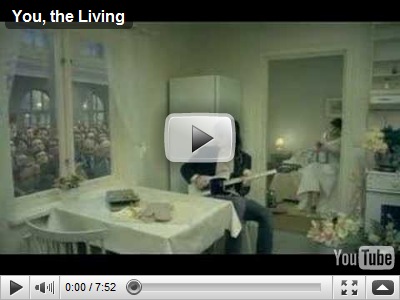
You, the Living

Therefore rejoice, oh thou living one, blest in thy love-lighted homestead,
Ere the dark Lethe's sad wave wetteth thy fugitive foot.

~ Goethe, from Roman Elegies

You, The Living
(A film about the grandeur of existing)
by Roy Andersson

“Man is the fascination of man, in big things and small. Life itself bears witness to this. Art confirms it. Spectacular and dramatic events and destinies captivate us. But so does sitting at a street café and watching people wordlessly go by. As compelling as Delacroix's passionate depictions of battle scenes are the paintings by Millet or van Gogh of peasants at work, of a pair taking an afternoon nap in the shade of a haystack, or a family sitting in a kitchen eating potatoes -- pictures that are so precise, empathetic and carefully executed as to give you the feeling that there is nothing more important to relate than this.”

Something Held Me Back

I Was Always Leaving
by Jean Nordhaus

I was always leaving, I was
about to get up and go, I was
on my way, not sure where.
Somewhere else. Not here.
Nothing here was good enough.

It would be better there, where I
was going. Not sure how or why.
The dome I cowered under
would be raised, and I would be released
into my true life. I would meet there

the ones I was destined to meet.
They would make an opening for me
among the flutes and boulders,
and I would be taken up. That this
might be a form of death

did not occur to me. I only know
that something held me back,
a doubt, a debt, a face I could not
leave behind. When the door
fell open, I did not go through.

From American Life in Poetry: Column 224

Sunday, July 05, 2009

Round-the-Clock Denial

“American popular culture is our eternal present, our illusion of deathlessness. We don’t really mourn the death of a pop-culture icon. We use his extinction to resurrect his life. In America, the death of an American star is really the occasion for a garrulous, obsessive, round-the-clock denial of death.”

~ From “How Constant Change Killed Michael Jackson," by Lee Siegel, The Daily Beast (July 5, 2009)

Saturday, July 04, 2009

On a Morning in Early Summer

Photo by Andrea Mohin/The New York TimesThe Sun
by Mary Oliver

Have you ever seen
anything
in your life
more wonderful

than the way the sun,
every evening,
relaxed and easy,
floats toward the horizon

and into the clouds or the hills,
or the rumpled sea,
and is gone -- 
and how it slides again

out of the blackness,
every morning,
on the other side of the world,
like a red flower

streaming upward on its heavenly oils,
say, on a morning in early summer,
at its perfect imperial distance --
and have you ever felt for anything
such wild love --
do you think there is anywhere, in any language,
a word billowing enough
for the pleasure

that fills you,
as the sun
reaches out,
as it warms you

as you stand there,
empty-handed --
or have you too
turned from this world --

or have you too
gone crazy
for power,
for things?

[Thanks JC and Kit!]

Thursday, July 02, 2009

An Unreal Life

Hermann Hesse "There is no reality except the one contained within us. That is why so many people live such an unreal life. They take the images outside them for reality and never allow the world within to assert itself."

~ Hermann Hesse

Humane Societies

From Ecce Homo (Behold Humanity) by Xavier Le Pichon:

Xavier Le Pichon Physical pain, like fear, are mechanisms of alarm that play a decisive role in the process of decision necessary for the survival of the individual, among animals as well as humans. They also play an important role at the community level. Beyond physical pain, there is the inner suffering. For example, the rupture, due to death or departure, of a relation of very strong dependence between two individuals, may lead to grief consumption or even death. Human societies integrate in their structure in an organic way the fragility and vulnerability manifested in this whole vast world of suffering and death. This is why they are called humane. In the French language the word “humain” is used to denote someone who is both human and humane. That is, he is sensitive to the suffering of his neighbor and tries to alleviate that suffering. In the same way, a society is humane in the degree that it takes care of the lives of those who suffer most without either rejecting or marginalizing them.

…Our humanity is not an attribute that we have received once and forever with our conception. It is a potentiality that we have to discover within us and progressively develop or destroy through our confrontation with the different experiences of suffering that will meet us throughout our life.

Tuesday, June 30, 2009

No Time


Check out Jeff Scher’s blog, The Animated Life.

From “The Parade,” June 29, 2009:

The streets of the city are a non-stop parade of humanity. It’s a kind of grand, unchoreographed ballet of human locomotion. One of the great pleasures and measures of being urban is losing yourself in the crowd, with your feet and mind wandering, alone in your head but elbow to elbow with an inexhaustible supply of strangers…

We can’t help it. We are fascinated by faces and bodies alike. Every face tells a story, and the story is a mystery. The clues abound and we read them instinctively in the blink of an eye. We categorize one another as bums, businessmen, tourists, models, etc., almost unconsciously. But what fun it is to stare, and revel in the passing faces, reading wardrobe, ethnicity, posture, age. Indeed, it’s a feast with every possible variation of the species on parade. By walking in their midst we too become a part of the constantly changing people-scape and offer our own version of the mystery.

Read the whole post and watch the related video...

[Thanks Kit!]

The Gradual, Lifelong Construction

“The purpose of art is not the release of a momentary ejection of adrenaline but rather the gradual, lifelong construction of a state of wonder and serenity.”

~ Glenn Gould

Monday, June 29, 2009

The Beginning of Language

W.S. Merwin in conversation with Bill Moyers (June 26, 2009):

One of the great themes that runs through poetry, all poetry, and I think is one of the reasons for poetry, one of the sources of poetry, one of the sources of language, is the feeling of loss. The feeling of losing things. Not being able to hold, keep things. That's what grief is -- the feeling of having lost. Of having something being out of reach. Gone. Inaccessible... But I think that language itself and poetry are born the same way.

The Shadow of SiriusI think poetry's about what can't be said and I think that language emerges out of what could not be said. Out of this desperate desire to utter something, to express something inexpressible. Probably grief. Maybe something else. You know, you see a silent photograph of an Iraqi woman who's husband or son or brother has just been killed by an explosion. And you know that if you could hear, you would be hearing one long vowel of grief. Just senseless, meaningless vowel of grief. And that's the beginning of language right there.

Inexpressible sound. And it's antisocial. It's destructive. It's utterly painful beyond expression. And the consonants are the attempts to break it, to control it, to do something with it. And I think that's how language emerged.

* * * * *

Youth
from Shadow of Sirius

Through all of youth I was looking for you
without knowing what I was looking for

or what to call you I think I did not
even know I was looking how would I

have known you when I saw you as I did
time after time when you appeared to me

as you did naked offering yourself
entirely at that moment and you let

me breathe you touch you taste you knowing
no more than I did and only when I

began to think of losing you did I
recognize you when you were already

part memory part distance remaining
mine in the ways that I learn to miss you

from what we cannot hold the stars are made

[Thanks Kit!]

Sunday, June 28, 2009

Communication Technology Triage

James Estrin/The New York Times“To Skype or not to Skype, that is the question. But answering it invokes a larger conundrum: how to perform triage on the communication technologies that seem to multiply like Tribbles — instant messaging, texting, cellphones, softphones, iChat, Facebook, MySpace, Twitter; how to distinguish among those that will truly enhance intimacy, those that result in T.M.I. and those that, though pitching greater connectedness, in fact further disconnect us from the people we love."

~ Peggy Orenstein, from “The Overextended Family,” The New York Times Sunday Magazine (June 28, 2009)

Saturday, June 27, 2009

This Small Container for a Lot of Stuff

Don't Cry "I remember when my father died...He didn't die quickly. I was with him and it lasted a few weeks. I was so astonished at the levels of feeling that I discovered in myself which I really wasn't aware of. It almost began to seem to me like people were like cans almost, that a lot substance was sort of squished into. That the form of our personalities and characters is sort of like this small container for a lot of stuff and it has to be compressed into this small thing and we can only be aware of what's on the surface at any given time. But then something like that happens, something that kind of forces the container to break a bit, a deep life-altering event, and suddenly all these feelings come to the surface that you weren't aware that you had. And because of having that experience and also other things -- it wasn't just my father's death, there've been other things that are complex to explain -- but just becoming aware of all the different layers in myself and in other people. Because once you see that in yourself, you begin to be aware of it in other people."

~ Mary Gaitskill, discussing her new collection of short stories, Don’t Cry, with Michael Silverblatt on KCRW’s Bookworm

Deadline

A short film by Bang-yao Liu

The Making Of

Wednesday, June 24, 2009

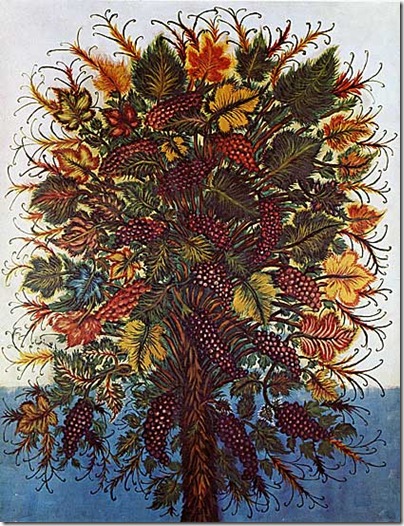
Séraphine

Seraphine

“Be ardent in your work and you will find God in your cooking pots.”

~ St. Teresa of Ávila

Tuesday, June 23, 2009

Convenient Solutions

train "To doubt everything or to believe everything are two equally
convenient solutions; both dispense with the need for thought."

Henri Poincaré (1854-1912), Science and Hypothesis

The Sun Grows In Your Smile

by Linda Rodriquez, from Heart’s Migration

When you smile, the air grows warm and soft,
the earth is watered with gentle mists,
seeds sprout and spread leaves above the dark, damp soil,
earthworms pierce the crust and frolic across the surface
to the delight of fat, happily hunting robins,
lilies of the valley unfurl beside purple, grape-scented irises,
fat pink and maroon peonies, and gay California poppies,
damask roses hurl their rich fragrance to the wind,
the crazy-with-sheer-joy song of the Northern mockingbird
echoes above other chirps and sweet winged notes,
gardeners join the worms in the warm, rich dirt,
children gallop across yards and grab handfuls of dandelions
to present to mothers who will set them in glasses of water
in kitchen windows or on dining room tables, weeds
glorious after the dark of winter with the color of the sun
that grows and warms and heals in your smile.

[Thanks Garrison!]

The Way We Orient

From TED Talks (June 2009): “Psychologist Philip Zimbardo says happiness and success are rooted in a trait most of us disregard: the way we orient toward the past, present and future. He suggests we calibrate our outlook on time as a first step to improving our lives.”

Philip Zimbardo knows what evil looks like. After serving as an expert witness during the Abu Ghraib trials, he wrote The Lucifer Effect: Understanding How Good People Turn Evil. From Nazi comic books to the tactics of used-car salesmen, he explores a wealth of sources in trying to explain the psychology of evil.

A past president of the American Psychological Association and a professor emeritus at Stanford, Zimbardo retired in 2008 from lecturing, after 50 years of teaching his legendary introductory course in psychology. In addition to his work on evil and heroism, Zimbardo recently published The Time Paradox, exploring different cultural and personal perspectives on time.

Still well-known for his controversial Stanford Prison Experiment, Zimbardo in his new research looks at the psychology of heroism. He asks, "What pushes some people to become perpetrators of evil, while others act heroically on behalf of those in need?"

Monday, June 22, 2009

How to Fly

Regina Spektor

Regina Spektor on trying to explain her song writing process:

“To try to go back and take it all apart, then try to put order on it, is almost not fair to it. Let’s say somebody actually knows how to fly, but people just can’t deal with that, they’re constantly looking, going, ‘But where is the button, the propeller, the jet?’ And eventually the person has to strap on the jet and say, ‘Here’s the button.’ I think that’s what happens with people having to explain their songs. The song was flying, and now I’m being pushed to make up shit about it. Sometimes it’s almost like people take it as an insult, like you’re being facetious or pretentious. Or, and this upsets me even more, people say, ‘Random’, ‘Puts together really cool sounds’. It’s not random, it’s very specific, and when I’m writing it, it feels like life and death. It would be so much more fun if people went, ‘Wow, that’s cool, he just flew.’”

[Thanks JC!]

Friday, June 19, 2009

Inspirational Reading

From “Some Thoughts on the Lost Art of Reading Aloud,” by Verlyn Klinkenborg, New York Times (May 16, 2009):

Reading aloud recaptures the physicality of words. To read with your lungs and diaphragm, with your tongue and lips, is very different than reading with your eyes alone. The language becomes a part of the body, which is why there is always a curious tenderness, almost an erotic quality, in those 18th- and 19th-century literary scenes where a book is being read aloud in mixed company. The words are not mere words. They are the breath and mind, perhaps even the soul, of the person who is reading.

…I read aloud to my writing students, and when students read aloud to me I notice something odd. They are smart and literate, and most of them had parents who read to them as children. But when students read aloud at first, I notice that they are trying to read the meaning of the words. If the work is their own, they are usually trying to read the intention of the writer.

It’s as though they’re reading what the words represent rather than the words themselves. What gets lost is the inner voice of the prose, the life of the language. This is reflected in their writing, too, at first.

[Thanks Kit!]

Tiny Swallowable Pieces

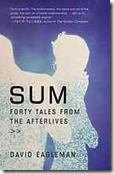
Sum
by David Eagleman

In the afterlife you relive all your experiences, but this time with the events reshuffled into a new order: all the moments that share a quality are grouped together.

You spend two months driving the street in front of your house, seven months having sex. You sleep for thirty years without opening your eyes. For five months straight you flip through magazines while sitting on a toilet.

You take all your pain at once, all twenty-seven intense hours of it. Bones break, cars crash, skin is cut, babies are born. Once you make it through, it's agony-free for the rest of your afterlife.

Sum: Forty Tales from the Afterlives But that doesn't mean it's always pleasant. You spend six days clipping your nails. Fifteen months looking for lost items. Eighteen months waiting in line. Two years of boredom: staring out a bus window, sitting in an airport terminal. One year reading books. Your eyes hurt, and you itch, because you can't take a shower until it's your time to take your marathon two-hundred-day shower. Two weeks wondering what happens when you die. One minute realizing your body is falling. Seventy-seven hours of confusion. One hour realizing you've forgotten someone's name. Three weeks realizing you are wrong. Two days lying. Six weeks waiting for a green light. Seven hours vomiting. Fourteen minutes experiencing pure joy. Three months doing laundry. Fifteen hours writing your signature. Two days tying shoelaces. Sixty-seven days of heartbreak. Five weeks driving lost. Three days calculating restaurant tips. Fifty-one days deciding what to wear. Nine days pretending you know what is being talked about. Two weeks counting money. Eighteen days staring into the refrigerator. Thirty-four days longing. Six months watching commercials. Four weeks sitting in thought, wondering if there is something better you could be doing with your time. Three years swallowing food. Five days working buttons and zippers. Four minutes wondering what your life would be like if you reshuffled the order of events. In this part of the afterlife, you imagine something analogous to your Earthly life, and the thought is blissful: a life where episodes are split into tiny swallowable pieces, where moments do not endure, where one experiences the joy of jumping from one event to the next like a child hopping from spot to spot on the burning sand.

“Eternal Whimsy,” review by Alexander McCall Smith, New York Times (June 14, 2009)

Thursday, June 18, 2009

We’re Caught in a Story

“I know the human spirit. My line is, we all love each other and there’s nothing we can do about it. And any thought that opposes that, we feel as stress. And stress is a gift. It says that we’re caught in a story that may not be true for us. Time to question your mind. Stress is like an alarm clock that says, It’s time to wake the baby, the innocent one who is caught in a dream.”

~ Byron Katie, from My Mother Is…

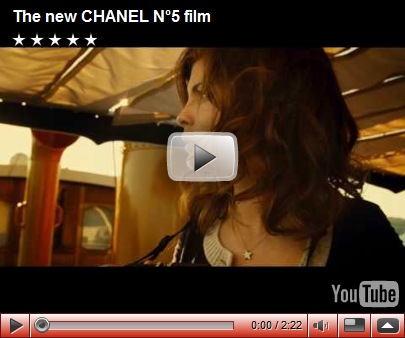
Night Train


Train de Nuit 
Chanel N°5 film by Jean-Pierre Jeunet
Starring Audrey Tautou and Travis Davenport

I Lose Interest

Photography for Interview by Vinoodh Matadin, Inez Van Lamsweerde “I feel like my last album was really very much about this emotion to want justice. And maybe I go with this emotion as a way to get at how it is to feel injustice—to want justice and to demand it. It’s very strong, this image of a person with a flag, declaring independence. But I’m not interested in politics. I lose interest the microsecond it ceases to be emotional, when something becomes a political movement. What I’m interested in is emotions.”

~ Björk, from Interview Magazine (June/July 2009). Voltaic, a two-CD, two-DVD box set of live recordings from Medúlla and Volta, will be available June 23 from Nonesuch.

Wednesday, June 17, 2009

Rubikcubism

French artist Invader’s solo show opens June 27th at Jonathan LeVine Gallery.

Teaching is a Kind of Learning

Teaching is a kind of
learning, much like loving,
mutual goings-on,
both doing each to each;
mutual forbearance;
life itself, you might say.

~ George Johnston, from Farewell to Teaching

Order from Chaos

M.C. Escher's "Print Gallery" (c) 2004 The M. C. Escher Company - The Netherlands.

"We adore chaos because we love to produce order."

~ M.C. Escher

Tuesday, June 16, 2009

Laughing With

Regina Spektor’s CD Far is due out next week (6/23). 
[Stream it. Explore it.]

God can be funny
When told he’ll give you money if you just pray the right way
And when presented like a genie who does magic like Houdini
Or grants wishes like Jiminy Cricket and Santa Claus
God can be so hilarious

Love and Its Near Enemy

From The Self-Esteem Trap: Raising Confident Compassionate Kids in an Age of Self-Importance by Polly Young-Eisendrath:

The Self-Esteem Trap Most of us think of love in terms of the comfort, passion, closeness, or beauty it will bring us. We imagine the enjoyment of passing hours and days with our beloved, who pleases us in touch, smell, and conversation. Perhaps we even think of living happily ever after. Unfortunately this is not love but its intoxicating sibling, idealization. Buddhists use the term “near enemy” to mean a superficial or misleading twin of a valuable state or attitude. In Buddhist parlance, then, we could say that idealization is the near enemy of love. If we mistake idealization for love, we can be harmfully misled in our connections to others and ourselves.

The special self is the creation of idealization. Exceptional, extraordinary, perfect: these are not the descriptions of any real human being, a person with weaknesses as well as strengths. If we have heard repeatedly how talented, beautiful, smart, or promising we are, we may grow up with an intolerance for weakness and difficulty in others, and a greater intolerance for imperfections in ourselves. Within such a self-esteem trap, we are unable to connect with others or embrace ourselves in the messy ambivalence of love.

Monday, June 15, 2009

Hope Must Remain

"Hope is both the earliest and the most indispensable virtue inherent in the state of being alive. If life is to be sustained, hope must remain, even where confidence is wounded, trust impaired."

~ Erik Erikson

Saturday, June 13, 2009

Trying Hard is One of the Problems

The Great Poem
by Lawrence Raab, from The History of Forgetting

The History of Forgetting The great poem is always possible.
Think of Keats and his odes.
But we shouldn't have to be dying,

What I'm writing now is not
the great poem. After a few lines
I could tell. It may not even be

a particularly good poem, although
it's too early to decide about that.
Keep going, I say. See what happens.

But trying hard is one of the problems.
since it shows in the lines as a strain
or struggle that reminds the reader

too much of the writer, whereas
most readers want to listen alone.
The great poem, I think, will arrive

when I no longer care. Perhaps
I'll have abandoned art altogether,
and I won't even want to write

the poem down. But then I'll remember
what I once would have given
for this moment, and I'll go back

to my desk. And I'll write the poem
as though I were another person,
someone I will never be again.

[More by Lawrence Raab]

Friday, June 12, 2009

Asking for Permission