Changing

“Avoid judging yourself by whether or not you succeed in making a change. Let the act of changing be the reward, and do not count on the outcome, for it may well be far different than you ever imagined.”



“Avoid judging yourself by whether or not you succeed in making a change. Let the act of changing be the reward, and do not count on the outcome, for it may well be far different than you ever imagined.”
“The Tibetan art form of sand painting is an ancient and sacred practice intended to uplift and benefit not only every person who sees it, but also to bless the environment. It is referred to as a mandala of colored powders. The Sanskrit term mandala is the name for this circular representation of spiritual truths. The Tibetan name is kyil-khor meaning essence of the circle.”
From the web page of Losang Samten, who created this center panel of the Kalachakra Mandala in the new Ohio Union of the Ohio State Campus this week.

We all helped dismantle the panel this afternoon…


…and scattered the sand into Mirror Lake to bless the campus.


Here is a time-lapse video of an entire Kalachakra Mandala.
Kalachakra mandala created by Losang Samten
Here’s another example.
5 Dhyani Buddhas from peacefeather imagery on Vimeo.
Description of the above design from Mandalas: Sacred Art and Geometry

[Thanks Suzanne!]

'Fare forward, you who think that you are voyaging;
You are not those who saw the harbour
Receding, or those who will disembark.
Here between the hither and the farther shore
While time is withdrawn, consider the future
And the past with an equal mind.
At the moment which is not of action or inaction
You can receive this: "on whatever sphere of being
The mind of a man may be intent
At the time of death"—that is the one action
(And the time of death is every moment)
Which shall fructify in the lives of others:
And do not think of the fruit of action.
Fare forward.
O voyagers, O seamen,
You who came to port, and you whose bodies
Will suffer the trial and judgment of the sea,
Or whatever event, this is your real destination.'
So Krishna, as when he admonished Arjuna
On the field of battle.
Not fare well,
But fare forward, voyagers.
~ T.S. Eliot, from "The Dry Salvages," the third poem of his Four Quartets
Commentary by Phillip Moffitt from Dancing with Life:
Eliot is saying that there is only this moment in your life, and each moment is a death and a rebirth. You only exist as a string of moments and you are new and different in each moment. It is only when you are present in a moment that you are capable of affecting your life or another's. You fail to notice this truth because life is constantly changing and because of the power of memory and association.
When Eliot cautions not to think of the fruit of your actions, he is echoing the Buddha's teaching of nonattachment. To be nonattached is "to care" and "to not care" simultaneously, which can only be realized as an insight, not as a concept. Through meditation and practice of the Twelve Insights [of the four noble truths which is the theme of his book] in daily life, you slowly come to understand this paradoxical wisdom, which is the way to dance with life.

~ Peter Buffett, discussing his book, Life is What You Make It, on Morning Edition, NPR (May 6, 2010)

~ Patricia Morrisroe, author of Wide Awake: A Memoir of Insomnia, from Talk of the Nation (May 4, 2010)
[Thanks Suzanne!]
“Part of what this poem meant for me was the idea that somehow I would be in love and that someone would love me back was a profound revelation…I think the very first library book I ever checked out was a collection of poems by E.E. Cummings which included this poem…But being in your body, giving love through your body, getting love back through your body, is something that I think is greater than just romantic love relationships.”
i like my body when it is with your
by E.E. Cummings
i like my body when it is with your
body. It is so quite new a thing.
Muscles better and nerves more.
i like your body. i like what it does,
i like its hows. i like to feel the spine
of your body and its bones, and the trembling
-firm-smooth ness and which i will
again and again and again
kiss, i like kissing this and that of you,
i like, slowly stroking the, shocking fuzz
of your electric fur, and what-is-it comes
over parting flesh....And eyes big love-crumbs,
and possibly i like the thrill
of under me you so quite new from
An excerpt from The Ticking Is the Bomb: A Memoir by Nick Flynn:

Excerpt from “Complexity Used to Be So Simple. It Meant Progress,” by David Segal, New York Times, April 30, 2010:


“We get seduced by the complicated in Western society,” Ms. Zimmerman says. “We’re in awe of it and we pull away from the duty to ask simple questions, which we do whenever we deal with matters that are complex.”

Dr. Alan Dienstag from “Alzhiemer’s, Memory, and Meaning,” in conversation with Krista Tippett on Speaking of Faith, March 26, 2009:
I was working with a woman who actually first brought her sister to see me. Her name was Ann, and she wanted, her sister to join one of the writing groups [for people in the early stages of Alzheimer’s], but her sister wasn't right for it. About two years later, she came back, and she [herself] had been diagnosed with Alzheimer's. And so I started to work with her, and she joined one of my support groups.
She was in the group for a long time, and then it just became impossible for her to participate. The conversation was moving too fast. She just didn't have the language. She couldn't string together more than a sentence or two, and it just wasn't working. And so she had to leave the group.
Her husband, who was just extraordinarily devoted to her, really wanted her to maintain her connection with me. It was very helpful that I had known her before. And she would bring photo albums in. She would do a little tchotchke tour of my office. You know, when it wasn't really possible to talk about things, she would kind of walk around and we would look at objects. She was very taken by the birds outside the window. I mean, that was the kind of time that we spent together.
And then even that became difficult. She was one of those people who started to kind of retreat into almost a mask-like blankness. It was harder and harder to access her. And so we were reaching the end of that time, and I was talking to her husband, telling him that I just didn't think that it was a really fruitful way for her to spend her time and so on.
So it was around that time, and I was going on vacation, and she loved the beach and I loved the beach and this was something that we used to connect about.
As I was leaving I said, "Ann, I'm going to the beach. I'm going to be away for a while." And she smiled and her face kind of lit up.
I said, "What do you love about the beach?"
She kind of drifted away, as she did, and she got very quiet. And again I waited and I thought, well, you know, she can't really answer that question.
And she turned to me and she said, "There's some kind of music that lives there."
“It’s about how much time you’ve spent together. That’s what makes a family, not biology, not sexual or political persuasion. It’s just that: time.”
~ Julianne Moore, from “Erotic Sparks Fly, and Lines Are Crossed,” by Dennis Lim, New York Times, April 30, 2010
Excerpt from Lessons from the Lifelines Writing Group for People in the Early Stages of Alzheimer's Disease: Forgetting That We Don't Remember by Alan Dienstag:
The challenge of putting Don DeLillo's observation about writing and memory to work for people in the early stages of Alzheimer's disease brought to light aspects of memory and the psychology of people experiencing memory loss that I knew about but had failed to put to any therapeutic use. I would summarize the most important of these aspects as follows: Writing is a form of memory. As a form of memory, its characteristics create some unique therapeutic possibilities for people with Alzheimer's disease. Because it presents another way of remembering, it provides an individual with additional experiences of being a remembering person and access to different kinds of memories. Perhaps most important, it returns to those whose memories are failing the opportunity to experience and share the memories they have. In this respect, the writing group transformed a weakness into a strength.
What was true of the writing was also true of the reading. In reading the written work, the insecurity of unprompted verbal recall (a factor that over time tends to discourage talking in this population) was replaced with something that is not only tangible and therefore more secure but also lasting. The group format seemed to extend and intensify these effects as well as to provide therapeutic benefit in more traditional ways. In a remark that beautifully encapsulated the acceptance, recognition, and sense of belonging found in the group, one of our members put it this way: "We may not remember everything, but we remember each other and I'm a part of everyone here."
A patient of mine in the early stages of Alzheimer's disease once said, "I feel like a picture that's fading; every time I look, there is less of me here. I almost don't recognize myself." Watching the group members in their struggle to remember, write, and read their work is a moving experience on many levels. One of these is surely our awareness that the picture is fading along with the sparks of recognition. This awareness lends a poignancy and triumph to the work with which one can identify. In this identification there is also a healing of the breach that separates us from people with Alzheimer's. We all know what fading is like, and we all know that our fate is not so different from theirs. The triumph is temporary; it is of this moment, but it is the triumph of life over death. If we do need stories to live, then these are truly lifelines, acts of writing that are life preserving.
Listen to “Alzhiemer’s, Memory, and Meaning,” Dr. Dienstag’s conversation with Krista Tippett on Speaking of Faith, March 26, 2009]
"I say that religion isn't about believing things. It's ethical alchemy. It's about behaving in a way that changes you, that gives you intimations of holiness and sacredness."

Waving Goodbye
by Wesley McNair, from Lovers of the Lost
Why, when we say goodbye
at the end of an evening, do we deny
we are saying it at all, as in We'll
be seeing you, or I'll call, or Stop in,
somebody's always at home? Meanwhile, our friends,
telling us the same things, go on disappearing
beyond the porch light into the space
which except for a moment here or there
is always between us, no matter what we do.
Waving goodbye, of course, is what happens
when the space gets too large
for words — a gesture so innocent
and lonely, it could make a person weep
for days. Think of the hundreds of unknown
voyagers in the old, fluttering newsreel
patting and stroking the growing distance
between their nameless ship and the port
they are leaving, as if to promise I'll always
remember, and just as urgently, Always
remember me. It is loneliness, too,
that makes the neighbor down the road lift
two fingers up from his steering wheel as he passes
day after day on his way to work in the hello
that turns into goodbye? What can our own raised
fingers do for him, locked in his masculine
purposes and speeding away inside the glass?
How can our waving wipe away the reflex
so deep in the woman next door to smile
and wave on her way into her house with the mail,
we'll never know if she is happy
or sad or lost? It can't. Yet in that moment
before she and all the others and we ourselves
turn back to our disparate lives, how
extraordinary it is that we make this small flag
with our hands to show the closeness we wish for
in spite of what pulls us apart again
and again: the porch light snapping off,
the car picking its way down the road through the dark.
[Thanks Kit!]

Why?
by Andrew Bird
Why? Why’d you do that
You shouldn’t have done that
If I told you once I told you three times
You’ll get your punishments when you show me your crimes
It’s not a spell or a curse you put on me
Or the way you make me smile so tenderly
But how I wish it was your temper you were throwing
Damn you for being so easygoing
I thought that time would tell
My sins would provoke you to raise some hell
Not a chance
Whatever happened to fiery romance
Oh how I wish it was those dishes you were throwing
Damn you for being so easygoing
No, don’t give that line
Don’t try to tell me that inaction is not a crime
Can’t you see what kind of seeds you’re sowing?
Damn you for being so easygoing
“[PowerPoint] is dangerous because it can create the illusion of understanding and the illusion of control. Some problems in the world are not bullet-izable.”
~ Brig. Gen. H. R. McMaster, from “We Have Met the Enemy and He is PowerPoint,” by Elisabeth Bumiller, New York Times, April 26, 2010

“In poetry I have a few axioms, and you will see how far I am from their center.
1st. I think poetry should surprise by a fine excess, and not by singularity; it should strike the reader as a wording of his own highest thoughts, and appear almost a remembrance.
2nd. Its touches of beauty should never be half-way, thereby making the reader breathless, instead of content. The rise, the progress, the setting of imagery should, like the sun, come natural to him, shine over him, and set soberly, although in magnificence, leaving him in the luxury of twilight.
But it is easier to think what poetry should be, than to write it. And this leads me to another axiom—That if poetry comes not as naturally as the leaves to a tree, it had better not come at all.”
~ John Keats, from a letter to John Taylor, February 27, 1818
Excerpts from "Sleep," Radiolab, May 25, 2007:

Robert Stickgold: So if it puts a sticky on everything that’s hard during the day, then all the brain has to do when it’s creating a dream is go and grab stickies.
Jad Abumrad: Stickgold thinks he’s seeing the outline if the dream-making process here. It starts really simply at the very beginning of sleep, right after you fall asleep, with the replay. This, he suspects, is just the brain emptying out its stickies.
Robert Krulwich: Are you at all puzzled by the super-duper, Technicolor, extraordinarily cinematic qualities of some of these [dreams]? Because if it were just an everyday brain function to sort of make sense of the world and allow you to make new connections, you wouldn’t really need quit the movie quality.
Robert Stickgold: When we talk about dreams, what seems to come into dreams are memories, concepts, relationships, associations that have a strong emotional flavor and — I’m guessing from the data — need a full-blown orchestration to be properly processed.
“Sleep is the annihilation of consciousness, so it’s a terrible time in which everything disappears — the universe and yourself with it. I think if people didn’t sleep and didn’t have the unconsciousness of sleep, they possibly wouldn’t even realize that consciousness is an enormous gift.”
“…fear does not actually speed up our rate of perception or mental processing. Instead, it allows us to remember what we do experience in greater detail. Since our perception of time is based on the number of things we remember, fearful experiences thus seem to unfold more slowly.”
From “How the Brain Stops Time,” by Jeff Wise, Psychology Today, March 13, 2010
Stetson C, Fiesta MP, & Eagleman DM. (2007). Does time really slow down during a frightening event? PloS One. 2 (12).
The Signal
by Sharon Olds, from One Secret Thing
When they brought his body back, they told
his wife how he'd died:
the general thought they had taken the beach,
and sent in his last reserves. In the smokescreen,
the boats moved toward shore. Her husband
was the first man in the first boat
to move through the smoke and see the sand
dark with bodies, the tanks burning,
the guns thrown down, the landing craft
wrecked and floored with blood. In the path of the
bullets and shells from the shore, her husband had
put on a pair of white gloves
and turned his back on the enemy,
motioning to the boats behind him
to turn back. After everyone else
on his boat was dead
he continued to signal, then he, too,
was killed, but the other boats had seen him
and turned back. They gave his wife the medal,
and she buried him, and at night floated through
a wall of smoke, and saw him at a distance
standing in a boat, facing her,
the gloves blazing on his hands as he motioned her back.
Excerpts from Taking Our Places by Norman Fischer:

Listening is basic and crucial because it is the soil out of which all the fruits of our human relationships grow. Listening takes radical openness to another, and radical openness requires surrender. This is why listening is frightening, although we don’t usually think of it that way. It requires a kind of fearless self-confidence that most of us have never developed.
…If you want to stay open to life and to change, you have to listen. To listen, really listen, is to accord respect. Without respect, no human relationship can function normally, for the pain and hurt that inevitably arise from disrespect eventually pervert it. When your mind is occupied (usually quite unconsciously) with your own thoughts and plans and strategies and defenses, you are not listening. And when you are not listening, you are not according respect. The speaker knows this and reacts accordingly.
It doesn’t take a psychic to know that someone is not really listening. We all know whether or not we are being listened to. But we are so accustomed to not being listened to that we take it for granted and even see it as normal. This is why it is so startling, and so powerful, almost magical, when we are actually heard by another person within the openness of true listening.
Perhaps the most common and pernicious form of nonlistening is our nonlistening to ourselves. So much of what we actually feel and think is unacceptable to us. We have been conditioned over a lifetime to simply not hear all of our own self-pity, anger, desire, jealousy, wonder. Most of what we take to be our adult response is no more than our unconscious decision not to listen to what goes on inside us. And as with any human relationship, not listening to ourselves damages our self-respect. It occludes the free flow of love from ourselves to ourselves. To allow ourselves to feel what we actually do feel—not to be afraid or dismayed but to open up a space inside our hearts large enough to safely contain what we feel, with the faith that whatever comes up is workable and even necessary—this is what any healthy, mature human being needs to do and what we so often fail to do.”
Excerpts from “The Boring Age,” by Michael Lind, Time, March 11, 2010:

Surprisingly, this stasis is most evident in an area where we assume we are way ahead of our predecessors: technology. In fact, the gadgets of the information age have had nothing like the transformative effects on life and industry that indoor electric lighting, refrigerators, electric and natural gas ovens and indoor plumbing produced in the early to mid-20th century. Is the combination of a phone, video screen and keyboard really as revolutionary as the original telephone, the original television set or the original typewriter was?
…I predict that in the year 2050, the nation-state will still be the dominant form of political organization, with a few new nation-states added to the U.N. The U.S. will still be the dominant global economic and military power, even if China has a somewhat larger GDP because of its larger population. Most energy will still be derived from fossil fuels, and nuclear power will account for an increasing share of global electricity production, while wind and solar power will still be negligible. Most people will get from place to place by means of cars, buses, taxis and planes, not fixed rail. Thanks to biotech advances, people will live longer and healthier lives, and consequently the largest single occupation in 2050 will be — drumroll, please — nursing!
I know, that's a boring vision of the future compared with a Chinese century in which everybody is a genetically modified immortal who rides monorails and eats algae grown in skyscrapers. But hey, in the future, phones will be really cool.
Michael McCullough from “Getting Revenge and Forgiveness,” a conversation with Krista Tippett, Speaking of Faith, March 25, 2010:

It's not every brand, right, that exercises that prerogative, but in the scriptures and traditions of every world religion that has been successful on a grand scale, there is a story there about the love of difference.
Compassion toward difference. Caring for the strangers in your midst. Being able to see beyond superficial differences toward the essential commonalities.
Religion is also good at appealing to people's meaner sides and the more brutish side and the resources are there for both. So it's really up to those people who have a passion for reconciliation in their own faiths to make sure that the right tones are struck and the others are a little bit more muted.
…I wish we could come up with a completely new word for what this human trait is or maybe find some new way to talk about it so that we could unload a little bit of the baggage from the past, because some of the baggage is that it's sort of a namby-pamby thing that doormats do or wimps do.
You know, only sort of milquetoast types of people are interested in. But from everything I've managed to read and see and understand in my own work it's that forgiveness is a brawny muscular exercise that I kind of imagine someone with a great passion for life and a great hardy sort of disposition being able to take on.”
Simple
by Rae Armantrout, from Versed
for Aaron Korkegian

from simple rules.
It's not
that we want to survive,
it's that we've been drugged
and made to act
as if we do
while all the while
the sea breaks
and rolls, painlessly, under.
If we're not copying it,
we're lonely.
Is this the knowledge
that demands to be
passed down?
Time is made from swatches
of heaven and hell.
If we're not killing it,
we're hungry.

Excerpts from “Hallucinogens Have Doctors Tuning In Again,” by John Tierney, New York Times, April 12, 2010:
Researchers from around the world are gathering this week in San Jose, California, for the largest conference on psychedelic science held in the United States in four decades. They plan to discuss studies of psilocybin and other psychedelics for treating depression in cancer patients, obsessive-compulsive disorder, end-of-life anxiety, post-traumatic stress disorder and addiction to drugs or alcohol.
…Scientists are especially intrigued by the similarities between hallucinogenic experiences and the life-changing revelations reported throughout history by religious mystics and those who meditate. These similarities have been identified in neural imaging studies conducted by Swiss researchers and in experiments led by Roland Griffiths, a professor of behavioral biology at Johns Hopkins.
…“There’s this coming together of science and spirituality,” said Rick Doblin, the executive director of Multidisciplinary Association for Psychedelic Studies. “We’re hoping that the mainstream and the psychedelic community can meet in the middle and avoid another culture war. Thanks to changes over the last 40 years in the social acceptance of the hospice movement and yoga and meditation, our culture is much more receptive now, and we’re showing that these drugs can provide benefits that current treatments can’t.”
…Dr. Charles S. Grob, a psychiatrist who is involved in an experiment at U.C.L.A., describes it as “existential medicine” that helps dying people overcome fear, panic and depression.
“Under the influences of hallucinogens,” Dr. Grob writes, “individuals transcend their primary identification with their bodies and experience ego-free states before the time of their actual physical demise, and return with a new perspective and profound acceptance of the life constant: change.”
[Thanks Dōshin!]
“Rumors are a great source of comfort for people…When you’re looking at truth versus gossip, truth doesn’t stand a chance.”
~ Barbara Mikkelson of Snopes.com, from “Debunkers of Fictions Sift the Net,” by Brian Stelter, New York Times, April 4, 2010
Listen to this short, remarkable story about a clever strategy which a nursing home in Düsseldorf, Germany came up with to address the problem of disoriented residents wandering away.
“It’s like another thought comes up and you forget what you wanted. It’s like fishes coming up to the surface of the water and then going down again. Thoughts come up and they disappear and you don’t know that they have ever been there. You forget.”
~ Richard Neureither (translated by Regine Hauch) for “The Bus Stop,” by Lulu Miller, Radiolab, March 23, 2010
Pressure
by Company of Thieves
I'm angry all the time
No one's fault but mine
Tell me how you fashion kind
When you're out of style
And I try hard to answer
All the questions that you've posed
Tell me now how should I care
When I feel so alone
And so unloved
The pressure is rising
I mean it, it's binding
I've been compromising for you
When you come home really late at night
Ripe to pick a fight
I know just the kind you'd like
So come on and bite
And I try hard to answer
All the punches that you throw
Tell me now how should I fair
When I feel so unloved and so alone
The pressure is rising
I mean it, it's binding
I've been compromising for you
The pressure is rising
I've been compromising for you
I'm waiting at the bus stop in the morning
And it's pouring
Oh, I am waiting at the bust stop for you
Staring at walls with closed doors
The key that won't work
Sure helps the time pass by
Saying I'm wrong when I'm wrong
Knowing it's the right thing
Sure helps the thoughts in my mind
The pressure is rising
I mean it, it's binding
I've been compromising for you
You, you
I am waiting at the bus stop
In the morning
And it's boring
Pressure
by Company of Thieves
I'm angry all the time
No one's fault but mine
Tell me how you fashion kind
When you're out of style
And I try hard to answer
All the questions that you've posed
Tell me now how should I care
When I feel so alone
And so unloved
The pressure is rising
I mean it, it's binding
I've been compromising for you
When you come home really late at night
Ripe to pick a fight
I know just the kind you'd like
So come on and bite
And I try hard to answer
All the punches that you throw
Tell me now how should I fair
When I feel so unloved and so alone
The pressure is rising
I mean it, it's binding
I've been compromising for you
The pressure is rising
I've been compromising for you
I'm waiting at the bus stop in the morning
And it's pouring
Oh, I am waiting at the bust stop for you
Staring at walls with closed doors
The key that won't work
Sure helps the time pass by
Saying I'm wrong when I'm wrong
Knowing it's the right thing
Sure helps the thoughts in my mind
The pressure is rising
I mean it, it's binding
I've been compromising for you
You, you
I am waiting at the bus stop
In the morning
And it's boring
Ornithology in a World of Flux
by Robert Penn Warren, from The Collected Poems of Robert Penn Warren
It was only a bird call at evening,
unidentified,
As I came from the spring with water,
Across the rocky back-pasture;
But I stood so still sky above was
not stiller than sky in pale-water.
Years past, all places and faces
fade, some people have died,
And I stand in a far land, the evening
still, and am at last sure
That I miss more that stillness at
birdcall than some things that
were to fail later.
[Thanks Rebecca Bradshaw!]

A Remedy for Insomnia
by Vera Pavlova, number 66 in the hundred poems that make up her collection If There Is Something To Desire 
Not sheep coming down the hills,
not cracks on the ceiling—
count the ones you loved,
the former tenants of dreams
who would keep you awake,
once meant the world to you,
rocked you in their arms,
those who loved you . . .
You will fall asleep, by dawn, in tears.
“The only thing I hope for is that, regardless of what the outward world is for different people, different nations, I hope their internal world is similar. And if I, hopefully, have managed to somehow describe my inner world in this book, all I count on is that it will have some resonance among the American readers, or, at the very least, the American readers will treat this book as a kind of a guidebook for my inner world, strange as it may appear.”
~ Vera Pavlova
“"Oh, there's many a time you're just going down the road at O-dark-thirty in the morning and you just start thinking about a particular pattern."
~ Long-haul trucker Dave White, on his newfound passion for quilting, “Idle Pastime: In Off Hours, Truckers Pick Up Stitching,” Wall Street Journal, March 29, 2010
[Thanks Kit!]
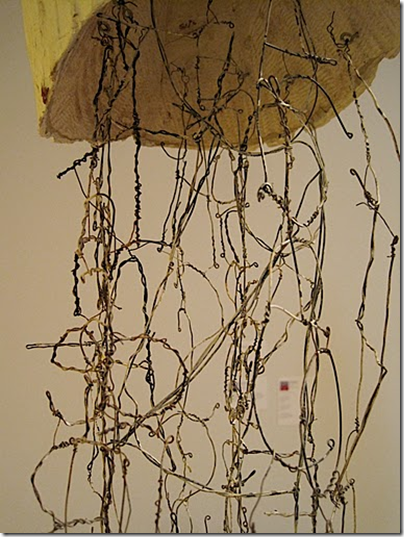
My friend Dōshin Owen spotted this compelling piece by Lesley Dill at the Kemper Museum of Modern Art recently.
Poem Spill, 1995
paint, plaster, collage, wire and wood
Here’s a description from Voices in My Head, a 1995 exhibit of works by Lesley Dill: “The exhibition [consisted] of large—12 feet long—hanging cloths of muslin or gauze, each silkscreened with an image of a figure or part of a figure. The surface is stained with tea, paint and varnish, and in most cases collaged with pieces of cloth, stitched with thread, or even burned. Fragments of Emily Dickinson's poems are painted directly on the figure, or are stamped on or below the images, even cut out of the cloth. The inspiration for this series are the Buddhist prayer flags that captivated Dill during her stays in India and Nepal. These flags, pieces of cloth on which prayers have been printed, are hung, sometimes in great numbers, outside of temples or in sacred places to blow in the wind. Used to convey prayers, they are imbued with a powerful sense of spirituality.”
One need not be a Chamber — to be Haunted —
One need not be a House —
The Brain has Corridors — surpassing
Material Place —
Far safer, of a Midnight Meeting
External Ghost
Than its interior Confronting —
That Cooler Host.
Far safer, through an Abbey gallop,
The Stones a'chase —
Than Unarmed, one's a'self encounter —
In lonesome Place —
Ourself behind ourself, concealed —
Should startle most —
Assassin hid in our Apartment
Be Horror's least.
The Body — borrows a Revolver —
He bolts the Door —
O'erlooking a superior spectre —
Or More —
Excerpts from “Time Lost and Found,” by Anne Lamott, Sunset:

Then I bring up the bad news: You have to make time to do this.
…I know how addictive busyness and mania are. But I ask them whether, if their children grow up to become adults who spend this one precious life in a spin of multitasking, stress, and achievement, and then work out four times a week, will they be pleased that their kids also pursued this kind of whirlwind life?
If not, if they want much more for their kids, lives well spent in hard work and savoring all that is lovely, why are they living this manic way?
…Time is not free—that’s why it’s so precious and worth fighting for.
Will they give me one hour of housecleaning in exchange for the poetry reading? Or wash the car just one time a month, for the turtles? No? I understand. But at 80, will they be proud that they spent their lives keeping their houses cleaner than anyone else in the family did, except for mad Aunt Beth, who had the vapors? Or that they kept their car polished to a high sheen that made the neighbors quiver with jealousy? Or worked their fingers to the bone providing a high quality of life, but maybe accidentally forgot to be deeply and truly present for their kids, and now their grandchildren?
I think it’s going to hurt. What fills us is real, sweet, dopey, funny life.
I’ve heard it said that every day you need half an hour of quiet time for yourself, or your Self, unless you’re incredibly busy and stressed, in which case you need an hour. I promise you, it is there. Fight tooth and nail to find time, to make it. It is our true wealth, this moment, this hour, this day.
[Thanks Kit!]
“In Zen literature the word intimacy is often used as a synonym for enlightenment. In the classical Zen enlightenment stories, a monk or a nun is reduced simultaneously to tears and laughter as he or she suddenly recognizes that nothing in this world is separate, that each and every thing, including one’s own self, is nothing but the whole, and that the whole is nothing but the self. What are such stories telling us if not that love is much wider and deeper than an emotion? Love is the fruition of, the true shape of, one’s self and all that is.”
~ Norman Fischer, from Taking Our Places
Spring
by Edna St. Vincent Millay, from Millay: Poems (Everyman's Library Pocket Poets)
To what purpose, April, do you return again?
Beauty is not enough.
You can no longer quiet me with the redness
Of little leaves opening stickily
I know what I know.
The sun is hot on my neck as I observe
The spikes of the crocus.
The smell of the earth is good.
It is apparent that there is no death
But what does that signify?
Not only under the ground are the brains of men
Eaten by maggots.
Life in itself
Is nothing,
An empty cup, a flight of uncarpeted stairs.
It is not enough that yearly, down this hill,
April
Comes like an idiot, babbling and strewing flowers.
“Time was passing, but I couldn’t tell…The overwhelming feeling I had was that you think you can understand a person just by looking at them, but when you look at them over a long period of time, you understand how impossible that is. I felt connected, but I don’t know how far the connection goes…We insulate ourselves in New York City. Everyone goes around with headphones. It’s one of the fantastic things about New York: you can be near all these people, and still be in your own head.”
~ Dan Visel, on sitting across a table from artist Marina Abramovic, from “Confronting a Stranger, for Art,” by Jim Dwyer, New York Times, April 2, 2010
[Thanks Matt!]
Ab Ovo
by Joseph Brodsky, from So Forth
Ultimately, there should be a language
in which the word "egg" is reduced to O
entirely. The Italian comes the closest,
naturally, with its uova. That's why Alighieri thought
it the healthiest food, sharing the predilection
with sopranos and tenors whose pear-like torsos
in the final analysis embody "opera." 
German poets, with practically every line
starting the way they'd begin a breakfast,
or to the equally cocky mathematicians
brooding over their regularly laid infinity,
whose immaculate zeros won't ever hatch.

From “Louder Than a Film Festival,” by Clint O’Connor, The Plain Dealer (March 29, 2010):
Poetry, let alone high school poetry, is not supposed to outshine flashy films from around the globe. But "Louder Than a Bomb," a documentary about the inspiring teens of a huge poetry slam in Chicago, thrilled the audiences and judges at the 34th Cleveland International Film Festival.
The movie, which had its world premiere here, won both the Roxanne T. Mueller Audience Choice Award for best film, and the Greg Gund Memorial Standing Up Film Competition, which honors movies about social justice and activism, and includes a $5,000 prize for co-directors Jon Siskel and Greg Jacobs.
Satellites
by Dan Chiasson, from Where's the Moon, There's the Moon
5. Next
If you can orbit the planet, why can't you see 
Is it art or is it sex?
Or is it, as I suspect, just keeping going
from next thing to next thing
to next thing to next thing
to next to next to next to next
pulsating stupidly to outlast time?
Poems should be more like essays and essays should be more like poems.
Two of every sort shall thou bring into the Ark.
~ Genesis
* * *
Religion
by Stephen Dunn, from Riffs and Reciprocities: Prose Pairs

“I do feel that images are gifts. I don’t know if they create the soul, but they certainly reveal it. The image is a revelation of sorts, therefore apocalyptic as opposed to ecliptic. While eclipses cover, an apocalypse is an uncovering. The writing of a poem is the uncovering of language to its sacred condition. Many people who don’t write poetry think that poetry is prettified language. But poetry undresses language down to its manifold meaning. I keep imagining the body of God naked, radiating meaning and significance and voice; somehow we cover it, and dress it up so it becomes prose. And I feel like images come from the body; it’s kind of a body wisdom. ”
~ Li-Young Lee, from “Poems from God,” by Amy Pence, Poets & Writers, November/December 2001 (subscription required)
* * *
To Life
by Li-Young Lee, from Behind My Eyes: Poems

hearing the wind go by?
And finding himself left behind, resumed
his own true version of time
on earth, a seed fallen here to die
and be born a thing promised
in the one dream
every cell of him has dreamed headlong
since infancy, every common minute has served.
Born twice, he has two mothers, one who dies, and one
the mortar in which he’s tried. His double
nature cleaves his eye, splits his voice.
So if you hear him say, while he sits at the bed
of one mother, “Take me home,”
listen closer. To Life,
he says, “Keep me at heart.”
Tearing the Page
by Li-Young Lee
Every wise child is sad.
Every prince, is a member of the grass.
Each bud opening opens on the unforeseen.
Every wind-strewn flower is God tearing God.
And the stars are leaves
blown across my grandmother’s lap.
Or the dew multiplying.
And of time’s many hands, who can tell
the bloody from the perfumed,
the ones that stitch
from the ones that rip.
Every laughing child is forgetful.
Every solitary child rules the universe.
And the child who can’t sleep
learns to count, a patient child.
And the child who counts negotiates
between limit and longing,
infinity and subtraction.
Every child who listens
all night to the wind eventually
knows his breathing turns a wheel
pouring time and dream to leave no trace.
Though he can’t tell what a minute weighs,
or is an hour too little or too long.
As old as night itself,
he’s not old enough in the morning
to heat his milk on the stove.
But he knows about good-byes.
Some of them, anyway. The good-bye
at the door each morning, a kiss for a kiss.
The good-bye at bedtime,
stories and songs until it’s safe to close his eyes.
And maybe he’s even heard about the waiting room
at Union Station, where dust and echoes climb
to the great skylights
accompanied by farewells
of the now-going, to join the distant
farewells of the long gone,
while a voice announces the departure
of the Twentieth Century for all points West.
Yes, every wise child is heart-broken.
A sorrowing pip,
he knows the play
he’s called away from each evening
is the beginning and end of order
in a human household.
He’s sure his humming to himself
and his rising and falling ball are appointed
by ancient laws his own heart-tides obey.
But he can’t tell anybody what he knows.
Old enough to knot his shoelaces,
he’s not old enough to unknot them.
Old enough to pray, he doesn’t always
know who to pray to.
Old enough to know to close the window
when it storms, old enough to know the rain,
given the chance, would fall on him,
and darken him, and darken him, the way
he himself colors the figures
he draws, pressing so hard he tears the page.

Daron Larson
Freelance Contemplative