



Sunday, November 15, 2009
 Paul
Paul
The Ghost Within Every Experience
Excerpts from an essay titled “On Becoming a Poet,” by Mark Strand, from The Making of a Poem: A Norton Anthology of Poetic Forms:

…good poems have a lyric identity that goes beyond whatever their subject happens to be. They have a voice and the formation of that voice, the gathering up of imagined sound into utterance, may be the true occasion for their existence. A poem may be the residue of an inner urgency, one through which the self wishes to register itself, write itself into being, and, finally, to charm another self, the reader, into belief. It may also be something equally elusive—the ghost within every experience that wishes it could be seen or felt, acknowledged as a kind of meaning.
It could be a truth so forgiving that it offers up a humanness in which we are able to imagine ourselves. A poem is a place where the conditions of beyondness and withinness are made palpable, where to imagine is to feel what it is like to be. It allows us to have the life we are denied because we are too busy living. Even more paradoxically, a poem permits us to live in ourselves as if we were just out of reach of ourselves.
Resources to Deal with the Ups and Downs

Pleasure depends very much on circumstances, on what triggers it. Then it's a sensation in a way. So, sensation changes from pleasurable to neutral and to unpleasurable...you can experience pleasure at the cost of other's suffering. So it's very vulnerable to the change of other circumstances. It doesn't help you to face the other circumstances better.
[But we can] think of happiness as a way of being that gives you the resources to deal with the ups and downs of life, that pervades all the emotional states, including sadness.”
~ Matthieu Ricard, from “The ‘Happiest’ Man in the World,” Speaking of Faith, November 12, 2009

Neither Young Nor Old

VII.
I know I am getting old and I say so,
but I don’t think of myself as an old man.
I think of myself as a young man
with unforeseen debilities. Time is neither
young nor old, but simply new, always
counting, the only apocalypse. And the clouds
—no mere measure or geometry, no cubism,
can account for clouds or, satisfactorily, for bodies.
There is no science for this, or art either.
Even the old body is new—who has known it
before?—and no sooner new than gone, to be
replaced by a body yet older and again new.
The clouds are rarely absent from our sky
over this humid valley, and there is a sycamore
that I watch as, growing on the riverbank,
it forecloses the horizon, like the years
of an old man. And you, who are as old
almost as I am, I love as I loved you
young, except that, old, I am astonished
at such a possibility, and am duly grateful.
~ From Leavings by Wendell Berry
Saturday, November 14, 2009

Fully Occupied
"To be a poet you must be crazy about language; and you must believe in the uniqueness of every person, and therefore in your own. To find your voice you must forget about finding it, and trust that if you pay sufficient attention to life you will be found to have something to say which no one else can say. And if at the same time your love of language leads you to develop your vocabulary, your ear, and your form-sense, and if you are scrupulously honest, you will arrive at writing what you apprehend in a way which embodies that vision which is yours alone. And that will be your voice, unsought, singing out from you of itself."
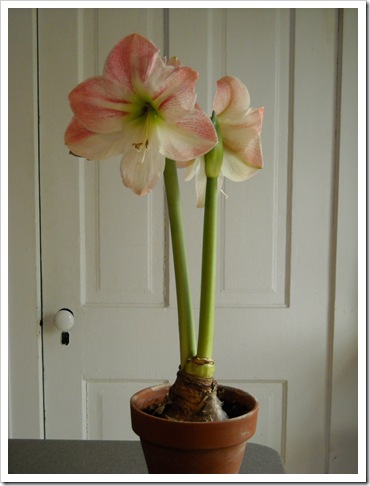
The Métier of Blossoming
by Denise Levertov
Fully occupied with growing—that's
the amaryllis. Growing especially
at night: it would take
only a bit more patience than I've got
to sit keeping watch with it till daylight;
the naked eye could register every hour's
increase in height. Like a child against a barn door,
proudly topping each year's achievement,
steadily up
goes each green stem, smooth, matte,
traces of reddish purple at the base, and almost
imperceptible vertical ridges
running the length of them:
Two robust stems from each bulb,
sometimes with sturdy leaves for company,
elegant sweeps of blade with rounded points.
Aloft, the gravid buds, shiny with fullness.
One morning—and so soon!—the first flower
has opened when you wake. Or you catch it poised
in a single, brief
moment of hesitation.
Next day, another,
shy at first like a foal,
even a third, a fourth,
carried triumphantly at the summit
of those strong columns, and each
a Juno, calm in brilliance,
a maiden giantess in modest splendor.
If humans could be
that intensely whole, undistracted, unhurried,
swift from sheer
unswerving impetus! If we could blossom
out of ourselves, giving
nothing imperfect, withholding nothing!
Friday, November 13, 2009
Watching

Grapefruit
by Ted McMahon, from The Uses of Imperfection
My grandfather got up early to section grapefruit.
I know because I got up quietly to watch.
He was tall. His hairless shins stuck out
below his bathrobe, down to leather slippers.
The house was quiet, sun just up, ticking of
the grandfather clock tall in the corner.
The grapefruit were always sectioned just so,
nestled in clear nubbled bowls used
for nothing else, with half a maraschino
centered bleeding slowly into
soft pale triangles of fruit.
It was special grapefruit, Indian River,
not to be had back home.
Doves cooed outside and the last night-breeze
rustled the palms against the eaves.
He turned to see me, pale light flashing
off his glasses
and smiled.
I remember as I work my knife along the
membrane separating sections.
It's dawn. The doves and palms are far away.
I don't use cherries anymore.
The clock is digital
and no one is watching.
[More by Ted McMahon from The Writer’s Almanac.]
What Was There All Along
From Sailing Home: Using Homer's Odyssey to Navigate Life's Perils and Pitfalls by Norman Fischer:

Life as an arduous journey is an ancient metaphor. The Greek word metapherein, from which our English metaphor comes, is made up of the words meta, meaning “over, or across,” implying a change of state or location, and pherein, meaning “to bear, or carry.” In modern as in ancient Greek, the word metapherein commonly means “to transport, or transfer.”
Though we think of metaphor as a mere figure of speech, something poetic and decorative, in fact metaphors abound in our lives, underlying many concepts that we take for granted. And metaphors condition, far more than we realize, the way we think about ourselves and our world, and therefore the way we are and act. So to consider a metaphor seriously, bringing it to consciousness, turning it over in our minds and hearts, is to allow ourselves to be carried across toward some subtle yet profound inner change.
Metaphors can engage our imagination and spirit, transporting us beyond the literality of what seems to be in front of us toward what’s deeper, more lively, and dynamic. Objects in the world can be defined, measured, and manipulated according to our specifications. But the heart can’t be. Its requirements are more subtle, more vague. Metaphors are inexact and suggestive; they take an image or a concept and map it onto another image or concept that may seem quite disparate, as if to say “this is like that; understand this and you will understand that.”
In this way metaphor can help us to feel our way into the unspeakable, unchartable aspects of our lives. Seeing your life as a “spiritual odyssey” is a metaphorical truth. Contemplating your life as a spiritual odyssey can help you to enter hidden parts of your life…
Perhaps we are living in a post-heroic age. Maybe the human race, so full of promise, bright ideas, and hubris, is finally weary of the toxic idealisms and thoughtless excesses of power that have been so destructive and so exhausting for so long. We have seen and done too much, and it has left us dazed and confused.
Maybe, like Odysseus, we are finally ready simply to return home to what we are, to our beauty and strength as well as our limitations. Maybe we are ready to see that what’s wanted and needed is what was there all along, 
Maybe the point of our life’s journey, our spiritual odyssey, is not conquest or perfection, whether spiritual or worldly, but rather the simple transformation into what we have been all along: flesh-and-blood people in a flesh-and-blood world, feeling what people feel and doing what people do. Returning home to what we are.
Could this be enough?
Thursday, November 12, 2009
A Place to Step in and Change Things

by Lawrence Raab, from The History of Forgetting
When something bad happens
we play it back in our minds,
looking for a place to step in
and change things. We should go outside
right now, you might have said. Or:
Let's not drive anywhere today.
The sea rises, the mountain collapses.
A car swerves toward the crowd
you've just led your family into.
We all look for reasons. Luck
isn't the word you want to hear.
What happened had to,
or it didn't. Maybe
the exceptional man can change direction
in midair, thread the needle's eye,
and come out whole. But even the hero
who stands up to chance has to feel
how far the world will bend
until it breaks him. He can see
that day: the unappeasable ocean,
the cascades of stone. A crowd
gathers around his body. He sees that too.
someone is saying: His luck just ran out.
It happens to us all.
Creating a Portrait on the Cheap
From Anonyponymous: The Forgotten People Behind Everyday Words by John Marciano:

While living in London, Étienne de Silhouette stumbled onto the black-magic secrets of Anglo-Saxon capitalism and fiscal responsibility. He returned to Paris spreading the dark gospel, no more popular on the Champs-Élysées in the mid-1700s than now. Silhouette, however, had the ear of the royal mistress, Madame de Pompadour, through whose devices he was elevated to be Contrôleur général des finances.
To pay down the crushing debt being incurred from the ongoing Seven Years’ War, Silhouette suggested what amounted to an import of the British Window Tax, although he wanted to tax doors too, and just about everything else he could think of. Silhouette also proposed slashing the pay of bureaucrats—again, never a way into the Gallic heart—and even ordered the king to melt down the royal plate.
The most amazing thing about Silhouette’s departure after nine months in the office was that he lasted so long. Parisian ridicule of the finance minister didn’t stop with his fall from grace, and anything made on the cheap was said to be done à la silhouette, including the then-popular method of producing a portrait without having to draw, in which the “artist” traced the subject’s shadow onto a piece of black paper, cut it out, and stuck it in a frame.
Wednesday, November 11, 2009
Few Words
I See You’ve Learned
by Olav H. Hauge, from The Dream We Carry
how you
use
few words,
few words and
short sentences
that drift
in a fine rain
down the page
with light and air
between.
I see you've learned
to make
a woodpile in the forest,
good to stack it
tall
so it can dry;
build one too long and low,
the wood will just sit there and rot.
Experiencing Light
Excerpt from Coming Home: The Experience of Enlightenment in Sacred Traditions by Lex Hixon:
Imagine you are wandering through a vast cathedral. Countless stain-glass windows, radiant in the darkness, represent the modes of worship and ways of understanding that humanity has evolved throughout its history. Some windows picture divine presence through personal forms or attributes, and seekers worship these windows with devotion. Other seekers, preferring the way of wisdom, contemplate stained-glass windows that present nothing personal, simply esoteric patterns evoking primal harmony and unity. Devotion and wisdom are alternate ways to enlightenment. Some sacred traditions interweave both ways.

Each window of devotion or wisdom translates the same radiance of ultimate consciousness by means of personal figures or symbolic patterns unique to itself. Through dedicated contemplation of even a single window, we can attune to light, or reality, and eventually realize that our intrinsic nature is the light. Once realizing the universal cathedral to be flooded with the conscious light of our true nature, once enlightenment has dawned, we are at home everywhere. We have been freed from the competition between worldviews, by understanding the essential equality of all windows of contemplation and the harmony between the ways of wisdom and of devotion. Everywhere in this vast cathedral, through all possible languages and images, we now recognize the light, or consciousness, which we are, which all beings are, which Being is.

Tuesday, November 10, 2009
The Silence is All

Oddjob, a Bull Terrier
by Derek Walcott, from Selected Poems

but another comes.
It is not like the weather,
you cannot brace yourself,
the unreadiness is all.
Your companion, the woman,
the friend next to you,
the child at your side,
and the dog,
we tremble for them,
we look seaward and muse
it will rain.
We shall get ready for rain;
you do not connect
the sunlight altering
the darkening oleanders
in the sea-garden,
the gold going out of the palms.
You do not connect this,
the fleck of the drizzle
on your flesh,
with the dog's whimper,
the thunder doesn't frighten,
the readiness is all;
what follows at your feet
is trying to tell you
the silence is all:
it is deeper than the readiness,
it is sea-deep,
earth-deep,
love-deep.
The silence is stronger than thunder,
we are stricken dumb and deep
as the animals who never utter love
as we do, except
it becomes unutterable
and must be said,
in a whimper,
in tears,
in the drizzle that comes to our eyes
not uttering the loved thing's name,
the silence of the dead,
the silence of the deepest buried love is
the one silence,
and whether we bear it for beast,
for child, for woman, or friend,
it is the one love, it is the same,
and it is blest
deepest by loss
it is blest, it is blest.
Monday, November 09, 2009
Seeing Through the Story

~ Edward Norton, from “‘Fight Club’ Fight Goes On,” by Dennis Lim, New York Times, November 6, 2009
Most of Our Time

“I had this very particular feeling about the three levels of ordinary life. Most of your life is taken up by mundane things like getting to an appointment on time, or whether you look too fat. Meanwhile, all over the world, people are being tortured and murdered. And at the same time there’s this six-billion-year-old mystery of the world that we’re a part of. And yet we spend most of our time dealing with losing our car 
~ Kenneth Lonergan, from “Playwright and Director in a Single Hair Shirt,” by Patrick Healy, New York Times, November 4, 2009
Saturday, November 07, 2009
Transforming Abstract Space into a Place
From “Global Impositioning Systems,” by Alex Hutchinson, The Walrus (November 2009):
Like any other human trait, navigational skill varies widely — some people crow about their abilities, while others lament 
We’re now on the cusp of an even more dramatic change, as we enter the age of the Global Positioning System, which is well on its way to being a standard feature in every car and on every cellphone.
At the same time, neuroscientists are starting to uncover a two-way street: our brains determine how we navigate, but our navigational efforts also shape our brains. The experts are picking up some worrying signs about the changes that will occur as we grow accustomed to the brain-free navigation of the GPS era…
To many, the beauty of the devices is precisely that we no longer have any need to painstakingly assemble those cognitive maps. But Cornell University human-computer interaction researcher Gilly Leshed argues that knowledge of an area means more than just finding your way around.
Navigation underlies the transformation of an abstract “space” to a “place” that has meaning and value to an individual. For the GPS users Leshed and her colleagues observed in an ethnographic study, the virtual world on the screens of their devices seemed to blur and sometimes take over from the real world that whizzed by outside. “Instead of experiencing physical locations, you end up with a more abstract representation of the world,” she says…
[Some researchers fear] that overreliance on GPS…will result in our using the spatial capabilities of the hippocampus less, and that it will in turn get smaller. Other studies have tied atrophy of the hippocampus to increased risk of dementia…
[Millions of people] now pay to join health clubs where they can spin their legs on treadmills and exercise bikes to make up the miles they no longer travel in their daily lives. Many others choose to forsake “efficiency” by biking to work or walking to the supermarket, because they’ve realized that letting technology do too much leaves their bodies worse off. We may soon take the same approach with our brains.
Trying to Find a Location

"Like the roots of a plant reaching down into the ground, filming remains hidden within a complex act, neither to be observed by the spectator nor even completely seen by the filmmaker. It is an act that begins in the filmmaker's eyes and is formed by his gestures in relation to the camera…
The filming is a search for correct contours, and is activated by a physical sense that is similar to trying to find a location that has been seen only once. Memory searches for the right direction. Drawing together details and hints, this sense is nearest to touch in its awareness of proportion. It is this quality in the filming that I compare to the roots of a plant.”
~ Robert Beavers, “La Terra Nuova,” The Searching Measure (University of California, Berkeley Art Museum/Pacific Film Archive, 2004)
Friday, November 06, 2009
Looking
"I think the process of looking is a joyful thing."


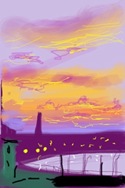
Drawings by David Hockney, made with the Brushes application on his iPhone, 2009.
Cultivating Ourselves
Excerpt from “Apples, Apples, Apples,” by Verlyn Klinkenborg, New York Times, November 5, 2009:
One good way to think about modern agriculture is to think about apples. 
Modern agriculture, as well as our carefully created preference for processed over fresh food, has pushed us in the opposite direction, toward uniformity...According to one estimate, only 11 varieties make up 90 percent of all the apples sold in this country, and Red Delicious alone counts for nearly half of that...
We live now in the world of the generic apple, in large part because our taste buds have gone generic. Cultivating ourselves is the first step toward rediversifying the fields and orchards around us.
[Thanks Kit!]
Thursday, November 05, 2009
Painting Has Its Own Inadequacy

~ Luc Tuymans, “Q & A,” CNN, October 18, 2006
Anything Else

“No biopics, no prequels, no sequels, no hero movies, no antihero movies, and definitely no superhero movies. Anything else I can handle.”
~ Pedro Almodóvar, from “Cinematic Soul Mates,” by Mark Harris, New York Times, Oct. 29, 2009
You’ve Been Contemplative
From Buddha's Brain: The Practical Neuroscience of Happiness, Love, and Wisdom by Rick Hanson, Ph.D. with Richard Mendius, MD:

Therefore, if you’d like to feel more happiness, inner strength, clarity, and peace, it makes sense to learn from contemplative practitioners—both dedicated lay people and monastics—who’ve really pursued the cultivation of these qualities.
Although “contemplative” may sound exotic, you’ve been contemplative if you’ve ever meditated, prayed, or just looked at the stars with a sense of wonder. The world has many contemplative traditions, most of which are associated with its major religions, including Christianity, Judaism, Islam, Hinduism, and Buddhism…
…scientists, clinicians, and contemplatives have already learned a great deal about the brain states that underlie wholesome mental states and how to activate those brain states. These important discoveries give you a great ability to influence your own mind. You can use that ability to reduce any distress or dysfunction, increase well-being, and support spiritual practice; these are the central activities of what could be called the path of awakening, and our aim is to use brain science to help you travel far and well upon it.
- Excerpts from Buddha’s Brain
- WiseBrain.org
Wednesday, November 04, 2009
Working without Words
“I feel like when I’m performing and I’m really in kind of a state, it’s quite like meditation…especially as a soloist where the forms are precise, but in a different way than when I’m with other people and we’re dependent on each other. But as a soloist I can be very precise and very rigorous and yet at the same time I feel that I’m very open and fluid to what’s happening in the moment. It’s that thing of trying to be really present in experience. In a sense I think that our culture teaches us to describe our experiences, to narrate our experiences, and that’s how we’re one step away from [them]. So in a way, I think that’s why I really like working without words because I think it throws your mind into a very different state.”
~ Meredith Monk, from Inner Voice

Meredith Monk's Songs of Ascension performed at the unveiling of the Ann Hamilton Tower at Oliver Ranch (July 2007).
Tuesday, November 03, 2009
Feeling Okay about Not Feeling Okay
"Whereas positive mood seems to promote creativity, flexibility, co-operation and reliance on mental shortcuts, negative moods trigger more attentive, careful thinking, paying greater attention to the external world…[and a] mildly negative mood may actually promote a more concrete, accommodative and ultimately more successful communication style."
~ Professor Joe Forgas, from “Feeling Grumpy is Good for You,” BBC News, November 3, 2009

Lidia Zylowska, M.D., a psychiatrist who works in the area of integrating mindfulness into ADHD treatment suggests the following steps when experiencing difficult or unpleasant emotions:
(R) Recognize the emotion by giving it a name using words like sadness, anger, hurt, embarrassment...Or perhaps there is a feeling of numbness or disconnection. Or just a neutral feeling...Whatever you notice, with courage allow yourself to fully have the experience.
(A) Accept the reality of this feeling in the present moment. There is no need to criticize yourself or thinking something is wrong with you, simply noting, ‘oh, there is anger', ‘oh there is sadness'. As much as possible, welcoming the experience.
(I) Investigate this feeling a little more. With a sense of beginner's mind or curiosity, drop your attention deeper into the body and notice any sensations present there. Perhaps there is some tensing up in the chest, feelings of clenching in the stomach or maybe a sinking feeling. You may even notice some reaction to the difficult emotion or the thought itself? There may be feelings of anger or shame for even having this emotion.
As you go through the steps of recognizing, accepting and investigating, you may notice that the emotion or the thought feels less personal, simply an emotion...simply a thought.
(N) Not identifying or not personalizing the feeling. Stepping back from the experience and seeing it for what it is, a set of reactions and sensations. As much as possible just witnessing them without getting caught up in them.
From “Mindfulness and ADHD,” by Elisha Goldstein, Mental Help Net, October 23, 2009
[Thanks Angela!]
The Survival of the More Versatile
Dr. Rick Potts, from “The Adaptable Human,” NOVA, October 26, 2009:
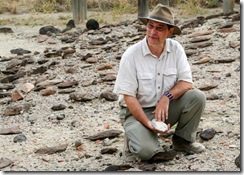
But when I began the work here at Olorgesailie, we kept seeing layer after layer of environmental change, from soils to volcanic ashes to a lake to a drought when the lake completely evaporated. We saw this through 700,000 years, and I began to think, well, maybe it's not the particular environment of a savanna that was important, but the tendency of the environment to change, to vary in very dramatic ways. And we saw that the large grazing animals of the savanna—elephants, baboons, pigs, zebras, all of whom ate grass—disappeared in the time period when worldwide climate began to vary the most.
So it dawned on me: Rick, you're an anthropologist. Maybe this has something to do with human evolution, and it's not the survival of the fittest in any one environment but the survival of the more versatile, the more general and flexible creatures that would really persist over time. This gave me a new insight into human evolution. The origin of stone tools, the expansion of the brain, and the complexity of social life that we see with the emergence of our own species may actually be a response not to just the dry savanna or the cold Ice Age but to the wide and dramatic variability of climate over time.
- Becoming Human Part 1 (PBS)
Monday, November 02, 2009
The Full Flowering of Humanity

All existence is revealed to the Enlightened human being as a seamless whole, as Divine Life. Some taste of this Enlightenment which consciously touches the Ultimate is possible for each of us. It need not be deferred to any future existence in heaven or on earth.
Enlightenment is the secret essence of our consciousness, and the gradual revelation of this essence is the process of spiritual growth in which everyone is involved.”
~ Lex Hixon, from Coming Home: The Experience of Enlightenment in Sacred Traditions
Endogenous Repair
From "Stem Cells: Untold Stories,” a conversation between Doris Taylor and Krista Tippett, Speaking of Faith, October 29, 2009:
Building Hearts + Lengthening Telomeres from Speaking of Faith on Vimeo.
"What we think impacts who we are. We know that. We know that, whether it's what we think makes us grumpy or what we think makes us happy. And we're learning that those have an impact on our physical body. Stress ages your stem cells. There's science out there from some of the best laboratories in the world showing that the way a cell knows how old it is, is it has a little piece of DNA, chromosome, right? On the end of that chromosome is a little piece of DNA called a telomere. And every time your cell divides, that gets shorter. And when it reaches a certain point, it says, "Oops. I'm old. Time to die." Well, stress makes that piece of DNA get shorter. So stress literally ages your stem cells. If you believe that's true, and it is, it also ought to be possible to reverse stress and make your cells younger...
[Matthieu Ricard] is doing some studies with some people at the University of Wisconsin where he and a number of his colleagues meditate, and as they meditate they measure differences in their brainwaves. And I basically said I would predict that those very same things that when you meditate and you have positive brainwave changes would also have an effect on your stem cells. He very graciously -- and this is an N of one -- let us measure cells in his blood before and after meditation. And what we found was a huge increase in the number of positive stem cells in blood. Largest increase I've ever seen, after fifteen minutes of meditation...
It's all about endogenous repair...
We have inflammation going on inside our blood vessels, inside our organs, inside our tissues. And I think those are nature's cues to say, "Send me cells." Well, I would also say that meditation is essentially doing that without the inflammation. It's nature's way of sending those cells to the sites where you need them in a way to turn down the negative aspects of stress. So stress in my mind is another word for inflammation. I would say inflammation is the physiologic consequence of stress."
Sunday, November 01, 2009
Caricatures

~ Edward Saïd, writing in 1980
Friday, October 30, 2009
Sabbaths
Excerpts from Leavings by Wendell Berry:

XIII.
Eternity is not infinity.
It is not a long time.
It does not run parallel to time.
In its entirety it always was.
In its entirety it will always be.
It is entirely present always
Sabbaths 2008
V.
How many of your birthdays
I have by now been
glad of! And all that time
I’ve been trying to tell you
how with you was born
my truest life and most
desired, the better man
by your birth I am, however
fallen short. I’ll never
get it right by half.
Between us now, what
is more telling than the silence
in which once more an old
redbud simply blooms?

IX.
…
plants, animals, humans,
soils, stones, stories,
songs—all belonging
to such small, once known
and forgotten, officially unknown
and exploited, beautiful places
such as this, where despite
all we have done wrong
the golden light of October
falls through the turning leaves.
…
Thursday, October 29, 2009
Gotta Listen

Even in the Dark
Company of Thieves
For those who work so hard
Never see their children
Never see their children grow
Into the gifts they give them
This is life, is all unknown
Gotta listen to their laughter
Everyone must be heard now
Even in the dark
For those who seek no answers
Keep it from the table
Ignorance is eaten up
When everyone must be fed
This life is constant hunger
See it in the dreamers
Believe in the believers of never-ending love
An end is kind of love
Even in the darkness
Whoa...
Even in the dark
Find your calling
Even in the dark
Find your calling
You gotta find your calling
Even in the dark
Everyone must be heard
Even in the darkness
On Making a Raft
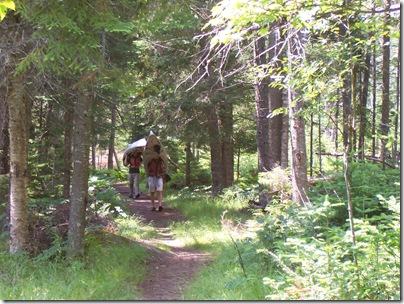
"How useful this raft has been to me! For it was in dependence on this raft that, making an effort with my hands and feet, I have crossed over to safety on the further shore. Why don't I, having hoisted it on my head or carrying on my back, go wherever I like?"
~ Buddha
Why would one make and use a raft to cross a river only to haul it uselessly around as a burden? This is often our unskillful practice, says Stephen Batchelor. We use spiritual practice to encounter life with freshness and openness, not clinging to any particular method, just as we do not carry around a raft after having crossed a river. Each moment is an opportunity to practice. If we truly embody the practice, we can act appropriately and spontaneously in every situation.
Wednesday, October 28, 2009
Less Like Homework
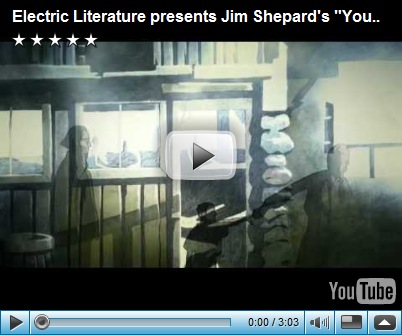
“The founders of Electric Literature, a new quarterly literary magazine, seek nothing less than to revitalize the short story in the age of the short attention span. To do so, they allow readers to enjoy the magazine any way they like: on paper, Kindle, e-book, iPhone and, starting next month, as an audiobook. YouTube videos feature collaborations among their writers and visual artists and musicians. Starting next month, Rick Moody will tweet a story over three days…One thing Electric Literature seems good at is getting people to read serious literature, making it less like homework.”
From “Serving Literature by the Tweet,” by Felicia R. Lee, New York Times (October 27, 2009)
Adrift

loose. Let me be drowned, baptized,
in the light given me. Day comes around,
night, fall, winter, spring,
summer. Leaves overhead, underfoot.
Waves arrive, buffets from friends
offended, enemies. Let it all come:
that is my way, this is the canoe I’m in.
By William Stafford, from The Answers Are Inside the Mountain: Meditations on the Writing Life
Tuesday, October 27, 2009
Thinking about Calcium Waves in Astrocytes
Excerpts from Andrew Koob’s discussion of glial cells and his related book, The Root of Thought, with Jonah Lehrer in "The Root of Thought: What Do Glial Cells Do?" Scientific American (October 27, 2009):

Interestingly, as you go up the evolutionary ladder, astrocytes in the cortex increase in size and number, with humans having the most astrocytes and also the biggest. Scientists have also discovered that astrocytes communicate to themselves in the cortex and are also capable of sending information to neurons. Finally, astrocytes are also the adult stem cell in the brain and control blood flow to regions of brain activity. Because of all these important properties, and since the cortex is believed responsible for higher thought, scientists have started to realize that astrocytes must contribute to thought.
In short, calcium waves are how astrocytes communicate to themselves. Astrocytes have hundreds of 'endfeet' spreading out from their body. They look like mini octopi, and they link these endfeet with blood vessels, other astrocytes and neuronal synapses. Calcium is released from internal stores in astrocytes as they are stimulated, then calcium travels through their endfeet to other astrocytes. The term 'calcium waves' describes the calcium release and exchange between astrocytes and between astrocytes and neurons.

Furthermore, calcium waves can also cause neurons to fire. And calcium waves in the cortex are leading scientists to infer that this style of communication may be conducive to the processing of certain thoughts. If that isn't convincing, it was recently shown that a molecule that stimulates the same receptors as THC can ignite astrocyte calcium release.
This idea [that glia and their calcium waves might play a role in creativity] stems from dreams, sensory deprivation and day dreaming. Without input from our senses through neurons, how is it that we have such vivid thoughts? How is it that when we are deep in thought we seemingly shut off everything in the environment around us?
In this theory, neurons are tied to our muscular action and external senses. We know astrocytes monitor neurons for this information. Similarly, they can induce neurons to fire. Therefore, astrocytes modulate neuron behavior.
This could mean that calcium waves in astrocytes are our thinking mind. Neuronal activity without astrocyte processing is a simple reflex; anything more complicated might require astrocyte processing. The fact that humans have the most abundant and largest astrocytes of any animal and we are capable of creativity and imagination also lends credence to this speculation.
Calcium is also released randomly and without stimulation from astrocytes' internal stores in small bursts called 'puffs.' These random puffs can lead to waves. It is possible that the seemingly random thoughts during dreams and sensory deprivation experience could be calcium puffs becoming waves in our astrocytes.
Basically, it is obvious that astrocytes are involved in brain processing in the cortex, but the main questions are, do our thoughts and imagination stem from astrocytes working together with neurons, or are our thoughts and imagination solely the domain of astrocytes? Maybe the role of neurons is to support astrocytes.
Continuous Revision
From The Faith of a Writer: Life, Craft, Art by Joyce Carol Oates:

By the time I come to type out my writing formally, I've envisioned it repeatedly. I've never thought of writing as the mere arrangement of words on the page but as the attempted embodiment of a vision: a complex of emotions, raw experience.
The effort of memorable art is to evoke in the reader or spectator emotions appropriate to that effort. Running is a meditation; more practicably it allows me to scroll through, in my mind's eye, the pages I've just written, proofreading for errors and improvements.
My method is one of continuous revision. While writing a long novel, every day I loop back to earlier sections to rewrite, in order to maintain a consistent, fluid voice. When I write the final two or three chapters of a novel, I write them simultaneously with the rewriting of the opening, so that, ideally at least, the novel is like a river uniformly flowing, each passage concurrent with all the others.
Present but Elsewhere
Flying Distracted
by Daron Larson
Can we honestly claim to be shocked
by attention’s prolonged absence
from the cockpit?
It never really left.
It was merely present but elsewhere,
at the same time,
behind a secure door.
Deadly altitudes and velocities
feel thin and inert
from the inside,
just like outsized economic expansions
which are always too good to be true.
What lures us with adrenaline
quickly turns stale and dull.
Look at us, for example,
waiting in the cabin
for a better or more familiar city
to loom up from the
sleeping patchwork earth.
No longer dressed for Sunday,
we look like pole dancers and suckers
who lost it all in Vegas,
too short on time to wash or comb our hair,
busy toying with the restrictions on electronic devices.
We are all flying distracted
until jolted awake
by contact with the ground,
speed dialing anyone who will answer
to let the other passengers know
we are special,
we are adored,
we are still alive.
Monday, October 26, 2009
Tree of Contemplative Practices
From the Center for Contemplative Mind in Society:
The Tree of Contemplative Practices illustrates some of the contemplative practices that have been developed over the past few thousand years. This is not intended to be a comprehensive list; the practices listed on the Tree are drawn from those mentioned by survey respondents during our 2001-2004 research project.

The Center for Contemplative Mind in Society helped design the Search Inside Yourself program at Google.
To Become Visible While Carrying What is Hidden as a Gift to Others
What to Remember When Waking
by David Whyte
In that first hardly noticed moment in which you wake,
coming back to this life from the other,
more secret, movable and frighteningly honest world
where everything began,
there is a small opening into the new day
which closes the moment you begin your plans.
What you can plan is too small for you to live.
What you can live wholeheartedly
will make plans enough for the vitality
hidden in your sleep.
To be human is to become visible
while carrying what is hidden
as a gift to others.
To remember the other world in this world
is to live in your true inheritance.
You are not a troubled guest on this earth,
you are not an accident amidst other accidents.
You were invited from another and greater night
than the one from which you have just emerged.
Now looking through
the slanting light of the morning window
toward the mountain presence
of everything that can be,
what urgency calls you to your one love?
What shape waits in the seed of you
to grow and spread its branches
against a future sky?
Is it waiting in the fertile sea?
In the trees beyond the house?
In the life you can imagine for yourself?
In the open and lovely
white page on the waiting desk?

[From The House of Belonging (1996)]
Sunday, October 25, 2009
Artists and Scientists

~ Richard Powers discussing his recent novel, Generosity: An Enhancement, with Studio 360’s Kurt Anderson (October 23, 2009)
Subscribe to:
Posts (Atom)




