
Looking for Maria




From Stillness Speaks by Eckhart Tolle:

He didn’t have the decency to return my call.
She let me down.
Little stories we tell ourselves and others, often in the form of complaints. They are unconsciously designed to enhance our always deficient sense of self through being “right” and making something or someone “wrong.” Being “right” places us in a position of imagined superiority and so strengthens our false sense of self, the ego. This also creates some kind of enemy: yes, the ego needs enemies to define its boundary, and even the weather can serve that function.
Through habitual mental judgment and emotional contraction, you have a personalized, reactive relationship to people and events in your life. These are all forms of self-created suffering, but they are not recognized as such because to the ego they are satisfying. The ego enhances itself through reactivity and conflict.
How simple would life be without those stories.
It is raining.
He did not call.
I was there. She was not.

~ Adyashanti, from Emptiness Dancing
Being a Person
by William Stafford
Be a person here. Stand by the river, invoke
the owls. Invoke winter, then spring.
Let any season that wants to come here make its own
call. After that sound goes away, wait.
A slow bubble rises through the earth
and begins to include sky, stars, all space,
even the outracing, expanding thought.
Come back and hear the little sound again.
Suddenly this dream you are having matches
everyone's dream, and the result is the world.
If a different call came there wouldn't be any
world, or you, or the river, or the owls calling.
How you stand here is important. How you
listen for the next things to happen. How you breathe.
To the Air
by W.S. Merwin, from Present Company

there you were
I cannot say
how long you have been
present all at once
color of the day
as it comes to be seen
color of before
face of forgetting
color of heaven
out of sight within
myself leaving me
all the time only
to return without
question never
could I live without you
never have you
belonged to me
never do I want
you not to be with me
you who have been
the breath of everyone
and each word spoken
without needing to know
the meaning of any of them
or who was speaking
when you are the wind
where do you start from
when you are still
where do you go
you who became
all the names I have known
and the lives in which
they came and went
invisible friend
go on telling me
again again

“For facial animation, in particular, we’ve been able to find ways to use a computer to help out the stop-motion. Replacement animation has been around forever, but there’s only a certain amount of refinement you can get with it—it’s hand-done and it’s a little crude, but it does have a real beauty to it. With the computer you can make it pixel-perfect, get real subtlety.”
“We have these machines that can transfer what we’ve done with the computer, make physical objects out of them. That’s how we did a lot of the facial replacement animation. We were modeling and sculpting in the computer, printing them out on these wacky 3-D printers, painting them all by hand, and then fitting them and putting them on the puppets. That was how we got this really incredible, subtle, beautiful, and expressive facial animation.”

“It hurts my stomach to think about all those poor people who had to paint all that stuff and build all that. But I think it shows. When you see the film, she really does emote, and she feels like a real, living, breathing girl. Of course, all that comes from the animators.”
From Stillness Speaks by Eckhart Tolle:

Whenever there is some silence around you—listen to it. That means just notice it. Pay attention to it. Listening to silence awakens the dimension of stillness within yourself, because it is only through stillness that you can be aware of silence.
See that in the moment of noticing the silence around you, you are not thinking. You are aware, but not thinking.
From TED Talks (March 2009):
“Newspaper designer Jacek Utko suggests that it's time for a fresh, top-to-bottom rethink of the newspaper. (At this point, why not try it?) In his work, he's proved that good design can help readers reconnect with newspapers. A former architect, Utko took on the job of redesigning several newspapers in former Soviet Bloc nations, starting from basic principles. He worked closely with newspaper executives to figure out the business goals of their papers, and then radically reformatted the product to fit those goals.”

~ Father Thomas Keating, from Manifesting God
From The Ego Tunnel: The Science of the Mind and the Myth of the Self by Thomas Metzinger:

...Throughout this book, I use one central metaphor for conscious experience: the "Ego Tunnel." Conscious experience is like a tunnel. Modern neuroscience has demonstrated that the content of our conscious experience is not only an internal construct but also an extremely selective way of representing information. This is why it is a tunnel: What we see and hear, or what we feel and smell and taste, is only a small fraction of what actually exists out there. Our conscious model of reality is a low-dimensional projection of the inconceivably richer physical reality surrounding and sustaining us.
Our sensory organs are limited: They evolved for reasons of survival, not for depicting the enormous wealth and richness of reality in all its unfathomable depth. Therefore, the ongoing process of conscious experience is not so much an image of reality as a tunnel through reality.
* * * * *
Research study: Full-body Illusions and Minimal Phenomenal Selfhood
by Mark Strand, from Selected Poems
In a field
I am the absence
of field.
This is
always the case.
Wherever I am
I am what is missing.
When I walk
I part the air
and always
the air moves in
to fill the spaces
where my body’s been.
We all have reasons
for moving.
I move
to keep things whole.
From "Boyle's Got Talent," by Mike Krumboltz, Yahoo's The Buzz Log:
Susan Boyle (remember that name) became a Web phenomenon after singing "I Dreamed a Dream" from Les Miserables. The performance brought the audience to its feet and left the judges (including Simon Cowell) either speechless or in tears.
Before going on stage, Ms. Boyle admitted some self-deprecating facts about herself (she's never been kissed and lives alone with her cat, Pebbles). For those reasons and more, audiences were expecting the female William Hung. They were wrong.
Lookups on the sudden star posted huge gains. A no-name just the other day, Ms. Boyle quickly surged into our top 5,000 overall searches. Blogs and gossip rags went wild. The Mirror jumped on the story, reporting that while Ms. Boyle thought she "looked like a garage" on TV, she received a standing ovation when she showed up at her local church.
Other sources write that as a child, Ms. Boyle was the target of bullies because of a disability. But, with her newfound fame, she is getting the last laugh. In fact, she's already meeting with officials from Mr. Cowell's Sony BMG label. This may have been the first you've heard of her, but it certainly won't be the last.
"Where I am, I don't know, I'll never know, in the silence you don't know, you must go on, I can't go on, I'll go on."


Mike Nichols, from “Mike Nichols, Master of Invisibility,” by Charles McGrath, New York Times (April 10, 2009):
“Movie acting was invented less than 100 years ago — movie acting with sound. You know how Harold Bloom says that Shakespeare invented us? It’s a fascinating idea, and you can go quite far with it. You could say that it’s in talking movies that 
“The greatest thrill is that moment when a thousand people are sitting in the dark, looking at the same scene, and they are all apprehending something that has not been spoken. That’s the thrill of it, the miracle — that’s what holds us to movies forever. It’s what we wish we could do in real life. We all see something and understand it together, and nobody has to say a word. There’s a good reason that the very best sound an audience can make — in both the theater and the movies — is no sound at all, just absolute silence.”

To the Gods
by W.S. Merwin, from Present Company

telling us what we could believe
when did you take that one step
only one
above
all that
as once you stepped
out of each of the stories
about you one after the other
and out of whatever we imagined we knew
of you
who were the light
to begin with
and all of the darkness
at the same time
and the voice in them
calling crying
and the enormous answer
neither coming nor going
but too fast to hear
you let us believe
the names for you
whenever we heard them
you let us believe the stories
how death came to be
how the light appeared
how the beginning began
you let us believe
all that
then you let us believe
that we had invented you
and that we no longer
believed in you
and that you were only stories
that we did not believe
you with no
moment for beginning
no place to end
one step above
all that
listen to us
wait
believe in us
Anslem Kiefer in conversation with Michael Auping from Anselm Kiefer: Heaven and Earth:
Religion was a part of my childhood and my youth. It was a very important thing. The rituals and rites were important. I can still do them in Latin. Of course, I knew the Latin before I knew what it meant. But I was involved, like many young people of my generation, in learning religion at an early age.
Later, I discovered that Christian mythology was less complex and less sophisticated than Jewish mythology because the Christians limited their story to make it simple so that they could engage more people and defend their ideas. They had to fight with the Jewish traditions, with the Gnostics. It was a war of the use of knowledge.
However, it wasn’t just a defense against outside ideas. It was aggressive. Like politics, they wanted to win. You know, the first church in Rome was not defensive and not aggressive. It was quiet. It was spiritual in the sense of seeking a true discussion about God. It was exploring a new idea about humanity. But then there was “iglesias triumphant,” the Triumph of the Church. And then the stones were stacked up and the buildings came, and the construction of the Scholastics, Augustine, and so on. They were very successful in limiting the meaning of the mythology. There were discussions about the Trinity and its meaning. Anyone who had ideas that complicated their specific picture was eliminated. This made Christianity very rigid and not very interesting. Whenever knowledge becomes rigid it stops living.

…Since childhood, I had studied the Old Testament, and sometime as a young man I began to read of Jewish mysticism. Then in the mid-1980s, I went to Jerusalem and began to read the books of Gershon Scholem. Beside the fact that kabbalistic stories and interpretations are very interesting, I think my attraction has something to do with the way that I work.
People say that I read a lot, but in some ways I don’t. I read enough to capture images. I read until the story becomes an image. Then I stop reading. I can’t recite a passage, but I can recite it as an image. For an artist it is important to have a strong, complex subject. Kabbala means “knowledge that has been received,” a secret knowledge; but I think of it as images that have been received.
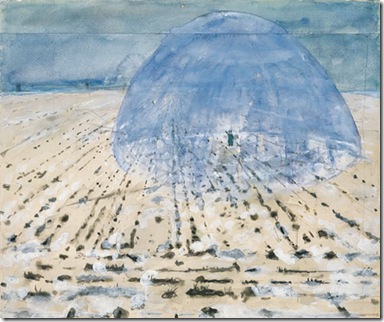
As I said before, the Christian church hardened in its knowledge and its symbolism at a certain point. The kabbalistic tradition is not one buy many, forming a sophisticated spiritual discipline. It is a paradox of logic and mystical belief. It’s part scholarship, part religion, part magic. For me, it is a spiritual journey anchored by images.
Holy Longing (Selige Sehnsucht)
By Johann Wolfgang von Goethe
Translated by Shinzen Young
Tell it to no one but the wise
For most will mock it right away
The truly living do I prize
Those who long in flame to die.
In the coolness of loves evenings
Where you beget and were begotten,
You're overcome by strange new feeling
As the silent candle brightens.
No longer are you trapped and mired
In the darkened shadowings
But swept away by new desire
To a higher lovemaking.
Distance does not pall your flight
Spellbound through the air you're borne
Til at last mad for the light
You are a butterfly, then…gone.
And until you know of this:
How to grow through death
You're just another troubled guest
On the gloomy earth.

“It may make us from time to time a little more aware of the deeper, unnamed feelings which form the substratum of our being, to which we rarely penetrate; for our lives are mostly a constant evasion of ourselves.”
~ Quoted in Matrix of Modernism by Sanford Schwartz
* * *
“If you want to write poetry, keep away from pencils and paper and typewriters until you have overcome the temptation…Whatever you think, be sure that’s what you think; whatever you want, be sure that’s what you want; whatever you feel, be sure that’s what you feel.”
~ From an address at Milton Academy, June 17, 1933

From East Coker
(No. 2 of Four Quartets)
From Wikipedia: East Coker is a village in Somerset, England from which T.S. Eliot's ancestors emigrated to Boston in 1660. Eliot visited the village in 1936-7 and his ashes are buried in the churchyard. Inside the church a plaque memorializing him was placed in 1965. It contains the words of his chosen epitaph, the opening and closing lines from East Coker: “in my beginning is my end"/"in my end is my beginning”. East Coker represents earth.
From “A Year in a Cage: A Life Shrunk to Expand Art,” by Roberta Smith, New York Times (Feb. 18, 2009):
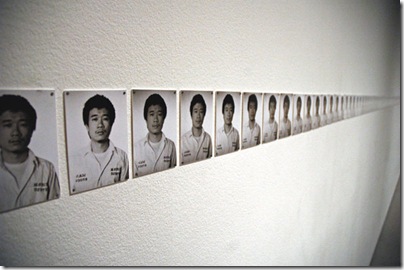
For “Cage Piece” Tehching Hsieh (pronounced dur-ching shay) built a cage from pine dowels and two-by-fours in a corner of his TriBeCa studio, furnishing it with a bed, a blanket, a sink (no toilet) and a pail, as well as some personal hygiene items. He entered the cell on Sept. 30, 1978. Robert Projansky, his lawyer, locked the door and affixed it and each dowel with paper seals that he signed. Every day a friend delivered food and dealt with the artist’s refuse. And each day the friend took a photograph of Mr. Hsieh, who had shaved his head at the beginning.

Daron Larson
Freelance Contemplative



