
Wednesday, March 31, 2010

Something More than Mere Survival

Judith Shulevitz, from “Making Room For The Sabbath,” a conversation with Terry Gross about her book, The Sabbath World: Glimpses of a Different Order of Time:
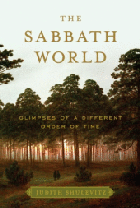
The Sabbath World I was fascinated by rules. I sensed that one of the things about my life that I didn't like is that I was a kind of knee-jerk libertarian. Nobody could tell me what to do. But that's not how life works in a society. Societies have rules and we keep them. We don't object to the ones we all keep because we all keep them together. We object to the new ones that don't seem familiar to us. And I wanted to get familiar with these rules because it seemed to me that rules are how society passes on from one generation to the next moral behavior and moral activity and its idea of how life should be shaped and life should be led. And I wanted to get to know what these rules had to say to me...

The basic principle uniting all these rules is that you as a human being should not be exerting mastery over the world. For one day a week, let the world be as it is and you be in it and you're not trying to dominate it. That's the basic principle. Now the form that the rules took when they were first thought up was agricultural because they were conceived of in an agricultural society. And there's something to me very beautiful about this because not only were they conceived in an agricultural society, they were conceived of in a mainly subsistence farming society. So people were being asked not to bring in the crops. They were being asked not to do basic labors which would have helped them survive and they had to transfer that work of surviving to six days a week. And it had to have been very, very hard because we know how hard it is to survive when you're living off the land. And that to me gives me a sense of the seriousness with which it was taken and the beauty of the idea. Imagine telling people who are struggling to barely survive that one day a week they must give themselves over to something more than mere survival -- and they have the right to even if circumstances dictate otherwise. Those two things are very beautiful to me...

The thing that was most intriguing to me when I was working on the book and remains most intriguing to me, is as a fundamental political idea. And it's an idea that we've really lost in America today, though I think we've had it in the history and, indeed, I try to make the case that we were really one of the most Sabbatarian nations when we were founded by the Puritans. (Sabbatarian meaning keeping the Sabbath.) But this is an idea that we have really moved radically away from. And the idea is this: that as a society we have the right to collectively regulate our time and that everyone has the right not to work at least one day a week. You have to imagine a world in which this idea was conceived of and codified. This had never been said before.

[Thanks Tammy!]

Tuesday, March 30, 2010

Preparing for Things that Matter Most

“Most people vastly overestimate the extent to which more money would improve our lives. Most schools and colleges spend too much time preparing students for careers and not enough preparing them to make social decisions. Most governments release a ton of data on economic trends but not enough on trust and other social conditions. In short, modern societies have developed vast institutions oriented around the things that are easy to count, not around the things that matter most. They have an affinity for material concerns and a primordial fear of moral and social ones…Governments keep initiating policies they think will produce prosperity, only to get sacked, time and again, from their spiritual blind side.”

~ David Brooks, from “The Sandra Bullock Trade,” New York Times (March 29, 2010)

To Practice Hope

Chosen Blindness
by Mary Karr, from Viper Rum

1.

Viper RumI was blind to flowers for one thing.
Picture a meadow stitched with dandelion,
those seed stalks whose tall white heads

poke up like ancestral ghosts
(pale auroras of wisdom), but profligate,
the fluff shot through with brown seeds

that others might follow. I never saw it,
just fixed on my own death, sat on the sofa
ingesting poison, looked out

at the rectangular field as if it were a postcard
from some foreign land, useless, already cancelled.
I sucked streams of gray smoke down my lungs

to blacken me deeper. The embroidery sampler I did in x’s
read BAD NEWS. The butterless popcorn I ate
was a bowl full of spiders. Skinny?

My skeleton forced itself forward. No word
of praise passed my lips though a million breaths
moved through me. That’s what human bodies do, keep

breathing, no matter the venom their brains manufacture.

2.

Now I go to church. Who’d think it?
We stand in rows, like graves, I’d once have thought,
like herd beasts lined up for slaughter. Now I notice

our bodies bend in the same places. We form the same angles.
To sing together, we have to breathe in unison,
draw the same air into the dark meat of our bodies

as if it actually were spiritu sancti and ourselves
that spirit incarnate. Every now and then,
a toddler bolts up the main aisle, pursued

by a lumbering adult. Babies list
in sloping arms and toothless grin.
The old lean on canes

and chrome walkers set down slow. People
pause to let them pass. Always a list of dead is read,
always the sick are mentioned so your own aches

seem aggressively minor. My forebears
forebore this way, in company. Bread fed them,
and they had to practice hope to keep

plowing up the Dust Bowl’s
starved earth in rows, year
after fruitless year, till the cotton came back.

3.

At the end of my drinking,
I coiled a garden hose in the back of my station wagon
and set off driving to a town

called Marblehead to breathe in the cool
exhaust and thus stop thoughts from streaming
through my mind like bad current.

I’d left my infant son a note, glowing green
on my computer screen, how he’d be
better off. Now a column of sun

through high windows shines
on his blond head. His hand
holds half our hymnal, index finger

underlining each word as we struggle
to match up our voices, hold the beat,
find the pattern emerging, feel the light

that glows in our chests, keep it going.

for Dev Milburn

Making Every Second Count


The Big C

See also: Laura Linney interviewed by Alec Baldwin, Studio 360

Monday, March 29, 2010

Scopophilia

Cleveland International Film Festival, March 27, 2010

We spent the weekend shoulder-to-shoulder with like-minded cinephiles, our collective gaze fixed on the lights flickering on the cave walls.

We watched a butcher in Jerusalem let trouble stir life into his cold bones, confining a nibble of vitality to be preserved forever in a meat locker and the icy waters of a nearby spring.

We watched Joseph Brodsky gazing back at the St. Petersburg of his youth: potatoes, paintings of nudes, shelves of books, his parents dancing after the war, an orchestra of musical instruments floating in the sky like clouds.

We watched a Croatian sniper try to dodge the trajectory of his own bullets while hunting down the traumatized Little Red Riding Hood he had fallen in love with through the scope of his rifle and nearly destroyed.

We watched a Mongolian folk singer search for the lyrics to a song hidden in the unrepeatable archives of fading human memory.

We watched Renaud Capuçon perform Gluck’s Orfeo Melody on a 1737 Guarnerius violin in the Paris subway from 7:57 a.m. to 7:57 p.m to mostly indifferent commuters a couple of days before playing the same piece to a sold-out auditorium in the Théâtre des Champs-Elysées. Our hearts were collectively broken until a blind woman renewed our hope by venturing as close as possible to warm herself in the glow.

We watched, Juan Pujol Garcia, a double agent from Spain and his contrived network of spies convince the Nazis to prepare for an attack on Pas de Calais as the Allied Forces stormed the beaches of Normandy.

We watched art collectors, dealers, galleries, and auction houses enthusiastically inflate the value of contemporary art to staggering and unsustainable heights through secrecy, speculation, tax strategies, and cornering markets.


Cleveland International Film Festival

Friday, March 26, 2010

We’ve Seen it All Before

Excerpt from the introduction of Taking Our Places: The Buddhist Path to Truly Growing Up by Norman Fischer:

Taking Our Places Another characteristic of maturity — one that any of us would mention — is experience. A grown-up is someone who is experienced and, through having lived long enough to have seen many things, has a point of view and a measure of savvy about how life works. There is certainly no substitute for the experience that accumulates as the years go by, but it is also possible to be alive for a long time and not really experience our living, not really see our life. The human capacity for self-deception and blindness runs deep. We may be alive, but we have not necessarily lived. If we accumulate experiences without really engaging with them, then our experience tends to make us stodgy and boring. As we catalog and define our experiences, possessing them without ever really being possessed by them, we begin to expect that new situations will just be repetitions of old ones. Soon we feel as if we’ve seen it all before. We know what to expect. Our point of view gradually becomes a set of blinders rather than a searching flashlight.

But if we pay close and open attention to our experiences, life’s larger patterns begin to come into view. We see that all things are transitory and unique. Nothing repeats. We understand that, though always instructive, the past can never tell us what the future will be. Within the larger pattern that experience reveals, there are endless variations. Insofar as we see this, our experience increases our wonder at and appreciation of all that happens. With little life experience, we might be naively excited by the novelty of a person we meet or an event that occurs. But when we truly appreciate our experience, we respond to that newness with a deeper understanding of its meaning and wonder as we relate it to what we have seen before. Far from dampening our sense of wonder, real experience refreshes and mellows it.

Wednesday, March 24, 2010

The Language of Individual Freedom

Excerpt from “The Broken Society,” by David Brooks, New York Times (March 18, 2010):

Phillip Blond argues that over the past generation we have witnessed two revolutions, both of which liberated the individual and decimated local associations. First, there was a revolution from the left: a cultural revolution that displaced traditional manners and mores; a legal revolution that emphasized individual rights instead of responsibilities; a welfare revolution in which social workers displaced mutual aid societies and self-organized associations.

Then there was the market revolution from the right. In the age of deregulation, giant chains like Wal-Mart decimated local shop owners. Global financial markets took over small banks, so that the local knowledge of a town banker was replaced by a manic herd of traders thousands of miles away. Unions withered.

The two revolutions talked the language of individual freedom, but they perversely ended up creating greater centralization. They created an atomized, segmented society and then the state had to come in and attempt to repair the damage.

The free-market revolution didn’t create the pluralistic decentralized economy. It created a centralized financial monoculture, which requires a gigantic government to audit its activities. The effort to liberate individuals from repressive social constraints didn’t produce a flowering of freedom; it weakened families, increased out-of-wedlock births and turned neighbors into strangers. In Britain, you get a country with rising crime, and, as a result, four million security cameras.

More…

[Thanks Suzanne!]

Tuesday, March 23, 2010

Why It Takes All Day

Silk Parachute “On a sentence-by-sentence level, it’s more spontaneous. In other words, I know what I want to have said when I’m finished with this writing, but I really don’t know, when I’m down to the nub of it to address it, what’s going to happen. I mean I know where it should go, but it certainly isn’t — the phraseology — is not prefabricated and that’s why it takes me all day to get one sentence written.”

~ John McPhee, discussing his writing process and his new collection of essays, Silk Parachute, with Michael Silverblatt on KCRW’s Bookworm (March 18, 2010).

Rambling Man


Rambling Man by Laura Marling from her new album, I Speak Because I Can. She will perform at the Wexner Center on May 5, 2010.

Enchanted by the Trick and the Story

How the Puppets from Fantastic Mr. Fox Were Made [Slide Show] by Julian Sancton, Vanity Fair, 11.23.2009

Wes Anderson discussing the appeal of stop-motion animation with Michael Specter from The Making of Fantastic Mr. Fox: A Film by Wes Anderson Based on the Book by Roald Dahl:

The thing I’ve always loved with stop-motion, more than anything else, is puppets that have fur, and actually not only that. I also like the fighting skeletons in, maybe it’s Jason and the Argonauts, or maybe it’s one of the Sinbad movies where they have the fighting skeletons. But I have always like — I love the way King Kong, the old King Kong, looked, with his fur – the animators call it “boiling.” And for some reason, the whole magical aspect of stop-motion was one of those things where you can see the trick — I mean, you know the Cocteau movies? The visual effects in Beauty and the Beast, for instance, are things where you can really see that a person is behind this wall sticking their arm through it, holding a torch, and the film is running backwards, and so that is how this light is coming on, or the mirror is actually water. You know, those kinds of effects, where you can see what it is, have always been the most fascinating and mesmerizing and moving to me. And with stop-motion, the whole film is that sort of thing in a way, to my mind. So I guess, to the degree that that makes any sense, that’s more or less where it comes from for me. That magical effect where you can see how it is accomplished — where at one and the same time you are enchanted by the trick to the effect and by the story itself. I have no idea why this concept means so much to me.

Monday, March 22, 2010

The Evil of Not Doing Anything

Hokai Sobol in conversation with Terry Patten from “Can Dharma Help us Turn the Corner?”, Buddhist Geeks Podcast #163 (March 15, 2010):

Originally, Dharma, meaning all traditional spirituality, in this case…All the great spiritual traditions have appeared in a world where human culture, because of technological reasons, first of all, and because of limited number of humans at the time, did not have the power to threaten the world. To threaten the natural world, to threaten the limits of the resources in the world, to threaten each other. Many cultures existed in spatial isolation, or distanced enough from each other to feel safe, which is now an impossibility. We can’t even plan to achieve that in the future because we’re going in the opposite direction. We’re not just closing on each other, we’re mixing up to an incredible degree all over the world.

So, basically, Dharma appeared in a situation where warnings and instructions on the importance of digging into the fundamentals of human culture and working to transform the culture, not the individual mind, was extremely important. So, that type of instruction couldn’t even appear at that time. Because if you simply practice non-violence, meaning if you did nothing wrong to anyone, there was nothing that could go much wrong on its own accord. But, at this moment, in human history, if you just passively don’t do anything wrong, this may be the greatest evil. Because if you’re capable of not doing anything wrong, then you are one of rare humans who are extremely equipped of doing a lot of good. And if you don’t contribute that good, a certain destructive or a certain skeptical or a certain small-hearted attitude may prevail in the world. Thus, allowing the culture, equipped with an incredible technology now, to actually wreck havoc all around us. We can see traces of this havoc already taking place, right?

More…

A Global Water Cooler

Excerpt from “Texts Without Context,” by Michiko Kakutani, New York Times (March 17, 2010):

Today's technology has bestowed miracles of access and convenience upon millions of people, and it’s also proven to be a vital new means of communication. Twitter has been used by Iranian dissidents; text messaging and social networking Web sites have been used to help coordinate humanitarian aid in Haiti; YouTube has been used by professors to teach math and chemistry. But technology is also turning us into a global water-cooler culture, with millions of people sending each other (via e-mail, text messages, tweets, YouTube links) gossip, rumors and the sort of amusing-entertaining-weird anecdotes and photographs they might once have shared with pals over a coffee break. And in an effort to collect valuable eyeballs and clicks, media outlets are increasingly pandering to that impulse — often at the expense of hard news. “I have the theory that news is now driven not by editors who know anything,” the comedian and commentator Bill Maher recently observed. “I think it’s driven by people who are” slacking off at work and “surfing the Internet.” He added, “It’s like a country run by ‘America’s Funniest Home Videos.’ ”

Sunday, March 21, 2010

Nature Guards Its Secrets

Spring Equinox 2010

Look Again
by Sarah Lindsay, from Twigs and Knucklebones 

I know how little I know
from observation:
that the dog sleeping on the rug
with pure concentration
will be sleeping, each time I look up,
in a different direction,

that five wart-lidded mushrooms
can form on the lawn
in the time rain takes
to shift from falling to fallen,

that my eyes are too slow
to track shooting stars, too quick
to spy continental drift,
and Earth conceals its spin
by spinning me with it,

that a tree won’t let me
see its growth, only its height,
that hairs on my head go singly gray
only by night. 

Opening to Sounds

“Everything supports wakefulness if you are willing to let yourself be awakened by tenderly yet consistently connecting though your senses. Everything. But it requires a brave heart, and a mind that sees the folly in clinging…to anything.

As an experiment, see if you can be here in the pure awareness of hearing, surrendering over and over, again and again, to a hearing that is always happening without your having to do anything or exert yourself at all…opening to sounds and the spaces between them, and to the silence lying inside, underneath, and in between all sound.”

~ Jon Kabat-Zinn, from Arriving at Your Own Door: 108 Lessons in Mindfulness

That Spark Will Never Be a Commodity

Excerpt from “America’s Real Dream Team,” by Thomas L. Friedman, New York Times (March 21, 2010):

Photo by Felipe T. Marques In today’s wired world, the most important economic competition is no longer between countries or companies. The most important economic competition is actually between you and your own imagination. Because what your kids imagine, they can now act on farther, faster, cheaper than ever before — as individuals. Today, just about everything is becoming a commodity, except imagination, except the ability to spark new ideas.

If I just have the spark of an idea now, I can get a designer in Taiwan to design it. I can get a factory in China to produce a prototype. I can get a factory in Vietnam to mass manufacture it. I can use Amazon.com to handle fulfillment. I can use freelancer.com to find someone to do my logo and manage by backroom. And I can do all this at incredibly low prices. The one thing that is not a commodity and never will be is that spark of an idea.

[See also: Outliers: The Story of Success by Malcolm Gladwell and The Genius in All of Us: Why Everything You've Been Told About Genetics, Talent, and IQ Is Wrong by David Shenk]

The Shrine Down the Hall

“Seven years after the beginning of the Iraq war — and with U.S.troop deaths in Iraq and Afghanistan exceeding 5,000 — a look at some of the bedrooms America’s young war dead left behind.”

Ashley Gilbertson/VII Network, for The New York Times

FIRST LT. BRIAN N. BRADSHAW, ARMY Killed June 25, 2009, Kheyl, Afghanistan; roadside bomb. AGE: 24 HOMETOWN: Steilacoom, Wash.

From the New York Time Sunday Magazine.

Saturday, March 20, 2010

A Clock in the Zendo

time ticks
     mind tocks

life gestates
     heart narrates

soul flows
     self knows

ruts in the road
     slowly erode

Speak Up

truth

@JSCarroll

Friday, March 19, 2010

Listen and Watch

Untitled #15,  2006
 Pigment Print
 
© Mikhail Baryshnikov
Courtesy Edwynn Houk Gallery, New York“It’s said that to understand a people you don’t need to speak their language, you just listen to their music and watch them move.”

~ Mikhail Baryshnikov, “Notes on Design,” from the Spring 2010 issue of Zoetrope: All-Story

[See also: Merce My Way]

Thursday, March 18, 2010

You Can Read Me Anything


The Book of Love
by Stephin Merritt (The Magnetic Fields), covered by Nataly Dawn (Pomplamoose)

The book of love is long and boring
No one can lift the damn thing
It's full of charts and facts and figures and instructions for dancing
But I
I love it when you read to me
And you
You can read me anything
The book of love has music in it
In fact that's where music comes from
Some of it is just transcendental
Some of it is just really dumb
But I
I love it when you sing to me
And you
You can sing me anything
The book of love is long and boring
And written very long ago
It's full of flowers and heart-shaped boxes
And things we're all too young to know
But I
I love it when you give me things
And you
You ought to give me wedding rings
And I
I love it when you give me things
And you
You ought to give me wedding rings
And I
I love it when you give me things
And you
You ought to give me wedding rings