Wednesday, April 20, 2011

Feeling Emotion Conveyed by a Performer

Chopin’s Étude Op. 10 No. 3, Tristesse,
performed by Derek Wang (11 years old).

The Musical Brain

The brain processes musical nuance in many ways, it turns out. Edward W. Large, a music scientist at Florida Atlantic University, scanned the brains of people with and without experience playing music as they listened to two versions of a Chopin étude: one recorded by a pianist, the other stripped down to a literal version of what Chopin wrote, without human-induced variations in timing and dynamics.

During the original performance, brain areas linked to emotion activated much more than with the uninflected version, showing bursts of activity with each deviation in timing or volume.

So did the mirror neuron system, a set of brain regions previously shown to become engaged when a person watches someone doing an activity the observer knows how to do — dancers watching videos of dance, for example. But in Dr. Large’s study, mirror neuron regions flashed even in nonmusicians.

Maybe those regions, which include some language areas, are “tapping into empathy,” he said, “as though you’re feeling an emotion that is being conveyed by a performer on stage,” and the brain is mirroring those emotions.

Regions involved in motor activity, everything from knitting to sprinting, also lighted up with changes in timing and volume.

Anders Friberg, a music scientist at KTH Royal Institute of Technology in Sweden, found that the speed patterns of people’s natural movements — moving a hand from one place to another on a desk or jogging and slowing to stop — match tempo changes in music that listeners rate as most pleasing.

“We got the best-sounding music from the velocity curve of natural human gestures, compared to other curves of tempos not found in nature,” Dr. Friberg said. “These were quite subtle differences, and listeners were clearly distinguishing between them. And these were not expert listeners.”

Dr. Daniel Levitin’s project found that musicians were more sensitive to changes in volume and timing than nonmusicians. That echoes research by Nina Kraus , a neurobiologist at Northwestern University, which showed that musicians are better at hearing sound against background noise, and that their brains expend less energy detecting emotion in babies’ cries.

Separately, the Levitin team found that children with autism essentially rated each nocturne rendition equally emotional, finding the original no more emotionally expressive than the mechanical version. But in other research, the team found that children with autism could label music as happy, sad or scary, suggesting, Dr. Levitin said, that “their recognition of musical emotions may be intact without necessarily having those emotions evoked, and without them necessarily experiencing those emotions themselves.”

Read the entire article here… 

*     *     *     *     *

See also:

Tuesday, April 19, 2011

Open and Listening

Excerpt from "Corner Office: Mark Fuller," by Adam Bryant, New York Times, April 16, 2011:

Mark Fuller, C.E.O. of WET Design (Photo: Richard Perry, NYT)Improv, if properly taught, is really about listening to the other person, because there’s no script. It’s about responding. I was noticing that we didn’t have a lot of good communication among our people (WET Design).

If you think about it, if you have an argument with your wife or husband, most of the time people are just waiting for the other person to finish so they can say what they’re waiting to say. So usually they’re these serial machine-gun monologues, and very little listening.

That doesn’t work in improv. If we’re on the stage, I don’t know what goofball thing you’re going to say, so I can’t be planning anything. I have to really be listening to you so I can make an intelligent — humorous or not — response.

So I got this crazy idea of bringing in someone to teach an improv class. At first, everybody had an excuse, because it’s kind of scary to stand up in front of people and do this. But now we’ve got a waiting list because word has spread that it’s really cool.

You’re in an emotionally naked environment. It’s like we’re all the same. We all can look stupid. And it’s an amazing bonding thing, plus it’s building all these communication skills. You’re sort of in this gray space of uncertainty. Most of us don’t like to be uncertain — you know, most of us like to be thinking what we’re going to say next. You get your mind into a space where you say, “I’m really enjoying that I don’t know what he’s going to ask me next, and I’m going to be open and listening and come back.”

We’ve got graphic designers, illustrators, optical engineers, Ph.D. chemists, special effects people, landscape designers, textile designers. You get all these different disciplines that typically you would never find under one roof — even making a movie — and so you have to constantly be finding these ways to have people connect.

So we do things like improv, and I think they really have developed our culture.

* * * * *

See also:

Monday, April 18, 2011

You Don’t Have That Kind of Time

lamott "When I was 38, my best friend Pammy died, and we went shopping about two weeks before she died, and she was in a wig and a wheelchair. I was buying a dress for this boyfriend I was trying to impress, and I bought a tighter, shorter dress than I was used to. And I said to her, 'do you think this makes my hips look big?' and she said to me, so calmly, 'Anne, you don't have that kind of time.' And I think Easter has been about the resonance of that simple statement; and that when I stop, when I go into contemplation and meditation, when I breathe again and do the sacred action of plopping and hanging my head and being done with my own agenda, I hear that 'you don't have that kind of time,' you have time only to cultivate presence and authenticity and service, praying against all odds to get your sense of humor back."

~ Anne Lamott, from “Beyond Bunnies: The Real Meaning Of Easter Season,” with Michele Norris, NPR’s All Things Considered, April 18, 2011

Animated Prose

Using around 3,000 still images, Andersen M Studio has animated an extract from Maurice Gee's novel, Going West, for the New Zealand Book Council...

Colenso BBDO commissioned Andersen M Studio to create this stop-frame animation, which took around eight months to complete. The film was designed and animated by the studio's Line Andersen and photographed by her brother, Martin, who set up Andersen M Studio in 2000.

"The entire film is handmade, using only 10A scalpel blades and paper," explains Martin Andersen.

~ Creative Review (11.30.09)

See also: Altered books (Wikipedia)

I Don’t Know

Dawn
by Cloud Cult, from Light Chasers

The airport's clear for a landing.
The snow is melting on the garden.
All our anxieties are in a box I mailed to Pluto.
And I feel like the sun.
Gonna burn it all away.

We rest our heads upon one pillow.
Beg for falling stars to break in our window.
Outside the evergreens are blowing out their birthday candles.
And I feel like the wind.
Gonna blow it all away.

Pray to the 'I Don't Know' that made me.
Protect my Love, protect my friends, protect my baby.
I may have worries, but I'm not going crazy.
I feel like the rain.
Gonna wash it all away.

I can't breathe unless you're in my air.
I'm not here unless you're somewhere near.
When old age calls, we'll share a rocking chair.
And I feel like the dawn.
That light is getting near.

Sunday, April 17, 2011

To Think Oneself into the Minds of Others

Excerpt from “Only Love and then Oblivion,” by Ian McEwan, the Guardian, September 15, 2001:

I suspect that in between times, when we are not consuming news, the majority of us are not meditating on recent foreign policy failures, or geopolitical strategy, or the operational range of helicopter gunships.

Instead, we remember what we have seen, and we daydream helplessly. . .

This is the nature of empathy, to think oneself into the minds of others. These are the mechanics of compassion: you are under the bedclothes, unable to sleep, and you are crouching in the brushed-steel lavatory at the rear of the plane, whispering a final message to your loved one. There is only that one thing to say, and you say it. All else is pointless. You have very little time before some holy fool, who believes in his place in eternity, kicks in the door, slaps your head and orders you back to your seat. 23C. Here is your seat belt. There is the magazine you were reading before it all began. . .

If the hijackers had been able to imagine themselves into the thoughts and feelings of the passengers, they would have been unable to proceed. It is hard to be cruel once you permit yourself to enter the mind of your victim. Imagining what it is like to be someone other than yourself is at the core of our humanity. It is the essence of compassion, and it is the beginning of morality.

Redefining Apathy

Dave Meslin identifies seven barriers that keep us from taking part in our communities, even when we truly care.

Saturday, April 16, 2011

Guide Her, Protect Her

A Mother’s Prayer for Its Child
by Tina Fey, from Bossypants

tina_fey First, Lord: No tattoos. May neither Chinese symbol for truth nor Winnie-the-Pooh holding the FSU logo stain her tender haunches.

May she be Beautiful but not Damaged, for it’s the Damage that draws the creepy soccer coach’s eye, not the Beauty.

When the Crystal Meth is offered, may she remember the parents who cut her grapes in half And stick with Beer.

Guide her, protect her when crossing the street, stepping onto boats, swimming in the ocean, swimming in pools, walking near pools, standing on the subway platform, crossing 86th Street, stepping off of boats, using mall restrooms, getting on and off escalators, driving on country roads while arguing, leaning on large windows, walking in parking lots, riding Ferris wheels, roller-coasters, log flumes, or anything called “Hell Drop,” “Tower of Torture,” or “The Death Spiral Rock ‘N Zero G Roll featuring Aerosmith,” and standing on any kind of balcony ever, anywhere, at any age.

Lead her away from Acting but not all the way to Finance. Something where she can make her own hours but still feel intellectually fulfilled and get outside sometimes And not have to wear high heels. What would that be, Lord? Architecture? Midwifery? Golf course design? I’m asking You, because if I knew, I’d be doing it, Youdammit.

May she play the Drums to the fiery rhythm of her Own Heart with the sinewy strength of her Own Arms, so she need Not Lie With Drummers.

Grant her a Rough Patch from twelve to seventeen.Let her draw horses and be interested in Barbies for much too long, For childhood is short – a Tiger Flower blooming Magenta for one day – And adulthood is long and dry-humping in cars will wait.

O Lord, break the Internet forever, that she may be spared themisspelled invective of her peers And the online marketing campaign for Rape Hostel V: Girls Just Wanna Get Stabbed.

And when she one day turns on me and calls me a Bitch in front of Hollister, Give me the strength, Lord, to yank her directly into a cab in front of her friends, For I will not have that Shit. I will not have it.

And should she choose to be a Mother one day, be my eyes, Lord, that I may see her, lying on a blanket on the floor at 4:50 A.M., all-at-once exhausted, bored, and in love with the little creature whose poop is leaking up its back. “My mother did this for me once,” she will realize as she cleans feces off her baby’s neck. “My mother did this for me.” And the delayed gratitude will wash over her as it does each generation and she will make a Mental Note to call me. And she will forget. But I’ll know, because I peeped it with Your God eyes.

Amen.

Listen to Tina Fey read from this essay on Fresh Air (April 13, 2011).

How Is It That the Innocent Survive

Excerpt from "Wicked’s Gregory Maguire on What Turns a Story into a Fairy Tale":

You might say that every fairy tale at its heart is the story of growing up, of a protagonist successfully navigating the treacherous path through the woods from innocence to experience without being eaten by the wolves. For children a fairy tale is about hope. They don’t yet know if they are going to make it. They read fairy tales as being about what might happen, that they might have the strengths to make it through the woods and fight the dragons, and end up in the castle with the princess or the prince. Adults look at fairy tales differently, because, if they are adults, presumably they have made it to that safety zone of having survived their childhoods. They look back at fairy tales with a combination of nostalgia––because don’t we all love something about our childhoods anyway, including the mystery of what was going to be on the other side of childhood––and a sort of clinical curiosity. We want to know how is it that the innocent survive when they are really so clueless. We love to read about how people became who they became, how Picasso became Picasso, or how Elizabeth Taylor became Elizabeth Taylor. As adults, let’s face it, even if we have make it to adult life, we are still not sure exactly who we are. To look back at the story of a fairy tale, which is to look back at the story of a path from cluelessness to potency, can continue to give us courage.

Erik Christian Haugaard, a Danish writer who is now dead, said in a speech once, “The Fairy tale always takes the side of the weak against the mighty. There is no such thing as a fascist fairy tale. A fascist fairy tale would be an absurdity.” There is something essential about that fact. The protagonist can’t be dominating or mean or the bully of the playground. There might be new fairy tales, but there are some eternals that have to exist. If they don’t exist, what we see is not a fairy tale––it is something else. The absolute requirement of a fairy tale may be that the protagonist has to be in some way less strong and more humble than other people in the story. But as long as that is in existence than the form of a fairy tale can change infinitely and it will always be recognizable by anyone who hears the words “once upon a time.”

See also: Director Joe Wright explains the surprising five films that inspired the making of Hanna.

Friday, April 15, 2011

Real Life

Phil Stutz describing the 96 Hour Academy Awards Principle to Kim Masters on KCRW’s The Business (April 4, 2011):

My rules of life are there’s uncertainty, there’s pain and it requires constant effort. You can’t abrogate those rules. I don’t care how many Academy Awards you’ve won. I find the high lasts roughly 96 hours. After that, the person’s a little bit stunned because life is going on just as it was, they just can’t believe it. And once in a while, they’ll really crash badly. The principle isn’t a treatment for it. I just try to warn them in advance. If they get nominated, I put them in the army to prepare.

*     *     *     *     *

Barry Michael describes the Realm of Illusion (New Yorker):

Our culture denies reality. It suggests that you can live in a world that is free of hardship. The media portray the beautiful people who inhabit this world. Their lives seem like glossy magazine photographs—airbrushed, like a “perfect moment” frozen in time. Phil Stutz was the first person I heard give this mythical world a name: the Realm of Illusion. We’re trained to feel like failures if our lives don’t resemble this ideal world.

But there’s a way to accept the imperfections of real life and still feel good about yourself: First, you must face the truth about reality.

Phil encapsulated this truth in the drawing above. The Realm of Illusion is depicted above the line. The stick figure is you on a quest for the perfect life (symbolized by the square with the dotted line). This realm is just an image. It has no more depth or movement than a still photograph.

Real life is below the line. Each circle represents an event (one project, one confrontation, even one day). The black dots inside each circle are turds. That means that no event is perfect; pain, uncertainty, loss are always with us. But, whether you consider an event a success or a failure, life will keep moving and produce another event. It’s this constant movement that gives life its creative power.

Look at the picture every morning. It reminds you that the Realm of Illusion doesn’t exist. No one’s life is without turds, no matter how successful people appear to be. Practice projecting yourself into the illusion at the top and then forcing yourself downward into the flawed (but alive) reality at the bottom. You’ll develop the following strengths:

  1. You’ll become more accepting of yourself and stop judging yourself against an impossible standard.
  2. You’ll deal with difficulties calmly and rationally as a natural part of life.
  3. You’ll begin to feel a sacred kind of wisdom in events, even the bad ones. This builds faith.

See also: “Hollywood Shadows: A Cure for Blocked Screenwriters,” by Dana Goodyear, New Yorker, March 21, 2011

Wednesday, April 13, 2011

You Will See

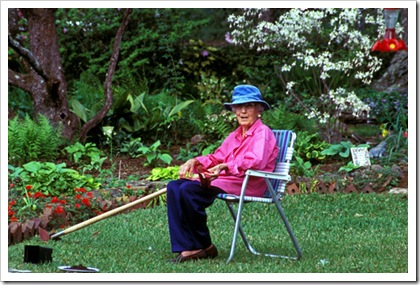
Evelyn Corley Buzbee

“Go into your own familiar yard. It may be a beautiful garden. It may be only a weedy lawn with a few half-dead shrubs. No matter — if you throw back your shoulders and look up into the sky, you will see what else is yours.”

~ Evelyn Corley Buzbee, lifelong gardener

See also: Cabin Tiger Studio

[Thanks, Pat!]

Tuesday, April 12, 2011

Compassion for Fun and Profit

“The first step is attention training. Attention is the basis of all higher cognitive and emotional abilities. Therefore, any curriculum for training emotional intelligence has to begin with attention training. The idea here is to train attention to create a quality of mind that is calm and clear at the same time. And this creates the foundation for emotional intelligence.”

~ Chade-Meng Tan, Google’s “Jolly Good Fellow,” talking about how the company practices compassion in its everyday business and the Search Inside Yourself program.

Monday, April 11, 2011

Still Not Found

A Buddhist priest prays for the souls of the victims still not found in the rubble, Yamada, Japan.

A Buddhist priest prays for the souls of the victims still not found in the rubble, Yamada, Japan. (New York Times)

See also: To Be Bothered and Perception, Intense City

Virtual Choir

“In a moving and madly viral video last year, composer Eric Whitacre led a virtual choir of singers from around the world. He talks through the creative challenges of making music powered by YouTube, and unveils the first two minutes of his new work, ‘Sleep,’ with a video choir of 2,052.”

Looking for Meaning in Objects

Excerpt from “Alive Enough?” on Being, April 7, 2011:

Krista Tippett (host): I'm utterly intrigued just by the way you describe your passion, your interest and concern, that you study this objective side of our encounters with technologies, that I'm concerned with— the human meaning of the objects of our lives. And just as we start, I wanted to ask you a kind of question I ask everyone, which is, was there a spiritual background to your childhood?

Sherry Turkle (author of Alone Together): Well, I think in my case the question didn't come from a spiritual quest. It came from a deeply personal psychological quest. My father — my biological father disappeared from my life when I was around two. My mother, my grandparents, my mother's sister, my aunt, didn't want me to know anything about him. And so, of course, I only wanted to know things about him and would search…

There were these places. There was a closet that had old books and trinkets and there was a junk drawer. There were just these places where the memories were kept. I would scour them for traces of him and finally I found one. I found a photograph of him in which someone in anger had rubbed out his face, but I found all kinds of information from that photograph, you know, that he wore tweed pants, where he was standing, what his lace-up shoes looked like, and I just think that some place in that quest of a child, the notion of looking for objects to fill in human meaning became very close to my heart in a very personal way.

As I became a sociologist, [I discovered] there's a fancy word for studying this; it's called bricolage. It's the science of studying meanings and the interplay of objects, and I realized that that's kind of what I'd been doing all the time. A little bit like Molière's, Monsieur Jourdain who'd been speaking prose all his life without knowing it, I'd been a bricoleur all my life without knowing it.

*     *     *     *     *

To make our life livable, we have to have spaces where we are fully present to each other or to ourselves, where we're not competing with the roar of the Internet and, quite frankly, where the people around us are not competing with the latest news off the Facebook status update. They may not have anything new. They may just be there being in a way that needs attention. I mean, people like to put things on Facebook--and certainly Twitter--that are happy. I've interviewed people who say things to me as simple as, you know, I don't even like to put that my dog died...because it doesn't seem the place. It doesn't seem the place for a lot of people to share negative things.

Anyway, I guess I'm saying that sacred space [are] the places in your daily life where you want to keep them for yourself and the people who you need to give your full attention to. I have very simple rules — so far as I have rules — for how to know you're close to one or in one or should be having one: it's dinner, it's sharing meals with your family, it's that moment at school pickup when your kid looks up and is trying to meet your eye. You know, you're looking down at your smartphone and your child is trying to meet your eye.

swing I have enough data from children who're going through this experience to know that it's a terrible moment for them. It's on the playground. Very bad when your child's on the jungle gym and is desperately trying to have you look at them, for them to be taking hands off the jungle gym to try to get your attention — accident time. I mean, be in the park. Be in the park with them. Spend less time there, but make it a space. Make it a moment. These are important moments.

*     *     *     *     *

See also: “Brainpower,” To the Best of Our Knowledge, 4/10/11

Saturday, April 09, 2011

Wherever They Are

“Wildflowers don't move to find the sun's rays. God makes them fecund wherever they are.”

~ Frère Christian de Chergé, from Of Gods and Men

Friday, April 08, 2011

To Increase Flourishing

From Flourish: A Visionary New Understanding of Happiness and Well-being by Martin Seligman:

When I started my work in Positive Psychology, my original view was closest to Aristotle’s—that everything we do is done in order to make us happy—but I actually detest the word happiness, which is so overused that it has become almost meaningless. It is an unworkable term for science, or for any practical goal such as education, therapy, public policy, or just changing your personal life. Moreover, the modern ear immediately hears “happy” to mean buoyant mood, merriment, good cheer, and smiling. “Happiness” historically is not closely tied to such hedonics—feeling cheerful or merry is a far cry from what Thomas Jefferson declared that we have the right to pursue—and it is an even further cry from my intentions for a positive psychology.

To understand what “happiness” is really about, the first step is to dissolve “happiness” into more workable terms. When I wrote Authentic Happiness a decade ago, I thought that happiness could be analyzed into three different elements that we choose for their own sakes: positive emotion, engagement, and meaning. Positive emotion refers to what we feel: pleasure, rapture, ecstasy, warmth, comfort, and other such emotions that contribute to the “pleasant life.” Engagement is about flow: being one with the music, time stopping, and the loss of self-consciousness during an absorbing activity, experiences which contribute to the “engaged life.” The third element is meaning. I go into flow while playing bridge, but after a long tournament, when I look in the mirror, I worry that I am fidgeting until I die. Human beings, ineluctably, want the “meaningful life”: belonging to and serving something that you believe is bigger than you are. Happiness and life satisfaction, I thought, could be increased by building positive emotion, engagement, and a sense of meaning in life.

This is not enough.

I no longer think that positive psychology is about happiness, or about a quest for increasing life satisfaction through positive emotion, engagement, and meaning. It turns out that how much life satisfaction people report is itself determined by how good we feel at the very moment we are asked the question. Averaged over many people, the mood you are in determines more than 70 percent of how much life satisfaction you report. If positive psychology is to be more than a “happiology” of cheerful mood, we need to shift our focus to well-being. I believe the gold standard for measuring well-being is flourishing, and that the goal of positive psychology is to increase flourishing. Flourishing rests on five pillars, each of which we value for its own sake, not merely as a means to some other end. Positive emotion, engagement, and meaning are three of the pillars, but they cannot do the “heavy lifting” of supporting human flourishing by themselves.

Room to Grow

April 7, 2011

“Loneliness is the human condition. Cultivate it. The way it tunnels into you allows your soul room to grow. Never expect to outgrow loneliness. Never hope to find people who will understand you, someone to fill that space. An intelligent, sensitive person is the exception, the very great exception. If you expect to find people who will understand you, you will grow murderous with disappointment. The best you’ll ever do is to understand yourself, know what it is that you want, and not let the cattle stand in your way.”

~ Janet Fitch, from White Oleander

Wednesday, April 06, 2011

Maybe We Try Too Hard

April 6, 2011

"Maybe we try too hard to be remembered, waking to the glowing yellow disc in ignorance, swearing that today will be the day, today we will make something of our lives. What if we are so busy searching for worth that we miss the sapphire sky and cackling blackbird. What else is missing? Maybe our steps are too straight and our paths too narrow and not overlapping. Maybe when they overlap someone in another country lights a candle, a couple resolves their argument, a young man puts down his silver gun and walks away."

~ Naomi Shihab Nye, from Time You Let Me: 25 Poets Under 25

@WhiskeyRiver

Narratives of Grace

Engels (Anselm Kiefer)

“We normally think of history as one catastrophe after another, war followed by war, outrage by outrage — almost as if history were nothing more than all the narratives of human pain, assembled in sequence. And surely this is, often enough, an adequate description. But history is also the narratives of grace, the recountings of those blessed and inexplicable moments when someone did something for someone else, saved a life, bestowed a gift, gave something beyond what was required by circumstance.”

~ Thomas Cahill