Thursday, July 17, 2008

Goodnight Moon

Richard Price borrowed from his novel Clockers, updating some of the jargon (crackheads and dealers from 1992 replaced by hoppers and hustlers in 2002) to write this closing scene from an episode of HBO's The Wire. Series creator David Simon often asked him to cannabilize from his book which inspired the show.

Karaniya Metta Sutta

This is what should be done
By one who is skilled in goodness,
And who knows the path of peace:
... Wishing: In gladness and in safety,
May all beings be at ease.

Whatever living beings there may be;
Whether they are weak or strong, omitting none,
The great or the mighty,
medium, short or small,

The seen and the unseen,
Those living near and far away,
Those born and to-be-born —
May all beings be at ease!

Let none deceive another,
Or despise any being in any state.
Let none through anger or ill-will
Wish harm upon another.

Even as a mother protects with her life
Her child, her only child,
So with a boundless heart
Should one cherish all living beings;

Radiating kindness over the entire world
Spreading upwards to the skies,
And downwards to the depths;
Outwards and unbounded,
Freed from hatred and ill-will.

Whether standing or walking, seated or lying down
Free from drowsiness,
One should sustain this recollection.
This is said to be the sublime abiding....

~ Suttanipata 1.8

After My Grandfather's Second Stroke

by Lou Lipsitz

Three-week coma,
enfeebled left arm. He slowly came back —
physical therapy, exercise — and after a time
he was himself again,
and we figured the binges would resume.

But instead he stayed in his room
without the radio on
and let his beard grow out white.

Instead of not coming home
for a week at a time, or coming home
cursing five nights in a row,
he was silent and every evening
came out for a snack of bread, jam,
and tea before bed.

While he was taking a stroll
one day, we snuck in
and found the poems:
one about the death-fear
he'd experienced before the coma;
one about walking the streets
alone; one about a woman
he could not speak of;
one about the ocean and
how it might feel to be a blind man
walking into it; one about
how he had seen his mother's
breasts when she'd been
drunk and wild, and he'd wanted
to run into the street.

It was as if we'd come across
a tunnel under our house
that led out beyond the lake
to the valley of another language.

No one mentioned the poems, but
something changed after we found them. My anger
began to dissolve. And when we assembled
at the table for dinner,
I noticed how my grandmother,
who had not slept in the same bed
with him for thirty years,
would sometimes, while serving
the food, reach over to touch his hand.

Wednesday, July 16, 2008

Happiness

"Happiness is a matter of one's most ordinary and everyday mode of consciousness being busy and lively and unconcerned with self."

~ Iris Murdoch

Tuesday, July 15, 2008

One Day's Following Another

Excerpt from "What He Was Like," by William Maxwell from All the Days and Nights:

all_the_days_and_nights

He himself got older. His wife got older. They advanced deeper into their seventies without any sense of large changes but only of one day's following another, and of the days being full, and pleasant, and worth recording. So he went on doing it. They all got put down in his diary, along with his feelings about old age, his fear of dying, his declining sexual powers, his envy of the children that he saw running down the street. To be able to run like that! He had to restrain himself from saying to young men in their thirties and forties, "You do appreciate, don't you, what you have?" In his diary he wrote, "If I had my life to live over again -- but one doesn't. One goes forward instead, dragging a cart piled high with lost opportunities."

Though his wife had never felt the slightest desire to read his diary, she knew when he stopped leaving it around as carelessly as he did his opened mail. Moving the papers on his desk in order to dust it she saw where he had hidden the current volume, was tempted to open it and see what it was he didn't want her to know, and then thought better of it and replaced the papers, exactly as they were before.

"To be able to do in your mind," he wrote, "what it is probably not a good idea to do in actuality is a convenience not always sufficiently appreciated." Though in his daily life he was as cheerful as a cricket, the diaries were more and more given over to dark thoughts, anger, resentment, indecencies, regrets, remorse. And now and then the simple joy in being alive. "If I stopped recognizing that I want things that it is not appropriate for me to want," he wrote, "wouldn't this inevitably lead to my not wanting anything at all -- which as people get older is a risk that must be avoided at all costs?" He wrote, "Human beings are not like a clock that is wound up at birth and runs until the mainspring is fully unwound. They live because they want to. And when they stop wanting to, the first thing they know they are in a doctor's office being shown an X ray that puts a different face on everything."

* * *

"William Maxwell: the Wisest, Kindest Writer," NPR/Fresh Air (1.25.08)

Friday, July 11, 2008

Fetchable

From "Koans for Troubled Times" by Joan Sutherland (Buddhadharma, June 2008):

joan_sutherland We spend a lot of time in the company of our thoughts and feelings, and sometimes we are a companion to silence. Even a hermit sits in a web of connections with things visible and invisible. Our meditation is made not just of the vastness and the deep engine of concentration; it is also made of these relationships. And then one day, for no apparent reason, something in particular comes to fetch us: the cook coughs or the morning star rises, and we fall open. A particular intimate meeting with a particular other opens us to an intimate relationship with life itself.

Practice is about making us fetchable. It helps us to recognize what gets in the way of our being fetched, and then it gives us a method to deconstruct the obstacle.

Thursday, July 10, 2008

Marry Me

a senryu sequence

when I come late to bed
I move your leg flung over my side
that warm gate

bednights you're not here
I inch toward the middle
of this boat, balancing

when I turn over in sleep
you turn, I turn, you turn,
I turn, you

some nights you tug the edge
of my pillow under your cheek,
look in my dream

pulling the white sheet
over your bare shoulder
I marry you again

by Veronica Patterson,
from American Life in Poetry (Column 172)

"...the senryu is a Japanese form similar to haiku but dealing with people rather than nature."

Wednesday, July 09, 2008

The Danish Poet


A fIlm by Torrill Kove
Narrated by Liv Ullman

[Spotted on JC's blog]

Making Mistakes

“People who believe in the power of talent tend not to fulfill their potential because they’re so concerned with looking smart and not making mistakes. But people who believe that talent can be developed are the ones who really push, stretch, confront their own mistakes and learn from them.”

~ Stanford psychologist Carol Dweck quoted in "If You’re Open to Growth, You Tend to Grow" (Janet Rae-Dupree, New York Times, 7.6.08)

[Thanks Kit!]

Tuesday, July 08, 2008

New Romantic

English folk/pop-singer Laura Marling performs 'New Romantic' at BBC2's Later... with Jools Holland (November 2007):

Glósóli

Sigur Rós


Digging In with Wendell Berry

Excerpts from a conversation between Jeff Fearnside and Wendell Berry from "Digging In," The Sun Magazine (July 2008):

Photo by Andrea BurnsJeff Fearnside: I’ve noticed that the Amish seem less self-conscious than most Americans. Why do you think this is so?

Wendell Berry: I’d say that in their community, honesty is the norm. One of the most striking things about the Amish is that their countenances are open. We pity Muslim women for wearing veils, yet almost every face in this country is veiled by suspicion and fear. You can’t walk down a city street and get anybody to look at you. People’s countenances are undercover operations here.

...

JF: In your Sierra Club talk, you said that you would like conservationists to become more interested in “economic landscapes” — in working farms, ranches, and forests. Do you feel that most people’s definition of the natural world is too small?

WB: The human definition of the natural world is always going to be too small, because the world’s more diverse and complex than we can ever know. We’re not going to comprehend it; it comprehends us. The question is whether we can use it with respect. Some people in the past who knew very little biology were able to use the land without destroying it. We, who know a great deal of biology, are destroying our land in order to use it.

...

JF: I came to Kentucky after four years of living in Central Asia, and I was struck by how environmental disasters both here and there have the same causes: shortsightedness, greed, and the concentration of wealth among a powerful elite. Do you think these are simply part of human nature?

WB: Greed is a part of human nature, and greed is the root cause of these disasters. Once you have greed and the means of Wendell Berryexploitation, the high-toned rationalizations — in other words, the excuses — follow as a matter of course. A real culture functions to limit greed. Our culture functions to increase it, because, we are repeatedly told, it’s profitable to do so, though the majority of the profits go to only a few people.
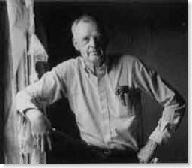
JF: We’ve talked about what consumers and producers can do to change things. What should the role of government be?

WB: The appropriate role of government should be to see that power and money don’t accumulate in too few hands.

JF: But too often governments act in their own self-interest and harm the people they’re supposed to be working for and protecting.

WB: Unless a community consists entirely of like-minded individuals, the community must, to some extent, have laws, which means government. It’s the nature of an organization like a government — or a corporation — to be self-aggrandizing and self-perpetuating. Once it starts running, it aims to keep running. The real limit on government would be reasonably independent, self-sustaining localities and communities. But if there is no local independence, then governments and other organizations have a kind of freedom that they wouldn’t have otherwise.

If you’ve got 300 million people, most of whom produce nothing for themselves or for the community and to whom everything has to be brought from somewhere else, then there’s no way you’re going to have limited government, or limited anything. All organizations feed upon the helplessness and ignorance and passivity of the people.

More...

Human Mirror

Another fun prank from Improv Everywhere, the folks who gave us the annual No Pants Subway Ride. This time, they recruited fifteen sets of twins to fill a subway car, creating a human mirror.


More missions here

A Gift

sands_of_the_well Just when you seem to yourself
nothing but a flimsy web
of questions, you are given
the questions of others to hold
in the emptiness of your hands,
songbird eggs that can still hatch
if you keep them warm,
butterflies opening and closing themselves
in your cupped palms, trusting you not to injure
their scintillant fur, their dust.
You are given the questions of others
as if they were answers
to all you ask. Yes, perhaps
this gift is your answer.

by Denise Levertov, from Sands of the Well

[Thanks Dōshin!]

Thursday, July 03, 2008

Indistinguishable

What you loved and what you strove for,
What you dreamed and what you lived through,
Do you know if it was joy or suffering?
G sharp and A flat, E flat or D sharp,
Are they distinguishable to the ear?

~ Herman Hesse

Wednesday, July 02, 2008

Ára Bátur

From Með suð í eyrum við spilum endalaust (With a Buzz In Our Ears We Play Endlessly) by Sigur Rós


Gobbledigook on Jonk Music

The New York City Waterfalls - Brooklyn Bridge

One of Olafur Eliasson's four massive installations on New York Harbor which started on June 25 and will run through October 13, 2008 (7:00am to 10:00pm). In addition to the waterfall in Brooklyn at the foot of the Brooklyn Bridge, there is one at Pier 35, just north of the Manhattan Bridge, another between Piers 4 and 5 near the Brooklyn Heights Promenade, and a fourth on the north shore of Governors Island. 

Tuesday, July 01, 2008

Double Awe

"Well, one of the tricks is to maintain your sense of awe at what you're experiencing. And one of the ways you do that is—Lush LifeI think André Gide said, The only way to write about Africa is to go there for ten days or ten years—so I'm one of those ten day, big-eyed guys...The other thing is to be a little afraid of what you're doing 'cause terror keeps you slender. If you feel like,  I don't know if I can capture this, that means you're going to bring everything to the table. And so it's a double awe: one is I can't believe I'm seeing this, the other one is I don't know if I have the chops to capture this. It's not as easy as it looks, I promise you that. It's a hummingbird that starts flying like a frigate-bird, but at the end it looks pretty quick."

~ Richard Price, discussing his most recent novel, Lush Life, with Michael Silverblatt on KCRW's Bookworm (6.12.08).

Authors@Google (3.27.08)

Monday, June 30, 2008

America

"What splendor! What poverty! What humanity! What inhumanity! What mutual good will! What individual isolation! What loyalty to the ideal! What hypocrisy! What a triumph of conscience! What perversity!"

~ Czeslaw Milosz on American life, from Milosz's A B C's

Sunday, June 29, 2008

Classical Music with Shining Eyes

"Benjamin Zander has two infectious passions: classical music, and helping us all realize our untapped love for it -- and by extension, our untapped love for all new possibilities, new experiences, new connections."

From TED Talks

Friday, June 27, 2008

Uncertainty

From "Surprises on the Way," by John Tarrant (Shambhala Sun, May 2008):

John Tarrant The core of all navigation is probably uncertainty: tolerating not knowing makes it possible to find your way. Not knowing means embracing what is not known rather than fighting with yourself over it. Since the mind always strives to know, not knowing is disorienting in a useful way. Uncertainty and not knowing teach you not to believe the stories your mind feeds you day in and day out. If you allow your own course to be mysterious, then even the hard things can become easy. This is the beginning of awakening.

...the most heartbreaking thing is not heartbreak; it's avoiding heartbreak. Inside the transience of life is the thusness of everything, of the tree with forty crows on it in the winter, the sound of death-metal drums from the kids in the barn, and the feeling of sadness when you lose someone. A lot of suffering is resistance to the life of feeling. If you surrender, you are surrendering to what is really going on. This is just to notice that nothing beyond your life is more important than your life.

Obstacles can be the gate. If your diagnosis is cancer or you lose people you love, there is no alternative but surrender. You can't rewind to yesterday when you were innocent. Meditation at such a moment might not take you back to the surface; it might take you down and through. Getting more emotional might be indicated; falling apart might happen. The practice is what tows you through. It doesn't take the rough crossing away from you but it give you a degree of safety in the passage.

Once when I lost a friend, I realized that I was weeping since my hands were wet. I was giving a talk at the time, being wise and all that, and it was a revelation--I couldn't trust myself not to weep in public. I also couldn't trust myself to sleep at night, either. At a time like that we have to surrender. We are facing something vast and, really, we have always known that we would have to face it. It is an enormous, shaggy beast blocking the way. And there is something exhilarating about the inevitable when at last it arrives; awakening is not a choice or a matter of technique anymore, it's the only place left. The huge animal rolls over us, and suddenly we find that we are riding on its back. It has become a vehicle. The obstacles really have become gates.

Things Get Better

"I like playing with ideas that invite people to think. I also like old-fashioned, upbeat themes and happy endings. Although life doesn't always seem that way, I believe that in the long term things get better. I don't think we're about to overpopulate the planet, blow ourselves into oblivion, poison ourselves into extinction, degenerate into Nazis, or disappear under our own garbage. For ten thousand years the power of human reason and creativity has continued to build better tomorrows, and nothing says it has to change now."

~ James Patrick Hogan

Thursday, June 26, 2008

Creative Writing 101

Here are the basic rules of creative writing according to Kurt Vonnegut. It appears in the preface to his short story collection Bagombo Snuff Box.

  1. bagombo Use the time of a total stranger in such a way that he or she will not feel the time was wasted.
  2. Give the reader at least one character he or she can root for.
  3. Every character should want something, even if it is only a glass of water.
  4. Every sentence must do one of two things—reveal character or advance the action.
  5. Start as close to the end as possible.
  6. Be a sadist. No matter how sweet and innocent your leading characters, make awful things happen to them—in order that the reader may see what they are made of.
  7. Write to please just one person. If you open a window and make love to the world, so to speak, your story will get pneumonia.
  8. Give your readers as much information as possible as soon as possible. To heck with suspense. Readers should have such complete understanding of what is going on, where and why, that they could finish the story themselves, should cockroaches eat the last few pages.

Vonnegut also noted,"The greatest American short story writer of my generation was Flannery O’Connor (1925-1964). She broke practically every one of my rules but the first. Great writers tend to do that."

Inner Truths

Charles Baxter "Writers may be practiced liars on the page, but they usually have a great respect for inner truths. There are, of course, exceptions, many of them famous. But writers tend to respect the truth of things and the otherness of other people, which makes them very poor liars. Very few writers are successful sociopaths. This is not the case with literary critics, who are often very good at lying."

~ Charles Baxter

[Thanks Linda!]

Wednesday, June 25, 2008

Boogie Man

Boogie Man: The Lee Atwater Story

"My illness helped me to see that what was missing in society is what was missing in me: a little heart, a lot of brotherhood. The '80s were about acquiring -- acquiring wealth, power, prestige. I know. I acquired more wealth, power, and prestige than most. But you can acquire all you want and still feel empty. What power wouldn't I trade for a little more time with my family? What price wouldn't I pay for an evening with friends? It took a deadly illness to put me eye to eye with that truth, but it is a truth that the country, caught up in its ruthless ambitions and moral decay, can learn on my dime. I don't know who will lead us through the '90s, but they must be made to speak to this spiritual vacuum at the heart of American society, this tumor of the soul."

~ Lee Atwater, from a February 1991 article for Life Magazine.

Sunday, June 22, 2008

Paying Attention

From "The Myth of Multitasking," Christine Rosen, The New Atlantis (Spring 2008):

When we talk about multitasking, we are really talking about attention: the art of paying attention, the ability to shift our attention, and, more broadly, to exercise judgment about what objects are worthy of our attention. People who have achieved great things often credit for their success a finely honed skill for paying attention. When asked about his particular genius, Isaac Newton responded that if he had made any discoveries, it was “owing more to patient attention than to any other talent.”

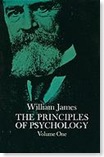
The Principles of Pscyhology William James, the great psychologist, wrote at length about the varieties of human attention. In The Principles of Psychology (1890), he outlined the differences among “sensorial attention,” “intellectual attention,” “passive attention,” and the like, and noted the “gray chaotic indiscriminateness” of the minds of people who were incapable of paying attention. James compared our stream of thought to a river, and his observations presaged the cognitive “bottlenecks” described later by neurologists: “On the whole easy simple flowing predominates in it, the drift of things is with the pull of gravity, and effortless attention is the rule,” he wrote. “But at intervals an obstruction, a set-back, a log-jam occurs, stops the current, creates an eddy, and makes things temporarily move the other way.”

To James, steady attention was thus the default condition of a mature mind, an ordinary state undone only by perturbation. To readers a century later, that placid portrayal may seem alien—as though depicting a bygone world. Instead, today’s multitasking adult may find something more familiar in James’s description of the youthful mind: an “extreme mobility of the attention” that “makes the child seem to belong less to himself than to every object which happens to catch his notice.” For some people, James noted, this challenge is never overcome; such people only get their work done “in the interstices of their mind-wandering.” Like Chesterfield, James believed that the transition from youthful distraction to mature attention was in large part the result of personal mastery and discipline—and so was illustrative of character. “The faculty of voluntarily bringing back a wandering attention, over and over again,” he wrote, “is the very root of judgment, character, and will.”

[Thanks New York Times!]

Drudgery

What I Talk About When I Talk About Running: A memoir "Writers who are blessed with inborn talent can write easily, no matter what they do—or don't do. Like water from a natural spring, the sentences just well up, and will little or no effort these writers can complete a work. Unfortunately, I don't fall into that category. I have to pound away at a rock with a chisel and dig out a deep hole before I can locate the source of my creativity. Every time I begin a new novel, I have to drudge out another hole. But, as I've sustained this kind of life over many years, I've become quite efficient, both technically and physically, at opening those holes in the rock and locating new water veins. As soon as I notice one source drying up, I move on to another. If people who rely on a natural spring of talent suddenly find they've exhausted their source, they're in trouble.

"In other words, let's face it: life is basically unfair. But, even in a situation that's unfair, I think it's possible to seek out a kind of fairness."

~ Haruki Murakami, from "The Running Novelist," The New Yorker (June 9, 2008). His memoir, What I Talk About When I Talk About Running, will be released in July.

Some Core Truth

"What I'd finally say about truth and autobiography is that all writers are probably trying to get at some core truth of life, at some configuration that is enduring and truthful. I just haven't found the truth to be my vehicle."

~ Mona Simpson

Friday, June 20, 2008

O + (N xS) + Cpm/T + He

Psychologist Cliff Arnall arrived at this formula for predicting happiness in an effort to "get people talking about what makes them happy."

O = Being Outdoors
N =  Connecting with Nature
S = Social interaction
Cpm = Childhood positive memories
T = Temperature
He = Holiday expected (vacations in America)

According to his calculations, June 20 is the happiest day of 2008. He notes that "the feeling of optimism caused by the combination of lighter evenings, the prospect of holidays and memories of childhood summers" tend to be highest each year around the summer solstice.

This is only a measure of external factors, however. To approximate how much subjective satisfaction one is able to derive from ideal conditions, consider this formula from Shinzen Young:

Satisfaction = Pleasure ÷ Grasping

He observes that a person’s subjective sense of satisfaction is inversely proportional to the degree to which the pleasure is subject to grasping. Conversely, a person’s subjective sense of satisfaction is directly proportional to the intensity of pleasure present and the degree to which one can monitor that pleasure with specificity.

In other words:

  • When grasping goes up, satisfaction tends to decrease.
  • When mindfulness goes up, satisfaction tends to increase.

Thursday, June 19, 2008

The Great Defeat

Excerpt from a Zoetrope: All-Story (Summer 2008) essay by John Hughes about the beginning of his satirical writing and Hollywood career:

For a vacation-themed issue, I proposed a piece set in the days when toddlers stood on the front seats of cars and parents' cigarettes blew into the faces of the children standing in the back (or hanging out the open rear windows of station wagons). I had no story but enough anecdotes to get the assignment.

In my bedroom office during the snowstorm, I wrote "Vacation '58." My outline was a Rand McNally Road Atlas I had dug out of the trunk of my car. I plotted the shortest route from Detroit to the most distant continental U.S. destination: Disneyland in Anaheim, California. I determined how many stops a family would have to make on such a trip, and where those stops might be.

I wrote the first sentence -- "If Dad hadn't shot Walt Disney in the leg, it would have been our best vacation ever!" -- and the rest was automatic. I used the voice of a boy to cover my lack of skill, and to flatten the big moments. In Rusty's prosaic language, a ruined vacation and an assault with a deadly weapon upon an entertainment legend enjoyed comparable importance. I called to mind a clamor of relatives, situations, catchphrases, and behaviors. I was mindful of my feelings as a child witnessing phony pop inventions go to hell. I understood that the dark side of my middle-class, middle American, suburban life was not drugs, paganism, or perversion. It was disappointment. There were no gnawing insects beneath the grass. Only dirt. I also knew that trapped inside every defeat is a small victory, and inside that small victory is the Great Defeat. This knowledge -- along with a cranky old lady; strange, needy relatives; a vile dog; and everything that could possibly go wrong on a highway --was enough to make a story, plug a hole in the magazine, and get on to the next issue.

...Despite my finishing the story in time for the FedEx pick-up, it was ultimately bumped from the vacation issue to an annual edition comprised of pieces that didn't make their intended issues.

Wednesday, June 18, 2008

Without Further Complications

Mindfulness itself does not condemn or condone any particular emotional reaction. Rather, it is the practice of honestly being aware of what happens to us and how we react to it. The more aware and familiar we are with our reactions, the easier it will be to have, for example, uncomplicated grief or straightforward joy, not mixed up guilt, anger, remorse, embarrassment, or judgement. Emotional maturity comes, not from the absence of emotions, but from seeing them clearly. Mindfulness helps us to be as we are without further complications. If we can be accepting of ourselves in this way, then it is much easier to know how to respond appropriately with choice rather than habit.”

~ Gil Fronsdal

[Thanks Kit!]

Beauty and Truth in Physics

"Wielding laypeople's terms and a sense of humor, Nobel Prize winner Murray Gell-Mann drops some knowledge about particle physics, asking questions like, Are elegant equations more likely to be right than inelegant ones? Can the fundamental law, the so-called 'theory of everything' really explain everything? His answers will surprise you."


After speaking at TED2007 on elegance in physics, the amazing Murray Gell-Mann gives a quick overview of another passionate interest: finding the common ancestry of our modern languages.

Experience by Proxy

From Richard Serra 's commencement address to this year's graduates of Williams College:

I have no problem with the virtual reality on your screens as long as you are aware that it is virtual. My concern is that experience by proxy is a poor substitute for the reality of the interactive space we inhabit.

As a sculptor I believe that perception structures thought and that to see is to think and conversely to think is to see.

The virtual reality of the media, be it television or Internet, limits our perception in that it affects our sense of space. It immobilizes our ability to apprehend actual physical space. Don’t let the rhetoric of simulation steal away the immediacy of your experience.

Keep it real, keep it in the moment. No one perceives anything alike; we only perceive as we are and it is our individual reality that counts.

Richard Serra's Torqued Ellipse IV (1998) and Intersection II (1992) being installed in the Abby Aldrich Rockefeller Sculpture Garden at The Museum of Modern Art in preparation for Richard Serra Sculpture: Forty Years (June 3 - September 10, 2007).

Monday, June 16, 2008

The Ego's Fear of Humiliation

From Dancing with Life by Phillip Moffitt:

dancingwithlife When you collapse into suffering, it is because your ego sees suffering as a personal failure and feels humiliated. This sense of failure is based on the ego's mistaken idea that winning in life means no suffering. Your ego may well be under the delusion that the opposite of suffering is happiness. When your ego believes this, then every moment of suffering is felt as a personal defeat, insult, indignity, or proof of your inadequacy or of life being unfair. This is subjective suffering, self-centered and neurotic.

Your subjective dukkha is your ego suffering from its own ideas about how things are supposed to be. When things go wrong, your ego may feel humiliated even though you may not consciously realize it. Such suffering is your ego's narcissistic and mistaken, self-centered reaction to life's challenges. The ego collapses, becomes depressed, or grieves for itself. Or it becomes resentful and refuses to participate, or helpless and frozen with dread. Or the ego contracts into anger and lashes out. In its delusion the ego is unwilling to voluntarily carry the darkness of life. When suffering is penetrated by mindfulness and compassion, the ego dies a thousand deaths and yet ends up healthier for it. Your ego isn't bad, nor are you a bad person because you have an ego. The ego is a result of causes and conditions and, in my view, is necessary for a healthy, whole life. I tell students don't leave home without it, but don't let it drive the vehicle on your spiritual journey.

The idea of being willing to bear your suffering like a carriage carrying a heavy load is a hopeful, comforting image. But if the opposite of your suffering isn't happiness, then what is it? Nonsuffering is having a relaxed, composed mind that is fully present with whatever is occurring in the moment. And it is the capacity to be in relationship to whatever is arising such that you're able to respond from your deepest intentions. And it is a feeling of relatedness in your life that is free from aversion to suffering.

Be Present

From Jessica Lange's commencement address to the graduates of Sarah Lawrence College:

jessica_lange Be present. I would encourage you with all my heart — just to be present. Be present and open to the moment that is unfolding before you. Because, ultimately, your life is made up of moments. So don’t miss them by being lost in the past or anticipating the future.

Don’t be absent from your own life. You will find that life is not governed by will or intention. It is ultimately the collection of these sense memories stored in our nerves, built up in our cells. Simple things: A certain slant of light coming through a window on a winter’s afternoon. The sound of spring peepers at twilight. The taste of a strawberry still warm from the sun. Your child’s laughter. Your mother’s voice.

These are the things that shape our lives and settle into the fiber of our beings. Don’t take them for granted.

Friday, June 13, 2008

Becoming

Saving Daylight by Jim Harrison Nowhere is it the same place as yesterday.
None of us is the same person as yesterday.
We finally die from the exhaustion of becoming.
This downward cellular jubilance is shared
by the wind, bugs, birds, bears and rivers,
and perhaps the black holes in galactic space
where our souls will all be gathered in an invisible
thimble of antimatter. But we're getting ahead of ourselves.
Yes, trees wear out as the wattles under my chin
grow, the wrinkled hands that tried to strangle
a wife beater in New York City in 1957.
We whirl with the earth, our soft brains ill-trained
except to watch ourselves disappear into the distance.
Still, we love to make music of this puzzle.

~ by Jim Harrison, from Saving Daylight.

Thursday, June 12, 2008

A Mystery to Solve

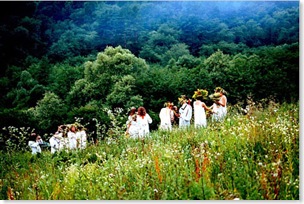
"I think there is a kind of slippery slope where once you've stopped believing that the mainstream discourse, whether that be that of science or whatever else, you've stopped going along with that discourse, then you become open to everything else. And if you're not careful and if you're not judicious, then you'll just kind of start believing that all those other things must therefore be true. So there's that tendency, which you find with social movements that are on the fringes. Young women from Poland celebrate the night of Kupala (Photo: Marek Kosior) And I've been fascinated by all of it because I think that even the extraterrestrial thing, how many millions of people claim to have been abducted by aliens in American society?...What do you do with that fact? Do you just say that they're all deluded or do you start getting interested in why it is that, you know, there's some kind of gap that people are filling with using that imagery of aliens. Why aliens? Well, because there aren't any fairies left so they got to come from off planet. Why are there no fairies left? Because we know...what happens in the natural world...So it becomes a kind of mystery to solve. And rather than rejecting the things that people say, I think, as an ethnographer of religion, one of the first principles is that you don't treat people as idiots for what they believe and that, in fact, by treating them seriously, you might get some insights that you wouldn't get to otherwise. And I think, for me, it's led to insights about myself as well."

~ Adrian Ivakhiv, "Pagans Ancient and Modern," Speaking of Faith, (6.12.08)

Awake at Night

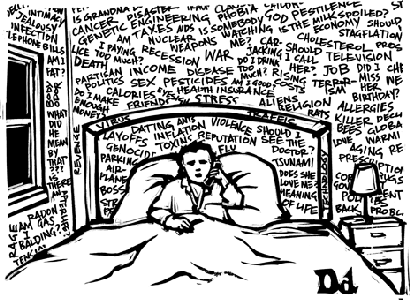
New Yorker

"When I can't sleep, I find that it sometimes helps
to get up and jot down my anxieties."

Monday, June 09, 2008

The Conjugation of the Paramecium

This has nothing
to do with
propagating

The species
is continued
as so many are
(among the smaller creatures)
by fission

(and this species
is very small
next in order to
the amoeba, the beginning one)

The paramecium
achieves, then,
immortality
by dividing

But when
the paramecium
desires renewal
strength another joy
this is what
the paramecium does:

The paramecium
lies down beside
another paramecium

paramecium_mating

Slowly inexplicably
the exchange
takes place
in which
some bits
of the nucleus of each
are exchanged

for some bits
of the nucleus
of the other

This is called
the conjugation of the paramecium.

~ by Muriel Rukeyser from The Speed of Darkness (1968)

Sunday, June 08, 2008

Designing Cities for Cars

"In developing-world cities, the majority of people don’t have cars, so I will say, when you construct a good sidewalk, you are constructing democracy. A sidewalk is a symbol of equality...We are designing cities for cars, cars, cars, cars, cars. Not for people. Cars are a very recent invention. The 20th century was a horrible detour in the evolution of the human habitat. We were building much more for cars’ mobility than children’s happiness...The upper-income people in developing countries never walk. They see the city as a threatening space, and they can go for months without walking one block."

~ Enrique Peñalosa, from an interview with Deborah Solomon, New York Times Magazine (6.8.08)

Double Spell

“The minds that had conceived the Tower of Babel could not build it. The task was too great. So they hired hands for wages. But the hands that built the Tower of Babel knew nothing of the dream of the brain that had conceived it. One man’s hymns of praise became other men’s curses.”

From Fritz Lang’s Metropolis (1927).

"That the urban future should be at once repellent and seductive is hardly surprising, since actual cities have always cast their own double spell. Their crowded streets and cramped habitations induce claustrophobia but also promise new forms of intimacy. The alienation and loneliness that blossom in the midst of crowds are romantic and agonizing in equal measure. City life is subject to all kinds of planning, scheduling, surveillance and regulation, which makes it both efficient and dehumanizing. Its buzzing disorder holds the threat of violence and the promise of vitality."

From "Metropolis Now" by A.O. Scott in today's New York Times Sunday Magazine.

Friday, June 06, 2008

Not to Adjust Ourselves

Martin Luther King, Jr.; Ralph Bunche, former UN Ambassador; & Abraham Joshua Heschel at Selma Civil Rights March (3.21.65)

"I would say about individuals: an individual dies when he ceases to be surprised. What keeps me alive — spiritually, emotionally, intellectually — is my ability to be surprised. I say, I take nothing for granted. I am surprised every morning that I see the sun shine again. When I see an act of evil, I am not accommodated — I don't accommodate myself to the violence that goes on everywhere. I'm still surprised. That's why I'm against it; why I can fight against it. We must learn how to be surprised, not to adjust ourselves. I am the most maladjusted person in society."

~ Abraham Joshua Heschel, from "The Spiritual Audacity of Abraham Joshua Heschel," Speaking of Faith (6.05.08)

From Order to Disorder


"Every time you break an egg or spill a glass of water you're learning about the Big Bang."

~ Physics professor Sean Carroll discussing how the discovery of fluctuations in cosmic microwave background light may provide Hints of Time Before Big Bang (BBC News).

[Thanks Dōshin!]

Tuesday, June 03, 2008

Forgotten Words

The purpose of a fish trap is to catch fish, and when the fish are caught, the trap is forgotten. The purpose of a rabbit snare is to catch rabbits. When the rabbits are caught, the snare is forgotten. The purpose of words is to convey ideas. When the ideas are grasped, the words are forgotten. Where can I find a person who has forgotten words? That is the one I would like to talk to.

~ Chuang Tzŭ

Sunday, June 01, 2008

Manifesto

Excerpts from a great essay included in The Braindead Megaphone by George Saunders:

braindead_megaphone Last Thursday, my organization, People Reluctant To Kill for an Abstraction, orchestrated an overwhelming show of force around the globe.
...

Who are we? A word about our membership.

Since the world began, we have gone about our work quietly, resisting the urge to generalize, valuing the individual over the group, the actual over the conceptual, the inherent sweetness of the present moment over the theoretically peaceful future to be obtained via murder. Many of us have trouble sleeping and lie awake at night, worrying about something catastrophic befalling someone we love. We rise in the morning with no plans to convert anyone via beating, humiliation, or invasion. To tell the truth, we are tired. We work. We would just like some peace and quiet. When wrong, we think about it awhile, then apologize. We stand under awnings during urban thunderstorms, moved to thoughtfulness by the troubled, umbrella-tinged faces rushing by. In moments of crisis, we pat one another awkwardly on the back, mumbling shy truisms. Rushing to an appointment, remembering a friend who has passed away, our eyes well with tears and we think: Well, my God, he could be a pain, but still I'm lucky to have known him.

This is PRKA. To those who would oppose us, I would simply say: We are many. We are worldwide. We, in fact, outnumber you. Though you are louder, though you create a momentary ripple on the water of life, we will endure, and prevail.

Join us.

Resistance is futile.

Unified Theory

"If we find out that there is this kind of a janna_levin_2unification, what we're really saying is that everything in the universe is traceable to one physical phenomenon. All the particles in your body, all the particles in my body, all the particles on the other side of the galaxy, and all of their interactions are unified into one simple kind of mathematical structure."

~ Columbia University astrophysicist and novelist Janna Levin discussing the significance of the Large Hadron Collider with Kurt Anderson on Studio 360 (5.23.08).

Saturday, May 31, 2008

Not in the Artist's Power to Know

George Saunders on KCRW's Bookworm (12.27.07):

"...my earlier ideal, which was the writer knew very well what he wanted you to feel at the end of the story. It was a Hemingwayesque model where I thought, I really thought and loved this idea, that I went to Spain, was gored by a bull, was made impotent, went to World War I, and drank Absynthe. Then the idea was that what I wrote was going to cause you -- a person I never met -- to be in approximately the same emotional state and sensual state that I was in at the end of the process.

George_Saunders

I really thought that's the way it worked. So, as you can imagine, that's impossible for a writer to -- I think Mamet talks about the intentional fallacy -- how do I know how to move you from Point A to Point B? Maybe some people can do it, but I can't. It's almost like trying to move something delicate with extension robot arms. I don't know how to do it.

So when I dropped that idea and just thought, I'm going to try to make an intense experience for myself as I write it, try to radically inhabit certain principles [plain language, compression, etc.], then I don't really know what happens to you out there. In a way, I don't care.

I want you to be moved from Point A to Point B and I think, really, since writing is in large part a form of very beautiful entertainment, the whole idea is that you've got to be moved from A to B. And I think actually, where you end up at B is actually not in the artist's power to know. I think.

Now I'm not positive about that, but I think the times that I thought I knew where I wanted you to be, those are always failed experiments. When I said, I'm going to pay really close attention to this sentence and this sentence and make sure that there's not falseness in there, then there does seem to be emotion at the end. And I think it does have, weirdly, a roughly moral trajectory."

[See also: CarrollBlog 5.16.08]

Free-for-All

From a Slate.com interview with Michael Crichton regarding his 1993 prediction of mass-media extinction ("Michael Crichton, Vindicated" by Jack Shafer, 5.29.08):

I have been very interested in the differences between how scientists and engineers treat information, for example. The fact is, engineers are much more rigorous about information, and it has legal consequences for them. In contrast, scientists (and politicians) are just playing with information. Broadly speaking, they have no responsibility for what they say at all. Now, as our society shifts away from manufacturing (now something like 15 percent of workers are engaged in making something), I speculate that this is having an effect on what we regard as information. I speculate we are moving from the rigor of engineers to the free-for-all of politicians. In which case, nobody is interested in high-quality information. It only gets in the way.

Arguably, contemporary media has made that shift away from hard information toward free-for-all opinion and speculation. This shouldn't cost a lot, and indeed modern media peddles an inexpensive product. Most cable television "news" is just talking heads and food fights; they don't even change the heads very often—they hire regulars who appear week after week. Most newspaper reporting consists of rewritten press releases and faxes. Many reporters don't go after stories, they wait for the stories to be fed to them by publicists and flacks. Now if you set aside this cheap model and instead start staffing bureaus around the world, putting reporters and cameras on the ground, assembling smart teams to do real investigative work in business, high tech, and so on, that costs a lot of money. I remain convinced that plenty of people would pay for a good news service—who stayed with a daisy wheel printer once laser printers arrived? We didn't know we wanted laser printers, as we didn't know we wanted digital cameras, but it turns out we did. In any case, what we are now being fed as news is repetitive, simplistic, and insulting.

Brain Control

From Discovery Health News (5.29.08):

Relying solely on brain signal manipulation, monkeys have learned to operate human-like robotic arms to feed themselves, U.S. researchers reported Wednesday.

This cutting-edge development in the field of neuroprosthetics was made possible by linking up neural pathways in the voluntary movement region of the monkey's brain to a specially designed computer software program. In turn, the monkey's mental "firings" were turned into fluid and natural prosthetic movements -- enabling arm-restrained primates to grip and eat marshmallows and fruit with a claw-like robotic hand.

"This a step on the way to fully mobile arms and dexterous prosthetic hand that will be controlled with brain activity recorded directly from the individual brain cells," said the study's lead author, Andrew Schwartz, a professor of neurobiology at the University of Pittsburgh School of Medicine.

The research, published Wednesday in the online edition of Nature, is being touted as a significant advance towards designing functional prosthetic devices for fully paralyzed individuals.

Thursday, May 29, 2008

Telling the Truth

Michael Silverblatt: How do we make real life happen on the page? Because the page is another place where until you learn how, you don't know how to tell the truth. Even some of the books we love most that are trying as hard as they can to tell the truth, you don't learn how until you find the style for truth-telling, that will open the door to possibility. How do you find that?

Anne Enright: I don't know. I blunder around.

Anne Enright in London after winning the Man Booker prize. (Photo: The Associated Press)

Discussing The Gathering, winner of the Man Booker Prize in 2007, on KCRW's Bookworm (4.10.08).

Wednesday, May 28, 2008

Bang, Bang, Bang, Kiss, Kiss

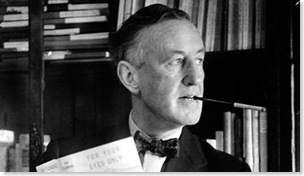
Ian Fleming

"James Bond is ... the feverish dreams of the author of what he might have been — bang, bang, bang, kiss, kiss, that sort of stuff. It's what you would expect of an adolescent mind — which I happen to possess."

~ Ian Fleming, born May 28, 1908

More Awful by Degrees

Riding Toward Everywhere "When I was finishing this book, Cormac McCarthy's The Road came out and I was thinking that, of course, is the life that a real hobo would be living and how awful it would be to live that life. Much more awful than the life that we are living now.

But the life we are all living now seems to be getting more and more awful by degrees. The control of thought, the fear, the acceptance of torture, the war crimes — all these things kind of make a mockery out of what being American is supposed to be, is supposed to mean.

And so who are we? In a way, we are all either living a lie or living nothing. And I'm trying to figure out how to stop living the lie that I live.

So who are we and where do we go? What should we be doing? And there's no answer. Except, once we think we know, we failed. And that is one of the reasons that I write a book without a beginning and end, and why I get on a train without knowing where the train is going to go."

...

"In part, to be an American means to go out and seek for a little piece of paradise. The frontier closed officially around the turn of the twentieth century, but we're still looking for it. We still love the idea that there's and economic frontier, a sexual frontier, an artistic frontier, somehow we're trying to sublimate it. But all these frontiers are rather lonely and we're less likely to meet people in our travels than ever before. So we become more narcissistic and solipsistic and more fearful."

~ "Fauxbo" William T. Vollmann, discussing his book Riding Toward Everywhere on KCRW's Bookworm (3.27.08)

Tuesday, May 27, 2008

A Signal

Dennis Palumbo "I think the reason there's so much envy is because it's such a competitive marketplace and we believe that if Person A has success, that's a success I'm not going to have.

My experience with envy, in myself and in my patients, is it's usually a signal to you of how important the thing is you want to do. I've never had a patient who was very happy with what they were writing or very excited about a film they were directing that had much envy. If you're sort of engaged with what you're doing you don't care what's on the best seller list. if you feel like nothing's happening in your career or that you're not excited about what you're working on, then I think every success someone else has is a piercing reminder to you of what's not happening for you.

And that's why one of the things I advise patients all the time is to look for solace and gratification in the work that they're doing. I think the process of work saves your butt, because if you're only excited when your screen play gets made into a film that's released, that's going to happen once every five or seven years. And when they do come, your dissatisfaction that they don't make you feel as good as you thought will just disconfirm the value of doing all the work.

Will you be jealous and envious of other people's success? Yes. "

~ Writer and therapist Dennis Palumbo, from Part II of "Hollywood on the Couch," KCRW's The Business (5.19.08).

There All Day

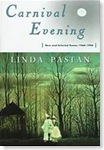
Carnival evening : new and selected poems, 1968-1998What We Want
by Linda Pastan

What we want
is never simple.
We move among the things
we thought we wanted:
a face, a room, an open book
and these things bear our names—
now they want us.
But what we want appears
in dreams, wearing disguises.
We fall past,
holding out our arms
and in the morning
our arms ache.
We don't remember the dream,
but the dream remembers us.
It is there all day
as an animal is there
under the table,
as the stars are there

From Carnival evening : new and selected poems, 1968-1998. Heard today, the poet's birthday, on The Writer's Almanac.

Monday, May 26, 2008

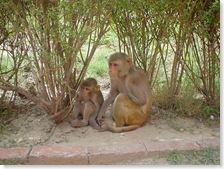
Don't Fall in Love With Your Monkey

Rhesus Macaques In this episode of The Moth, Ari Handel recounts a special relationship he developed when working on his Ph.D. in Neuroscience which he completed in 2000. He has worked as a producer on for Darren Aronofsky films and as a story collaborator on The Fountain.

Sunday, May 25, 2008

Nirvana

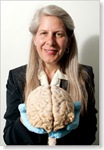
Photo by AJ Mast for The New York Times"Religion is a story that the left brain tells the right brain...nirvana exists right now. There is no doubt that it is a beautiful state and that we can get there."

~ Dr. Jill Bolte Taylor, from "A Superhighway to Bliss," New York Times (5.25.08)

How to Read a Myth

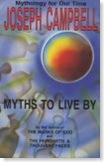
Joseph Campbell’s Ten Commandments for Reading Mythology

Myths to Live By 1. Read myths with the eyes of wonder: the myths transparent to their universal meaning, their meaning transparent to its mysterious source.

2. Read myths in the present tense: Eternity is now.

3. Read myths in the first person plural: the Gods and Goddesses of ancient mythology still live within you.

4. Any myth worth its salt exerts a powerful magnetism. Notice the images and stories that you are drawn to and repelled by. Investigate the field of associated images and stories.

5. Look for patterns; don’t get lost in the details. What is needed is not more specialized scholarship, but more interdisciplinary vision. Make connections; break old patterns of thought.

6. Resacrilize the secular: even a dollar bill reveals the imprint of Eternity.

7. If God is everywhere, then myths can be generated anywhere, anytime, by anything. Don’t let your Romantic aversion to science blind you to the Buddha in the computer chip.

8. Know your tribe! Myths never arise in a vacuum; they are the connective tissue of the social body which enjoys synergistic relations with dreams (private myths) and rituals (the enactment of a myth).

9. Expand your horizon! Any mythology worth remembering will be global in scope. The earth is our home and humankind is our family.

10. Read between the lines! Literalism kills; imagination quickens.

Saturday, May 24, 2008

Curious Case

Here is the first trailer (in Spanish) for David Fincher's The Curious Case of Benjamin Button about a man (Brad Pitt) who ages in reverse. The film, which also features Cate Blanchett and Tilda Swinton, is based on a short story written in 1922 by F. Scott Fitzgerald who said, "This story was inspired by a remark of Mark Twain’s to the effect that it was a pity that the best part of life came at the beginning and the worst part at the end."


The film is scheduled to be released around Christmas 2008. The music used in the trailer is Aquarium from Carnival of the Animals by Camille Saint-Saens.

The Fear of Being Found Out

Dennis Palumbo "From a very young age, when a person says, Gee, I'd like to be a writer or I'd like to be an actor or whatever, it seems so grandiose. It seems so elevated. I mean, if you watch Will Smith on screen and you're a kid who says, Gee, I wanna be a movie star just like him, your fantasy is he or she has something you don't have. You're not enough. I think one of the reasons that people read self-help books and stuff is that they have this idea that there's this perfectible version of themselves in the future. And that person will be happy and successful and very secure. Most creative people, when they begin having some success, get a kind of validation like they're on Oprah or the paparazzi follow them or magazines interview them and want to know their position on the environment, but inside themselves they know they're the same schmuck that grew up in some small town looking up at a movie screen wanting to be an actor. So they see a disconnect between the public approbation and validation and their sense of themselves, which is that they're just this regular, insecure, neurotic slug and so someone will find that out. The fear is that it will be found out that they are much less than we thought."

~ Writer and therapist Dennis Palumbo, from "Hollywood on the Couch," KCRW's The Business (5.12.08). The conversation continues in Part II (5.19.08)

Friday, May 23, 2008

To Be Open to What It's Going to Be

"The way I write is very much without kind of a goal. I have something I'm interested in and then I decide I'm going to explore it. I don't know where the characters are going to go, I don't know what the movie is going to do or what the screenplay is going to do. For me, that's the way to keep it alive. I tried to approach the directing in the same way. We have the script, we have the actors, and we're trying to figure out what this is, and you don't know what it is. You have to be open to what it's going to become rather than have this thing that you're trying to get to, which is boring."

"I'm interested in dreams and the way we tell ourselves stories in a dream. Let me make it clear that this film isn't a dream, but it does have a dreamlike logic. In a dream, you may start to fly and it doesn't seem unusual to you. Your reaction is not at all like the one you'd have if you were awake in the normal world. You have to accept everything that happens in the film the way it comes. Of course it's something that wouldn't happen in real life – we're in a film!"

~ Charlie Kaufmann, speaking at Cannes this week about his latest film and directorial debut, Synecdoche

Making Artisan Ice Creams at Home

Photo of Jeni Britton by Lisa FjeldOur sweet friend Jeni recently developed recipes for making a few of her famous ice cream flavors at home. It took 75 attempts to get it right, but she is thrilled with the results which can be made using a modestly priced machine like this Cuisinart. The results were published in the June 2008 issue of Food & Wine.

You can take a stab at her Sour Cherry Lambic Sorbet which won a Gallo Family Vineyards Gold Medal this year in the outstanding fruit or vegetable category. When Jeni makes it, she uses Lindeman's Kriek Lambic from Belgium.

Jeni recommends scrapping the egg yolks which are typically used as a thickener in homemade ice cream. Boiling the cream and milk evaporates some of the water which gives most homemade ice creams their iciness. Adding cornstarch thickens the cream and absorbs more of the water.

Thursday, May 22, 2008

Impermanence

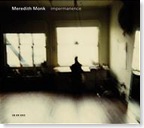
Impermanence "How do you convey a sense of change? How do you convey that everything in our lives — everything — is constantly changing and that one cannot hold on to anything? And certainly the impulse was coming from the sense of the preciousness of life and that every moment is the only moment that we have."

~ Meredith Monk, discussing her recent work, Impermanence, with Lara Pellegrinelli on All Things Considered (May 13, 2008)

Tuesday, May 20, 2008

Only Hitting One

Mothers and Sons: Stories by Colm Tóibín"Reading and writing are done alone and there's still a lovely privacy in that and a power about it, that you're affecting someone when they're alone. Which is probably the most powerful time to affect people. And I know we should all be making movies or writing rock songs or something. But fiction remains powerful in this sense, that you're hitting one person at a time. And I think that idea of only hitting one, therefore, has an interesting attraction and power to it."

~ Colm Tóibín, KCRW's Bookworm (April 17, 2008)

Monday, May 19, 2008

What You Can, Like, Do

mccullough_boston_college

"Please, please do what you can to cure the verbal virus that seems increasingly rampant among your generation...Just imagine if in his inaugural address John F. Kennedy had said, 'Ask not what your country can, you know, do for you, but what you can, like, do for your country actually,' "

~ David McCullough, in his commencement address to Boston College's class of 2008 today.